

Read the first chapter
The whole of chapter one, free. About 6 min. Turn the pages with the arrows, your keyboard, or a swipe.
Chapter 1
Why Big Changes Collapse
The Monday Overhaul
On Monday morning, you decide everything is changing.
You’ll wake at 5:30, run before work, cook every meal, stop checking your phone, read thirty pages, and finish the project you’ve delayed for months. You write the plan in a fresh notebook. The list looks clean. Almost impressive.
By Wednesday, the alarm has been silenced twice. The vegetables are still in the bag. Your running shoes are beside the door, untouched. One missed task makes the whole plan feel spoiled, so you stop trying until next Monday. Then Monday arrives with a new plan, usually bigger than the last one. Have you recognised yourself in this cycle?
The problem isn’t that you’re lazy or incapable. The problem is that you’ve asked your brain to carry a packed suitcase uphill while pretending it’s a light walk. People fail because they try to change too much, too fast. A dramatic overhaul creates drama, not stability.
The Question Beneath the Goal
What if your goal is failing because it is too impressive to repeat?
That question changes the job. Instead of asking, “How can I force myself to become a completely different person?” you ask, “What is the smallest version of this change I can still do on a difficult Tuesday?”
Your brain has limited attention, energy, and patience. A large goal demands decisions before you’ve even begun. When you say, “I’ll exercise every day,” you also need to decide when, where, for how long, what to wear, and what counts as exercise. Each decision adds weight. By evening, the goal feels like another unpaid bill.
Consider the difference between “I’ll get fit this month” and “After I brush my teeth tonight, I’ll do five squats.” The first sounds serious but has no clear starting point. The second is almost too small to argue with. That’s its strength. After a week, five squats may become ten. Or they may remain five. Either way, you’ve created a repeatable action instead of a heroic promise.
This is the Smallness Threshold: the point where a change is large enough to matter but small enough to repeat without needing a perfect mood, a free afternoon, or a fresh burst of enthusiasm.
How Oversized Goals Create Resistance
Here’s the usual chain:
1. When you set a sweeping goal - lose weight, clear the whole garage, or rebuild your business in thirty days... 2. You feel pressure because the finish line is huge and the daily path is unclear. 3. So you avoid starting, or you make one enormous effort to prove you’re serious. 4. Which leads to exhaustion, a missed day, and the familiar conclusion that you “can’t stick with anything.”
The alternative chain is quieter:
1. When you choose one action below your Smallness Threshold... 2. You feel less threatened because the task has a clear edge. 3. So you begin before motivation has a chance to disappear. 4. Which leads to repetition, evidence that you can trust yourself, and a natural opportunity to grow.
Notice what’s missing: a personality transplant. You don’t need to become disciplined before you begin. You need an action that doesn’t require discipline in heroic quantities.
Suppose your kitchen is a mess and your oversized goal is “keep the house spotless.” That goal may produce a three-hour cleaning spree followed by six days of avoidance. A smaller target is “clear the counter beside the kettle for two minutes after dinner.” It won’t transform the house tonight. It will, however, teach your brain that cleaning is something you do regularly, not a punishment you endure when the mess becomes unbearable.
Make the change repeatable before you make it remarkable.
Rate the Size of Your Goals
Use these questions honestly. Don’t rate the person you wish you were. Rate what your current life can actually carry.
1. On a scale from 1 to 10, how demanding is your current version of the goal? A 1 or 2 may be too vague or too easy to notice; a 7 or higher often signals that the goal is competing with your real responsibilities.
2. On a scale from 1 to 10, how likely are you to do it on your worst ordinary day? A high score means the action has probably reached your Smallness Threshold. A low score means it depends on ideal conditions.
3. Yes or no: Can you describe the first action in one sentence with a time and place? “Exercise more” is no. “At 6:30, I’ll walk to the end of the street” is yes. A no answer reveals that the goal is still a wish, not a repeatable action.
4. On a scale from 1 to 10, how much recovery would you need after doing it? If the answer is 8 or 9, you’re probably spending tomorrow’s energy today. A sustainable habit should leave room for the next repetition.
Here’s a simple reading of your answers. If your goal feels demanding, unclear, and hard to repeat, shrink the action. If it feels almost laughably small but clear, you’re close. If you’ve made it easy but still don’t know when it happens, attach it to something already in your day, such as making coffee, locking the office, or brushing your teeth.
The point isn’t to make every goal effortless. Some work will always be difficult. The point is to stop confusing difficulty with value. A task can be important without being enormous.
The Two-Minute Threshold Challenge
Shrink one goal before the day gets away from you.
1. Choose one oversized goal and cut it to a visible first move. Take five minutes today. Write down the goal you keep postponing, then reduce it until the action takes two minutes or less. “Write the book” becomes “open the document and write one sentence.” Difficulty: Easy.
2. Attach the action to a fixed daily cue. Pick a cue you already trust. After your first coffee, before lunch, or when you return home, do the tiny action immediately. Repeat it for the next seven days, even if you could do more. Difficulty: Medium.
3. Record completion, not performance. Put seven boxes on paper or in your phone. Mark one each time you complete the small action. Don’t add extra tasks to earn a better mark. Your job is to prove that the action can return tomorrow. Difficulty: Easy.
You’ll know it’s working when:
• You begin without negotiating with yourself for ten minutes. - Missing one day feels like a pause, not a collapse. - You start noticing the next step without forcing it.
If the action still feels heavy, don’t call yourself unmotivated. Shrink it again. Open the document instead of writing. Put on your walking shoes instead of walking. Clear one item from the counter instead of cleaning the kitchen. The right starting point may feel almost absurdly modest. That’s fine. Modesty is often what gets the engine running.
The Smallness Threshold
Big change usually collapses because the daily version is too big to survive real life.
The Smallness Threshold gives you a practical test:
• The action must connect to the change you want. - It must have a clear time or cue. - It must be possible on a low-energy day. - It must be small enough to repeat before you need a reward.
This doesn’t mean you’re lowering your standards forever. You’re lowering the entry cost so repetition can begin. A person who wants to read more doesn’t need to start with an hour each night. One page after turning off the television may be enough to build the doorway. A business owner who wants better records may begin by entering one invoice before closing the laptop. A person who wants to run may begin by walking for three minutes after putting on their shoes.
Once the action is stable, you can increase it carefully. But don’t expand because you feel guilty about how small it is. Expand because the current version has become ordinary.
Your first job isn’t to conquer the whole goal. It’s to make tomorrow’s action easy enough that you’ll still do it when the notebook is no longer fresh. What small change can you place below your Smallness Threshold today - and repeat before you ask yourself for anything bigger?
End of chapter one. 7 more chapters and about 11,391 words in the full book.
Swipe or use the arrows to turn the page


What's inside: 8 chapters
- 1. Why Big Changes Collapse
- 2. Choose an Identity You Can Practice
- 3. Make Habits Almost Effortless
- 4. Build a Routine That Fits Real Life
- 5. Track Progress Without Perfectionism
- 6. Recover Quickly After a Miss
- 7. Grow Habits at the Right Pace
- 8. Connect Daily Habits to What Matters
About this book
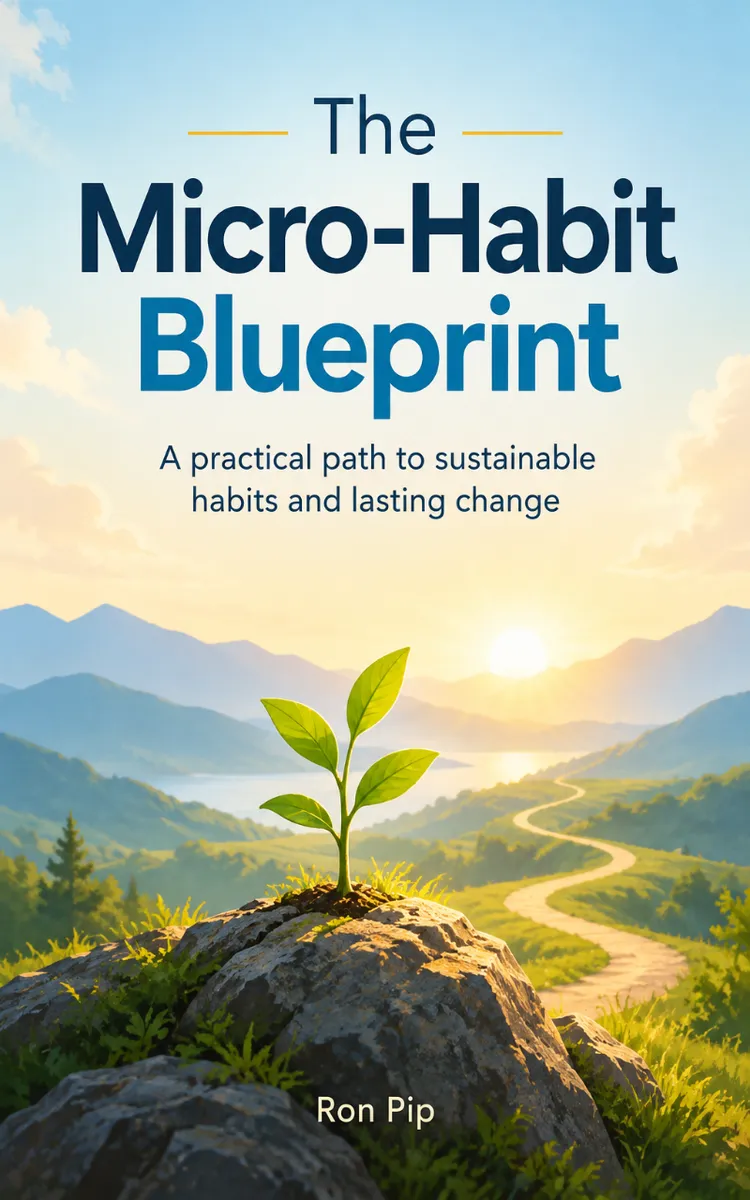
"The Micro-Habit Blueprint" is a self-help book by Ron Pip with 8 chapters and approximately 11,391 words. Sustainable habit formation through small, manageable changes and practical frameworks.
This book was created using Inkfluence AI, an AI-powered book generation platform that helps authors write, design, and publish complete books. It was made with the AI Self-Help Book Writer.
Frequently Asked Questions
What is "The Micro-Habit Blueprint" about?
Sustainable habit formation through small, manageable changes and practical frameworks
How many chapters are in "The Micro-Habit Blueprint"?
The book contains 8 chapters and approximately 11,391 words. Topics covered include Why Big Changes Collapse, Choose an Identity You Can Practice, Make Habits Almost Effortless, Build a Routine That Fits Real Life, and more.
Who wrote "The Micro-Habit Blueprint"?
This book was written by Ron Pip and created using Inkfluence AI, an AI book generation platform that helps authors write, design, and publish books.
How can I create a similar self-help book?
You can create your own self-help book using Inkfluence AI. Describe your idea, choose your style, and the AI writes the full book for you. It's free to start.
Write your own self-help book with AI
Describe your idea and Inkfluence writes the whole thing. Free to start.
Start writingCreated with Inkfluence AI


