
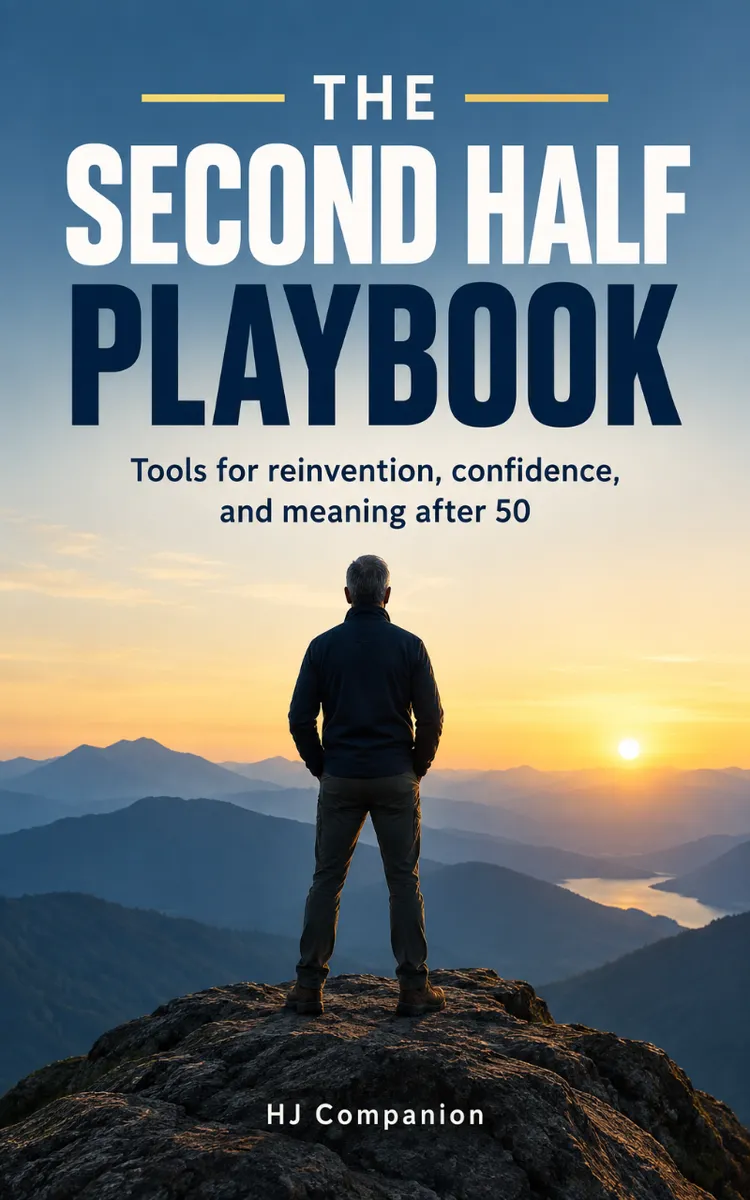
Read the first chapter
The whole of chapter one, free. About 5 min. Turn the pages with the arrows, your keyboard, or a swipe.
Chapter 1
The 50+ Mindset Reset
The Wall That Looks Like a Calendar Problem
“Your calendar can be full and your life can still feel strangely empty.”
That line may sound a little rude, which is often how useful truths arrive. You wake before the alarm, check messages, handle an appointment, answer one more work question, and tell yourself you’ll think about what comes next after things settle down. Then the day fills up again. You’re still the dependable one, the fixer, the man who knows where the shut-off valve is and which bill needs paying.
But something has shifted. The old rewards don’t land the same way. A promotion feels like more responsibility. Retirement sounds peaceful until you picture Tuesday morning. Your children need you differently, your marriage may be changing, and the mirror has started offering commentary nobody requested. You keep performing the old version of yourself, even though the job description has quietly expired. Recognise any of that in yourself?
The Question Behind the Second Wall
What if the problem isn’t that you’ve lost your identity, but that you’re still using an identity that has finished its job?
The first half of life often gives a man ready-made labels: provider, husband, father, tradesman, boss, employee, problem-solver. Those roles matter. They may have carried you through hard years. But when the children leave, work slows down, a relationship changes, or your body refuses to negotiate like it used to, the labels stop doing all the heavy lifting.
That’s the second wall. Not a lack of character. A lack of updated instructions.
A man who spent thirty years being “the owner” may retire and discover that nobody asks his opinion before breakfast. Before, he filled every hour with jobs and decisions. After, he starts inventing errands, correcting the way the dishwasher is loaded, and checking the news for the ninth time. The old identity demanded action. The new life requires intention. Those are different muscles.
The shift is simple but not easy: stop asking, “What am I supposed to do now?” Start asking, “What kind of man do I want my days to prove I am?” That question moves identity from a title to a choice.
The Second Wall Switchboard
Use this chain to spot where the wall gets built:
1. When a familiar role disappears or changes, you feel uncertain. 2. You feel uncertain, so you reach for old habits that make you feel useful. 3. So you stay busy, avoid honest conversations, and call it “keeping your options open.” 4. Which leads to a life that looks organised from the outside but feels borrowed on the inside.
Now switch the wiring:
1. When a familiar role changes, you name what has ended. 2. You feel the discomfort without rushing to cover it with chores, screens, or another unnecessary project. 3. So you choose one identity quality to practise - curious, steady, connected, useful, or brave. 4. Which leads to small actions that build a new version of you before you have a perfect plan.
The Second Wall Switchboard has three controls: Name the loss. Choose the quality. Prove it today. No dramatic reinvention required. You don’t need a new motorcycle, a podcast, or a linen shirt unbuttoned to the navel. Start with one honest adjustment.
Your next identity is built by repeated proof, not a grand announcement.
Rate the Identity Gap
1. On a scale of 1-10, how much of your current day is driven by obligation rather than choice? A low score suggests room to choose; a high score may mean your old role is still running the schedule.
2. Can you name three qualities you want to carry into the next decade - yes or no? “No” isn’t failure. It simply means you’ve been managing tasks without defining the man behind them.
3. On a scale of 1-10, how uncomfortable are you when nobody needs you for a practical problem? A high score can reveal that usefulness has become your main source of worth.
4. Have you taken one action in the past week that belonged to your future rather than your past - yes or no? “No” points to a planning gap, not a permanent condition. Your future needs scheduled space, not vague good intentions.
As a rough guide, mostly low scores may mean you’re ready for expansion. Mostly high scores suggest the second wall is close. Mixed answers are normal. You’re not a faulty appliance; you’re a man between operating systems.
The Three-Day Identity Proof
Choose one quality and put it on the calendar.
1. Name the quality - Today, 10 minutes - Easy. Write one word you want your next decade to show: “curious,” “connected,” “strong,” “generous,” or “steady.” Under it, write one behaviour that proves it. For “connected,” that might be calling a friend instead of merely liking his post.
2. Schedule the proof - Tomorrow, 20-30 minutes - Medium. Put the behaviour in your calendar at a real time. Contact the former colleague. Visit the gym. Research the class. Have the conversation. Keep it small enough to complete and meaningful enough to matter.
3. Review the evidence - Day three, 10 minutes - Medium. Write what you did, how it felt, and what made it easier or harder. Then schedule the next repetition within seven days. Identity grows through evidence, not enthusiastic stationery.
You’ll know it’s working when:
• You stop describing yourself only by your old job or family role. - Your calendar contains at least one action chosen for the man you’re becoming. - You feel slightly uncomfortable, but not helpless, when the old routine loosens.
The Truth About Starting Again
You don’t need to become a different man; you need to stop abandoning the parts of you that never got a proper turn.
• The second wall appears when old roles no longer explain your life. - Identity can be rebuilt through chosen qualities and repeated proof. - The Second Wall Switchboard helps you name the loss, choose the quality, and act. - Small scheduled actions beat dramatic promises made after midnight.
The next question is unavoidable: once you know who you’re becoming, how will you handle the pressure that keeps pulling you back into the old version?
End of chapter one. 9 more chapters in the full book.
Swipe or use the arrows to turn the page

Shadows At Gullhaven Light

The Orphean Circle

The Ultimate Newfoundland and Labrador Bucket List: Travel Experiences
What's inside: 10 chapters
- 1. The 50+ Mindset Reset
- 2. Rewriting Your Identity After 50
- 3. Silent Pressure: Stress That Sneaks In
- 4. Overthinking Without Losing the Plot
- 5. Bottled Anger: Release Without Exploding
- 6. Marriage, Divorce, and Dating Again
- 7. Retirement Anxiety and Career Reinvention
- 8. Health Fears Without Catastrophe Thinking
- 9. Loneliness Fix: Build Real Connection
- 10. Confidence After Setbacks, On Purpose
About this book
"The Second Half Playbook" is a self-help book by HJ Companion with 10 chapters and approximately 9,466 words. Mindset shifts and practical strategies for men rebuilding life after 50.
This book was created using Inkfluence AI, an AI-powered book generation platform that helps authors write, design, and publish complete books. It was made with the AI Self-Help Book Writer.
Frequently Asked Questions
What is "The Second Half Playbook" about?
Mindset shifts and practical strategies for men rebuilding life after 50
How many chapters are in "The Second Half Playbook"?
The book contains 10 chapters and approximately 9,466 words. Topics covered include The 50+ Mindset Reset, Rewriting Your Identity After 50, Silent Pressure: Stress That Sneaks In, Overthinking Without Losing the Plot, and more.
Who wrote "The Second Half Playbook"?
This book was written by HJ Companion and created using Inkfluence AI, an AI book generation platform that helps authors write, design, and publish books.
How can I create a similar self-help book?
You can create your own self-help book using Inkfluence AI. Describe your idea, choose your style, and the AI writes the full book for you. It's free to start.
Write your own self-help book with AI
Describe your idea and Inkfluence writes the whole thing. Free to start.
Start writingCreated with Inkfluence AI


