
Read the first chapter
The whole of chapter one, free. About 8 min. Turn the pages with the arrows, your keyboard, or a swipe.
Chapter 1
Days 1-4: Set Up a Safe Haven
Make One Quiet Place Feel Safe
Your new dog slips behind the sofa, curls into the smallest space available, and keeps one eye on every person who walks past. Someone offers food. Someone else calls the dog’s name. A child kneels down for a closer look. Within minutes, the hiding place no longer feels private, and the dog retreats farther.
The first four days work better when you reduce those demands. Your dog does not need to greet everyone, inspect every room, or respond to every invitation. Your job is to create a quiet retreat, protect it from interruptions, and allow exploration to happen at the dog’s pace. This lowers the number of decisions your dog must make while the home still feels unfamiliar.
The Safe Haven Map gives you a simple way to arrange that first space. By the end of these first days, you should know where your dog can rest, how people will behave near that area, which parts of the home remain closed, and how to recognize voluntary exploration. Ask yourself: “Can my dog move away from us without getting trapped or followed?” If the answer is no, adjust the space before asking for anything else.
Build the Safe Haven Map
Start with one quiet area, not the whole house. Choose a corner of a bedroom, a section of the living room away from the television, or another place with a clear exit. Keep the area away from busy doorways, children’s play spaces, loud appliances, and windows where constant street activity may alarm your dog. Your dog needs a retreat that feels protected but does not become a dead end.
Place a comfortable bed or folded blanket there. Add water within easy reach, but keep the bowl far enough from the sleeping area that a small spill will not soak the bedding. If you use a crate, leave the door open during settling-in unless your rescue or veterinarian has given you a specific reason to close it. An open crate can offer cover without forcing your dog to remain inside. Do not push your dog into the space or reach in to pull the dog out. Choice makes the retreat safer.
Use the Safe Haven Map to mark three areas:
1. Rest zone: Place the bed, blanket, or open crate here. Your dog should be able to lie down without people stepping over the space. 2. Care zone: Put water, food, and any needed supplies nearby but not directly beside the resting place. This separation lets your dog eat without feeling cornered. 3. Exploration boundary: Decide which rooms your dog may visit during Days 1-4. Close doors, use a baby gate, or block narrow gaps so your dog can explore a small area safely.
The map does not need to cover every inch of your home. It should answer one practical question: where can your dog rest undisturbed, and where may the dog go next? A smaller area also makes supervision easier. You can notice whether your dog is drinking, using the toilet, pacing, or choosing to return to the retreat.
Limit household demands around this map. Ask family members to avoid staring, petting, calling, photographing, or offering repeated treats. Use one calm phrase, such as “You’re safe,” and then give the dog space. Visitors should wait until later unless they must enter the home. If someone needs to pass near the retreat, walk slowly, keep a little distance, and avoid reaching toward the dog.
Let exploration begin with a choice rather than an invitation. Leave the retreat accessible, sit several feet away, and do something quiet. Read, work on a laptop, or fold laundry without facing the dog directly. If the dog steps out, keep your body still and let the dog decide whether to continue. If the dog returns, allow that return without comment. A retreat only works when your dog can use it in both directions.
A useful check: after you set up the space, stand where your dog may stand and look around. Can the dog see the main movement in the room? Can the dog reach water? Can the dog leave without passing between two people? Fix anything that makes the answer unclear. Your practical takeaway is simple: make the first area small, quiet, and easy to leave.
Apply the Map During the First Four Days
Consider a dog who arrives home at 4:00 p.m. and immediately hides behind a chair. Instead of dragging the chair away or coaxing the dog out, set up the Safe Haven Map around that location if it meets the safety requirements. Move foot traffic away, place water nearby, and block access to unsafe gaps behind furniture. The expected outcome is not instant friendliness. The expected outcome is a dog who can rest without repeated interruption.
Use this sequence:
1. Choose the retreat before arrival or as soon as possible. Clear a 6-by-8-foot section of a quiet room. Remove cords, small objects, cleaning products, and anything the dog could chew or swallow. A clear space prevents you from needing to pull the dog out later for safety reasons. 2. Set the household rule for the first 24 hours. Tell everyone that the dog may not be touched, followed, or called from the retreat. This removes pressure and gives the dog a predictable break. 3. Keep the exploration boundary narrow. Offer one room at first, with access to the retreat. Close the hallway and other rooms. A dog that explores one safe room can build a clear path back to rest. 4. Watch from a distance for five minutes at a time. Notice whether the dog looks toward the doorway, sniffs, drinks, lies down, or returns to the bed. Do not turn every movement into a training session. 5. Open more space only after calm movement repeats. If your dog leaves the retreat, sniffs the room, and returns calmly several times, open one additional area for a short period. If the dog freezes, pants heavily, hides deeper, or rushes back, close the extra area and return to the smaller boundary.
For example, on Day 1, the dog may spend most of the evening under an open table. On Day 2, the dog may walk 3 feet to the water bowl while the room stays quiet. On Day 3, the dog may inspect the doorway, then return to the blanket. On Day 4, the dog may explore the adjoining hall for two minutes before choosing the retreat. Those small choices show useful progress even if the dog still avoids touch.
Keep a simple note on paper:
• Time the dog leaves the retreat - Area explored - Whether the dog returned voluntarily - Any signs that the space felt too busy
Avoid measuring success by greetings. A dog who sleeps, drinks, and returns to the safe area has learned something important: the home contains a place where nothing is demanded.
Quick checklist
• [ ] Choose one quiet retreat with a clear exit. - [ ] Place a bed or blanket and accessible water. - [ ] Keep food and water near the retreat but not in the sleeping spot. - [ ] Remove cords, small objects, cleaners, and unsafe gaps. - [ ] Close off most of the home during Days 1-4. - [ ] Tell household members not to touch, follow, stare at, or call the dog from the retreat. - [ ] Sit nearby without facing or pressuring the dog. - [ ] Let the dog return to the retreat whenever the dog chooses. - [ ] Open one additional area only after calm exploration repeats.
At the end of each day, ask: “Did my dog get more chances to choose rest or exploration without being followed?” If yes, the Safe Haven Map is doing its job.
Fix Problems Before They Grow
The retreat sits in the busiest part of the home
A bed beside the front door may look convenient, but every arrival forces your dog to react. Footsteps, keys, voices, and opening doors can keep the dog alert instead of resting.
Do this: Move the retreat to a quieter corner with a clear view of the room and a path away from traffic.
Not this: Keep asking the dog to “get used to it” while people pass within inches of the bed.
If you cannot move the bed, redirect traffic with a gate or close the door during busy periods. The goal is fewer interruptions, not total silence.
The family treats the retreat like a meeting place
People often crouch beside a hiding dog because they want to help. The dog may read the close body position, reaching hands, and direct eye contact as pressure. Repeated attention can make the dog stay hidden longer or snap when someone reaches in.
Do this: Give the dog a clear “no touching” zone. Let family members sit quietly at a distance and allow the dog to approach first.
Not this: Send children to offer treats into the hiding place or ask the dog to come out for a group greeting.
If a child lives in the home, provide a specific job away from the retreat, such as filling a water bowl while an adult supervises. The child can participate without entering the dog’s private space.
The dog explores, and the household expands access too quickly
A dog may walk into the hallway once and then encounter stairs, several people, a vacuum, and a closed door. That sudden increase can send the dog running or cause frantic pacing. One brave step does not mean the dog feels ready for the entire house.
Do this: Open one additional area for five to ten quiet minutes, then keep the route back to the retreat clear.
Not this: Leave every door open and follow the dog to see where the dog goes.
If the dog becomes tense, stop the expansion and reduce the space again. Signs include freezing, crouching, rapid panting, repeated scanning, rushing, or refusing to return through the doorway. Give the dog time to settle before trying a smaller exploration period.
A safe haven is not a place where your dog must remain. It is a reliable starting point and a reliable way back. During Days 1-4, protect that choice, keep the household predictable, and let curiosity grow without a deadline. When your dog can rest undisturbed and explore by choice, the new home begins to feel less like a test and more like a place the dog can understand.
End of chapter one. 7 more chapters and about 13,889 words in the full book.
Swipe or use the arrows to turn the page

Building A Business Cybersecurity Program

Social Posts In Google AI Answers

Potty Training Without A Yard
What's inside: 8 chapters
- 1. Days 1-4: Set Up a Safe Haven
- 2. Days 5-8: Read Stress Signals
- 3. Days 9-12: Build a Food Routine
- 4. Days 13-16: Create Predictable Routines
- 5. Days 17-20: Prevent Household Mishaps
- 6. Days 21-24: Build Trust Through Choice
- 7. Days 25-27: Start Calm Leash Walks
- 8. Days 28-30: Review Progress and Next Steps
About this book
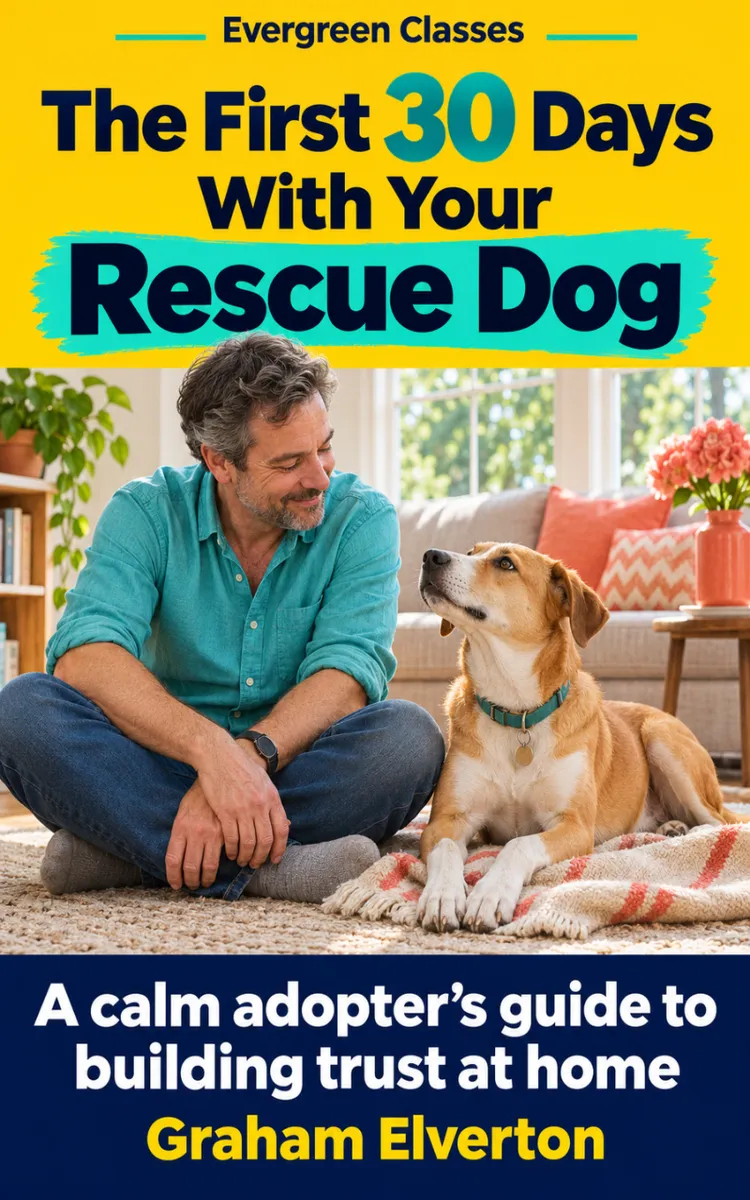
"The First 30 Days With Your Rescue Dog" is a how-to guide book by Graham Elverton with 8 chapters and approximately 13,889 words. Your new dog is under the sofa, and everyone in the house is trying to help. The more people call, reach, and offer food, the farther the dog retreats.
This book was created using Inkfluence AI, an AI-powered book generation platform that helps authors write, design, and publish complete books. It was made with the AI Ebook Generator.
Frequently Asked Questions
What is "The First 30 Days With Your Rescue Dog" about?
Your new dog is under the sofa, and everyone in the house is trying to help. The more people call, reach, and offer food, the farther the dog retreats. The First 30 Days With Your Rescue Dog gives you a clear plan for easing that pressure. In the first four days, you’ll set up a Safe Haven Map: one quiet place to rest, a clear way out, and simple rules for keeping interruptions away. Then you’ll learn to spot stress signals like a stiff body, a closed mouth, or a freeze that can look like calm. You’ll also build a predictable meal routine, with set feeding times and a simple record of what your dog eats. The goal is not to hurry affection or obedience. It’s to make home feel safe enough for your dog to choose when to come out from behind the sofa.
How many chapters are in "The First 30 Days With Your Rescue Dog"?
The book contains 8 chapters and approximately 13,889 words. Topics covered include Days 1-4: Set Up a Safe Haven, Days 5-8: Read Stress Signals, Days 9-12: Build a Food Routine, Days 13-16: Create Predictable Routines, and more.
Who wrote "The First 30 Days With Your Rescue Dog"?
This book was written by Graham Elverton and created using Inkfluence AI, an AI book generation platform that helps authors write, design, and publish books.
How can I create a similar how-to guide book?
You can create your own how-to guide book using Inkfluence AI. Describe your idea, choose your style, and the AI writes the full book for you. It's free to start.
Write your own how-to guide book with AI
Describe your idea and Inkfluence writes the whole thing. Free to start.
Start writingCreated with Inkfluence AI


