
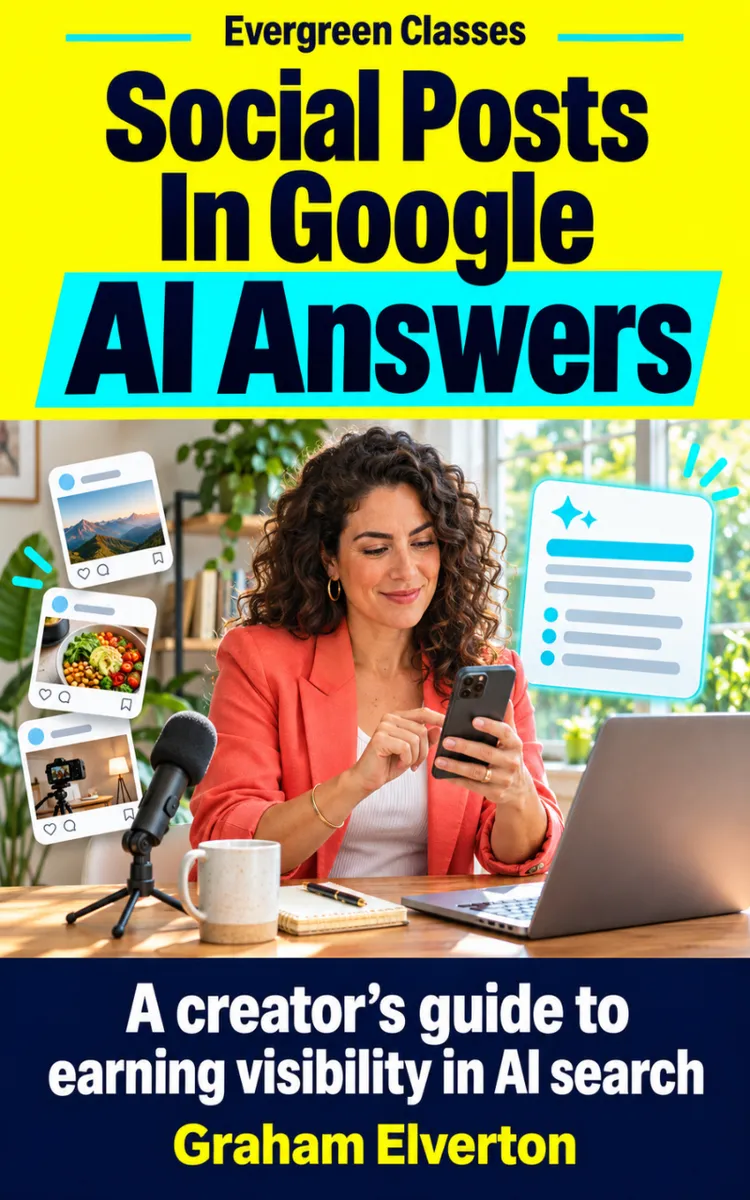
Read the first chapter
The whole of chapter one, free. About 9 min. Turn the pages with the arrows, your keyboard, or a swipe.
Chapter 1
Choosing Platforms for AI Visibility
Find the Platforms Google Can Actually Use
Could the post you publish today answer a customer’s Google question next month, or is it trapped behind a login, a short lifespan, or a platform search box?
That question matters because platform choice affects more than reach. Google can discover and index public posts on some social networks, while other content is difficult to access, expires quickly, or carries little searchable context. When Google’s AI features assemble an answer, a clear public post can support visibility at the exact moment someone asks for advice, comparisons, local recommendations, or solutions.
The right choice also depends on the funnel stage. Awareness content should meet broad questions and repeated problems. Conversion content should help a person choose a provider, product, or next step. A local plumber may use YouTube for “how to stop a toilet from running,” Reddit for detailed troubleshooting discussions, and public Facebook posts for proof of service in the area. Those platforms serve different searches and different levels of buying intent.
The Discoverability Fit Matrix keeps the decision practical. For each platform, score four things from 1 to 5: how well your audience uses it, how strong your content is there, how much of the content is public, and how closely the platform supports the questions you want to answer. A platform with a high audience score but weak public discoverability may still help with community building, but it is a weaker choice for Google AI visibility.
Key Stats
• Google processes billions of searches each day, creating a large pool of questions that can lead to AI-generated answers.
• YouTube videos can appear in Google Search results, video results, and AI answer citations when their titles, descriptions, and spoken content match a query.
• Reddit discussions frequently rank for specific product, troubleshooting, and recommendation searches because they contain detailed first-hand language.
• Google Business Profile posts are public, but their strongest value is local discovery rather than broad national visibility.
Match Platform Strengths to Searchable Questions
Start with the platform where your best evidence already exists, then shape that evidence for public discovery. Do not choose a network only because it has a large user base. Choose it because your audience asks relevant questions there and because Google can understand and retrieve the answers.
YouTube for demonstrations and awareness questions
YouTube is the strongest fit when your content teaches, shows, compares, or explains. A fitness coach can demonstrate “three low-impact exercises for sore knees.” A roofing company can show how to identify storm damage from the ground. These topics attract awareness-stage searches and can later lead viewers toward a consultation or service page.
Use the exact problem in the title, then add a useful qualifier: location, product type, skill level, or time limit. Put the same language in the first two sentences of the description and say it aloud in the video. Google can use the transcript and surrounding metadata to understand the subject.
A practical caption and description formula is:
Problem: Why is [specific problem] happening?
Answer: The first thing to check is [clear action].
Proof: Here is what [demonstration, test, or experience] shows.
Next step: Use [resource, service, or checklist] if [condition].
For conversion content, create comparison and decision videos: “Repair or replace a 10-year-old water heater?” These attract fewer viewers than broad tips but often reach people closer to choosing a provider.
Reddit for detailed answers and consideration
Reddit suits businesses and creators who can explain trade-offs without turning every response into an advertisement. Public threads often contain the exact wording people use when they are comparing tools, fixing problems, or deciding whether to hire help. Your strength here must be useful detail, not polished promotion.
Answer one narrow question per post. Include steps, limits, and signs that the reader needs professional help. A home-services company might explain why a drain keeps backing up after a chemical cleaner, including what to check before calling a plumber. The post can surface for long-tail searches because it contains specific terms and first-hand reasoning.
Respect each subreddit’s rules. A useful answer with a clear disclosure is safer and more durable than repeated links to your own site. Track which public discussions earn Google impressions or referral visits, rather than judging success only by upvotes.
LinkedIn for professional problems and conversion support
LinkedIn is a good fit when your audience searches for expertise, processes, or business decisions. Consultants, software companies, recruiters, and business-to-business creators can publish public posts that explain a mistake, show a result, or break down a decision.
Use a strong first line that matches a work-related question: “What should a small manufacturer measure before buying inventory software?” Follow with three concrete considerations and one example. Keep the post self-contained. A reader should understand the answer even if Google displays only part of it.
LinkedIn is usually better for consideration and conversion support than for broad consumer awareness. A post about reducing payroll errors may reach fewer people than a general productivity tip, but it can attract a more relevant buyer. Link to a detailed page only after giving the core answer in the post.
Public Facebook and Google Business Profile for local intent
Public Facebook posts can support local discovery when they include a clear service, location, and useful answer. A gym might publish “Beginner strength classes in Leeds: what to expect in your first week.” A dental practice might explain what to do after a lost filling and name the neighborhoods it serves. Visibility depends on public settings, consistent wording, and genuine local relevance.
Google Business Profile is not a substitute for social platforms, but it belongs in the same discoverability decision. Its updates, photos, questions, and reviews directly support local searches. Use it for opening hours, service updates, seasonal reminders, and proof of completed work. A public Facebook post can explain the problem; the Business Profile can help the searcher take the next step.
Use the Discoverability Fit Matrix before committing
Create one row for each platform and score it against your actual strengths. You may find that YouTube and Google Business Profile are your best combination: one builds awareness through demonstrations, while the other supports local conversion. Another business may find Reddit and LinkedIn more suitable because their advantage is detailed explanation rather than visual instruction.
A simple workflow keeps the choice grounded:
• List ten customer questions from sales calls, comments, reviews, and Google Search Console.
• Label each question awareness, consideration, or conversion.
• Score YouTube, Reddit, LinkedIn, public Facebook, and Google Business Profile for audience fit, content strength, public discoverability, and search-question fit.
• Choose no more than two primary platforms for the next 30 days.
• Publish enough related posts to create a searchable topic cluster rather than isolated updates.
A topic cluster means several public pieces answer connected questions. For example, a fitness business could publish a YouTube demonstration, a LinkedIn explanation for workplace wellness buyers, and a Business Profile update about local beginner sessions. The wording changes by platform, but the underlying question stays connected.
Content Calendar Sample
Day
Content Type
Topic/Hook
Format
Mon
Awareness answer
“Why does my boiler lose pressure?”
YouTube short demonstration
Tue
Detailed explanation
“What to check before calling an engineer”
Public Reddit response
Wed
Proof post
Recent repair and the cause found
Public Facebook photo post
Thu
Consideration answer
“Repair or replace an older boiler?”
YouTube comparison video
Fri
Conversion support
Service area, hours, and booking guidance
Google Business Profile update
This cadence works because each post has a different job. The YouTube pieces answer broad and comparison questions, Reddit adds detailed credibility, and local posts help a ready buyer act. If your content strength is writing rather than video, reverse the emphasis and make Reddit or LinkedIn the primary platform.
Measure Google Visibility, Not Just Social Activity
Platform metrics can make a weak strategy look busy. A post may receive likes from existing followers but never appear for a non-follower search. Track whether public content is being discovered, indexed, and connected to useful business actions.
Metric
What It Measures
Target Benchmark
Tool to Track
Google impressions for social URLs
Whether Google shows your public posts in results
Rising month over month after 30 days
Google Search Console
Non-follower visits
Discovery beyond your existing audience
At least 30% of post-driven visits
GA4 and platform analytics
Search queries producing visits
Whether posts match real customer wording
Three or more relevant queries per topic cluster
Search Console
Assisted conversions
Whether awareness content supports later action
Track a positive trend, not a universal number
GA4 conversion paths
Google impressions for social URLs are the most important metric because they confirm Google is showing the content at all. A high view count inside YouTube or LinkedIn does not prove that the post contributes to AI visibility. Add the public URL to a Search Console inspection workflow where possible, and use GA4 referral data to identify visits from Google to your owned pages after people discover the social content.
Review results by funnel stage. Awareness posts may generate impressions and new visitors without immediate leads. Conversion posts should produce actions such as calls, bookings, downloads, or contact-form completions. A common mistake is judging a how-to video by the same standard as a local service update. Another is counting branded searches as proof that you answered a broad question. Separate branded and non-branded queries, and compare each platform against the job it was chosen to perform.
Also check the post itself when performance is poor. If Google impressions are zero, confirm that the post is public, the URL works without a login, and the topic appears in the title or opening text. If impressions rise but visits remain low, the result may not answer the query clearly enough. If visits rise but conversions do not, the content may be doing awareness work while lacking a relevant next step.
Build a Focused Publishing Sequence
Sequencing prevents you from spreading thin content across every network. First establish which public platform can carry your strongest answer, then connect awareness posts to consideration and conversion content so visibility has somewhere useful to lead.
This Week:
• [ ] Export ten customer questions from Google Search Console, sales notes, reviews, and platform comments; label each as awareness, consideration, or conversion.
• [ ] Build the Discoverability Fit Matrix in Google Sheets and score YouTube, Reddit, LinkedIn, public Facebook, and Google Business Profile for your audience and content strengths.
This Month:
• [ ] Choose two platforms and publish one connected topic cluster of at least four public posts, using YouTube Studio, Reddit, LinkedIn, or Business Profile as appropriate.
• [ ] Add every public URL to a tracking sheet with its publication date, funnel stage, target query, impressions, visits, and conversions.
Ongoing:
• [ ] Review Search Console and GA4 every Monday; record non-branded impressions, referral visits, and assisted conversions by platform.
• [ ] Keep, revise, or drop a platform after 30 days based on public Google visibility and the business action it supports, not follower growth alone.
Quick Win: Take your best existing how-to post, rewrite its title around one real customer question, make it public, and publish the answer on the platform Google can most easily discover.
End of chapter one. 5 more chapters and about 10,123 words in the full book.
Swipe or use the arrows to turn the page


What's inside: 6 chapters
- 1. Choosing Platforms for AI Visibility
- 2. Audience Questions That Earn Citations
- 3. Instagram Reels for Search Discovery
- 4. YouTube Shorts as Answer Assets
- 5. Trust Signals Across Social Profiles
- 6. Measuring and Scaling AI Answer Visibility
About this book
"Social Posts In Google AI Answers" is a social media book by Graham Elverton with 6 chapters and approximately 10,123 words. A 35-second plumber video can answer the question someone types into Google next month. The difference is not fame.
This book was created using Inkfluence AI, an AI-powered book generation platform that helps authors write, design, and publish complete books. It was made with the AI Social Media Strategy Generator.
Frequently Asked Questions
What is "Social Posts In Google AI Answers" about?
A 35-second plumber video can answer the question someone types into Google next month. The difference is not fame. It is whether the post is public, specific, and clear enough for search systems to understand. Social Posts In Google AI Answers shows you how to choose platforms Google can use, find real audience questions, and shape posts around the words people search. You’ll see how a plumber can use YouTube for a repair explanation, Reddit for troubleshooting, and public Facebook posts for local proof. You’ll also learn the Reel Signal Stack: the question, spoken answer, on-screen text, caption, and profile details that give a Reel useful context. Across six chapters, build social content that supports awareness and conversion, and establish expertise with answers people can find when they need them.
How many chapters are in "Social Posts In Google AI Answers"?
The book contains 6 chapters and approximately 10,123 words. Topics covered include Choosing Platforms for AI Visibility, Audience Questions That Earn Citations, Instagram Reels for Search Discovery, YouTube Shorts as Answer Assets, and more.
Who wrote "Social Posts In Google AI Answers"?
This book was written by Graham Elverton and created using Inkfluence AI, an AI book generation platform that helps authors write, design, and publish books.
How can I create a similar social media book?
You can create your own social media book using Inkfluence AI. Describe your idea, choose your style, and the AI writes the full book for you. It's free to start.
Write your own social media book with AI
Describe your idea and Inkfluence writes the whole thing. Free to start.
Start writingCreated with Inkfluence AI


