
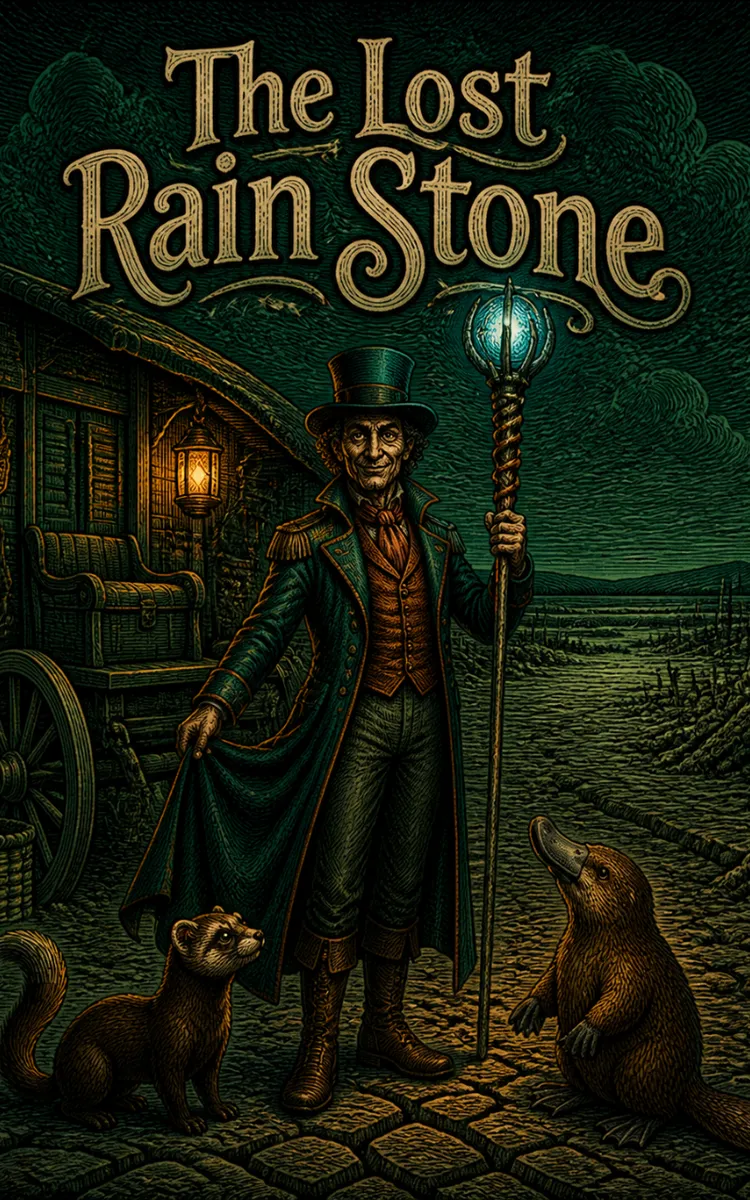
Read the first chapter
The whole of chapter one, free. About 7 min. Turn the pages with the arrows, your keyboard, or a swipe.
Chapter 1
The Empty Lake Village
Dust curled around Tombolini’s battered wagon as it rolled into the far-west village, and he sat hunched on the driver’s bench like a man who had carried too many roads in his bones. He was from the lands to the east, where wind-swept fields met crooked forests, the son of a magician who taught him quiet tricks of light and shadow and a dancer mother who taught him how to move when the world threatened to knock him off balance.
The wheels bumped over hard ground. Datcha, the sleek ferret, poked her silver-tipped nose through the wagon curtain. Pimmel, the platypus, sat beside her with his broad bill resting on the wooden rail.
“Do you smell water?” Tombolini asked.
Datcha sniffed once. Then she sneezed.
Pimmel gave a soft, unhappy chirp.
Tombolini looked ahead. The village was small and quiet. Its houses stood low and close together, with fishing nets hanging from the walls. Empty baskets rested beside empty boats. Beyond the houses lay a wide, cracked basin where a lake should have been.
He had seen this village years before. Then, the lake had shone like a blue mirror. Fish had jumped near the reeds, and children had raced along the shore.
Now the air smelled of dust and dry grass.
Tombolini pulled the wagon to a stop. He stepped down from the driver’s bench, his long coat brushing the wheels. From the wagon, he took his magic staff. Copper wire curled around its wooden length, and a glass orb at the top gave a faint blue flicker.
A few small, sturdy villagers watched from their doorways.
Tombolini swept off his hat and bowed. “I am Tombolini, circus man and wanderer. We bring no show today - only ourselves.”
No one smiled. A little fisher child held a wooden trout. The toy had a hollow belly.
An elder stepped forward. She was small, with a face lined like a dried apple. She leaned on a fishing spear taller than she was.
“I am Grawnet,” she said. “You bring yourselves, Tombolini. Can you bring water?”
Tombolini glanced at the cracked lake basin. “I wish they could.”
Grawnet’s fingers tightened around her spear. “So do we.”
Datcha slipped from the wagon and padded across the dust. She pressed her nose to the ground, searching for a cool scent. Pimmel climbed down after her. His webbed feet slapped softly against the dry earth.
“Months have passed without rain,” Grawnet said. “Perhaps longer. Our nets hang empty. Our boats sit on the lake floor. Even the frogs have moved away.”
Pimmel waddled to one of the boats. He climbed inside and peered at the dry, cracked bottom.
Tombolini followed Grawnet along the village path. The sun warmed one side of his face, but the wind was dry and sharp against the other.
“Have you tried digging?” he asked.
“We dug beside the old reeds.” Grawnet pointed toward a pile of dusty tools. “We found mud, then stones, then nothing.”
“Have you tried saving the little water you have?”
“We save every drop.” Grawnet stopped beside a clay jar. It held so little water that the bottom showed through. “There is enough for drinking, but not enough for the lake.”
Tombolini knelt beside the jar. He touched the cool clay. Datcha came close and looked inside.
Datcha dipped one paw toward the water, but Grawnet gently shook her head.
“Only a sip,” the elder said. “For the smallest ones first.”
Datcha pulled back at once. Pimmel made a soft sound and nudged the jar toward a nearby child.
Tombolini felt a small pinch in his chest. His first thought had been to make water appear with his staff. He lifted it and tapped the glass orb.
Blue light shimmered.
A tiny cloud puffed above the jar.
The villagers leaned closer. Tombolini smiled and turned the staff in a slow circle. The cloud grew round and gray. Then it gave a little puff.
A single drop fell.
It landed on the dust and vanished.
Tombolini lowered the staff. “That was less water than I hoped.”
Grawnet did not laugh. “Magic is not always the same as help.”
Tombolini looked at the dry basin. She was right. A trick could make one drop. The village needed a lake.
Pimmel waddled away from the jar and hurried toward the basin. Datcha followed, her tail held high. Tombolini took his staff and went after them.
The basin was wider than he remembered. Cracks ran through it like crooked roads. An old boat lay on its side near the center. Its paint had faded, but a blue fish still curled along its bow.
Pimmel climbed into the boat and tapped the bottom with his bill.
Tok. Tok. Tok.
He stopped and tapped again.
Tok. Tok.
Datcha crouched beside a crack in the earth. Her whiskers trembled.
Tombolini knelt. “What is it?”
Datcha scratched at the crack. Dust slipped away, revealing a thin line of dark, damp soil.
Tombolini touched it. The soil was cool.
Grawnet reached them, breathing hard after the walk. “There was water under the lake once. But it went down.”
“Down where?” Tombolini asked.
Grawnet pointed to the far edge of the basin. There, half hidden by dry reeds, stood a round stone rim.
“The misty well,” she said.
Tombolini had heard of it. The well sat at the heart of the lowlands, where clouds once gathered from the sea. At its bottom rested the Rain Stone, a bright stone that drew rain across the land and kept the lakes full.
He looked at the well rim. Even from far away, it seemed darker than the dusty ground around it.
“What happened to the Rain Stone?” he asked.
Grawnet’s eyes lowered. “It was taken.”
“By whom?”
“We do not know.” She rested both hands on her spear. “But on the morning the lake vanished, we heard a sound beneath the village.”
Pimmel climbed out of the boat. His bill pointed toward the well.
Grawnet nodded slowly. “Something crawled up from below. We saw marks near the well rim. Long marks. They led down into the dark.”
Datcha’s ears lifted.
Tombolini studied the well. The blue light in his staff flickered once, then went still.
“Did anyone go after it?” he asked.
“We tried to reach the well,” said Grawnet. “The path had become wet and cold, though the land around it was dry. We could not see far inside. Our people are fishers, not cave explorers.”
Tombolini glanced at the empty boats. “And you want me to go down?”
“I want you to help us,” Grawnet said. “You have a wagon, a magic staff, and two companions who notice what others miss.”
Datcha sat up proudly.
Pimmel gave a firm little slap of his bill against the ground.
Tombolini looked at his friends. Datcha was small enough to slip through narrow places. Pimmel could swim through water that no one else could cross. Their skills were different, but each one mattered.
He looked again at the village. A child had placed the wooden trout beside the empty jar. The toy fish seemed to be waiting for a lake.
Tombolini had planned to stay only long enough to mend a wagon wheel and trade for fresh bread. He had not planned to enter a dark well or search for a lost stone.
But plans, he knew, were like juggling balls. Sometimes one rolled away, and you had to choose whether to chase it.
He set his staff beside the well rim. “I will look for the Rain Stone.”
Grawnet’s face softened with relief, though worry still rested in her eyes. “The way below may be difficult.”
“Then we will move carefully.”
“It may be damp.”
Pimmel lifted his webbed feet.
“It may be narrow.”
Datcha slipped between two stones and popped out on the other side.
Tombolini smiled. “Then we will not travel alone.”
Grawnet reached into a small pouch at her belt and drew out a coil of strong fishing line. “Take this. Tie it as you go. It will help you find your way back.”
Tombolini accepted it with both hands. “Thank you.”
“Bring back the stone if you can,” Grawnet said. “Not for me. For every boat in this village.”
Tombolini tied the line to the well rim. Datcha crept ahead, her nose close to the ground. Pimmel followed with careful steps. Tombolini lifted his staff, and the glass orb cast a gentle blue glow over the stones.
At the first step, cool air brushed his face.
At the second, the village sounds grew faint.
At the third, he heard water.
Not the bright splash of a lake. Not the cheerful drip of rain.
This sound was slow and deep, far below the earth.
Tombolini paused. Behind him, sunlight shone across the cracked basin. Ahead, the well opened into a narrow path where damp stones gleamed.
Datcha looked back at him.
Pimmel placed one webbed foot on the next step.
Tombolini tightened his grip on the fishing line. “Together,” he said.
They went down.
The village waited above, and the dry lake waited below. Tombolini did not know what had carried away the Rain Stone, but he knew what he had to do.
When we share our courage and our gifts, even a dry place can begin to hope.
End of chapter one. 4 more chapters and about 7,767 words in the full book.
Swipe or use the arrows to turn the page
What's inside: 5 chapters
- 1. The Empty Lake Village
- 2. Across the Cracked Lowlands
- 3. The Rain Stone Below
- 4. A Race Across Black Water
- 5. Rain Returns to the Lowlands
About this book
"The Lost Rain Stone" is a children's book by Earl LaClare with 5 chapters and approximately 7,767 words. Tombolini and his animal companions seek a stolen stone to end a devastating drought.
This book was created using Inkfluence AI, an AI-powered book generation platform that helps authors write, design, and publish complete books. It was made with the AI Children's Book Creator.
Frequently Asked Questions
What is "The Lost Rain Stone" about?
Tombolini and his animal companions seek a stolen stone to end a devastating drought
How many chapters are in "The Lost Rain Stone"?
The book contains 5 chapters and approximately 7,767 words. Topics covered include The Empty Lake Village, Across the Cracked Lowlands, The Rain Stone Below, A Race Across Black Water, and more.
Who wrote "The Lost Rain Stone"?
This book was written by Earl LaClare and created using Inkfluence AI, an AI book generation platform that helps authors write, design, and publish books.
How can I create a similar children's book?
You can create your own children's book using Inkfluence AI. Describe your idea, choose your style, and the AI writes the full book for you. It's free to start.
Write your own children's book with AI
Describe your idea and Inkfluence writes the whole thing. Free to start.
Start writingCreated with Inkfluence AI


