

Read the first chapter
The whole of chapter one, free. About 5 min. Turn the pages with the arrows, your keyboard, or a swipe.
Chapter 1
Ethical Influence Mindset Reset
Build an Executive Mindset for Calm, Value-First Persuasion That Holds Under Pressure
If you want consistent conversion, you need more than a good pitch - you need a steady mind. Pressure shows up fast in the real world: the buyer interrupts, the deal stalls, the competitor undercuts, or legal/compliance asks for “one more thing.” When your body goes tense and your tone gets sharp, your message stops landing. That’s not a character flaw. It’s a predictable response. The fix is training your executive mindset so your persuasion stays value-first - even when the room gets noisy.
Your broader journey in this workbook is about becoming reliable: clear message, credible delivery, and disciplined follow-through. This section locks in the foundation that makes all of that work. Because “ethical influence” isn’t just what you say. It’s how you stay calm enough to listen, think, and respond with precision when it matters.
Here’s the executive standard: you don’t need to win every moment. You need to keep your influence clean and your thinking sharp. Then your conversion becomes a byproduct of control, not a gamble.
---
Skill Builder: The Calm Pressure Script + Executive Reset Loop
Goal: Build a repeatable routine that keeps you calm under pressure while steering the conversation back to value.
Setup (2 minutes): Pick one real pressure trigger you’ve faced in the last 30 days. Examples: “They say ‘we’ll think about it’ right after pricing,” “They challenge my authority,” or “They push back with a competitor name.” Write it down in one sentence.
Your Turn: Build your Executive Reset Loop 1) Name the pressure trigger (one sentence). Write: “When I hear ______, my body usually ______.”
2) Choose your Calm Pressure Script (10-12 seconds). Write one sentence you can say immediately that buys time without sounding defensive. Template: “Totally hear you. Before we decide, can I make sure I’m addressing what matters most to you about ________?” (Replace the blanks with your deal reality.)
3) Run the Reset Loop (3 moves, in order). Keep this exact sequence: - Reset breath: inhale through your nose for 3 seconds, exhale for 5 seconds (do it once, then speak). - Signal respect: acknowledge their concern in plain language (no sarcasm, no “as I said”). - Re-anchor value: ask a single question that points to impact, not features.
4) Practice with a worked example (then mirror it with your own trigger). Use the same rhythm - 10-12 seconds on the script, one question to re-anchor.
> Worked example (real-world style): > Trigger: “They say, ‘We’re not ready for this - send more info.’” > Calm Pressure Script: “Totally hear you. Before we decide, can I make sure I’m addressing what matters most to you about reducing risk during onboarding?” > Reset Loop: (1) exhale once, (2) “I get it - timing matters,” (3) “What would ‘safe and smooth’ onboarding look like for you in the first 60 days?”
What good looks like (checklist) - You can say your Calm Pressure Script in 10-12 seconds without rushing or sounding rehearsed. - After the script, you ask one high-quality question that connects to impact (risk, time saved, outcome, cost of inaction). - Your tone stays neutral (not apologetic, not combative) even if they interrupt. - You use the Reset Loop sequence exactly once per pressure moment (breath → respect → re-anchor). - You leave the interaction with a clearer next step, not just “we’ll follow up.”
Apply It: In your next live call or meeting, use your script the first time your pressure trigger shows up. Then jot down: Did I stay calm? Did I ask one value question? Did the conversation move?
---
Going Deeper: Advanced Mindset Variations for Different Pressure Types
One script won’t cover every kind of pressure. Smart executives adjust without changing their ethics or their standards. Use these variations to fit the room.
| Pressure type | What changes | Your adaptation (use the same Reset Loop) | |---|---|---| | Challenge pressure (“Prove it,” “That can’t be true,” “Who are you to say that?”) | You prioritize credibility fast | Add a credibility anchor inside your Calm Pressure Script: “Totally hear you. Before we decide, can I show the specific benchmark we use for ______ and then you tell me if it matches your situation?” | | Timing pressure (“Not now,” “Maybe later,” “We’re in budget season”) | You protect the timeline while staying value-first | Modify the question to clarify decision timing and consequences: “Before we decide, what happens if nothing changes until ______ - and what would make this worth moving sooner?” | | Loss pressure (they compare, threaten to leave, or bring a competitor) | You reduce defensiveness and increase relevance | Re-anchor around outcomes and constraints: “Before we compare options, can I clarify which outcomes you’re trying to protect most - cost, speed, or quality - so we don’t waste time on mismatched solutions?” |
Your Turn: Adapt your exercise in 60 seconds 1) Pick your trigger sentence from the setup. 2) Write two alternate Calm Pressure Scripts: - One for Challenge pressure - One for Timing pressure 3) For each, write the single re-anchor question that points to impact.
Keep them short. If your script is longer than a breath, it won’t survive real pressure.
---
Self-Check: Executive Calm + Value-First Influence Scorecard
You don’t need vibes for this - you need signal. Use these questions after a call, roleplay, or meeting where pressure showed up. Answer honestly. Then check the criteria so you know what to fix next.
Quick setup (1 minute): Choose the last pressure moment you remember most clearly. If you can’t remember one, use the last conversation where you felt yourself tighten up.
Guiding questions 1) Did my first response stay calm enough that the buyer could trust my intent? ________________________________________________ ______________________________________________ ________________________________________________
• Success looks like: you acknowledged without attacking, your tone stayed neutral, and you didn’t rush to “defend” your position.
2) Did I ask a value-first question (impact, outcome, risk, or cost of inaction) instead of a feature question? ________________________________________________ ______________________________________________ ________________________________________________
• Success looks like: your question moved toward what changes for them, not what the product/service does.
3) Did I run the Reset Loop in the right order (breath → respect → re-anchor)? ________________________________________________ ______________________________________________ ________________________________________________
• Success looks like: you used the sequence once, even if you didn’t nail the wording perfectly.
4) Did the conversation produce a next step or clarification, not just “send info”? ________________________________________________ ______________________________________________ ______________________________________________ ________________________________________________
• Success looks like: you left with a decision path, timeline clarity, or a specific follow-up action tied to their priorities.
5) If I replay the moment, where did I lose calm - or where did I recover it fast? ________________________________________________ ______________________________________________ ______________________________________________ ________________________________________________
• Success looks like: you can name the exact point you shifted (too fast, too defensive, too vague) and the exact recovery moment (breath, acknowledgment, better question).
Takeaway: Calm under pressure isn’t soft. It’s control. When you can reset quickly and ask one impact question, you stay ethical and persuasive. That’s the executive edge - no theatrics, no guessing, just a repeatable mindset that holds when the room tests you.
End of chapter one. 4 more chapters in the full book.
Swipe or use the arrows to turn the page
What's inside: 5 chapters
- 1. Ethical Influence Mindset Reset
- 2. Message Architecture for Credibility
- 3. Premium Positioning Above Price
- 4. Discovery Frame for Buying Signals
- 5. Elegant Objection Handling Reframes
About this book
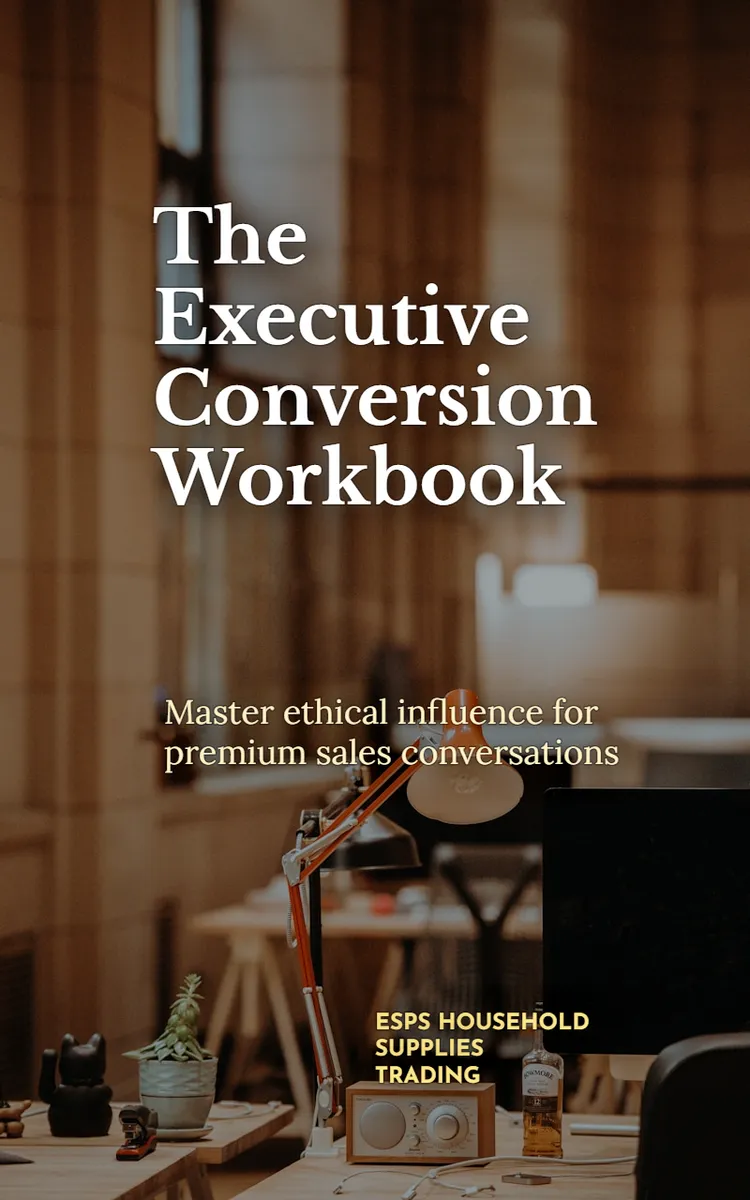
"The Executive Conversion Workbook" is a workbook by ESPS HOUSEHOLD SUPPLIES TRADING with 5 chapters and approximately 6,456 words. 30-day executive sales workbook for ethical influence and conversion.
This book was created using Inkfluence AI, an AI-powered book generation platform that helps authors write, design, and publish complete books. It was made with the Workbook Generator.
Frequently Asked Questions
What is "The Executive Conversion Workbook" about?
30-day executive sales workbook for ethical influence and conversion
How many chapters are in "The Executive Conversion Workbook"?
The book contains 5 chapters and approximately 6,456 words. Topics covered include Ethical Influence Mindset Reset, Message Architecture for Credibility, Premium Positioning Above Price, Discovery Frame for Buying Signals, and more.
Who wrote "The Executive Conversion Workbook"?
This book was written by ESPS HOUSEHOLD SUPPLIES TRADING and created using Inkfluence AI, an AI book generation platform that helps authors write, design, and publish books.
How can I create a similar workbook?
You can create your own workbook using Inkfluence AI. Describe your idea, choose your style, and the AI writes the full book for you. It's free to start.
Write your own workbook with AI
Describe your idea and Inkfluence writes the whole thing. Free to start.
Start writingCreated with Inkfluence AI


