

Read the first chapter
The whole of chapter one, free. About 8 min. Turn the pages with the arrows, your keyboard, or a swipe.
Chapter 1
Exploring AI-Shaped Career Paths
When a Familiar Job Starts to Change
A job posting can keep the same title while changing the work underneath it. A customer service representative may now review AI-generated replies, correct errors, and handle the cases that require judgment. An accounts assistant may spend less time entering invoices and more time checking exceptions. A warehouse supervisor may use software that predicts stock needs, then explain unusual results to the team. If you search only by title, you can miss both the opportunity and the preparation it requires.
That creates a practical problem for people seeking work, changing careers, or returning after time away. They need to know which roles match their interests and circumstances, which tasks AI may change, and which human abilities will remain important. They also need to distinguish a genuine opportunity from a job that quietly expects unpaid technical work, unclear monitoring, or responsibility for tools no one has properly tested.
The Readiness Radar gives you a way to make that investigation concrete. By the end of this section, you will be able to compare roles through four points: personal data, skills, work habits, and professional culture. You will then use the Opportunity Signal Scan to decide whether a role deserves deeper research, what questions to ask an employer, and what preparation would make you a stronger candidate.
The Readiness Radar and the Opportunity Signal Scan
The Readiness Radar is not a personality test or a score that decides your future. It is a structured check of the conditions that affect whether an AI-shaped role fits you. Start with the role itself, not with a tool that happens to be popular. Read several current postings, note repeated tasks, and look for phrases such as “AI-assisted,” “automated workflow,” “data review,” “quality checking,” or “process improvement.” Then compare those demands with your own situation.
Use four points:
1. Personal data: Identify what information the role expects you to handle and what access you would receive. A claims processor may review medical records; a recruiter may work with applicant information; a marketing assistant may handle customer behavior data. Ask whether the employer explains access, storage, correction, and human review. This matters because your comfort with sensitive information affects whether the role feels sustainable and responsible.
2. Skills: Separate the tasks AI may support from the abilities the employer still needs. A writing tool may produce a first draft, but the worker must still understand the customer, check facts, protect confidential information, and make the final decision. List the skills that remain visible after automation: judgment, communication, technical knowledge, problem solving, and quality control.
3. Work habits: Check how the role expects you to work with changing tools. Does the posting mention testing, documentation, review, or learning time? A role that changes its software every few months may suit someone who enjoys regular practice but frustrate someone who needs a stable routine. Neither preference is wrong. The fit depends on your circumstances.
4. Professional culture: Look for evidence that people can question an AI result and escalate a problem. A healthy workplace explains who owns the tool, who checks its output, and what happens when it fails. A weak workplace says “use AI to work faster” but gives no standard, training, or person to contact.
After this four-point check, run the Opportunity Signal Scan. It sorts what you find into three signals. Strong signals show a clear business need, defined human responsibility, and a reasonable path to learn the work. Caution signals show unclear expectations, heavy dependence on a tool, or missing information that you must ask about. Stop signals show conditions that conflict with your boundaries, such as pressure to upload private customer information into an unapproved system or responsibility for decisions that no human reviews.
Record your findings in a simple table. You can use a spreadsheet, a paper page, or a note-taking tool. The point is not to create a perfect rating. The point is to make your reasoning visible so an attractive title does not hide a poor fit.
| Readiness Radar point | Question to answer | Evidence to collect | |---|---|---| | Personal data | What information will I handle, and who can access it? | Job duties, privacy rules, interview answers | | Skills | Which abilities will the role still need after AI support? | Task list, required skills, work samples | | Work habits | How often will tools, tasks, or procedures change? | Training plan, review process, learning expectations | | Professional culture | Can employees question results and report failures? | Manager answers, escalation process, team practices |
This approach also protects you from a common error: treating AI exposure as either automatically good or automatically bad. A role can offer useful learning while still demanding careful questions. Another role can use little visible AI but provide poor training and limited growth. Your decision should rest on the actual work, the support around it, and the match with your needs.
A Practical Scan of an AI-Shaped Role
Consider a jobseeker comparing two operations coordinator positions. Both advertise scheduling, customer communication, and record keeping. One posting says the coordinator will use an AI scheduling assistant, review exceptions, and document changes. The other says the successful applicant must “embrace automation,” manage several software tools, and deliver faster results, but it does not explain training, data access, or review.
Use the following process to examine the first role and compare it fairly with the second:
1. Collect five postings: Save five operations coordinator postings from the same area within a seven-day period. Highlight repeated tasks and mark every reference to automation, data, software, review, or training. Expected outcome: a list of common work demands rather than a conclusion based on one employer.
2. Build a task map: Divide the role into tasks such as scheduling appointments, correcting conflicts, answering routine questions, updating records, and handling unusual cases. Mark each task as “AI may assist,” “human judgment leads,” or “unclear.” Expected outcome: a clearer picture of where your existing strengths matter.
3. Check the four Radar points: For personal data, ask whether the role handles customer contact details or payment information. For skills, identify spreadsheet work, communication, and exception handling. For work habits, check whether the employer provides time to learn the scheduling system. For professional culture, ask who approves changes when the tool produces an incorrect schedule. Expected outcome: four specific questions for the application or interview.
4. Run the Opportunity Signal Scan: Give the first role strong signals for named training, human review, and a stated process for correcting errors. Give it a caution signal if the employer does not explain how it measures quality. Give the second role caution signals for unclear expectations and a stop signal if the employer expects you to enter customer information into personal tools. Expected outcome: a reasoned comparison, not a guess based on the word “AI.”
5. Choose one preparation action: If exception handling appears often, practice reviewing a sample schedule and explaining each correction. If data protection appears often, prepare a short explanation of how you would limit access, check recipients, and report a mistake. Expected outcome: one work sample or interview answer tied directly to the role.
6. Set a decision deadline: Give yourself 30 minutes to review each posting and 15 minutes to record questions. After three role comparisons, decide whether the pattern supports further applications, a short course, or a different role family. Expected outcome: movement from browsing to a practical career choice.
Quick checklist
• Save five current postings for the same role family. - Highlight every task involving automation, data, checking, or training. - Sort tasks into AI assistance, human judgment, or unclear. - Review personal data, skills, work habits, and professional culture. - Record strong, caution, and stop signals. - Prepare one question and one work sample for the strongest opportunity. - Recheck the role after the interview; do not rely only on the posting.
A scan works when it changes your next action. You should know which roles to pursue, which questions to ask, and which skill to strengthen first. If you still cannot explain what the employer expects a person to decide, pause before investing more time.
Mistakes That Distort the Opportunity Signal
Mistaking an AI tool for a career direction
A tool does not define a role. A company may mention an AI assistant because it wants to reduce routine work, because it expects employees to supervise it, or because it has not decided how the tool should be used. Treat the tool as evidence to investigate, not as proof of opportunity.
Do this: Ask, “Which task does this tool change, and what remains my responsibility?”
Not this: Assume that a job becomes future-ready simply because the posting names a popular application.
Ignoring personal data limits
Some roles may fit your skills but conflict with your boundaries around sensitive information. A remote position may require you to download customer files to a personal device. A health-related role may expect access to records without explaining controls. These details affect whether you can perform the work safely and comfortably.
Do this: Ask what information you will access, where the system stores it, and who reviews access.
Not this: Wait until after accepting an offer to discover that the role requires handling data you cannot responsibly manage.
Scoring a role without checking the culture
A polished posting can describe AI support while the daily workplace rewards speed over accuracy. If employees cannot challenge a bad result, the role may expose you to avoidable risk. Ask for a specific example: “What happens when the system produces an incorrect recommendation?” The answer reveals more than a general promise to support innovation.
Do this: Look for a named reviewer, a correction process, and time for learning.
Not this: Treat a company’s broad statement about responsible AI as evidence that the team follows a clear process.
The Readiness Radar helps you see the whole opportunity: the information involved, the skills that remain valuable, the habits the work demands, and the culture that determines whether AI supports people or simply pressures them. The Opportunity Signal Scan turns that view into a decision. You do not need to predict every change in the labor market. You need to examine the work closely enough to choose your next move with open eyes.
End of chapter one. 7 more chapters and about 14,601 words in the full book.
Swipe or use the arrows to turn the page


What's inside: 8 chapters
- 1. Exploring AI-Shaped Career Paths
- 2. Mapping Skills to AI-Ready Roles
- 3. Using AI for Career Research
- 4. Writing AI-Aware Application Materials
- 5. Practicing Interviews with AI
- 6. Evaluating Workplace AI Culture
- 7. Setting Boundaries for AI Use
- 8. Building Your AI Learning Roadmap
About this book
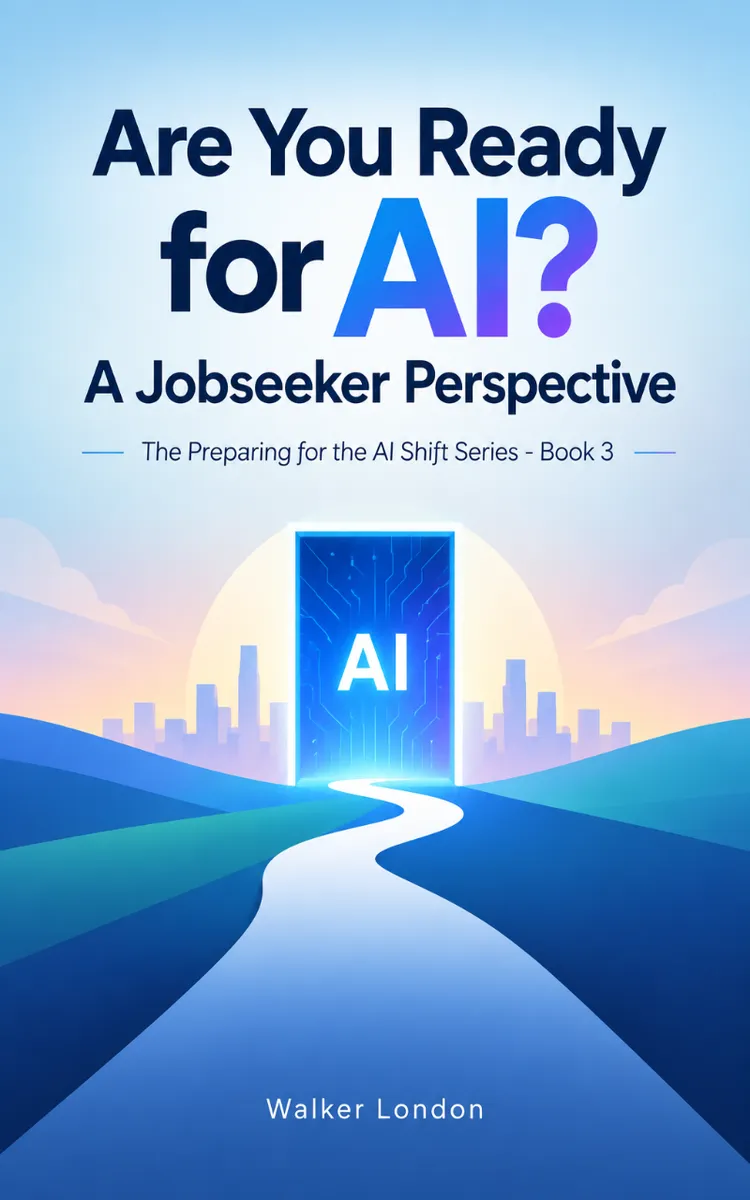
"Are You Ready for AI? A Jobseeker Perspective" is a business book by Walker London with 8 chapters and approximately 14,601 words. A job can keep its title while AI changes the work underneath it. The customer service representative now checks AI-written replies.
This book was created using Inkfluence AI, an AI-powered book generation platform that helps authors write, design, and publish complete books. It was made with the AI Business Book Writer.
Frequently Asked Questions
What is "Are You Ready for AI? A Jobseeker Perspective" about?
A job can keep its title while AI changes the work underneath it. The customer service representative now checks AI-written replies. The accounts assistant reviews invoice exceptions. The warehouse supervisor explains a software forecast to the team. Are You Ready for AI? A Jobseeker Perspective gives you tools to judge what those changes mean and how to best prepare for them.
How many chapters are in "Are You Ready for AI? A Jobseeker Perspective"?
The book contains 8 chapters and approximately 14,601 words. Topics covered include Exploring AI-Shaped Career Paths, Mapping Skills to AI-Ready Roles, Using AI for Career Research, Writing AI-Aware Application Materials, and more.
Who wrote "Are You Ready for AI? A Jobseeker Perspective"?
This book was written by Walker London and created using Inkfluence AI, an AI book generation platform that helps authors write, design, and publish books.
How can I create a similar business book?
You can create your own business book using Inkfluence AI. Describe your idea, choose your style, and the AI writes the full book for you. It's free to start.
Write your own business book with AI
Describe your idea and Inkfluence writes the whole thing. Free to start.
Start writingCreated with Inkfluence AI


