
Read the first chapter
The whole of chapter one, free. About 9 min. Turn the pages with the arrows, your keyboard, or a swipe.
Chapter 1
The Watch That Skips Midnight
The pocket watch ticked once after midnight, then struck thirteen.
Mara Ellison froze beside the kitchen sink, one hand submerged in gray dishwater. The sound was too deep for the little silver case resting on the counter. It seemed to come from inside the walls, from beneath the floorboards, from somewhere below the building where the pipes shuddered whenever the upstairs toilet flushed.
She pulled her hand from the water. A plate slipped, struck the porcelain basin, and cracked.
The watch ticked again.
Its minute hand jerked backward.
Mara snatched it up. The metal was cold enough to sting her palm. On the face, the hour hand trembled between twelve and one. A hairline crack ran across the glass, though she had not seen it there ten minutes earlier.
“No,” she whispered.
The hallway outside her apartment answered with a hard knock.
Mara turned toward the door. Her apartment was narrow and overfull, every surface occupied by books, laundry, unopened mail, and the tools of a life that had never quite found its proper shape. The hallway beyond the door was worse. A bicycle leaned against the coat rack. Two moving boxes blocked half the passage. Her landlord had left a dead fern beneath the fuse panel, its brittle leaves brushing the wallpaper whenever the heat came on.
Another knock sounded.
“Mara?” called Mr. Vale from the stairwell. “Everything all right?”
She looked at the watch. The hands had stopped.
“I’m fine,” she called.
A pause.
Then, “Your lights are flickering.”
The bulbs above her began to blink. Once. Twice. On the third flicker, the kitchen stretched.
Not visibly. Not like rubber or cloth. The room simply acquired distance. The counter slid away from her. The sink became a pale rectangle at the end of a long corridor. The ticking swelled until it filled her teeth.
Mara gripped the watch.
The hallway light snapped off.
For an instant, she saw the apartment as a negative image: white furniture, black windows, the silver watch shining in her fist. Then the floor lurched beneath her.
She fell against the front door. The chain rattled. Something struck the wall behind her with a pop like a rifle shot, and the door flew open.
Cold rain slapped her face.
Mara stumbled onto the pavement.
She landed hard on one knee, the watch clenched against her ribs. Water ran beneath her fingers. She pushed herself upright, expecting the familiar row of brick buildings, the pharmacy sign across the street, the blue glow of the late bus shelter.
None of them were there.
The street was narrower. Gas lamps burned in iron brackets along the walls, their flames blurred by rain. Horse hooves struck the cobbles with frantic, uneven clatter. A carriage swerved around her, its driver shouting as a wheel splashed through a gutter.
Mara backed against a building.
Her building was gone.
In its place stood a three-story facade of soot-darkened stone, its windows tall and narrow. Above the doorway, painted gold letters read ELLIS & SONS - CLOCKMAKERS.
She stared at the sign until rain trickled beneath her collar.
“No,” she said again, but the street offered no correction.
A man in a bowler hat shouted from the carriage. “Clear the way!”
Mara moved too late. The horse reared, iron shoes scraping sparks from the stones. The driver hauled the reins, and the carriage clipped the edge of the curb. A crate toppled from its rear, bursting open at Mara’s feet. Brass gears scattered across the wet street.
The driver swore.
Mara crouched instinctively and caught one of the gears before it rolled into the gutter. Its teeth were warm despite the rain.
A hand seized her shoulder.
“Inside,” a woman hissed.
Mara twisted, ready to strike. The woman wore a dark wool coat buttoned to the throat and a hat pinned low over reddish hair. Her face was young, perhaps thirty, but her eyes had the sharp, exhausted look of someone who had been awake through several bad nights.
“Let go of me.”
“Unless you want the constable to ask why you’re dressed like a lunatic.”
Mara glanced down. She wore jeans, a soaked sweater, and one sneaker. The other had vanished somewhere between the apartment and the street.
The woman dragged her through the clockmaker’s doorway.
Inside, the air was thick with oil, damp wool, and hot metal. Clocks covered every wall. Tall cases stood shoulder to shoulder, their pendulums swinging in uneven rhythm. A workbench filled the back room, crowded with springs, screwdrivers, and disassembled watch movements.
The woman bolted the door.
Outside, the driver continued shouting. A whistle shrilled at the far end of the street.
“Where am I?” Mara asked.
The woman looked at her clothing, then at the watch in Mara’s hand.
“That depends,” she said. “What year do you think it is?”
Mara’s mouth went dry. “2026.”
The woman’s expression changed.
Not disbelief. Recognition.
She stepped closer. “What does it say on the watch?”
Mara looked down. The silver case had opened somehow. The face was no longer white. A thin black line circled the rim, and beneath the twelve, tiny engraved letters had appeared.
ELLIS PATENT.
“Your name is Ellis?” Mara asked.
“My father’s name was Ellis.” The woman reached for the watch. “Give it to me.”
Mara closed her fingers around it. “Tell me the year.”
The woman glanced toward the curtained window. “It’s 1891.”
The word passed through Mara like another fall.
She laughed once, sharply. “No.”
“Then step outside and ask the constable.”
“I need to get back.”
“So does everyone who comes through that door.”
Mara stared at her. The clocks ticked around them, hundreds of small mechanisms keeping different kinds of time. One chimed. Another answered from somewhere overhead.
“Who are you?” Mara asked.
“Clara Ellis.”
“And you know what this is?”
Clara’s gaze remained fixed on the watch. “I know what it does.”
A pounding began at the door.
“Mara Ellison!” a man called from outside.
Her blood turned cold.
The voice was Mr. Vale’s.
Clara caught her wrist. “Don’t answer.”
“That’s my landlord.”
“Not in this year.”
The pounding came again. The brass door latch trembled.
“Mara! Open up!”
She looked through the narrow pane beside the door. Rain silvered the glass, but the figure beyond it was unmistakable: Mr. Vale’s broad shoulders, his wool cap, the pale scar beside his left eye.
Only his coat was different. It hung to his calves, black and buttoned high. A gas lamp shone over his face, making him look older than he had an hour ago.
Mara pulled back.
Clara moved quickly to the workbench and lifted a wooden panel beneath it. “The rear passage.”
“You said everyone who comes through the door.”
“I said nothing about helping them.”
“Then why are you helping me?”
Clara’s eyes flicked toward the watch. “Because my father disappeared with one.”
The door shook under another blow.
Mara followed her behind the bench. Clara shoved aside a crate of clock cases, revealing a low opening in the wall. The passage beyond was black and narrow.
“Where does it lead?”
“Out.”
“That’s not an answer.”
“It’s the only one you have time for.”
The lock snapped.
Mara crawled through first. The bricks scraped her palms. Behind her, the shop door burst inward. Men’s voices filled the room.
“Search the premises!”
“Check the cellar!”
Clara slammed the panel shut. Darkness swallowed them.
Mara crawled faster, breathing dust and old plaster. The passage sloped downward, then turned sharply. Somewhere ahead, water dripped in a steady pattern. Her shoulder struck a pipe. She bit back a cry.
The watch clicked in her fist.
One click.
Two.
The black face lit from within.
Mara stopped.
A thin blue hand appeared beneath the glass, sweeping backward across the dial.
“Clara,” she whispered.
The woman reached her in the dark. “What?”
“It’s doing it again.”
Clara seized Mara’s hand. “Do not let it - ”
The watch struck.
The passage vanished.
Mara slammed onto a wooden floor. Pain flashed through her hip. Dust burst from beneath her, and something heavy crashed nearby. She rolled onto her back, coughing.
The room was enormous and dim. Sunlight poured through tall windows, bright enough to show dust turning in the air. Shelves rose along the walls, packed with clocks, books, and brass instruments. A great pendulum swung at the far end, its polished weight moving silently.
Clara lay several feet away, one hand pressed to her temple.
The passage was gone.
So was the sound of the men outside.
Mara scrambled up. “Are you hurt?”
Clara stared past her.
At the center of the room stood a machine shaped like a tram car, though no rails ran beneath it. Its sides were painted green, its windows clouded with age. Brass pipes curled over its roof and disappeared into the ceiling.
A bell rang inside the car.
Once.
Then again.
Clara rose unsteadily. “That wasn’t supposed to happen.”
“What wasn’t?”
“The second jump.”
Mara looked at the watch. Its blue hand had stopped. The face now showed a date beneath the twelve.
OCTOBER 17, 1891.
She read it twice.
The number did not change.
Her knees weakened. “We’re still in 1891.”
Clara crossed the room to the machine. “Not the same place.”
Mara followed. Through the nearest window, she saw a street far below, crowded with people in dark coats and hats. A line of electric lamps ran along the avenue, but beyond them stood smokestacks and unfinished towers. A tram bell clanged in the distance.
“Where are we?” Mara asked.
Clara touched the green-painted door. “The transit hall.”
“That doesn’t explain anything.”
“It will when the tram leaves.”
Mara grabbed her sleeve. “I’m not boarding anything. I need my apartment. My street. My year.”
Clara looked at the watch. “Then you need the tram.”
The machine’s door opened with a sigh.
Inside, rows of wooden seats faced one another. A conductor stood at the far end, his uniform dark and immaculate, his face hidden beneath the brim of a cap. He held a punch in one hand and watched Mara without blinking.
Clara stepped toward him.
The watch jerked in Mara’s grip.
Its hands spun backward, faster and faster, until the ticking became a shriek. The tram windows filled with darkness. For one impossible instant, Mara saw her apartment hallway beyond the glass: the bicycle, the dead fern, the broken bulb above the fuse panel.
She lunged for the door.
The watch snapped shut around her fingers.
Pain tore through her hand. She cried out and dropped it.
The conductor moved.
He crossed the tram in a single stride, caught the watch before it hit the floor, and pressed it against the brass panel beside the door.
A lock turned somewhere inside the machine.
The windows flashed white.
Mara seized the conductor’s wrist. “Give it back.”
His glove was cold and rigid beneath her fingers.
“You have arrived,” he said.
His voice was not Mr. Vale’s now. It was deeper, worn smooth by years.
“I didn’t choose this.”
“No one does.”
Clara grabbed Mara from behind and pulled her away as the tram began to hum. The floor vibrated under their shoes. Outside, the transit hall stretched and blurred, its lamps becoming long golden threads.
The conductor tucked the watch into a compartment beneath the controls.
Mara struck the glass between them. “Stop! That’s mine!”
The tram lurched.
Clara caught her before she fell. The bell rang once, and the hall vanished into a rushing tunnel of blackness.
Mara looked down at her empty hand.
The watch was gone.
On the other side of the glass, the conductor opened the compartment again. He removed a small brass token and held it up between two fingers. Its surface bore a single engraved mark: a circle split by a line.
He pressed it against the window.
The token remained there as the tram accelerated, while the date on the watch disappeared into the dark.
End of chapter one. 14 more chapters and about 30,114 words in the full book.
Swipe or use the arrows to turn the page


What's inside: 15 chapters
- 1. The Watch That Skips Midnight
- 2. Buying Passage on the Chrono Tram
- 3. The Token’s Map Refuses Answers
- 4. A Library Fire Erases the Ledger
- 5. Mara Chooses the Wrong Year
- 6. Juniper’s Arrest Burns the Proof
- 7. The Museum Door Opens to 1943
- 8. The Chronologist’s Ledger Names Mara
- 9. Mara Breaks the Anchor Rule
- 10. The Tram Conductor Vanishes for Good
- 11. The Watch’s Weight Turns Against Her
- 12. Anchor One Fails Again, Then Stops
- 13. Mara Sacrifices the Token to Save Time
- 14. The New Memory Letter Arrives
- 15. Midnight Returns, but Not for Her
About this book
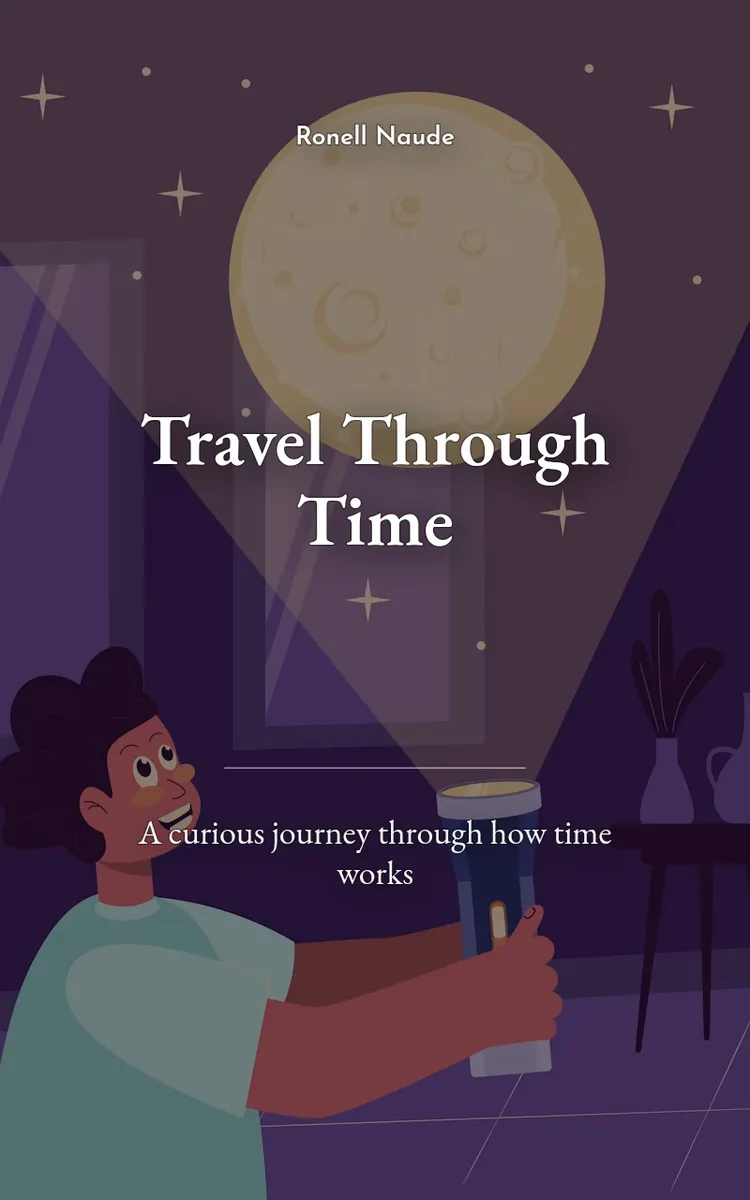
"Travel Through Time" is a fiction book by Ronell Naude with 15 chapters and approximately 30,114 words. Time travel concepts across physics, history, and imagination.
This book was created using Inkfluence AI, an AI-powered book generation platform that helps authors write, design, and publish complete books. It was made with the AI Novel Writer.
Frequently Asked Questions
What is "Travel Through Time" about?
Time travel concepts across physics, history, and imagination
How many chapters are in "Travel Through Time"?
The book contains 15 chapters and approximately 30,114 words. Topics covered include The Watch That Skips Midnight, Buying Passage on the Chrono Tram, The Token’s Map Refuses Answers, A Library Fire Erases the Ledger, and more.
Who wrote "Travel Through Time"?
This book was written by Ronell Naude and created using Inkfluence AI, an AI book generation platform that helps authors write, design, and publish books.
How can I create a similar fiction book?
You can create your own fiction book using Inkfluence AI. Describe your idea, choose your style, and the AI writes the full book for you. It's free to start.
Write your own fiction book with AI
Describe your idea and Inkfluence writes the whole thing. Free to start.
Start writingCreated with Inkfluence AI


