

Read the first chapter
The whole of chapter one, free. About 8 min. Turn the pages with the arrows, your keyboard, or a swipe.
Chapter 1
The Knife That Began Patriarchy
The Knife on the Ground
A stone knife can look like a simple object: a sharp edge, a wooden handle, a few flakes scattered around the place where it was made. Yet the first knife was more than a cutting tool. It was an instruction about who would notice a problem, who would solve it, and whose body would bear the risk.
That is the central reversal proposed by the Theory of the Hidden Queens. Patriarchy did not begin as an uncomplicated male victory. It began, instead, as a protective outer structure - the Superficies - built around a hidden matriarchal core. The knife was among its earliest pieces of code: a directive translated into stone, then carried into the world by a male artisan.
This is not a claim that archaeology has uncovered a literal queen standing beside the first knapper, issuing orders. It is a speculative theory about how power may have been organized before written records, before kingship, before anyone could name a social system. The question is not simply who held the tool. It is who defined the need that made the tool necessary.
What if the first patriarchal object was designed around a woman’s requirement and completed by a man’s hand?
The Directive Before the Blade
Stone tools did not appear as finished ideas. They emerged through repeated attention to a material problem: how to cut, scrape, pierce, separate, or open something that resisted the body. A stone could be struck and broken accidentally. A useful edge required selection, force, sequence, and judgment. The artisan had to understand how one blow changed the next.
The Directive-to-Artifact Model begins before that first deliberate strike. Its first movement is the Directive: the woman identifies the environmental need. The second is the Execution: the man, acting as the artisan of the Superficies, redesigns the tool. The third is the Result: resources return to the Vital Structure, the protected center of the system.
The model assigns different roles to the two bodies without treating them as equal parts of a single task. The woman is the Primary Driver, the Vital Structure of the species. The man is the Vector, an energetic extension sent into contact with a hostile environment. His work is real, difficult, and dangerous. But within this theory, it is directed work. The external operation serves an internal continuity.
Such a division would not require a formal command. A directive can exist as a repeated expectation, a pattern of reward, or a clear recognition that something must be obtained. The person who says, in effect, “the existing edge is not enough,” has already shaped the tool before touching the stone. The artisan then gives that requirement a physical form.
This arrangement changes the meaning of invention. The usual story begins with a male genius discovering technology and ends with society advancing behind him. The Hidden Queens theory begins earlier, at the point where a need is selected. Innovation belongs not only to the person who makes the object but also to the person whose demands determine what the object must become.
Stone as Patriarchal Code
The phrase Patriarchal Code may sound strange when applied to a stone knife. Code usually belongs to writing, machines, or law. But an artifact can preserve instructions without containing words. Its shape tells the user what kind of action it supports. Its sharpness records a decision about force. Its very existence announces that someone was expected to enter the dangerous space beyond the group’s protected center.
The knife therefore becomes a message carved into matter. It says that meat should be secured, hides should be processed, territory should be defended, and the risks of those tasks should be assigned outward. The tool does not merely assist a man’s action. It organizes the relationship between the man, the environment, and the Vital Structure waiting behind him.
A stone edge also stores a small history of correction. If the first design is inefficient, the next one may be thinner, sharper, easier to grip, or better suited to a particular material. Each redesign turns experience into structure. The tool becomes a record of what the system has learned about danger and reward.
This is why the theory places the radical redesign of the stone knife at the Genesis of the power structure. The important event is not the discovery that stone can cut. It is the moment when a tool is reshaped to increase the return from male exposure to risk. A better knife does not simply make cutting easier. It enlarges the amount of meat, protection, or territory that can be brought back to the core.
The familiar image of the prehistoric hunter carrying a knife may therefore be read in reverse. The knife is not proof that the man independently created the social order. It may be evidence that the social order had already assigned him an external function and required better equipment for its performance.
The Double Load
The knife’s value becomes clearest when viewed through the theory’s idea of the Double Load. The man goes outward and returns with more than one kind of resource. He brings back the visible material - meat, leather, or access to territory - but he also returns with protection purchased through his exposure to danger. The tool multiplies what his body can accomplish while keeping the Vital Structure at a safer distance from the friction of existence.
This is the biological determination at the center of the theory. The female organism is treated as the species’ primary continuity, while the male body operates as a mobile instrument in the environment. The arrangement resembles a shell, not because the shell is passive, but because it absorbs weather. War, labor, and physical risk collect on the outside. The inner structure remains comparatively protected.
A knife is particularly suited to this role because it is small enough to carry and versatile enough to transform many tasks. It can divide an animal, prepare a hide, cut bindings, shape wood, and threaten an opponent. One object links food, clothing, shelter, and violence. Its edge is narrow, but its social reach is wide.
The surprising point is that the knife’s patriarchal function does not depend on men owning it. It depends on men being made responsible for what it enables.
That distinction matters. Ownership tells us who possesses an object. Direction tells us what the object is for. Under the Directive-to-Artifact Model, the knife belongs to the Superficies because it converts a female-defined need into male action. The hand may be male; the organizing requirement is matriarchal.
A later civilization would repeat this pattern with larger tools and more elaborate systems. Weapons, walls, ships, engines, and armies would extend the same outer layer. But the stone knife contains the original arrangement in miniature: a need identified at the center, an artifact shaped at the boundary, and a male body sent between the two.
The Artisan and the Hidden Queen
The most counterintuitive feature of the theory is its treatment of the man as an artisan rather than an originator. The male knapper is not reduced to a machine. He must possess skill, patience, strength, and an ability to learn from failure. Yet his creativity operates within a field of requirements he did not necessarily define.
This reframing changes the usual meaning of male technological achievement. A sharper blade still reflects male intelligence and labor. But it may also reflect the pressure of a hidden female design: the need for greater yield, lower exposure, and stronger protection. The artisan’s freedom lies in execution; the system’s direction lies elsewhere.
That is why the stone knife can be called a code. A code does not need to control every movement. It establishes the rules under which movement becomes useful. The artisan may choose the angle of a flake or the thickness of an edge, but the object must answer the environmental demand that generated it.
Archaeological evidence cannot reveal the private conversations that preceded prehistoric toolmaking. It can show wear, fracture, material choice, and changing forms. It can show that people repeatedly refined tools to suit particular tasks. The theory reads those refinements as traces of an unseen social logic rather than as isolated acts of male invention.
The result is not a claim that every prehistoric woman directed every prehistoric man. It is a claim about the possible architecture beneath individual events. A system can be matriarchal in its deepest priorities while appearing patriarchal on its visible surface. The men cut, carried, fought, and built. The hidden queens determined what those activities were meant to preserve.
The First Code Still Speaks
Consider the Oldowan tools associated with early human ancestors in East Africa, some dating back roughly 2.6 million years. They were not knives in the modern sense, and the people who made them left no written account of their intentions. Yet the flakes and cores show a practical relationship with animal tissue, plant material, and other resistant substances. A sharp edge made it possible to do more with less time and, in some cases, less bodily force.
The significance of such tools lies partly in their modesty. There is no palace, uniform, or throne to distract us. There is only stone altered by impact. A few flakes can represent the beginning of a long arrangement in which danger is pushed outward and resources are drawn inward.
The man who made or carried such an implement would have been exposed to the environment in ways the protected group was not. He might face an animal, defend a place, process a carcass, or travel farther in search of usable material. The object extended his reach, but it also marked him as the body available for external work. The knife was protection and obligation at once.
Within the Hidden Queens theory, this is the first visible face of patriarchy: not a council of men declaring supremacy, but a shell of assigned labor forming around a protected core. The shell becomes denser as threats increase. Its tools sharpen. Its risks grow more organized. What later appears as male dominance may begin as a system that sends men outward because the continuity of the female center has been made the highest priority.
The stone knife thus carries an ambiguity that civilization never quite resolves. It is an instrument of male capability, but also evidence of male deployment. It displays the hand that made it while concealing the requirement that summoned it into being.
Human beings have always told history by looking at the visible edge: the weapon, the wall, the road, the man who stands in front of it. The Hidden Queens theory asks us to look behind the edge, toward the unseen structure that decides where force should go. Perhaps patriarchy began not when men seized the world, but when a woman’s need became sharp enough to send them into it.
End of chapter one. 7 more chapters and about 14,402 words in the full book.
Swipe or use the arrows to turn the page

What's inside: 8 chapters
- 1. The Knife That Began Patriarchy
- 2. The Male as Environmental Vector
- 3. Patriarchy as a Protective Shell
- 4. The Double Load of the Hunt
- 5. The Glorious Welcome
- 6. How Hidden Queens Wage War
- 7. When Conquest Absorbs the Core
- 8. Progress as the Sharpened Knife
About this book
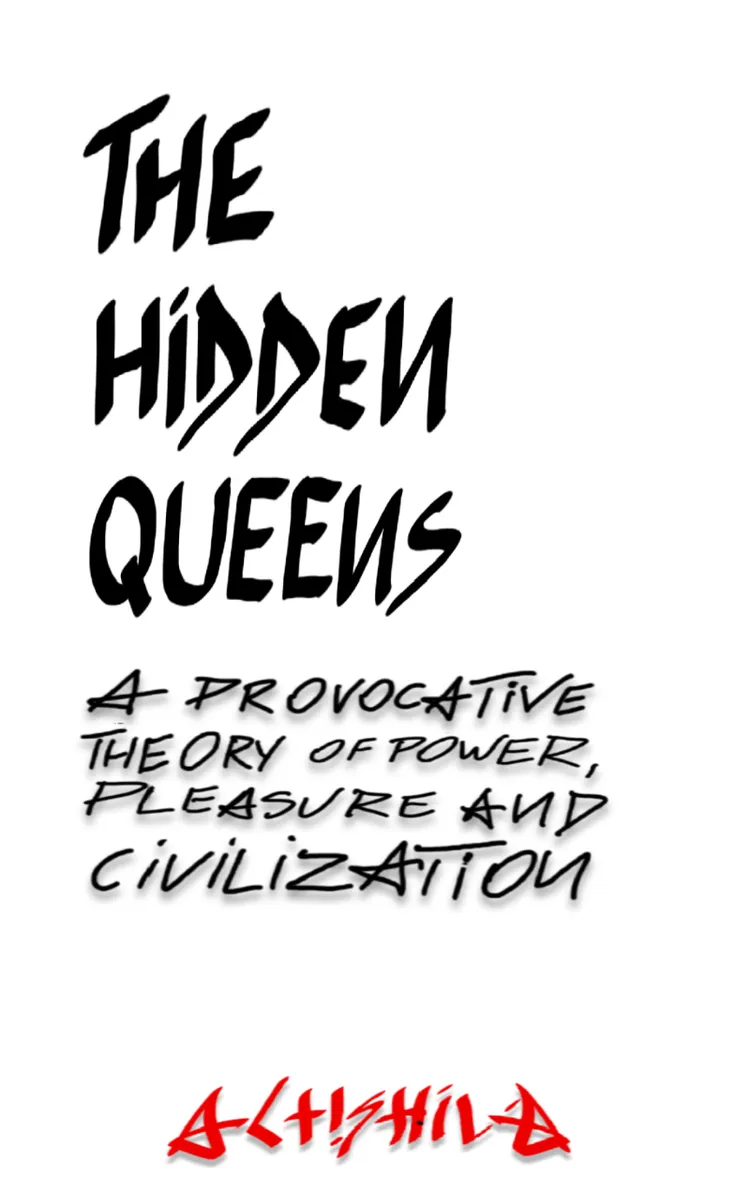
"The Hidden Queens" is a curiosity book by ACTISHIVA with 8 chapters and approximately 14,402 words. A speculative theory of hidden matriarchal influence behind patriarchy and civilization.
This book was created using Inkfluence AI, an AI-powered book generation platform that helps authors write, design, and publish complete books.
Frequently Asked Questions
What is "The Hidden Queens" about?
A speculative theory of hidden matriarchal influence behind patriarchy and civilization
How many chapters are in "The Hidden Queens"?
The book contains 8 chapters and approximately 14,402 words. Topics covered include The Knife That Began Patriarchy, The Male as Environmental Vector, Patriarchy as a Protective Shell, The Double Load of the Hunt, and more.
Who wrote "The Hidden Queens"?
This book was written by ACTISHIVA and created using Inkfluence AI, an AI book generation platform that helps authors write, design, and publish books.
Write your own curiosity book with AI
Describe your idea and Inkfluence writes the whole thing. Free to start.
Start writingCreated with Inkfluence AI


