
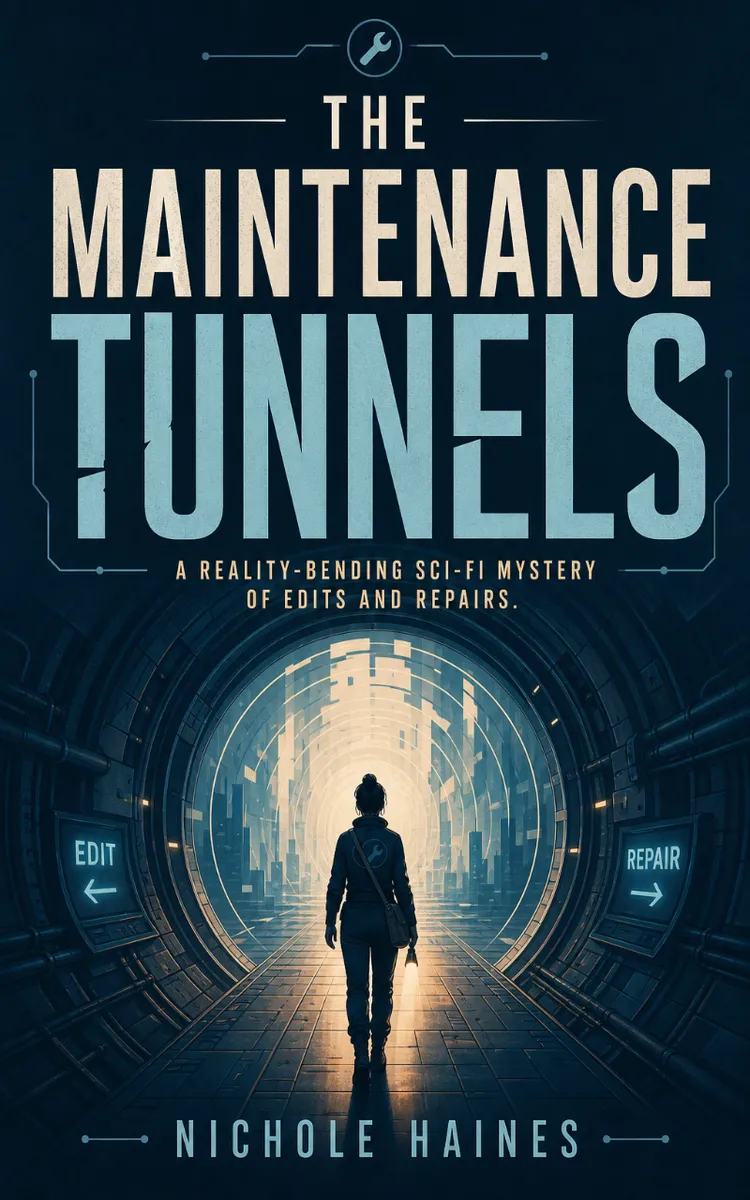

Science fiction story about tunnels that manually maintain reality.
Table of Contents
- 1. The First Wall That Vanished
- 2. Skies Swapped Under Emergency Lighting
- 3. The Map That Refused to Match
- 4. A Doorway That Opened Wrong
- 5. Mara’s Name on a Blank Tag
- 6. The Tag Fragment Rewrites Her Voice
- 7. Who Signed the Authorization Key?
- 8. The Corridor Fills With Stored Rain
- 9. A Stranger’s Handprint Matches Mine
- 10. The Sky Panel Falls Into a Box
- 11. Dead Ends With Living Labels
- 12. A Wall Archive Eats the Lights
- 13. Mara Chooses Which Self to Keep
- 14. The Index Shows a Future Edit
- 15. Purge Doors Open Only for Lies
- 16. A Maintenance Lift Drops Without Warning
- 17. Mara Refuses the Edit Offer
- 18. The Key Opens a People-Editor Bay
- 19. The Unfamiliar Name Becomes a Trap
- 20. Elo’s Signature Appears in the Static
- 21. Mara Trades Her Certainty for a Key
- 22. The Chamber Door Replaces the Air
- 23. Elo’s Work Log Shows a Third Edit
- 24. The Pursuit Corridor Stores Her Footsteps
- 25. Mara Finds a Wall Labeled “Undo”
- 26. The Surface Static Turns Into a Map
- 27. The Trap Asks for a Confession
- 28. A Sky Replacement Begins Without a Sky
- 29. Mara Pulls the People Editor Offline
- 30. The Tunnels Forget Mara Venn
- 31. Elo’s Coordinate Leads to the Root
- 32. The Root Node Demands a Replacement
- 33. Mara Edits the Editor’s Rules
- 34. The Patch Tries to Store Her Away
- 35. Competing Patches Collide in One Sky
- 36. Mara Replaces the Sky With Stability
- 37. The Tunnels Keep Running Without Her
- 38. The Last “Elo…” Becomes a Name
- 39. Mara Breaks the Mercy With One Choice
- 40. The Maintenance Tunnels Become a Door
- 41. The Gatekeeper’s Name
Preview: The First Wall That Vanished
A short excerpt from “The First Wall That Vanished”. The full book contains 41 chapters and 101,922 words.
The wall behind Mara’s inspection cradle didn’t crack. It unzipped.
One second the residential block’s back corridor held steady - gray paneling, conduit seams, the faint vibration of the building’s life-support fans - then the surface went soft at the edges like it had been rendered in thin foam. Mara watched it peel away from the studs in a clean, impossible curve. Her glove hovered, fingers spread, catching nothing but air where there should have been weight.
The jobsite lights flickered from white to sickly amber. Somewhere farther down the maintenance corridor, a relay clicked too fast for comfort. Mara’s wrist console chimed once, sharp as a snapped cable.
“Unauthorized delta,” it read, then stuttered into static. The corridor’s temperature dropped a notch, enough to raise gooseflesh beneath her uniform collar.
“Hey,” she said, voice loud in the narrow space. “Control? That wall is - ”
The console didn’t answer. Instead, the missing wall’s outline shimmered, not like heat haze but like a picture refusing to settle. The studs were there one frame, gone the next. A thin strip of darkness opened where the panel had been, deep and featureless, swallowing the corridor’s dim light.
Mara stepped forward on instinct, boots thudding against the polymer floor. The sensation under her sole changed - less traction, more give - as if she’d crossed from built material into something that hadn’t decided to be a surface yet. She reached for the seam with her left hand.
The moment her glove brushed the empty space, the air grabbed her.
The corridor rewrote itself from the inside out. The vanished wall didn’t return. It slid sideways into nothing, like a drawer being pulled closed behind her. Her wrist console went black. The amber lights steadied, then dimmed to a deeper, colder glow as if the corridor had been swapped for a colder version of itself.
Mara grabbed the nearest conduit rail. It was warm. Too warm. The metal felt alive under her palm, humming faintly, and the sound didn’t come from any fan. It came from the rail itself, vibrating into her bones.
“Okay,” she breathed, and the word sounded wrong in the space, like it didn’t belong to this reality. “Okay. This is a fault. It’s a fault.”
No alarms screamed. No supervisor barked. That was worse. If the system had truly failed, it would have announced itself. This felt… curated. Like the building had noticed her noticing and decided to edit the scene.
Her training kicked in anyway: freeze, observe, don’t make it worse. She yanked her hand back and scanned the corridor. The wall that had disappeared was now a continuous stretch of paneling - clean, uninterrupted, as if nothing had ever been missing. But the floor in front of her boots showed a faint indentation, a bruise in the polymer where the air had grabbed her.
A hatch should not exist behind a residential jobsite wall.
Yet there it was now, disguised as a repair panel with fresh sealant and older scuff marks beneath. Mara saw the telltale line where the seal met the frame: too straight, too recent. Someone had covered it. Or the corridor had created it to manage what she’d touched.
Her throat tightened. “Maintenance access,” she muttered, and hated how hopeful it sounded.
She knelt. The panel’s surface was cool, but the sealant at the edges carried a thin warmth, like it had been applied minutes ago. Mara pressed her fingertips along the seam and felt the hatch’s resistance shift under pressure - mechanical, but not to her standards. It wasn’t a standard residential lock. It was a decision being made somewhere else.
Behind her, the corridor’s speaker system crackled once. A voice cut through, flat and urgent.
“Work zone breach. Step back. Do not actuate access.”
Mara spun, heart snapping against her ribs. The speaker was at the far end, half-hidden behind a conduit box, but it sounded like it was right inside her skull. The air smelled faintly of ozone now, sharp enough to sting the back of her nose.
“That’s what I’m doing,” Mara said, palms up. “I didn’t breach anything. The wall - ”
“Work zone breach,” the voice repeated, and this time there was a second layer beneath it, like multiple speakers agreeing. “Do not actuate access. Unauthorized contact recorded.”
“Recorded?” Mara stood, trying to keep her balance as the corridor’s perspective tugged at her vision. The world didn’t blur exactly. It re-sorted itself, frame by frame, like someone was re-rendering the scene at different resolutions.
She glanced down at her console - still dead. No signal. No local map. Great. The one time she needed the system to back her up, it had gone silent.
Mara forced her breathing steady and looked at the hatch again. If it had appeared because she touched the missing wall, then the hatch wasn’t a regular access point. It was a mechanism for holding reality in place - or storing it.
She couldn’t explain the manual feeling in her bones....
About this book
"The Maintenance Tunnels" is a fiction book by Nichole Haines with 41 chapters and approximately 101,922 words. Science fiction story about tunnels that manually maintain reality..
This book was created using Inkfluence AI, an AI-powered book generation platform that helps authors write, design, and publish complete books. It was made with the AI Novel Writer.
Frequently Asked Questions
What is "The Maintenance Tunnels" about?
Science fiction story about tunnels that manually maintain reality.
How many chapters are in "The Maintenance Tunnels"?
The book contains 41 chapters and approximately 101,922 words. Topics covered include The First Wall That Vanished, Skies Swapped Under Emergency Lighting, The Map That Refused to Match, A Doorway That Opened Wrong, and more.
Who wrote "The Maintenance Tunnels"?
This book was written by Nichole Haines and created using Inkfluence AI, an AI book generation platform that helps authors write, design, and publish books.
How can I create a similar fiction book?
You can create your own fiction book using Inkfluence AI. Describe your idea, choose your style, and the AI writes the full book for you. It's free to start.
Write your own fiction book with AI
Describe your idea and Inkfluence writes the whole thing. Free to start.
Start writingCreated with Inkfluence AI


