
Read the first chapter
The whole of chapter one, free. About 9 min. Turn the pages with the arrows, your keyboard, or a swipe.
Chapter 1
The Fog Beyond the Last Hill
For seven days after the Rain Stone returned to its well, rain fell on the lowlands.
It did not fall in a hurry. It fell softly, like a lullaby sung over and over, and the Empty Lake Village drank it in. On the first day, puddles gathered in the cracks of the basin. On the third day, the old boats began to lift from the mud. On the fifth day, a silver fish jumped near the reeds, and every child in the village screamed with joy.
On the seventh morning, the lake was full.
Tombolini stood on the shore with his hat pushed back and his boots in the cool water. Datcha chased ripples along the edge. Pimmel floated in the shallows with his eyes half closed, looking like the happiest platypus in all the world.
"I said I would stay until the boats could float," Tombolini said.
"And you stayed for supper," said Grawnet, leaning on her fishing spear. "And breakfast. And six more suppers."
"Your soup is very good."
"My soup is only soup. Your friends are the ones who ate three bowls each."
Datcha tried to look innocent. Pimmel did not even try.
A small, sturdy fisher child came running along the path, carrying something wrapped in a cloth. It was the wooden trout. Its belly was no longer hollow with sadness, only hollow with wood, and it had been painted with fresh blue stripes.
"This is for luck," the child said, and held it up to Datcha.
Datcha sniffed the little fish. It smelled of paint, lake water and care. She took it gently in her teeth and carried it to the wagon, where Tombolini hung it from the lantern hook. It swung there, bright and cheerful.
The road south had been waiting for them all week.
The letter had arrived on the second day of the rain, carried by a travelling tinker whose cart was stacked with kettles. The paper was folded small and felt stiff, as if it had been left out in the cold. Tombolini had read it by lamplight so many times that he could have said it with his eyes closed.
To the circus man Tombolini, who once came to our village with a dancer's grace and a magician's light, it said. The nights here are long and the days are short, and the children have forgotten the sound of a crowd laughing. If you can come, come before the last light fails. - Sigrid Icevein, Elder of Winterhearth.
He remembered Winterhearth, though only a little. He had been a boy when his mother danced there, on a night of snow and bright lanterns. He remembered a great round hearth with a golden glow at its heart. He remembered the warmth on his cheeks, even with snow in his hair.
It was far to the south, beyond the south isles and the great tundra.
"A show," Tombolini had said to his friends. "Just a show. A little juggling, a little music, a few lights. We will go there, make the children laugh, and come home again."
Datcha had looked at the letter, then at him. She had sniffed it twice.
She had not looked convinced.
Now, as the wagon was packed, Grawnet pressed a heavy bundle into Tombolini's arms. Inside were dried fish, a round loaf of bread and a thick woollen scarf the colour of rain clouds.
"The south is cold," she said. "Colder than we remember."
"I will wear it," Tombolini promised.
"Wear it before you need it." She gave Datcha a pat and Pimmel a rub between the eyes. "And remember what you learned below. A leader is only as strong as the friends who walk beside him."
Tombolini bowed low. "I will remember."
The villagers lined the path to wave them off. The wagon wheels rolled over ground that had once been cracked and was now soft and green at the edges. Behind them, the misty well hummed quietly. Ahead, the road curved toward a line of low grey hills.
For two days the journey was pleasant. The lowlands slowly gave way to rolling moorland, and the moorland gave way to a bare, windy coast. Gulls cried overhead. The sea was a cold pewter colour.
On the third day, they reached the south isles.
There were many of them, small and rocky, scattered across the water like dropped buttons. Long wooden causeways joined one isle to the next, and the old road ran along them like a thread through a needle. Tombolini stood on the driver's bench and looked out over the water.
"Four isles to cross," he said, "and then the Hushwood, and then the tundra. We should reach Winterhearth in three days."
Datcha put her nose in the air. Then she wrinkled it.
Pimmel lifted his bill and held very still.
Tombolini frowned. "What is it?"
Both of them looked south.
At first, Tombolini saw only a thin white line along the water, as if someone had drawn a pencil mark between sea and sky. Then the line thickened. It rose. It rolled across the water toward the first causeway, slow and soft and silent.
"Fog," he said. "That is all it is. Fog."
Datcha pressed close to his boot. Fog did not usually smell like this. It smelled of old iron and snow that had been shut in a cupboard.
The wagon rolled onto the first causeway.
The fog met them halfway across.
It came in wisps first, white threads curling around the wheels. Then it came in sheets. Within a hundred steps, the world had turned to milk. The sea disappeared. The sky disappeared. Even the wooden rail beside the road became a faint grey smudge.
Tombolini sat forward on the bench. He could not see the end of the wagon. He could barely see his own hands.
"Stay close," he said.
His voice came out flat and small, as if the fog had swallowed the best part of it.
Datcha pressed against his leg. Pimmel climbed up onto the bench and sat shoulder to shoulder with him, his webbed feet tucked under his body.
The wagon wheels rolled on, but their rumble sounded far away. There was no creak from the boards. There were no gulls. There was no wind. Tombolini had heard many kinds of quiet in his life, but never one so heavy.
"I will light the way," he said.
He lifted his magic staff and tapped the glass orb.
Blue light burst out, bright and bold.
The fog took it, spread it, and threw it straight back at him. In a moment, they were sitting inside a glowing white wall. Tombolini squinted and covered his eyes.
"Oh dear," he said. "That is worse."
He tapped the orb again, and the light went out.
The dark and the fog closed over them like a blanket. Pimmel gave a worried chirp. Datcha's whiskers trembled.
Tombolini sat very still. He felt foolish, and a little afraid. He had been so used to the staff doing the hard work. Light had always been his answer.
Then he remembered his father.
His father had been a quiet magician, who never used great flashes or bangs. He had taught his son tricks of light and shadow so small that people leaned forward to see them. Never shout when a whisper will do, he used to say. Never blaze when a glimmer will do.
Tombolini lifted the staff and tapped the orb, so lightly that it hardly made a sound.
A thread of blue light slid out of the glass.
He turned the staff downward. The thread spread thin along the ground, no higher than a hand, like a narrow ribbon laid across the boards. It did not climb into the fog. It stayed low, and it shone clearly on the wood.
"There," Tombolini whispered. "A little road of light."
Pimmel chirped with relief.
Datcha hopped down and trotted along the glowing ribbon, her silver-tipped nose close to the wood. Every few steps she stopped and sniffed the air. Tombolini climbed down, took the wagon's lead rope, and followed her one slow step at a time.
They crossed the first causeway like that, barely faster than a snail. The boards were damp underfoot. Water dripped from the rail. Twice, Tombolini thought he saw tall grey shapes standing at the edge of the road, and twice they turned out to be old mooring posts wrapped in frost.
On the second isle, a bell was ringing.
It rang slowly, with a dull note that rolled through the fog from no direction at all.
Dong.
Tombolini stopped. Datcha stopped. Pimmel put his bill against the ground and listened.
Dong.
"Someone is out there," Tombolini said, hardly breathing.
Pimmel shook his head. He tapped the boards with his bill, pointed it out toward the water, and tapped again.
Tok. Tok.
Tombolini understood. "A bell on the water. A buoy, perhaps. It is only the sea moving it."
He did not feel better, even so. A bell that nobody rang seemed lonelier than a bell with someone to ring it.
They crossed the second isle in silence. At the end of the second causeway, the road turned sharply, and Datcha stopped dead.
Tombolini raised his staff.
On the boards ahead, there was a patch of white. It was not fog. It was frost, furred and glittering, spread across the road in a perfect circle.
"Frost," he said, "in autumn?"
Pimmel touched it with the tip of his bill and pulled back at once.
Tombolini crouched. The frost was cold enough to sting his fingers through his glove. It spread outward in feathery lines, as if something cold had breathed on the wood and walked away.
"The fog is not just fog," he murmured. "It is cold. It is old cold, and it is coming from the south."
Datcha stared down the road. The little hairs along her back had lifted.
Tombolini looked at his friends. He wanted to say that everything would be all right. He wanted to be the kind of leader who always knew.
Instead, he said, "I am a little afraid."
Datcha leaned against him. Pimmel chirped softly, a low, steady sound.
They did not say that they were not afraid, too. They did not need to. Being afraid together was easier than being afraid alone.
"Then we go slowly," Tombolini said. "And we go together."
He wrapped Grawnet's thick grey scarf around his neck. It was warm, and it smelled faintly of lake water and soup.
They crossed the third isle and the fourth, step by step, ribbon of light by ribbon of light. The fog pressed close. Sometimes it seemed to whisper. Sometimes it seemed to watch. Once, Tombolini heard a sound like a very long sigh, and he did not stop walking until it was far behind.
At last, the boards under the wagon turned to packed earth.
The last causeway had ended.
A wooden signpost stood where the road began again. Its boards were furred with white frost, but Tombolini wiped one clean with his sleeve and read it by the thread of blue light.
The top board said WINTERHEARTH and pointed straight ahead.
The second board said THROUGH THE HUSHWOOD.
The third board, smaller and lower and cracked at one corner, said BEYOND THE SULLEN MIRE.
Pimmel read the last board twice and made a very small noise.
Tombolini rubbed his chin. "A wood and a mire. Well. We have crossed worse."
Datcha gave him a look that said they had not.
Beyond the signpost, the fog thinned just enough to show the edge of a forest. The trees were tall and grey, and they stood very close together, as if sharing a secret. No leaf stirred on any branch.
Tombolini took a deep breath and tightened his grip on the staff.
He had thought a circus show was a small thing. A few tricks. A few smiles.
But the fog was cold and old, and the road ahead was dark. Somewhere beyond the trees, a village was waiting for more than juggling.
"One careful step at a time," he said.
Datcha went first. Pimmel followed. Tombolini walked between them with his ribbon of light.
When the way is hidden, patience is a lantern, and a friend's company is the warmest light of all.
End of chapter one. 6 more chapters and about 13,422 words in the full book.
Swipe or use the arrows to turn the page


What's inside: 7 chapters
- 1. The Fog Beyond the Last Hill
- 2. The Hushwood and the Sullen Mire
- 3. Winterhearth Under Frost
- 4. The Glass Hollow
- 5. The Sun Returns to Winterhearth
- 6. Graphic Novel
- 7. Charcters
About this book
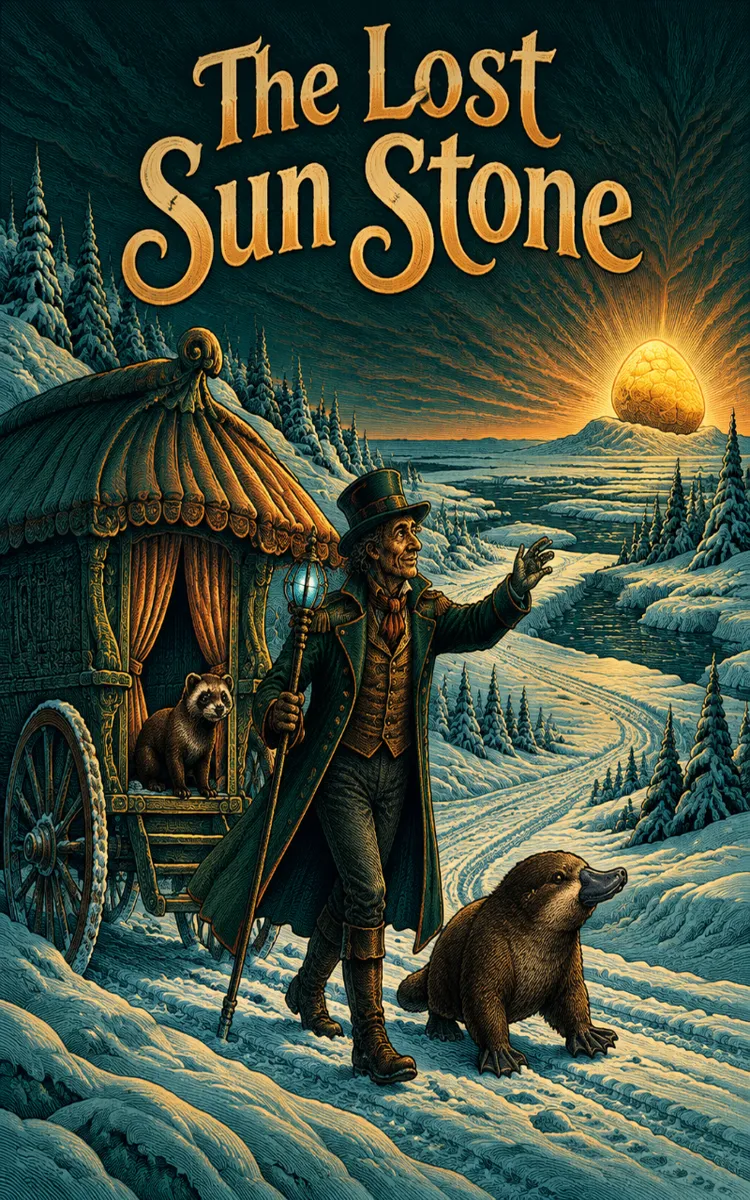
"The Lost Sun Stone" is a children's book by Earl LaClare with 7 chapters and approximately 13,422 words. Tombolini, Datcha, and Pimmel journey into the frozen southern tundras to find the missing Sun Stone and restore light to the village of Winterhearth..
This book was created using Inkfluence AI, an AI-powered book generation platform that helps authors write, design, and publish complete books. It was made with the AI Children's Book Creator.
Frequently Asked Questions
What is "The Lost Sun Stone" about?
Tombolini, Datcha, and Pimmel journey into the frozen southern tundras to find the missing Sun Stone and restore light to the village of Winterhearth.
How many chapters are in "The Lost Sun Stone"?
The book contains 7 chapters and approximately 13,422 words. Topics covered include The Fog Beyond the Last Hill, The Hushwood and the Sullen Mire, Winterhearth Under Frost, The Glass Hollow, and more.
Who wrote "The Lost Sun Stone"?
This book was written by Earl LaClare and created using Inkfluence AI, an AI book generation platform that helps authors write, design, and publish books.
How can I create a similar children's book?
You can create your own children's book using Inkfluence AI. Describe your idea, choose your style, and the AI writes the full book for you. It's free to start.
Write your own children's book with AI
Describe your idea and Inkfluence writes the whole thing. Free to start.
Start writingCreated with Inkfluence AI


