
Read the first chapter
The whole of chapter one, free. About 13 min. Turn the pages with the arrows, your keyboard, or a swipe.
Chapter 1
The Rumble Beyond the Tundra
Spring came to Winterhearth the way a shy guest comes to a party: late, a little muddy, and holding a very small bunch of flowers.
The snow slid off the turf roofs in long soft sighs. The chimneys smoked all day in friendly grey ribbons. The Lantern Fair, promised in the long dark and kept at last, ran for three whole days, and on the third evening the square was so full of laughter that the old black hearthstones seemed to hum along.
Tombolini had juggled until his arms ached. Datcha had spun her ribbons until the children begged her to stop, and then begged her to start again. Pimmel had beaten his mended drum so well that a cobbler wept into his apron, and nobody was quite sure whether it was joy or onions.
Now the fair was over. The three friends sat on the wagon steps with Brynn, who wore her red knitted hat and held the little wooden trout, and who had announced that she was the Official Keeper of the Wagon and might remain so for the rest of her life.
“It is very quiet tonight,” said Tombolini, who had been listening to the quiet for some time.
“It is quiet every night,” said Brynn. “Except when Mister Pimmel snores.”
Pimmel lifted his bill, looked offended, and put it down again.
“No,” said Tombolini slowly. “I mean the sky.”
Elder Sigrid Icevein had come up beside the wagon, leaning on her birch staff. The hearth-fire glowed in the square behind her, and for once her face looked warm and rosy instead of pale as a winter morning.
“You have good ears,” she said. “I have been listening to it for a month. Every spring of my life, the storms have come up out of the east in the last weeks of the thaw. Great black clouds with lightning in their bellies. We hid under our blankets and the children counted the seconds between the flash and the bang. This year the clouds come and sit above the hills like cats on a wall, and they say nothing at all.”
Datcha sniffed the air. It smelled of wet earth and woodsmoke, and underneath, very faintly, of something sharp, like a coin held on the tongue.
“Is that bad?” asked Brynn.
“I do not know,” said Sigrid. “I know only that a sky which has stopped speaking is a sky with something on its mind.”
That was when the sound came.
It began so low that Tombolini felt it in the soles of his boots before he heard it with his ears. It was a long, deep, rolling note, like the lowest string of a fiddle as big as a barn, and it came from the east, far across the dark tundra, rising and falling and rising again. The lanterns in the square trembled. A dog howled. The wooden trout swung on its hook and knocked against the wagon wall.
Hooooooom. Hooooooom.
“That,” said Brynn, with great authority, “is a cow with a cold.”
“That,” said Sigrid, “is a Thrumox.”
She looked east, to where the stars lay thick above the empty land, and her voice dropped.
“The Greymantles of Tharakûn keep them. They are beasts of the high mountains, shaggy as haystacks, with four sturdy legs and horns that curl around twice. They do not call unless they must, and they do not call so far unless a great many of them are calling together.”
The sound rolled away over the tundra and was gone.
Datcha had fluffed to twice her size. Pimmel stood very straight on the step, as if somebody had called his name.
“Someone,” said Tombolini, “wants us to hear that.”
It took the messenger two more days to cross the tundra, and he arrived in Winterhearth looking quite unbothered, which was more than could be said for the villagers.
His mount was the largest, shaggiest creature Tombolini had ever seen. It looked like a Highland cow grown to the height of a haystack, with long grey-brown wool that swept the snow, a broad blunt face half hidden beneath a shaggy fringe, and a pair of horns that curled twice around like the springs of a clock. And it had four legs. Two on each side, thick and sure, ending in broad cloven hooves, so that it rolled across the square in a rocking, steady, cheerful way, like a very friendly ship.
Datcha sat up on the wagon rail and stared. Pimmel searched for its eyes beneath that fringe, gave up, and searched again.
The man on its back was shorter than Tombolini by a full head, but twice as wide across the shoulders, and he looked as though he had been carved out of a mountain by somebody who liked mountains. His beard was brown and braided with copper beads. His cloak was made of the same shaggy hide as his mount, drawn up tight about his ears, and his hands, which were as broad as shovels, were scarred across every knuckle.
He swung down from the saddle, looked around the square, and gave a small nod, as though he approved of it.
“Hargen Flintbrow,” he said. His voice was a deep, gravelly rumble, not unlike the Thrumox’s. “Scout of the Greymantles. This is Gravelgut.”
Gravelgut blew out a long breath and flopped his tongue sideways, which Tombolini decided was a greeting.
“I am Tombolini,” said Tombolini, bowing with his hat on his chest. “This is Datcha, and this is Pimmel. We are, as you can see, a circus.”
“I can see,” said Hargen, looking at the wagon, the ribbons and the platypus with grave interest. “I was told to look for a man with a staff and a glass stone on top. I was told he would be small and nervous and polite.”
“I am not nervous,” said Tombolini.
Datcha made a small, rude noise.
“I am a little nervous,” said Tombolini.
Hargen very nearly smiled. It was a close thing.
He drew from inside his cloak a flat grey stone, as smooth as a river pebble, with a spiral carved on one side and a jagged line on the other. He put it into Tombolini’s hand. It was heavier than it looked, and faintly warm.
“From my Elder,” he said. “Maldrik Cragfather, Elder of the Greymantles, Keeper of the High Fires. He is the oldest living soul in the mountains, and he does not send for people often. His words are these.”
He cleared his throat and spoke slowly, like a man who has said a thing over and over to himself across a hundred miles of snow.
“ Send for the one who carried the rain home and the sun home. Tell him that the sky over Tharakûn has lost its voice, and that the mountain has found a heartbeat that is not its own. Tell him the Light Stone is gone from its place. Tell him to come before the High Fires go cold. ”
Nobody spoke.
Sigrid had stepped up beside Tombolini, and she was looking at the grey stone in his hand with eyes as pale as winter.
“The Light Stone,” she said softly. “I have heard of it in the old tales. I always thought it was a story to frighten children into going to bed. A stone that drinks the lightning. A stone that teaches the thunder when to speak.”
“No story,” said Hargen. “But it is gone.”
Tombolini looked down at the spiral and the jagged line. He thought of the Hushwood and the Sullen Mire and the long cold road that had led him here. He thought, quite clearly, that he was only a circus man, and that circus men are not supposed to climb mountains.
Then Datcha ran up his sleeve, sat on his shoulder, and bit his ear very gently. Pimmel waddled over and leaned against his boot. Behind them, the little wooden trout tapped against the wagon wall, as if it were saying yes.
“We will come,” said Tombolini.
He was surprised by how steady his voice sounded.
They left the wagon behind. The mountain paths of the Skeldrheim, said Hargen, were no place for wheels, and Brynn, who had taken the news with enormous seriousness, swore upon the wooden trout that she would guard every plank until they came home.
“And I will feed the trout,” she added.
“It does not eat,” said Tombolini.
“I will feed it anyway.”
Sigrid gave them hard bread, dried fish and a fresh grey scarf, and she pressed Tombolini’s hands between her long cold ones.
“Come back by midsummer, circus man,” she said. “The square is still waiting for its show.”
Gravelgut carried their packs in two great wicker baskets, and Pimmel, who had never in his life been so high above the ground, rode on top of them with an air of enormous dignity. Datcha rode on Tombolini’s shoulder. Tombolini walked beside Hargen, with the grey stone in his pocket and his magic staff in his hand, and for the first mile he kept looking back at Winterhearth until it was only a smudge of chimney smoke on the white horizon.
They travelled east for three days.
The tundra did not end all at once. It grew thin, the way a blanket does that has been washed too often. First the snow gave way to brown moss. Then the moss gave way to scrubby little willows no taller than a boot. Then came boulders, big and round and grey, scattered like marbles dropped by a careless giant, and streams of snowmelt that chattered and rushed over pebbles. Overhead, the sky was the colour of a pigeon’s wing.
On the second evening, they saw the clouds.
They were heaped along the eastern horizon in black towers, with the last of the sunset gilding their tops. They looked ready to roar. They did not.
Datcha’s whiskers stood out stiff as pins. Pimmel’s bill, which could feel the faintest flicker of life in a dark pond, was tingling so hard he kept rubbing it against Gravelgut’s wool, like a tooth about to ache.
“Aye,” said Hargen, watching them. “Same as home. All shout and no bark.”
“Is it the missing stone that does it?” asked Tombolini.
Hargen was quiet for a time.
“The Light Stone drinks the wild fire out of the sky,” he said at last. “That is how my grandmother told it. All the lightning that would crash down on the peaks, it takes in and holds, and gives back a little at a time, so that the sky gets to speak and not to scream. Take it away, and the fire has nowhere to go. It piles up. It gets restless.” He rubbed his scarred knuckles. “I am a scout, not a wise man. But I have seen a pot with the lid held down.”
Nobody wanted to ask what happened to the pot.
On the third day they reached the foothills.
The Skeldrheim rose out of the plain all at once, like a wall. Tombolini had thought he knew what mountains looked like from pictures. He had not known they would be so large that the top of one seemed to belong to another country. They were grey and black and streaked with old snow, and their summits were lost in the heaped, silent clouds. Between the great peaks ran dark clefts and shadowed valleys, and somewhere inside them, Hargen said, lay Tharakûn.
“We go in by the Gateway,” he said. “Before dark, if the mountain lets us.”
“If the mountain lets us?” said Tombolini.
Hargen said nothing. He only looked at Gravelgut, and Gravelgut, who had been walking cheerfully all day, had slowed to a careful, wary plod.
It happened a little after noon, on a long slope of loose grey stones.
First Tombolini noticed a tightness in the air, like the moment before a sneeze. Then the hairs on his arms stood up, and his teeth began to buzz, as though he had bitten on a spoon. Datcha’s fur lifted in a great bristling cloud. Pimmel gave one small, startled tok.
“Stand easy,” said Hargen, very quietly. “Here it comes.”
The pulse struck.
It was not a sound and it was not a wind. It was a great, soft, invisible hand that closed around the whole world and held it still.
Tombolini had one foot raised for his next step, and there it stayed. He could not move his foot, nor his fingers, nor even blink. He could still see and still think, and he thought, with a rather ridiculous calm, I am a statue. A pebble that had been rolling down the slope hung in the air a hand’s breadth above the ground. Datcha had been leaping from a rock to his shoulder, and she hung in the air in a furry curve, like a comma. Pimmel’s bill was half open. Gravelgut stood caught in mid-stride, all four legs in different places, which Tombolini considered a very interesting thing to be caught in the middle of.
Only the hum went on, thick and deep and trembling, all through his bones.
How long it lasted he could not have said. Long enough to count his heartbeats, which he did, because there was nothing else to do. It seemed to him a hundred years.
Then it let go.
It went all at once, like a held breath. The pebble clattered down the slope. Datcha landed on his shoulder in a heap and said something extremely rude in ferret. Gravelgut finished his stride, stumbled, and gave a long, offended hoooom. Tombolini’s raised foot came down, and he sat very suddenly on the stones.
“Hush-Pulse,” said Hargen, who had caught himself on Gravelgut’s wool and was breathing hard. “That is what we call it. It comes, it holds you, it lets go. It started the first new moon after the sky went quiet. Once a day, at the beginning. Now it is much more often.”
“Does it hurt?” asked Tombolini.
“No. It is only that you cannot do anything about it.” Hargen looked up at the clouds. “And here is the thing to learn. Between the letting go and the next holding, there is a gap. An interval. It is not long. It is long enough to cross a room, not long enough to cross a river. Learn the length of it, and you can plan your steps.”
Pimmel was already tapping.
Tok. Tok. Tok. Tok.
He tapped slow and steady against the stones, one tap for every breath, with his eyes half closed and his bill raised like a little conductor. Tombolini listened, and then he understood, and he took out his father’s old pocket watch, which had not worked in years, and held it to his ear out of habit.
The next pulse came when Pimmel reached two hundred and forty.
This time they were ready. They did not move. They stood together, breathing, and let the great hand close around them, and hold, and let go. Pimmel began to count again before the stones had stopped rattling.
Two hundred and forty. Exactly.
“Good bill,” said Hargen, and meant it.
Pimmel looked like a platypus who had been given a medal.
They went on up the slope, counting. When the interval ran low, they stopped, and when the pulse held them, they stood like statues, and when it let go they went on again, a few hundred steps at a time. It was slow work. It was strange work. By the time the light began to go, Tombolini had stood perfectly still more times that afternoon than he had in his whole life, and he had begun to notice small things he had never noticed before: the way the moss grew in neat little cushions along the rocks, the way a single bright beetle crossed the path with enormous purpose, the shape of the clouds.
At dusk, they came to the foot of a great grey cliff.
In it was a cave mouth as wide as a barn door, ringed with ancient carved stones, each cut with the same spiral and the same jagged line as the grey stone in Tombolini’s pocket. Across the lintel, in letters taller than a man, was one word, worn almost smooth by wind.
THARAKÛN.
“The Gateway of the Greymantles,” said Hargen. “The passes run through the mountain, not over it. Keep your feet where I tell you, and your friends where you can see them.”
Beyond the arch the dark was deep and cool, and from somewhere far inside it came a soft, strange sound, like a great many small bells being rung by a very slow wind.
Tombolini took a breath. Datcha tightened her grip on his collar. Pimmel stopped counting, for a moment, and listened.
They stepped into the mountain.
There is a time to move and a time to stand still, and a traveller who learns to count the gap between them will always find the way.
End of chapter one. 5 more chapters and about 13,568 words in the full book.
Swipe or use the arrows to turn the page


What's inside: 6 chapters
- 1. The Rumble Beyond the Tundra
- 2. The Singing Passes
- 3. The Greymantles and the High Fires
- 4. The Pause Between the Pulses
- 5. Down into the Thunderdeep
- 6. The Sky Finds Its Voice
About this book
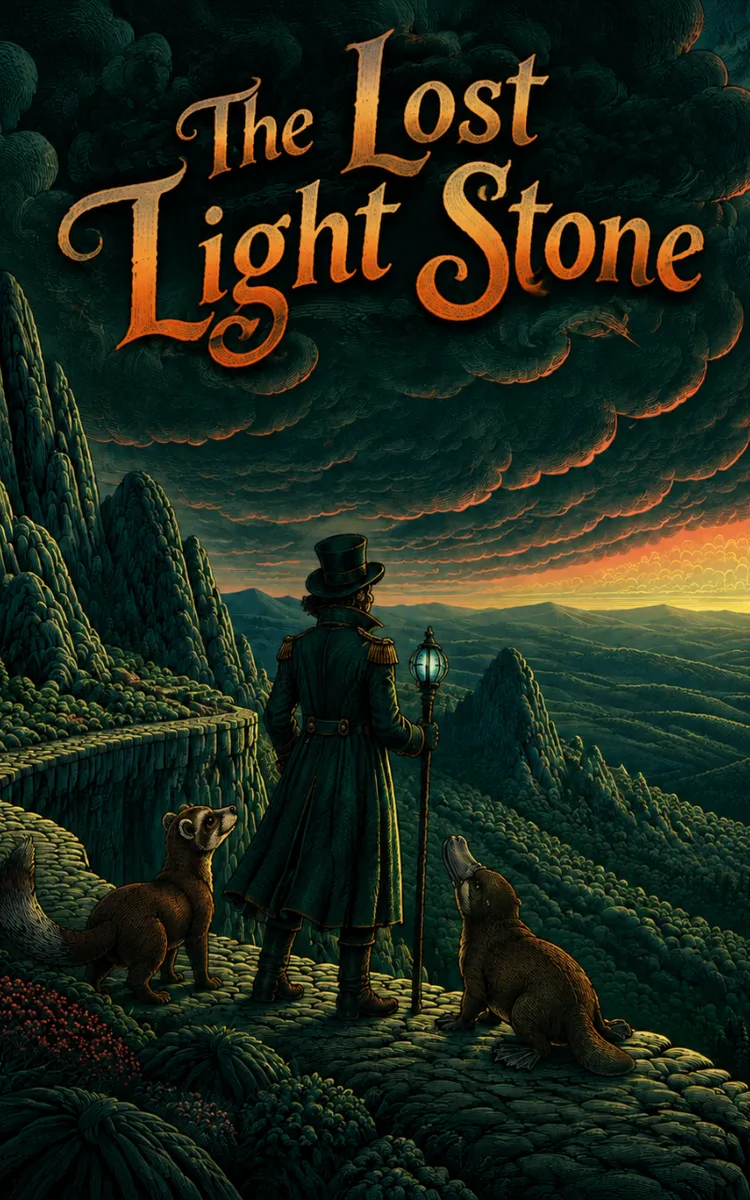
"The Lost Light Stone" is a children's book by Earl LaClare with 6 chapters and approximately 13,568 words. Tombolini and his animal companions climb into the thunder mountains of Tharakûn to find the stone that teaches the sky to speak.
This book was created using Inkfluence AI, an AI-powered book generation platform that helps authors write, design, and publish complete books. It was made with the AI Children's Book Creator.
Frequently Asked Questions
What is "The Lost Light Stone" about?
Tombolini and his animal companions climb into the thunder mountains of Tharakûn to find the stone that teaches the sky to speak
How many chapters are in "The Lost Light Stone"?
The book contains 6 chapters and approximately 13,568 words. Topics covered include The Rumble Beyond the Tundra, The Singing Passes, The Greymantles and the High Fires, The Pause Between the Pulses, and more.
Who wrote "The Lost Light Stone"?
This book was written by Earl LaClare and created using Inkfluence AI, an AI book generation platform that helps authors write, design, and publish books.
How can I create a similar children's book?
You can create your own children's book using Inkfluence AI. Describe your idea, choose your style, and the AI writes the full book for you. It's free to start.
Write your own children's book with AI
Describe your idea and Inkfluence writes the whole thing. Free to start.
Start writingCreated with Inkfluence AI


