
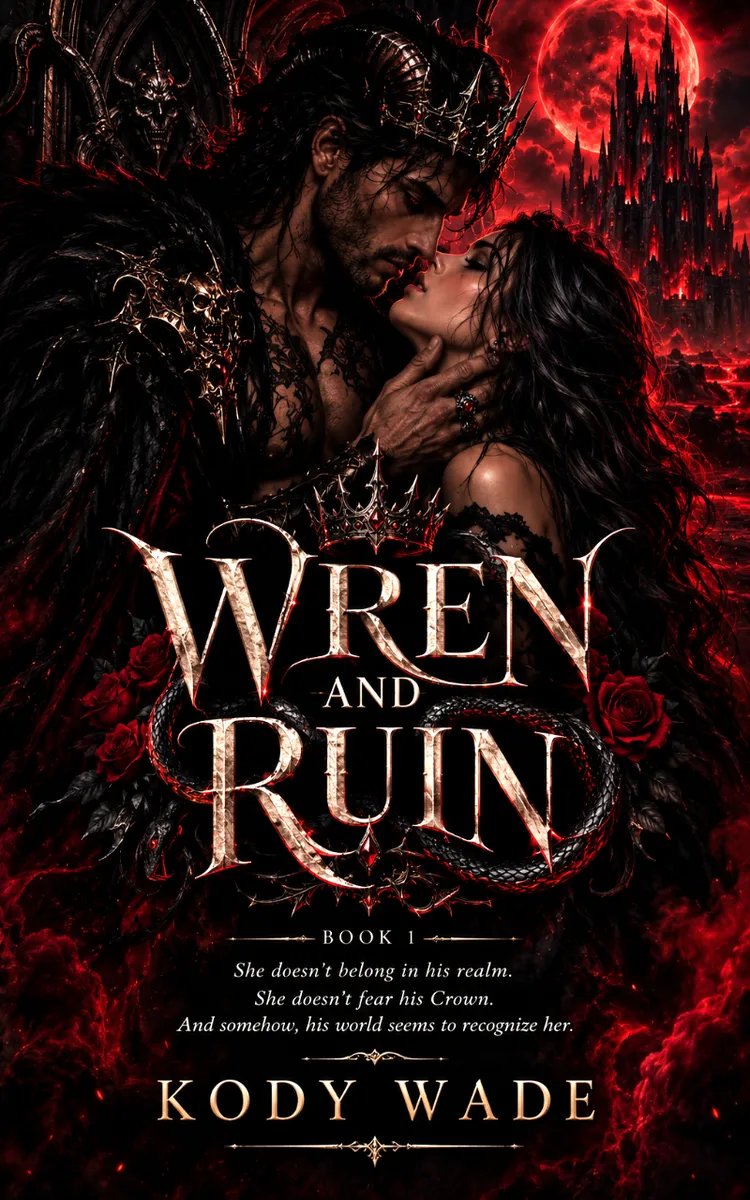
Read the first chapter
The whole of chapter one, free. About 18 min. Turn the pages with the arrows, your keyboard, or a swipe.
Chapter 1
Chapter 1- Wren
WREN
In Wren Calloway's defense, the mirror had been forty dollars.
She wanted that on the record, wherever the record was kept, because she had a feeling she was about to need it. Forty dollars for an entire abandoned storage unit, sight unseen, was the kind of deal that made a reasonable person ask questions. Wren had asked exactly one: “Is it haunted?” The auctioneer, a man with a mustache like a dead ferret, had said, “Lady, it’s a storage unit,” and she had decided that counted as a no.
She was starting to think she should have asked a better question.
The unit had been mostly junk. Water-stained boxes, a lamp shaped like a swan, a box of VHS tapes labeled DO NOT PLAY in handwriting she chose to find charming. And at the back, leaning against the corrugated wall like it had been waiting for her, a tall mirror in a black iron frame covered in tiny etched symbols.
She hadn’t even touched it. That was what she kept coming back to, in the half second she had to think about it. She had stood a respectful three feet away and said, out loud, to nobody, “Okay, you’re definitely cursed, and I’m definitely leaving.”
The mirror had apparently taken that as an invitation.
The surface rippled like someone had dropped a stone into black water. Wren had time to say, “Oh, come on,” before the floor went out from under her and the world turned inside out, and she fell through nothing for what felt like a full minute and also no time at all, her stomach left somewhere behind her in a Midwestern storage facility, her tote bag clutched to her chest like that would help.
Then she hit something hard and shiny and landed on her backside with a sound like a dropped tray.
Silence.
Wren sat very still. Her tailbone had opinions. Beneath her palms was black marble, glossy as a frozen lake, veined with threads of dull red that pulsed faintly, like the whole floor had a slow heartbeat. Above her, a ceiling disappeared into dark. Torches burned along the walls in a green-white flame that threw no warmth at all.
And all around her, in a wide silent ring, stood roughly forty demons.
She counted, because counting was what she did when her brain wanted to scream. Forty-one, actually, if you included the one with the extra head. Horns, hooves, scales, and in one case what appeared to be a very elegant arrangement of living smoke wearing a monocle. They were dressed in black and crimson and silver, in the kind of fabrics that cost more than her car. Every single one of them had the frozen stillness of a crowd that had just watched someone commit an unthinkable crime.
Wren’s eyes traveled upward, past the ring of demons, past a set of wide black steps, to the throne.
It was made of something that looked like fused obsidian and bone, tall and jagged and aggressively theatrical, the kind of chair that had never once been described as cozy. And in it, or rather half out of it, because he had clearly started to rise, was a man.
She used the word man generously.
He was tall even sitting, built like someone had taken the idea of a predator and refined it. Black hair, a little too long, falling to the sharp line of his jaw. Dark clothes cut so precisely they looked poured on, buttoned to the throat, sleeves to the wrist. A crown of black iron sat on his head like it had grown there. His face was the kind that should have come with a warning label: sharp, severe, painfully beautiful, and carrying the expression of a man who had not been surprised in several centuries and was now taking the news badly.
His eyes were the worst part. They were gold, and they were fixed on her with the flat, bottomless attention of something that had just noticed a mouse on the dinner table and was deciding how much of a scene to make.
The torches guttered. Somewhere to Wren’s left, a demon made a small sound like a kettle clearing its throat.
Wren did what she always did when she was in over her head, which was the one thing every self-help book and every ex-boyfriend had told her not to do.
She held up both hands and started talking.
“Okay,” she said. “Before anyone does anything dramatic, I’d like it noted that this is not my fault.”
The king finished rising. He did it slowly, the way a storm finishes arriving. The robes at his shoulders shifted, and she noticed, absurdly, that he was wearing black leather gloves, fitted to the fingers, buttoned at the wrist. Who wore gloves to their own throne room?
“Mortal,” he said.
His voice was low and cool and utterly unhurried, with a faint formality in the vowels, like English was a language he had learned a very long time ago and refused to update. It filled the whole hall without his raising it. Wren felt it in her sternum.
“Do you know where you are?”
She looked at the marble, the torches, the horned gentleman at her elbow, the smoke in the monocle.
“A really aggressive hotel lobby?”
A sound moved through the crowd. It was the sound of forty creatures collectively deciding not to breathe.
The king’s expression did not change. But one of his gloved hands, resting on the arm of the throne, closed slowly into a fist.
“This,” he said, “is the Court of Ashen Crowns. You stand in the Obsidian Hall, seat of the Ninth Circle. I am Kaelen Vorhaas, Sovereign of the Burning Throne, Lord of the Nine Gates, Keeper of the Ruin.” He paused. “Four hundred and twelve thousand souls answer to my name.”
“That’s a lot of souls,” Wren said. “Is there a group discount, or—”
“Silence.”
It wasn’t loud. It didn’t need to be. The word hit the room like a dropped blade, and the green fire along the walls flared sideways. The demons flinched. Several of them took a half step back.
Wren did not flinch. This was not courage. It was a malfunction. Her whole life, when the stakes rose, her mouth sped up and her fear went somewhere very far away and very quiet, and she had long since stopped trying to understand why.
She closed her mouth.
For about three seconds.
“Sorry,” she said. “Reflex. I’m going to stand up now. Slowly. With my hands where everyone can see them. Is that okay, or is that a thing?”
Nobody answered. She took that as permission, which was how she had taken most things in her life, and got to her feet. Her knees wobbled. She locked them. Her tote bag swung at her hip, and a roll of masking tape fell out and rolled across the marble with a tiny, deeply embarrassing sound.
Every demon in the hall watched it go.
It came to rest against the toe of a boot belonging to a woman in a gown the color of dried blood. The woman looked down at it. Then she looked up at Wren with an expression of pure aristocratic horror.
“Mine,” Wren said weakly. “Sorry. I’ll just—”
She took one step.
The king moved.
She didn’t see it happen. One moment he was standing at the top of the dais, and the next he was on the floor of the hall, six feet in front of her, and the demons had somehow spread back in a perfect ring to give them room. He was taller than she had thought. The air around him had a strange quality, a dry cold, like the inside of a church in winter, and where it touched her skin, her arms prickled.
He looked down at her, and for the first time Wren saw something that was not quite anger move behind the gold.
“You came through the Warden’s Glass,” Kaelen said quietly. “That mirror has been sealed for eight hundred years. It does not open for mortals. It does not open at all.”
“Well, it opened for me,” Wren said. “I’m not saying that’s a good thing. I’m saying I’m as confused as you are, and I have a very small amount of information and a very large amount of regret.”
“How did you open it?”
“I didn’t. I stood near it and said it was cursed.”
“You stood near it,” he repeated, with the faint disbelief of a man hearing someone confess to a serious crime that had also been an accident.
“I’d describe it as a minor trespass.”
The lady in the gown made a noise. Wren decided to ignore it.
Kaelen’s eyes narrowed. He lifted one gloved hand, and for a heartbeat Wren thought he was going to touch her, just reach out and take her chin or her throat or her wrist, the way villains did in the movies. Instead the hand hovered, stopped a careful distance from her cheek, and held there, as if he had remembered something.
His fingers curled. The hand dropped.
Something in the room changed, a tiny shift in pressure that Wren felt more than saw. The demons had noticed it too. One of them, an enormous horned man at the edge of the crowd with scars crossing his face like a map, drew in a very slow breath.
“Interesting,” the king murmured. He said it to himself.
“What’s interesting?” Wren said. “Is it good interesting or ‘let’s put her in a jar’ interesting? Because I should mention, for the record, I’m very bad at being in jars.”
He didn’t answer. He circled her instead, one slow turn, the way you’d examine a statue or a bomb. His voice dropped.
“You are not from this realm. You carry no sigil. You have no power I can sense.” A pause. “And yet you smell of the Wardens.”
“I smell of what?”
“Of old iron and rain,” he said. “And salt.”
Wren blinked. “Oh. That’s just my laundry detergent.”
Someone, somewhere in the hall, choked.
Kaelen stopped in front of her again. For a moment, an actual moment, his face did something complicated, as though a muscle that hadn’t moved in a very long time had twitched without permission. It was gone before she could name it.
“Lord Marrec,” he said, without taking his eyes from her.
The man with the map of scars stepped forward. He bowed. He was huge, shoulders like a door, a sword at his hip as long as Wren’s whole body. He looked at her the way you look at a dog that has bitten the postman but seems to be wagging its tail anyway.
“Sire.”
“Summon the executioner.”
“Whoa,” said Wren.
“The mortal has breached the Warden’s Glass and entered the royal court uninvited,” Kaelen continued, in the flat, final voice of a man reading a verdict. “The penalty for trespass in the Obsidian Hall is death.”
“Okay, hold on, hold on.” Wren took a step back, held up both hands, then immediately regretted every decision that had led to this one. “I want to flag that I did not trespass. I was transported. That’s a completely different legal category. I have been abducted by a mirror.”
“The mirror is mine.”
“Then you should have kept it better locked up! Who leaves a magic portal in a storage unit? Do you know how many people go through those? There was a man there with a metal detector.”
The lady in the blood-colored gown opened her mouth. Kaelen lifted two fingers, without looking at her, and she shut it. Wren filed that away: He doesn’t even have to look.
“Your mouth,” the king said, “is unwise.”
“My mouth is the only thing I’ve got,” Wren said. “And right now it’s the only thing keeping me from screaming, so if you’re going to execute me, could you at least let me finish my sentence?”
“Which is?”
“I don’t know,” she admitted. “I was making it up as I went.”
The silence that followed was long enough to hear the torches hiss. Wren realized, with a distant and rather useless clarity, that her hands were shaking. She pressed them against her thighs. She was going to die in a stranger’s basement, in a pair of leggings with a hole in the knee, and the last thing she would ever say to anyone was metal detector.
She thought of her grandmother, who had once told her, in the tone of someone predicting weather, You attract trouble, little bird. It finds you the way water finds low ground. Wren had been nine. She had laughed.
She was not laughing now.
Because here was the thing she had never told anyone, not her ex, not her sister, not the therapist she had seen twice before deciding she could get the same results from a good playlist: it wasn’t bad luck. It had never been bad luck. The cursed vending machine at her old job. The wedding where the groom’s uncle turned out to be a very old and very hungry thing wearing a suit. The sinkhole, the gargoyle, the three separate occasions on which a stranger had looked at her too long in a parking lot and she had known, in her bones, that whatever they were, they weren’t only people. Trouble didn’t happen to Wren. Trouble walked into rooms and asked for her by name.
And now she had walked into the biggest room of all.
The executioner, apparently, took a while to arrive. Wren had never been so aware of someone’s absence. She could hear her own pulse, and beneath it, faint and terrible, the sound of forty-one demons waiting to see what their king would do.
Kaelen was watching her.
Not the way a man watches a prisoner. The way you watch a locked door when you can hear something behind it.
“You are afraid,” he said.
“Extremely,” Wren agreed.
“You hide it.”
“Badly.”
“Not so badly.” His head tilted a fraction. “You have insulted my court, my throne, my mirror, and my person, and you have not once begged.”
“Would that help?”
“No.”
“Then I’m saving my strength.”
The corner of his mouth moved. It wasn’t a smile. It was the ghost of the idea of a smile, something he had once known the shape of and had put away somewhere cold. But Wren saw it, and so did Lord Marrec, whose eyebrows climbed his scarred forehead like they were trying to escape.
“Sire,” Marrec said carefully. “The executioner awaits your word.”
Kaelen did not answer.
He was looking at her again, and the weight of it had changed. Wren felt the strangest thing: heat. Faint, strange, and wrong in a room that had held nothing but cold since she arrived. It came from nowhere. It curled around her ankles and slid up her spine, and she realized it was coming from him, from the careful space between them, as though the air itself were leaning toward her.
She took a breath. “Look. I get that I’m a problem. I really do. I’m an extremely inconvenient person. I’ve been told. But I’m also a very small problem. I’m five-foot-five, I have forty-three dollars and a library card, and the most dangerous thing in my bag is a stapler. Nobody here has anything to fear from me.”
“Nobody here,” said Kaelen, “is afraid of you.”
“Okay. Rude.”
“But you smell of the Wardens, and you came through a door that has not opened in eight centuries, and you stood in my hall with your hands up and told me I should have locked my mirror better.” He said it slowly, like he was setting each word down on a scale. “Those facts do not sit well together.”
“Then maybe,” Wren said, “you shouldn’t kill the one person who can explain them.”
“Can you?”
“Not even a little.”
A ripple of something that was almost laughter passed through the gathered demons. It died quickly, strangled by their king’s expression. But it had been there.
Wren could feel the moment tilting, like a seesaw with a very large person on one end. She did the only thing she could think of.
She took a step toward him.
The hall gasped. Marrec’s hand went to his sword. The lady in the gown actually put a palm to her chest. Even the monocle-smoke wavered.
Kaelen did not move. But his whole body went still in a way that felt like a held breath, and the cold at the edges of him sharpened.
“Do not,” he said, very quietly, “come any closer.”
“Why? Are you contagious?”
“Yes.”
The word dropped into the silence like a stone into a well. It was not a joke. Wren stopped.
He was looking at her, and for the first time he did not look like a king. He looked like a man standing very still at the edge of something, with great care, because one wrong step would take it out from under him. His gloved hands were pressed flat against his thighs.
“Anything living that touches me,” Kaelen said, “withers.”
The hall had gone so quiet that Wren could hear the green flames breathing.
“That’s,” she began. “Okay. That’s a lot of information to drop on a girl on her first day.”
“You will not touch me,” he said. “You will not stand within my reach. You will not hand me anything, or brush past me, or let any part of you cross the line of my skin. If you do, you will die, and it will not be quick, and I will not be able to prevent it.” His voice did something strange on that last part. A fraction of a note, no more. “Do you understand?”
“Yes,” Wren said, and meant it. “Gloves. Right. That makes a lot more sense.”
Something went through his face. Surprise, maybe. She wasn’t sure he had felt it in a while.
And then, from somewhere very high in the vaulted dark above them, came a sound like a sheet of glass cracking.
Every head in the hall turned.
A long hairline fracture was running across the ceiling, glowing faint violet. The torches bent toward it. Something that was not wind rushed through the hall and lifted the hair from Wren’s shoulders, and the smell of it was wrong: wet earth, old blood, and a sweet rot like flowers left too long in a vase.
Wren knew that smell. She had smelled it behind a bar in Dayton, and under a bridge, and once in her own bathroom at three in the morning, and she knew, with the resigned certainty of a woman who had never once been spared, exactly what it meant.
“Oh,” she said. “No. Nope. I want to be clear that I did not bring that.”
“Marrec,” said Kaelen.
“Sire.” The scarred lord already had his blade drawn. “It’s a breach. From the north spire.”
“Clear the hall.”
The demons moved, fast and silent, in a flood of crimson and black. Within seconds the ring had become a retreat, and Wren found herself standing alone on the black marble with the king of Hell and a ceiling that was coming apart.
The crack widened. A shape began to push through it, long limbs, too many joints, a face like a mask of white wax that smiled with too much of its mouth.
“ Mortal, ” it hissed, in a voice made of a dozen voices. “ Warden’s blood. Warden’s blood. Found you. Found you. ”
Wren looked at the thing. Then she looked at the king.
“So,” she said, in a very small voice. “This is, like, a thing that happens to me.”
Kaelen was already moving. She had never seen anything move that fast. He crossed the floor in one blink, stepped between her and the falling creature, and tore a glove off with his teeth.
Black veins of light ran up his bare hand to the wrist. The air around it shrieked.
He did not look at her. He looked up at the thing in the ceiling, and when he spoke, the voice was one Wren would hear in her dreams for months, low and soft and absolutely, terribly calm.
“Touch her,” said the Demon King, “and die.”
The thing in the ceiling opened its mouth to answer.
He didn’t let it.
The light left his hand like a thrown spear. It struck the creature mid-fall, and for an instant the whole hall went white. When Wren could see again, there was a smear of ash on the black marble, a long, thin curl of smoke going up into the dark, and the ceiling stitched itself quietly shut.
The silence afterward was enormous.
Kaelen stood with his back to her, bare hand held away from his body, the veins of light fading slowly under the skin. His shoulders rose and fell once. Then he reached for the fallen glove, and put it back on, one finger at a time, with the slow care of a man who had done it ten thousand times and never once gotten used to it.
Wren realized she had stopped breathing. She started again.
“So,” she said, and her voice came out much smaller than she wanted. “Does this mean I’m not getting executed?”
Kaelen turned.
Up close, in the aftermath, he looked different. The severity was still there, but under it was something rawer, as if the last thirty seconds had cost him something he hadn’t planned to spend. His golden eyes moved over her face, her shoulders, her hands, checking, she realized, for injuries.
“It means,” he said at last, “that I have not decided.”
“That’s very reassuring.”
“It was not meant to be.”
“Yeah. I got that.”
Behind them, the doors of the Obsidian Hall thundered open. Demons spilled in again, in a rush of armor and alarm, and Marrec’s voice rose above the noise, barking orders. Kaelen did not turn his head. He was still looking at her.
“Mortal,” he said, quieter now, for her alone. “What is your name?”
“Wren,” she said. “Wren Calloway.”
He repeated it under his breath, testing the shape, like a word in a language he had not heard in a long time.
“Wren,” said the Demon King. “You will not leave this hall without an escort. You will not speak to anyone until I say. And you will not,” and here, absurdly, something that might have been exhaustion crept into the corners of his voice, “you will not attract any more trouble until I have had time to think.”
Wren considered this.
“I’ll do my best,” she said. “But I should warn you, I’m historically very bad at that last one.”
For a long moment he simply looked at her. Then, to the astonishment of the entire court, and to Marrec in particular, who dropped his sword, Kaelen Vorhaas closed his eyes, drew a long slow breath through his nose, and said, with the deep weariness of a man contemplating a very long century:
“Yes. I had feared as much.”
End of chapter one. 31 more chapters in the full book.
Swipe or use the arrows to turn the page


What's inside: 32 chapters
- 1. Chapter 1- Wren
- 2. Chapter 2- Wren
- 3. Chapter 3- Wren
- 4. Chapter 4- Kaelen
- 5. Chapter 5- Wren
- 6. Chapter 6- Wren
- 7. Chapter 7- Wren
- 8. Chapter 8- Wren
- 9. Chapter 9- Kaelen
- 10. Chapter 10- Wren
- 11. Chapter 11- Wren
- 12. Chapter 12- Wren
- 13. Chapter 13- Kaelen
- 14. Chapter 14- Wren
- 15. Chapter 15- Wren
- 16. Chapter 16- Wren
- 17. Chapter 17- Wren
- 18. Chapter 18- Wren
- 19. Chapter 19- Wren
- 20. Chapter 20- Wren
- 21. Chapter 21- Wren
- 22. Chapter 22- Wren
- 23. Chapter 23- Wren
- 24. Chapter 24- Kaelen
- 25. Chapter 25- Wren
- 26. Chapter 26- Kaelen
- 27. Chapter 27- Wren
- 28. Chapter 28- Wren
- 29. Chapter 29- Wren
- 30. Chapter 30- Wren
- 31. Chapter 31- Wren
- 32. Epilogue
About this book
"the demon king new" is a general book by Kody Wade with 32 chapters and approximately 132,742 words. It covers key insights and practical takeaways on the topic.
This book was created using Inkfluence AI, an AI-powered book generation platform that helps authors write, design, and publish complete books.
Frequently Asked Questions
What is "the demon king new" about?
"the demon king new" is a general book by Kody Wade covering key insights and practical takeaways on the topic.
How many chapters are in "the demon king new"?
The book contains 32 chapters and approximately 132,742 words. Topics covered include Chapter 1- Wren, Chapter 2- Wren, Chapter 3- Wren, Chapter 4- Kaelen, and more.
Who wrote "the demon king new"?
This book was written by Kody Wade and created using Inkfluence AI, an AI book generation platform that helps authors write, design, and publish books.
Write your own book with AI
Describe your idea and Inkfluence writes the whole thing. Free to start.
Start writingCreated with Inkfluence AI


