
Read the first chapter
The whole of chapter one, free. About 28 min. Turn the pages with the arrows, your keyboard, or a swipe.
Chapter 1
Chapter 1- Wren
WREN
The Glass did not shatter the way glass shatters.
It broke the way ice breaks on a river in the dead of winter: with one long, singing crack that ran from the top of the frame to the bottom, and then a silence so complete that Wren heard her own pulse stop and start again. For one held second the whole tall mirror hung in its black iron frame like a pane of frozen breath. Then it fell inward, and the cold came through.
It was not a draft. It was an arrival. A white wind rolled across the black marble of the throne room and the torches along the walls bent flat and went out one by one, not guttering, not flaring, simply stopping, as though somebody had reached out a hand and closed each flame inside a fist. Frost raced up the pillars. It ran across the floor in feathered fans. The air in her lungs turned to needles.
And in the broken frame, on a threshold of drifted snow that had not existed a moment before, a woman stepped through.
She was barefoot.
That was the detail Wren would remember, afterward, in the dark, when she tried not to remember the rest. A pale, narrow, perfect foot, setting itself down on the black floor of the Obsidian Hall, and frost blooming out around the toes like a flower. Then another. Then the long white gown the color of the inside of a shell, and the colorless fall of hair, and the thin crown of ice, and the face.
It was the most beautiful face she had ever seen. It was also, in the exact way that a winter field at night is beautiful, empty. The skin was pale as milk. The lips were the faint blue-white of a vein under snow. The eyes had no color at all: two clear pools like melt-water over stone. And they moved over the room slowly, without hurry, without hunger, without any feeling whatsoever, like a person reading the spines on a shelf.
“Ah,” said the Pale Queen.
Her voice rang in the silence like a bell under ice.
“There you are.”
Nobody moved.
Wren knelt on the floor of the dais with her arms locked round her sister and a cat pressed between them, and found that she could not make her own body obey her. It was not fear. It was not even cold. It was something much worse, a heavy, drowsy, creeping hush that crept up through her bones like water filling a well, and the thing it whispered was: Why bother? Why struggle? Be still.
Beside her, Dani let out a thin sound.
“ Wren, ” she whispered. “ Wren, my hands. ”
They were blazing.
The silver light poured off her sister’s fingers in long shivering sheets and the air around them rang, high and sweet and furious, like a bell struck underwater. It was the only warm thing in the whole hall. It beat against the hush like a fist against a pane. And the Queen turned her colorless eyes on it, and, for the first time, something moved in her face.
It was interest.
“ Nightingale, ” said the Queen, very softly. “Oh, look at you. A thousand years, and still you sing.”
“Get away from her,” said Wren.
It came out thin. She was ashamed of that. She forced herself to her feet, with Dani’s hand locked in hers, and put herself between her sister and the woman in the white gown. Her knees were water. Her heart was going so hard that it hurt. She raised her chin, and said, in the small bright flat voice that had gotten her through a hundred nights in strange rooms:
“You can’t just walk into someone’s house.”
The colorless eyes moved to her.
It was like being looked at by a lake.
“Wren Calloway,” said the Queen. “The Wren. How very small. ” The pale lips curved. It was not a smile. It was the memory of one, preserved in ice. “I confess I expected something larger. I am told you have been so much trouble.”
“I’ve had a great month.”
“So I hear.” The Queen took a step down from the threshold. The frost followed her foot. “Do forgive me. I did try the door. It was so unkind of your sovereign to leave it sealed.”
“ Maelis. ”
It was Kaelen.
He had come up beside her without a sound. He stood at her shoulder in his plain black coat, with his hands bare and loose at his sides and his face the color of old paper, and his voice, when it came, was low and rough and careful, the voice of a man speaking to a thing that might at any moment decide to be a storm.
The Queen’s head turned.
“Kaelen Vorhaas,” she said, with something that was almost fondness. “Little king. You have grown. ”
“You are not welcome in my hall.”
“No.” She considered it. “I should think not. I do so dislike being welcome.” She looked at his hands. “And you have lost your gloves. How very brave. How very mortal. ”
The air in the room dropped ten degrees.
Wren felt him go rigid. It ran through him like a blade. She knew what the Queen had seen; she had seen it too, in the first gray week of his freedom, in the long soft mornings in the north tower. The Ruin was gone from him. It slept in the white circle in the vault with an old man to read it stories. And what was left was only a man: tall, strong, quick, dangerous, and every inch of him breakable.
“State your business,” said Kaelen.
“I have stated it.” The Queen drifted another step. “I wish to see the door.”
“Which door?”
“The eighth. ” She turned her colorless gaze on Dani, and Dani flinched as though struck. “A small silver thing. A very old one. Hidden so well, by so clever a woman, that I have spent a thousand years looking for the lock.” Her head tilted. “And now the key has come singing through my mirror, and I find that I cannot wait. ”
“She’s not,” said Wren. “It’s not. You can’t have her.”
“Can’t I?”
“She doesn’t even know what she is. ”
“ Precisely. ” The Queen’s eyes glittered. “How very convenient. She will have no objections. ”
“Marrec,” said Kaelen, very quietly.
The Lord Marshal of the Burning Court was already moving.
He came across the floor like a landslide. He had been at the foot of the dais, with his sword half drawn and his scarred face gone to stone, and now he put himself in front of the king, and the sisters, and the whole room, a vast black wall of armor and iron-gray hair with a blade as long as a door. He did not speak. He did not ask permission. He only lowered his head, and set his feet, and said, in a low rumble that she felt in the floor:
“ Lady. You are a guest of the Ninth Circle by no invitation. You will go back through the Glass, or I will cut you in half. ”
The Pale Queen looked at him.
It was a very long look. It was almost gentle. She tilted her head, and her crown of ice caught the last light of the dying torches, and she smiled for real, for the first time. It was a tiny, sad, terribly tender thing.
“Oh, Marrec, ” said Maelis. “Of course you would.”
She lifted one pale hand.
She did not strike him. She did not even touch him with any force. She simply reached out, as one reaches to straighten a picture on a wall, and laid two fingertips against the center of his chest, over the breastplate, over the heart.
The sound that followed was the worst Wren had ever heard.
It was a crackle. It was a long, slow, spreading, crystalline crackle, like a pond freezing from the middle out, and under it was a sigh, a soft, shocked, almost-surprised exhalation from a man who had been alive for six hundred years and had never once, in all that time, been taken unawares. Frost raced across his armor. It ran up his throat, and over his scarred cheek, and into his hair. His eyes widened. They fixed on the king’s face, with a look of terrible, calm, apologetic regret.
“ Sire, ” whispered Marrec.
Then his lips went white, and his eyes went white, and his sword fell from his fingers, and the whole enormous body stopped.
It rang when it hit the floor.
He did not fall. He stood. He stood as a statue stands, rigid, upright, one hand outstretched, with a coat of clear ice sealed over every inch of him like glass, and in the bright hard stillness of his face a look that Wren knew she would see on the inside of her eyelids for the rest of her life.
“ Marrec! ”
It was Kaelen’s voice. It was a thing she had never heard come out of him, not on the stair, not in the vault, not over a dying woman on a black glass floor. It was raw. It broke in the middle. It was a boy’s cry, a nineteen-year-old’s, ripped out of four hundred years of silence.
He was on the Queen before she had turned.
He did not have the Ruin. He did not have a sword. He had only his hands, and the speed of a man who had spent four centuries learning to kill, and he hit her like a thrown spear. She went back a step. Her gown whirled. His fingers closed on her wrist, and she looked down at them, at the bare hand wrapped around her narrow white arm, with an expression of mild, delicate astonishment.
“How warm, ” said the Queen.
The frost took him.
It went up his arm in a white flash. She saw it, with her whole body frozen in horror: the ice bursting along his sleeve, the rime on his knuckles, the cold blue light under his skin. He cried out. It was a short, hoarse, strangled sound. He wrenched his hand away, and the ice tore with it, and where it parted, along the whole length of his forearm, the skin split open in a long red line.
Blood.
It was red. It was so red. It ran down his wrist in a bright thin sheet and fell on the black marble, drop by drop, and each drop steamed. Wren stared at it. She had never in her life seen him bleed. He had been a thing of ash, and iron, and silence, a thing that could not be hurt. And now there was a man in front of her with his arm laid open and his face gone gray, and the red running between his fingers, and the whole hall filled with the dreadful ordinary smell of it, hot and copper and alive.
“ Kae! ”
“Stay,” he gasped. “ Stay back. ”
“ You’re bleeding— ”
“ Wren, stay —”
The Queen raised her hand again.
“ Enough, ” she said.
She did not raise her voice. She did not need to. The word rang through the hall like a struck bell and every sound in it died. Dani’s silver light flickered and went down to a low faint glow. Biscuit’s snarl stopped in his throat. Behind her, Wren heard Tamsin make a thin high sound and stop.
The Hush closed over the room like a hand.
She felt it take her. It was gentle. It was so gentle. It slid into her chest like cold water into a cup, and the pounding of her heart began to slow, and the roaring in her ears grew soft, and she thought, very clearly, from very far away: Oh. That’s how it works. It doesn’t hurt. It just makes you stop wanting to.
The mark between her shoulder blades flared.
It was a small hot white spark in the middle of all that winter. It burned. She gasped, and her heart kicked, hard, in her chest, and the Hush shuddered and recoiled from her like a hand from a stove.
The Queen’s head turned.
“ Ah, ” she said. “ There is the Wren.”
The pale eyes narrowed. For the first time something moved in them that was not interest. It was something older, and colder, and a little bit afraid.
“It is as I was told,” said Maelis, softly. “The lock sings. The whole house sings.” She lowered her hand. “It seems I have come a little early.”
She stepped back.
It was the most graceful motion Wren had ever seen. She withdrew one foot over the threshold of the broken Glass, and the frost drew back with her, like a tide, off the pillars and the floor and the dais, and left behind a hall full of broken, shivering, gasping people and a pool of bright red blood.
“Nine nights,” said the Pale Queen.
She stood in the frame of the shattered mirror, in her white gown, with her crown of ice, with the snow drifting around her bare feet. She looked past Wren. She looked at Dani. At the cat. At the king, on one knee, with his hand clamped round his bleeding arm.
“Nine nights,” she said, “to bring the Nightingale to the gate of the First Circle. Willingly. Of her own will, and her own two feet. She will sing the eighth door open, and I shall look behind it, and then,” the pale lips curved, “you may all go on being so terribly happy. ”
“And if we don’t?” said Wren.
Her voice shook. She did not care.
The Queen regarded her.
“Then I shall come again,” said Maelis. “And I shall not be so polite.”
She lifted one hand. She pointed, very delicately, at the frozen figure in the middle of the floor, the great ice-sealed statue of a man with his hand outstretched.
“ He will keep until then,” she said. “He is a very lovely statue. I have always thought that a pity.” Her eyes were clear and calm and terrible. “If you bring me the door, I shall thaw him. If you do not, I shall shatter him, piece by piece, and send you each fragment in a little box.”
A sound tore out of Kaelen.
“ Nine nights, ” said the Pale Queen again, almost kindly, and stepped back through the broken frame into the snow. “ Do give my love to the Ruin. ”
The mirror went dark.
They could not move him.
They tried. Four of the Burning Guard, in black armor, gray-faced and silent, put their shoulders to the huge frozen figure at the center of the Obsidian Hall and strained until the veins stood out in their necks. It did not shift. It did not so much as rock. It stood where it had stood when the Queen touched it, upright and rigid, with one great gloved hand outstretched toward a king it would never again reach, sealed in an inch of ice so clear that you could see every pore in the scarred face, every gray hair of the brows, every drop of the last sweat of his terror. The eyes were open. They looked at nothing.
“It is warded,” said Voss, at last, in a thin dry voice that did not quite hold. She had come in at a run, with her needles and her case, and had put one hand flat on the ice and kept it there for nearly a minute. “It is a binding. Cold as a, as a seal. If we try to carry him, the ice will, it will fracture. ”
“Then he stays,” said Kaelen.
He had not looked away from the statue since the mirror went dark.
He sat on the black marble steps of the dais with his back against the foot of the empty throne and his left arm laid across his knees. The wound ran from the wrist to the elbow: a long, ragged, white-edged furrow, deep as a thumb, from which the blood had stopped flowing only because the cold had sealed it. Voss had cleaned it. She had stitched it, with a silver needle and a thread of black ghostsilk, in eleven neat, tight, merciless loops, and he had sat through it without a sound. He had not so much as flinched. He had only watched the face in the ice.
“Kaelen,” said Wren, softly.
“Not now.”
“Kae.”
“I said,” said the king of Hell, in a flat, careful, terrible voice, “ not now. ”
She stopped.
She stood on the steps of the dais with her arms wrapped round herself, in a hall that stank of frost and blood and fear, and watched the man she loved sit in the ruin of his own throne room with a dead friend’s face in front of him, and did not know what to do. It was the first time. In all the long road to the end of the world, in the vault and the circle and the dead garden, there had been something she could do. A joke. A hand. A vote. She stood there empty-handed, with her sister’s silver light still pulsing faintly at the edge of her sight, and learned what it was to be useless.
They took Dani away at midnight.
She had not wanted to go. She had clung to Wren with both hands, white-faced and shaking, with the great orange cat clutched to her chest like a shield, and said over and over in a thin cracked voice that she was fine, she was completely fine, it was fine, she just needed a minute, she had just been through a mirror, and then her knees had given out, and Tamsin had caught her. The little maid had taken the weight of her without a word. She had put an arm round her shoulders, and said in a voice that was shaking too, but steady underneath, “ Come on, miss. Come with me. I’ve got a room with a very big bed. ”
“ I’m not a, I’m not a miss, I’m a —”
“ You’re Lady Wren’s sister, ” said Tamsin. “ That makes you the second most important person in this palace. Come and have some soup. ”
And Dani, a twenty-four-year-old woman with a lanyard and a glowing pair of hands, had let herself be led away down a black glass corridor by a nineteen-year-old maid, with the cat looking back over her shoulder at Wren with one flat yellow eye, and the silver light dimming slowly out of her fingertips like a lamp turned down.
They had all gone, after that.
Ilvane had gone, ashen, with the ledger clutched to his chest like a life-raft, to begin writing something that he could not bring himself to name. The Guard had gone, to the walls and the doors. Biscuit had gone last. He had stood for a long time in front of the statue with his head lowered and his coal-red eyes fixed on the frozen face, not growling, not whining, only looking, and then he had lain down heavily on the floor at its feet, with his chin on his paws, and had not moved.
It was Sevrin who came, at the end.
He came down the long dim corridor from the vault in a gray shawl, with a lantern in his thin old hand, walking slowly, with a stick. He stopped in the door of the Obsidian Hall. He looked at the broken Glass, and the pool of frozen blood, and the great clear figure standing in the middle of the floor, and Wren saw his old face change.
“I heard it wake,” he said.
His voice was a rasp.
Kaelen did not turn his head.
“The Ruin,” said Sevrin Thale, quietly. “It has been asleep for nine days. It sleeps like a child. It takes my voice in the evenings, when I read, and I can feel it listen.” He drew a long breath. “Tonight, at the stroke of the third bell, it sat up.”
Wren’s heart gave a thud.
“It said a name.” The old man’s eyes were very bright and very afraid. “It has not spoken, not once, since the circle. It does not speak as you or I do. It is a pressure, a thing like weather. But tonight it said a name, in my head, in a voice like the end of the world, and I have been awake with it ever since.”
“ Whose? ” said Wren.
He looked at the figure in the ice.
“ Maelis, ” said Sevrin.
Nobody spoke.
“It said it with recognition, ” said the old man, softly. “As a prisoner says the name of a jailer. As a child says the name of a mother. ” He swallowed. “I do not know which. I do not think that it knows.”
He turned and went back down the dark corridor with his lantern, leaning on his stick, without another word.
She found Kaelen in the hall at three in the morning.
He was exactly where she had left him. He sat on the steps of the dais in the dark, with the Glass gone black beyond him and the torches dead on their hooks, and the only light in the whole cavernous room came from a single lantern that someone had set on the floor beside the statue. It lit the ice from below. It made the great still figure glow faintly gold, like a thing preserved in amber. The shadow of the sword on the marble was a long black line that pointed at his feet.
He did not look up when she came.
She had thought of a hundred things to say. She had walked the long corridors of the palace for two hours, past guards who would not meet her eye, past a locked door behind which she could hear her sister sobbing into a cat, and practiced them. She said none of them. She crossed the floor in her bare feet, and sat down on the cold stone step beside him, close, not touching, and looked at the face in the ice.
“He told me,” she said, “that I was the rarer talent.”
A breath, beside her. It might have been a laugh.
“He said I knew about people. ” She swallowed. “He gave me his sword. In the vault. He held it out on both his hands. And I said I didn’t know anything about armies, and he said that was fine.”
Kaelen said nothing.
“I never said thank you.”
It was the stupidest thing she could have said. She heard it. It came out of her in a small cracked whisper and fell into the dark and lay there, and for a second she thought she would be sick. And then she felt the man beside her begin, very slowly, to shake.
He was not crying.
It was something worse. It was a deep, silent, bone-shaking tremor, like a tree in a gale, and it ran through his shoulders and his chest and his clenched bare hands, and he made no sound at all. He sat with his eyes on the ice and his bandaged arm laid across his knees, and he shook.
“Kae.”
“I was not fast enough,” said the Demon King.
It was barely a voice.
“I stood there. She said his name. She put out her hand.” His jaw worked. “And I knew. I knew what she meant to do. I saw it in her face. And I was three feet away, and I did not move.”
“You did move. You hit her.”
“ After. ”
“Kaelen—”
“I was a god, Wren.” It came out raw. “I was the most dangerous thing in the Nine Circles. I held the end of the world in my chest. And I stood on that floor and she took my oldest friend from me with two fingers, and I could not so much as, as scratch her.” He held up the bandaged arm. His hand shook. “ Look at it. Look at what I have. It bled. It bled like a, like a butcher’s shop. I am a man. I am just a man. And I find that I do not know, I do not know how to be one, I do not know how to be afraid in any way that is useful —”
His voice broke.
She did not say it’s not your fault. She did not say he’ll be okay. She had learned long ago that the kindest things were the most useless, and that there are hours when the only honest thing you can do for a person is stay.
She put her hand over his bandaged one.
He went rigid.
She did not move. She sat with her fingers laid over the black thread and the clotted white edges of the wound, and let the warmth go through, and felt his pulse beat against her palm, fast and hard and alive. It was a stupid, ordinary, miraculous thing. It was a man’s heartbeat in the dark. It was the thing she had been so afraid of losing on a black glass floor in the Ash Court, and she was holding it.
“You’re bleeding,” she said, very quietly.
“Yes.”
“That means you’re here. ”
He looked at her.
His eyes in the lantern light were red-rimmed and enormous and full of something terrible and naked. She saw the whole thing in them. The fear. The rage. The guilt that had been sitting on him like a stone since a boy of nineteen had stood in a vault and held on. And under it, so fierce and so sudden that it took her breath, something else: a want so raw that it looked like pain.
“I need,” said Kaelen, hoarsely.
“I know.”
“Wren, I do not, I cannot, I do not know how to stop. I keep seeing his, his face. I keep hearing it crack. ” He drew a ragged breath. “I need to feel something that is warm. ”
She did not answer.
She took his face in both her hands, and kissed him.
It was not like the other times.
There was no gentleness in it. There was no article one, no ask, no slow reverent fumbling for permission. He made a sound against her mouth like something tearing, and his arms came round her so hard that her ribs creaked, and then he was kissing her back with a hungry, desperate, shaking violence that she had never felt from him, not in the vault, not on the balcony, not even in a green-covered bed in the first sweet hour of the world. It was grief. It was terror. It was a man holding on to the only living thing in a room full of ice.
She did not mind.
She wanted it. She wanted all of it, every ragged, ugly, frightened, furious piece. She got her hands in his hair and pulled, and he groaned, and she bit his lower lip, hard enough to taste copper, and felt the shudder go through him from head to heel. He got a fist in the back of her shirt. He dragged her into his lap on the cold stone step. She felt the whole hard length of him under her, fierce and shaking, and heard her own breath come out in a long hoarse whimper.
“ Not here, ” she gasped, against his mouth.
“ Wren —”
“ Not in front of him. ”
He stopped.
It cost him. She felt it. He stilled with his forehead against hers and his chest heaving and his eyes squeezed shut, and for a long moment neither of them moved. Then he drew back. He looked past her, at the golden figure in the ice, and something broke across his face, and he nodded.
He stood.
He lifted her as he rose, one arm under her knees, and carried her out of the dark hall without looking back. Behind them, on the black floor, a hellhound lifted his great head, and watched them go with his coal-red eyes, and put it down again.
They did not make it to the bed.
They made it as far as the door of the north tower room. He kicked it shut behind him. He set her down against the wood, and she felt him press her back against it, his whole hot weight against her, his mouth on her throat and his bare hand sliding up under her shirt, rough and shaking and urgent, and she had time to think, with a dizzy kind of joy, oh, thank God, he’s alive, before he found the place under her ear that made her knees give and every thought left her head.
Her hands were on his shirt. She tore at the buttons. One flew across the room and rang on the floor. She did not care. She got the black cloth open and shoved it off his shoulders, down his arms, careful of the bandage even now, and put her mouth on his collarbone, and tasted salt and iron and the faint cold smell of snow.
“ Gentle, ” he gasped. “ I will hurt you, I am, I cannot —”
“ Don’t be. ”
“ Wren —”
“ I don’t want gentle. ” She looked up. Her eyes were wet. Her voice was low and fierce and shaking. “ Not tonight. I want you to, I want to feel you. I want to know you’re here. I want you to, God, Kae, don’t you dare be careful with me. ”
He stared at her.
Then something in his face gave way, entirely, like a dam.
He took her by the hips and lifted her, and she wrapped her legs round his waist, and he carried her the six steps to the bed and put her down on it hard enough that the whole frame shook. She laughed. It cracked in the middle. He was over her in an instant, dark and fierce and wild-eyed, with his bandaged arm braced beside her head and the other hand pushing up her shirt, and his mouth on her skin, hot and open and starving, her ribs, her stomach, the soft place beneath her breast.
She arched. She heard herself cry out.
It was a long hot ragged rush of a thing. There were no words in it. There was her shirt gone, and his, the cold air of the room on her bare skin and his mouth burning against it, his teeth at her shoulder, his hand sliding down the inside of her thigh. There was the moment she got her fingers into the waist of his trousers and felt him shudder and swear against her throat in a voice she had never heard. There was the long slow dragging heat of him, and the sound she made when he finally, finally, took her, in one hard shaking thrust that tore a cry out of both of them at once.
She held on.
She wrapped her arms and legs around him as though she meant to drag him into the bed and keep him there. She dug her nails into the broad scarred back and felt every muscle move under her palms. She heard him say her name, over and over, rough and cracked and wrecked, Wren, Wren, Wren, like a man praying, and she answered him in kind, low and breathless and incoherent. The mark between her shoulder blades blazed under his hand. It lit the dark room gold. It rolled through them both like a tide, and the whole bed shook, and the lamp on the table rattled, and in the middle of it she felt him break.
It was not a quiet thing.
He cried out. He buried his face in her neck and shook from head to foot with a long, deep, wracking cry that was half a sob, and she felt the heat of him spill into her and the tears run down his face onto her skin, and it tipped her over the edge. She came with a gasp, with her head thrown back and her nails in his shoulders and her whole body arching like a bow, wave on wave, hard and bright and endless, until she thought she would shatter.
Then it was over, and they lay still, tangled, wrecked, gasping, in the dark.
It was a long time before either of them spoke.
She lay on her back with her legs still wrapped round him and her fingers in his sweat-damp hair. He lay on top of her with his face in the curve of her neck and his whole weight on her, heavy and warm and real, and his breathing slowly steadied. She felt his heart. It was thudding against her breastbone like a fist on a door. She held him, and did not say anything, and stared up at the black beams of the ceiling.
“I am sorry,” said Kaelen, at last, into her skin.
“Don’t.”
“I was not, I did not mean to be, so rough —”
“Kae.” She turned her head and kissed his temple. “I asked.”
“You were crying.”
“So were you.”
He made a sound. It was almost a laugh.
“It was good,” she said, softly. “It was, I needed it. I needed to, I don’t know. Know. ”
“Know what?”
“That you can still be loud. ” She smiled in the dark. Her voice shook. “That we’re still, that there’s still some us left in the world after tonight.”
He lifted his head.
In the dark, she could just see his face: wet, gaunt, bruised round the eyes, with a smear of her own tears on his cheek. He looked a hundred years older, and ten years younger, and entirely, helplessly hers.
“There is,” said the Demon King. “There will be.”
“Promise.”
“I swear it.” His voice was rough. “Nine nights. We will bring him back. I swear it on your life and mine.”
“Don’t swear on my life.”
“Then on his.”
She pressed her lips together. She nodded, once.
He rolled off her, carefully, onto his back, and gathered her against his side, with his good arm under her head and the bandaged one laid across his chest. She tucked her face against his shoulder and listened to his heart slow. The room was cold. She pulled the green coverlet up round them both. Somewhere far away, in the dark, a bell struck four.
“Wren,” said Kaelen, very low.
“Mm.”
“You said that I am here.”
“You are.”
“I find that I wish to be.” His fingers moved in her hair. “More than I have ever wished for anything.”
She smiled against his skin. She did not answer. She closed her eyes.
And it was, she thought afterward, a long time later, with a coldness in her stomach, because of that, because her eyes were shut, because her whole body had gone loose and heavy and warm, that she heard it.
It was very faint.
It came through the wall.
It was a note. It was a single thin, high, silver note, rising and falling like a thread drawn through water, hardly more than a breath. It was beautiful. It was so beautiful. It rose and fell in the dark of the sleeping tower, from the room next door, where a woman who had never sung a note in her life lay asleep in a very big bed with a cat on her head.
Dani.
She opened her eyes.
It was still dark. The window was a pale gray square against the black. And on the glass, spreading as she watched, delicate and silent and bright as spilled salt, a frost was forming.
It began in the corner. It crept in long feathered fans across the pane, thin and fine, in the hush of the night. It made lines. It made curves. It drew them slowly, as an unseen finger draws on a fogged window, and Wren lay in the arms of the man she loved, with every hair on her body standing on end, and watched it write.
It was a door.
It was a very small one. It was no taller than her hand. It had a rounded top, and a tiny latch, and a frame of fine curling vines, and in the center of it, drawn last, with a flourish, a keyhole.
It was the shape of a bird.
The singing stopped.
In the silence that followed, from somewhere very far away, from the other side of the frosted glass and the black towers and the Reach and the whole wide dark of the world, Wren heard a bell, a single high clear silver chime, like a spoon on a crystal glass.
Then, very softly, a voice. It was warm and low and fond, and it came from nowhere and everywhere, and it said her name.
“ Eight nights, ” said the Pale Queen.
The frost on the window glittered.
“ Do sleep well. ”
End of Chapter One
End of chapter one. 17 more chapters in the full book.
Swipe or use the arrows to turn the page


What's inside: 18 chapters
- 1. Chapter 1- Wren
- 2. Chapter 2- Dani
- 3. Chapter 3- Wren
- 4. Chapter 4- Wren
- 5. Chapter 5- Wren
- 6. Chapter 6- Wren
- 7. Chapter 7- Wren
- 8. Chapter 8- Wren
- 9. Chapter 9- Marrec
- 10. Chapter 10- Wren
- 11. Chapter 11- Dani
- 12. Chapter 12- Wren
- 13. Chapter 13- Wren
- 14. Chapter 14- Kaelen
- 15. Chapter 15- Wren
- 16. Chapter 16- Wren
- 17. Chapter 17- Marrec
- 18. Chapter 18- Wren
About this book
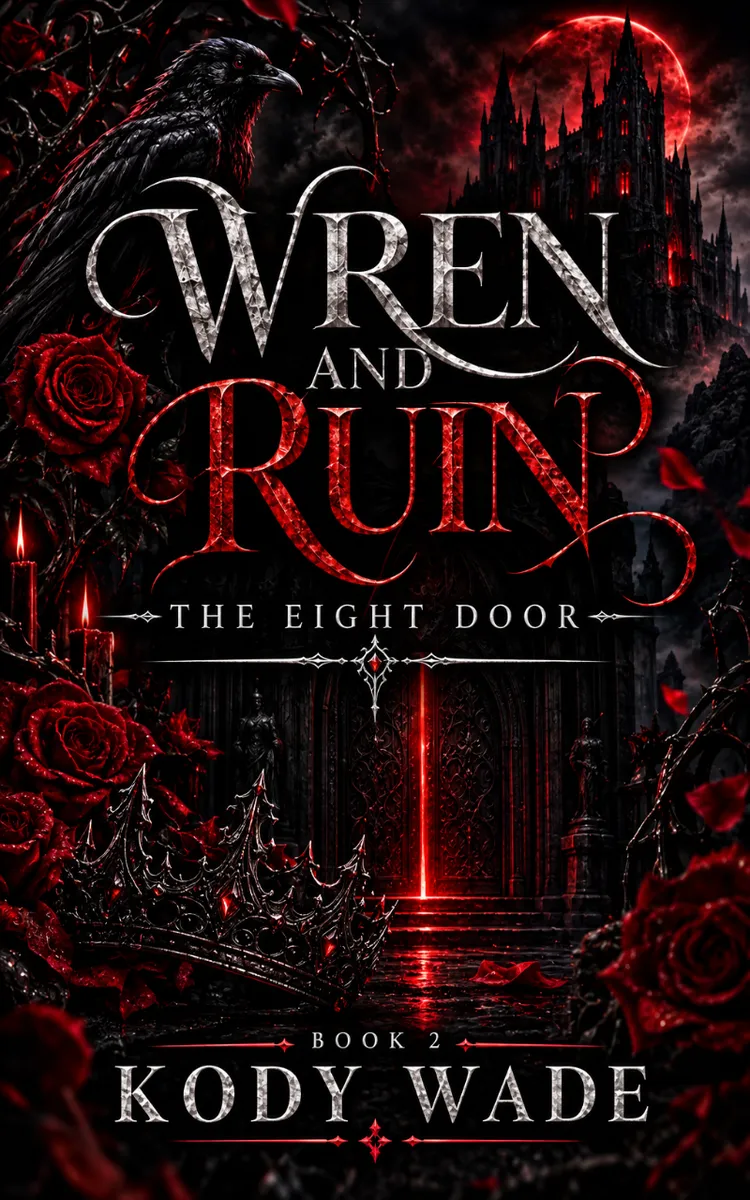
"Wren and Ruin Book 2" is a general book by Kody Wade with 18 chapters and approximately 146,372 words. It covers key insights and practical takeaways on the topic.
This book was created using Inkfluence AI, an AI-powered book generation platform that helps authors write, design, and publish complete books.
Frequently Asked Questions
What is "Wren and Ruin Book 2" about?
"Wren and Ruin Book 2" is a general book by Kody Wade covering key insights and practical takeaways on the topic.
How many chapters are in "Wren and Ruin Book 2"?
The book contains 18 chapters and approximately 146,372 words. Topics covered include Chapter 1- Wren, Chapter 2- Dani, Chapter 3- Wren, Chapter 4- Wren, and more.
Who wrote "Wren and Ruin Book 2"?
This book was written by Kody Wade and created using Inkfluence AI, an AI book generation platform that helps authors write, design, and publish books.
Write your own book with AI
Describe your idea and Inkfluence writes the whole thing. Free to start.
Start writingCreated with Inkfluence AI


