
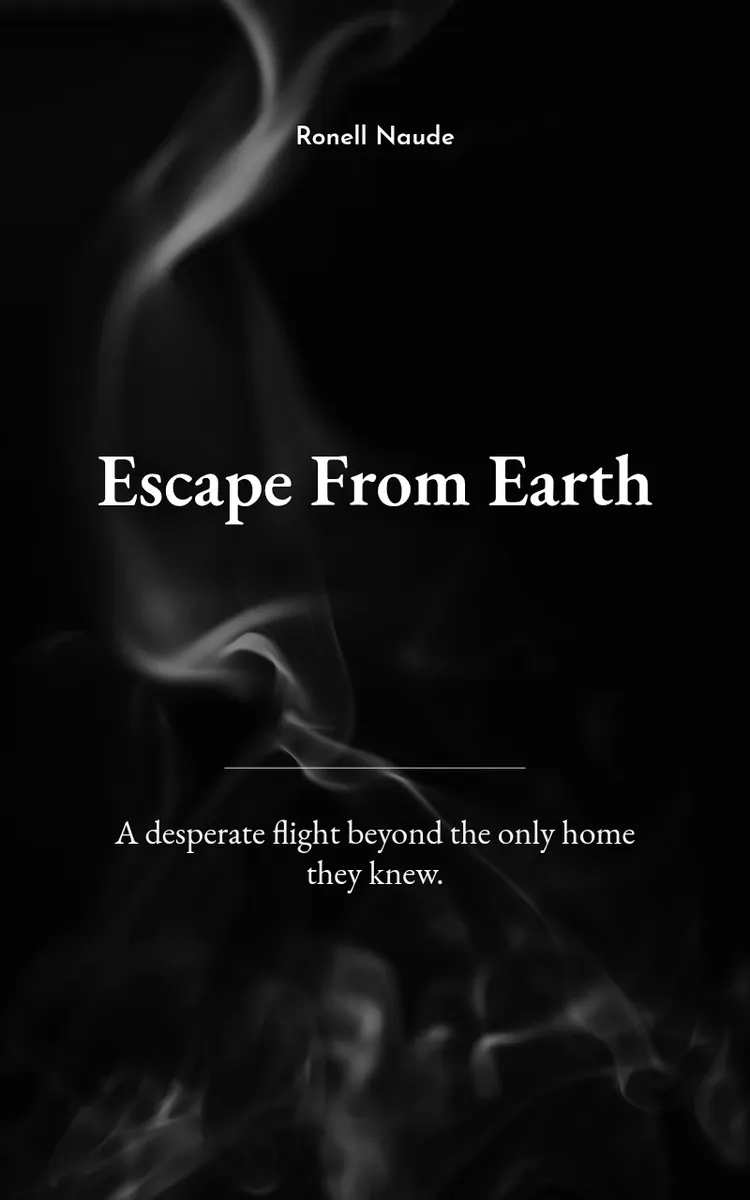
Read the first chapter
The whole of chapter one, free. About 10 min. Turn the pages with the arrows, your keyboard, or a swipe.
Chapter 1
The Sky Turns Red Over Lagos
The traffic lights along Marina Street turned blue all at once.
Amina Okoye saw them flicker through the rain-streaked windshield of her father’s Peugeot, each one glowing with the same cold, impossible color. Lagos had used amber for flood warnings, red for military closures, green for ordinary permission. Blue meant nothing. Not in any code she knew.
Then every phone on the street screamed.
Her father’s screen lit up on the dashboard. The radio crackled, spat static, and found a voice beneath it.
“Emergency evacuation corridor Delta-Seven is now active. Proceed to designated transit gates. Do not stop. Do not - ”
The voice broke into a burst of white noise.
Amina gripped the door handle. “That’s our route.”
Her father stared at the blue lights. Rain crawled down his glasses. “It goes through the island.”
“Then drive.”
He did not move.
Behind them, horns erupted across the road. Danfo buses pressed against one another, their yellow sides shining under the rain. Motorcycles threaded between bumpers. A woman in a red wrapper dragged two children across the median while soldiers lifted a steel barrier from the back of a truck.
Amina checked the time on her phone. 17:42.
The message from her brother had arrived eleven minutes earlier.
Ikeja gate closing. Take Baba. Don’t wait for me.
She had read it until the words blurred. Her brother had been at the airport, working the night shift at the weather-monitoring station. He knew what the warning meant. He had not said it plainly because plain words made things real.
Her father reached for the ignition.
“Wait,” he said.
“For what?”
“For Chidi.”
“He told us not to wait.”
“He is your brother.”
“And you are my father.” Amina pointed through the windshield. “You can barely walk three streets without stopping. If we stay here, they’ll close the corridor and we’ll be trapped between the barricades.”
A deep vibration rolled beneath the car. The steering wheel trembled against her palm.
People on the pavements looked upward.
The clouds above Lagos had split open.
A red line burned across the evening sky, too straight to be lightning and too high to belong to any aircraft. It stretched from the ocean beyond the harbor toward the mainland, brightening until rain turned crimson around it. For one breath, the towers along the waterfront shone like black teeth.
Then the line widened.
A flare bloomed above the clouds, vast and red, and the whole city answered with sirens.
Her father whispered, “Orbital debris.”
Amina looked at him. “That was not debris.”
“No.” His voice had gone thin. “No, it was not.”
The radio returned in fragments.
“ - loss of station control - repeat, all civilian movement toward elevated transit facilities - ”
The rest vanished.
Amina unfastened her belt. “We’re walking.”
Her father’s hand closed around her wrist. His fingers were cold. “The car has supplies.”
“It also has four hundred cars in front of it.”
“We need the documents.”
She pulled free and opened the glove compartment. Their passports lay beneath a folded maintenance permit, sealed in plastic. Her father’s national identity card was tucked behind them, the corners worn smooth from years of use.
Amina shoved the passports into her backpack. “I have them.”
“Not mine.”
She looked at him.
He tapped his chest. “My ID. The transit gates are biometric.”
“You said the permit would get us through.”
“I said it might.”
“You said - ”
“I said what I had to say to get you out of the house.”
Another vibration shook the Peugeot. Somewhere down the road, glass shattered. A blue-white flash rose behind the buildings, followed by a pressure wave that slapped the rain sideways.
Her father flinched.
Amina opened his door. “Out.”
He looked past her at the crowded road, the soldiers, the red sky. His face had become very old.
“If we leave the car,” he said, “we may not find it again.”
“If we stay in it, we may not leave Lagos.”
For a moment, neither moved. Then he reached beneath the seat and pulled out his walking stick.
Amina slung the backpack over her shoulder and took his arm.
They stepped into the rain.
The city had lost its rhythm. Lagos usually moved even when blocked, a restless machine of shouting conductors, music leaking from shops, engines coughing themselves alive. Now the sound came in broken pieces. Sirens rose and died. Loudspeakers barked instructions from rooftops. People ran without knowing where to run.
Amina pulled her father through the gap between two buses. A conductor leaned out of one doorway.
“Island gate!” he shouted. “Island gate, no stopping!”
“Will it move?” Amina called.
The conductor laughed once, without humor. “Nothing moves.”
A soldier slammed his palm against the side of the bus. “Keep the corridor clear!”
“Which corridor?” someone shouted back.
The soldier lifted his rifle.
The crowd surged before he could answer.
Amina tightened her grip on her father. The rain had soaked his shirt to the skin. His walking stick slipped between paving stones, and he stumbled.
“Baba.”
“I’m fine.”
“You’re bleeding.”
He looked down. A thin red line ran from his temple into his beard.
“Glass,” he said. “Keep moving.”
They crossed toward the pedestrian bridge, but a line of armored trucks blocked the stairs. Soldiers had stretched cable across the entrance. Beyond it, the evacuation lane ran toward the transit checkpoint, packed with people carrying suitcases, children, cages, plastic bags, anything they had managed to seize before leaving.
Amina saw the elevated rail above them. Its tracks shuddered. One carriage hung between stations, doors open, passengers pressed against the windows.
A woman on the bridge screamed.
The carriage lights went out.
The train dropped three inches with a metallic groan. People below scattered as bolts and fragments of glass rained onto the road.
Amina dragged her father behind a concrete planter. A shard struck the pavement beside her shoe.
“Stay here,” she said.
He caught her sleeve. “Where are you going?”
“To the checkpoint.”
“Through that?”
She looked at the crowd, the soldiers, the broken train. “There has to be another way.”
A narrow service lane opened beside a shuttered bank. A security gate hung crooked on its hinges. Two men were forcing their way through, carrying a child between them.
Amina pointed. “There.”
Her father shook his head. “That leads to the drainage road.”
“The drainage road leads to the ferry terminal.”
“The ferries were suspended.”
“Then it leads somewhere.”
They pushed through the gate.
The lane was ankle-deep in water. Oil spread across its surface in rainbow skins, and each step sent ripples through wrappers, leaves, and floating phone cases. Amina kept one hand on the wall and the other around her father’s elbow.
Behind them, a loudspeaker boomed.
“By order of the Lagos Emergency Authority, all unauthorized movement is prohibited. Remain within your assigned zone. Await further instruction.”
Her father stopped.
Amina turned. “What?”
He was listening to the announcement.
“Assigned zone,” he said. “They changed the language.”
“So?”
“Evacuation becomes containment when they stop calling it evacuation.”
Amina heard the fear beneath his voice. She had heard it only once before, when her mother’s oxygen machine failed during the blackout.
“Baba, move.”
They reached the end of the lane and found the drainage road under water. A bus had overturned across it, its windows glowing from an interior fire. People climbed over the roof, slipping and falling into the flood.
The ferry terminal stood beyond the wreck, its gates sealed.
Amina swore.
Her father leaned against the wall, breathing hard. “We can go back.”
“No.”
“The checkpoint is across the main road.”
“The main road is blocked.”
“Then we wait.”
Amina looked toward the sky. The red flare had spread into branching veins. New lights appeared beyond it, descending in silence. One struck somewhere inland. The ground rolled under their feet, and a column of dust rose behind the towers.
Her phone vibrated.
Chidi.
She answered at once. “Where are you?”
Static. Then his voice, distant and shredded.
“Amina?”
“I’m at Marina. We’re going to the transit gate.”
“No. Don’t use the main gate.”
“Why?”
“They’re locking the outer corridor.”
“Chidi, listen to me. We have Baba. He can’t - ”
“Find a checkpoint marked - ” His voice vanished.
“Chidi!”
The call ended.
She tried again. No signal.
Her father watched her face. “What did he say?”
“That they’re locking the corridor.”
“I heard that.”
“He said not to use the main gate.”
“Then we do not use it.”
“Do you know another gate?”
“No.”
Amina looked at the burning bus, the sealed ferry terminal, the crowded road beyond. Her father’s passport pressed against her ribs inside the backpack. His ID card was still in the Peugeot.
She could go back.
The thought arrived cleanly, almost calmly. Leave him at the terminal. Run to the car. Return with the card. It would take five minutes if the crowd had not swallowed the street. Ten if the soldiers stopped her. By then the gate might close.
She looked at her father’s bent shoulders.
“No,” she said.
“What?”
“We go to the main gate.”
His expression hardened. “You just heard your brother.”
“I heard him say they’re locking the corridor. That means the gate is still open.”
“Or it means we are walking into a trap.”
“Everywhere is a trap now.”
She climbed onto the overturned bus.
The metal roof buckled beneath her weight. Rain hammered her back. She reached down for her father, and he placed his stick between two roof seams before taking her hand.
“Slowly,” she said.
“I am not the one rushing.”
“Baba.”
“I know.”
They crossed the bus roof while flames licked through the broken windows below. Heat touched Amina’s calves. Smoke scraped her throat. On the far side, she jumped into waist-high water and nearly lost her footing.
Her father landed badly.
Amina caught him under the arms. His walking stick disappeared beneath the flood.
“Leave it,” she said.
“It was your mother’s.”
He reached back.
Amina seized his coat. “Leave it.”
For one second, grief and anger fought across his face. Then he let the stick go.
They waded onward.
At the main road, the crowd had become a river flowing toward the transit checkpoint. Security drones hovered above it, their lenses shining red. Every few seconds, one descended and scanned a face. Those who failed the scan were pulled aside by guards in gray armor.
Amina pushed forward.
“Transit documents!” a guard shouted. “Hold them open!”
She took out the passports. Her father raised both hands, empty.
The checkpoint barrier stood fifty meters ahead. Beyond it, the elevated transit platform gleamed under floodlights. A shuttle waited there, doors open, engines whining. Its destination flashed across the display.
LUNAR ORBITAL TRANSFER.
Amina’s lungs tightened.
They were going to make it.
“Keep your eyes down,” she told her father.
“I have nothing to hide.”
“That has never stopped them.”
The line lurched forward. A man ahead of them was dragged away when his passport failed to scan. He shouted that his wife was on the platform. No one answered.
Amina reached the barrier.
A guard took her passport, pressed it against the scanner, and waved her through. Another guard seized her father’s arm.
“Identity card.”
“My passport,” he said.
“National ID.”
“He has a passport.”
“National ID.”
Amina opened the backpack. “It’s in the car.”
The guard’s visor reflected the red sky. “Then he does not pass.”
“He is seventy-two. He has a medical clearance.”
“National ID.”
“My father is registered in Lagos. Check the system.”
The guard turned to a terminal. “Network is down.”
“Then use the passport.”
“National ID.”
The second guard twisted her father’s arm behind his back.
Amina stepped between them. “Don’t touch him.”
The first guard drew his weapon. “Back away.”
On the platform, the shuttle doors began to close.
Amina could see the passengers inside. Faces turned toward the checkpoint. No one moved to help.
Her father looked at her. “Go.”
She stared at him.
“Go, Amina.”
“No.”
The guard tore the passport from her hand and held it out of reach. “His identification.”
“In the car,” she said. “We came through Marina. The car is - ”
“Confiscated.”
“What?”
“All abandoned vehicles in the corridor are subject to emergency seizure.”
“You cannot take his ID.”
The guard reached into her father’s coat and found the card in the inner pocket.
Amina had forgotten he kept it there.
He looked down as the guard pulled it free.
For a moment, the card rested between them, rainwater shining on its plastic surface. Her father’s photograph stared upward, younger than he was now, eyes steady, mouth unsmiling.
The guard scanned it.
The terminal flashed red.
“Flagged,” he said.
Amina felt the world narrow to the card in his hand. “Flagged for what?”
The guard did not answer. He passed the ID to the second guard, who sealed it inside a transparent evidence sleeve.
“My father is not a criminal.”
“Step aside.”
“He has done nothing.”
The shuttle lifted from the platform with a rising mechanical whine. Its lights washed over the barrier, over her father’s face, over the guard’s sealed hand. Then it vanished into the rain and red glare above the city.
Amina lunged for the gate.
The second guard caught her around the waist and slammed her against the barrier. Metal cut into her ribs. Her father shouted, but another guard forced him to his knees.
“Baba!”
The first guard leaned close. Behind his visor, his eyes were pale and tired.
“Containment begins at eighteen hundred,” he said. “You should have come sooner.”
He turned away with her father’s identification card.
Amina looked at the clock above the checkpoint.
17:59.
The final minute ticked over while the gates began to close.
End of chapter one. 14 more chapters in the full book.
Swipe or use the arrows to turn the page


What's inside: 15 chapters
- 1. The Sky Turns Red Over Lagos
- 2. Stealing a Seat on the Atlas Lift
- 3. The Elevator’s Blackout Map
- 4. Quarantine Gates Seal Behind Her
- 5. Amina’s Choice to Hide the Map
- 6. Mara Velez Orders the Purge
- 7. The Observation Feed Shows Her Father Alive
- 8. Chasing the Broadcast Key Through Ducts
- 9. Amina Breaks Her Own Rules for Him
- 10. The Map’s Loss Reveals the Real Route
- 11. Mara Velez Trades Amina for Time
- 12. Following the Quiet Signal Off-Grid
- 13. Boarding the Dock While Alarms Bloom
- 14. The Cargo Bay Confession on Loop
- 15. Earth Falls Silent as They Jump
About this book
"Escape From Earth" is a fiction book by Ronell Naude with 15 chapters and approximately 30,167 words. A story about escaping Earth and surviving elsewhere.
This book was created using Inkfluence AI, an AI-powered book generation platform that helps authors write, design, and publish complete books. It was made with the AI Novel Writer.
Frequently Asked Questions
What is "Escape From Earth" about?
A story about escaping Earth and surviving elsewhere
How many chapters are in "Escape From Earth"?
The book contains 15 chapters and approximately 30,167 words. Topics covered include The Sky Turns Red Over Lagos, Stealing a Seat on the Atlas Lift, The Elevator’s Blackout Map, Quarantine Gates Seal Behind Her, and more.
Who wrote "Escape From Earth"?
This book was written by Ronell Naude and created using Inkfluence AI, an AI book generation platform that helps authors write, design, and publish books.
How can I create a similar fiction book?
You can create your own fiction book using Inkfluence AI. Describe your idea, choose your style, and the AI writes the full book for you. It's free to start.
Write your own fiction book with AI
Describe your idea and Inkfluence writes the whole thing. Free to start.
Start writingCreated with Inkfluence AI


