
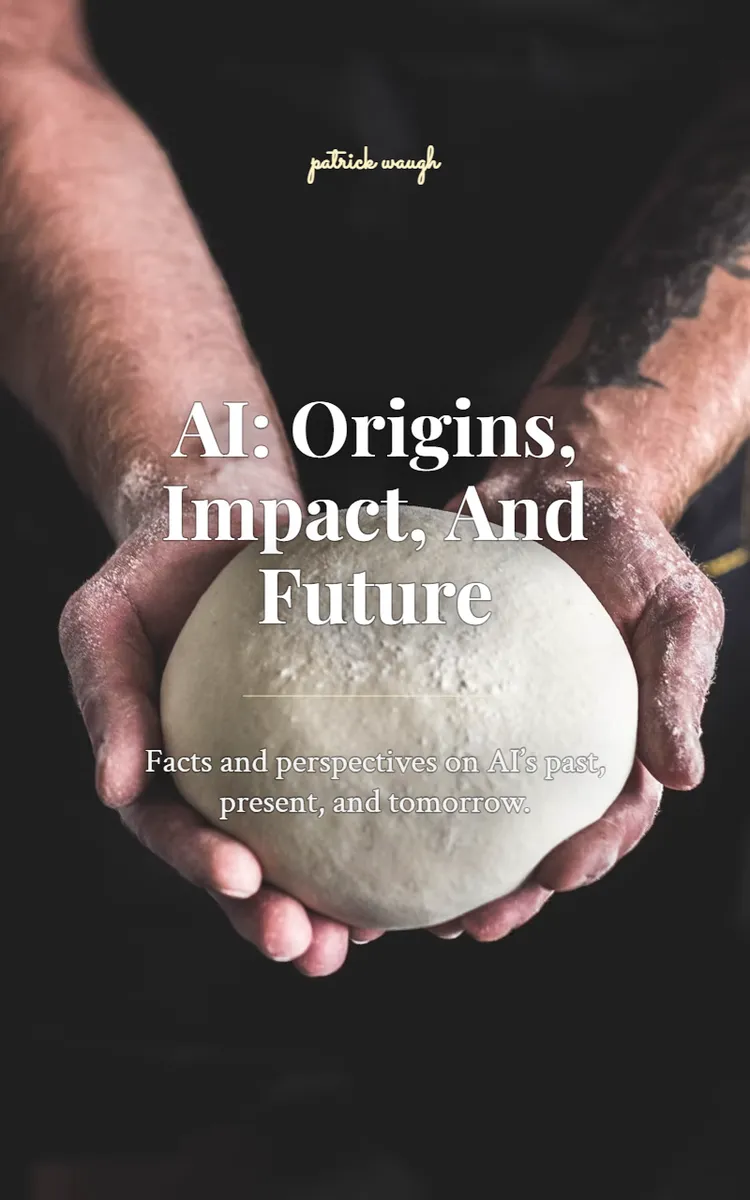
Artificial intelligence history, future, pros/cons, and societal impact
Table of Contents
- 1. AI That Writes, Sees, and Talks
- 2. The “When” Behind AI’s Big Bang
- 3. From Rules to Learning Machines
- 4. The Data That Decides Your Destiny
- 5. The Hidden Costs of “Helpful” AI
- 6. AI in Schools: Tutor or Threat?
- 7. Jobs Rewritten by Automation Pressure
- 8. The Future We Choose, Not Predict
Preview: AI That Writes, Sees, and Talks
A short excerpt from “AI That Writes, Sees, and Talks”. The full book contains 8 chapters and 13,881 words.
The Machine in the Office
A person opens an AI assistant before breakfast and asks it to summarize a long report, explain a confusing paragraph, draft an email, and turn a rough idea into an image. Within seconds, the screen offers polished language, a neat structure, and an answer that sounds as though someone has checked the facts. The strange part is that the machine may be excellent at producing form while remaining uncertain about truth.
That tension defines modern AI. Today’s systems can write, see, hear, translate, classify, calculate, and hold conversations across many subjects. They can help a radiologist examine an image, help a programmer find an error, and help a small business owner describe a product. Yet the same systems can invent sources, misread a photograph, repeat prejudice in their training material, or state an incorrect answer with impressive confidence.
The useful question is not whether AI is “intelligent” in the broad human sense. It is more precise to ask what a particular system can do, under what conditions, and where its performance breaks down. The Capability Map offers a way to make that distinction: separate observable abilities from the stories people tell about them.
When a machine sounds certain, what exactly has it understood?
From Calculating Machines to Generative Systems
The roots of present-day AI reach back farther than chatbots. In the middle of the twentieth century, researchers began asking whether a computer could perform tasks associated with human reasoning. Early programs played games, proved mathematical statements, and manipulated symbols. These systems were limited, but they established an important idea: intelligence might be described as a collection of operations rather than treated as a mysterious human essence.
For decades, progress came in bursts. Some systems relied on rules written by people. A medical program, for example, might follow instructions such as: if a patient has certain symptoms, consider a particular diagnosis. These systems could be useful inside narrow boundaries, but they struggled with the untidy variety of ordinary life. Human knowledge contains exceptions, ambiguities, slang, incomplete information, and context that is rarely written down in a clean rulebook.
A major shift came when researchers increasingly used machine learning, in which systems detect patterns from examples rather than receiving every instruction directly. A computer trained on many labeled images can learn recurring visual features associated with cats, tumors, road signs, or damaged machinery. It is not memorizing a single definition in the way a student might memorize a sentence. It is adjusting a large network of mathematical connections until its predictions become more accurate on examples similar to those it has seen.
The arrival of deep learning made this approach far more capable. Powerful processors, vast collections of digital data, and improved network designs allowed systems to recognize speech, translate languages, identify objects, and generate text. The public noticed this progress most dramatically in the 2020s, when generative systems became available through ordinary websites and phone applications rather than research laboratories.
The word “generate” matters. Earlier software usually retrieved, sorted, or classified information. Generative AI produces a new sequence of words, pixels, sounds, or code based on patterns learned from large collections of examples. A writing system does not pull a finished answer from a hidden encyclopedia. It predicts what should come next, one piece at a time, guided by the prompt and its training.
That process can produce language with remarkable fluency. Fluency, however, is not the same as knowledge. A system can arrange words in a convincing order without possessing a dependable connection to the world those words describe.
The Capability Map: What AI Can Actually Do
The first layer of the Capability Map is language production. AI systems can draft letters, summarize documents, rewrite material for different audiences, translate between languages, create outlines, and answer questions. They are especially useful when the task has a recognizable shape: a meeting summary, a product description, a computer function, or a comparison of two passages.
Their strength often lies in transformation. Give a system a paragraph and ask for a shorter version, a clearer explanation, or a different tone, and it may produce a useful result quickly. It can also make connections across a large amount of text that would take a person much longer to scan.
But language models do not automatically verify the claims they make. They can produce hallucinations, the common term for plausible but false material. A fabricated court case, an invented quotation, or a nonexistent book may appear beside accurate information in the same calm voice....
About this book
"AI: Origins, Impact, And Future" is a curiosity book by patrick waugh with 8 chapters and approximately 13,881 words. Artificial intelligence history, future, pros/cons, and societal impact.
This book was created using Inkfluence AI, an AI-powered book generation platform that helps authors write, design, and publish complete books.
Frequently Asked Questions
What is "AI: Origins, Impact, And Future" about?
Artificial intelligence history, future, pros/cons, and societal impact
How many chapters are in "AI: Origins, Impact, And Future"?
The book contains 8 chapters and approximately 13,881 words. Topics covered include AI That Writes, Sees, and Talks, The “When” Behind AI’s Big Bang, From Rules to Learning Machines, The Data That Decides Your Destiny, and more.
Who wrote "AI: Origins, Impact, And Future"?
This book was written by patrick waugh and created using Inkfluence AI, an AI book generation platform that helps authors write, design, and publish books.
Write your own curiosity book with AI
Describe your idea and Inkfluence writes the whole thing. Free to start.
Start writingCreated with Inkfluence AI


