
Read the first chapter
The whole of chapter one, free. About 9 min. Turn the pages with the arrows, your keyboard, or a swipe.
Chapter 1
Be the Entrepreneur Before Income
Chasing money feels like driving with your eyes on the fuel gauge - eventually you’ll run out of road.
I remember the exact moment I realised I was doing it. I’d be flicking between “How do I make more?” and “What if I’m missing the big break?” while my side projects sat there like a dog waiting to be taken for a walk. The weird part? I wasn’t lazy. I was busy. I just kept treating income like it was something that would magically appear if I stared hard enough at my bank balance. Then Tahlia, 22, uni student, messaged me after a rough week of part-time work. She said she felt like she was always one shift away from being okay… and one bill away from panicking. She wasn’t asking for a new hustle idea. She was asking how to stop feeling like money was the boss.
That’s when I started teaching my own rule: successful side hustles don’t start with income goals - they start with identity. Not “positive thinking” identity. Real, practical entrepreneurial identity. The kind that notices problems, speaks to people, tests ideas, and keeps going even when the pay isn’t instant. I call it The Identity-to-Income Loop - and it begins the moment you stop treating money like the only scoreboard you’re allowed to look at.
• You’ll recognise a repeating pattern where you “reach for income” instead of “reach for opportunity.” - You’ll shift the question from “How do I get paid?” to “What kind of person earns consistently?” - You’ll learn the cause-and-effect behind that shift (it’s not fluffy - it’s behaviour). - You’ll leave with a challenge you can start today, even if your weekends are already booked.
The Fuel-Gauge Pattern: Reaching for Money Instead of Becoming the Sort of Person Opportunities Find
Here’s the pattern I see again and again in young Aussies juggling study and work. It starts small: you check your balance when you’re stressed, or you open an app that tells you your spending is “tracking over budget,” and your brain goes into problem-solving mode. But the problem it solves isn’t “How do I help someone?” - it’s “How do I stop feeling broke?” So you chase the fastest-looking option: the side hustle that promises quick cash, the gig that “just needs effort,” the thing you can start tomorrow without learning anything. You might even tell yourself you’re being strategic. But inside, it’s fear-driven. You’re trying to outrun the feeling, not build something that lasts.
With Tahlia, it looked like this: after a bad shift at her part-time job, she’d lose the plot for the rest of the evening. She’d scroll through hustle posts, bookmark a few ideas, and then do the classic “research binge” where you learn just enough to feel productive - without actually talking to anyone or making anything real. The next day, she’d feel guilty and try to compensate by working harder at her existing job, or forcing herself to “push through” with zero energy. Then the cycle repeats: stress → search → plan → no action → more stress. The money chase keeps you busy, but it doesn’t build traction because your identity stays stuck in receiver mode (“I need to be saved”) instead of builder mode (“I can create value and opportunities over time”). Do you recognise that fuel-gauge loop in yourself?
The Question That Changes Everything: What If Your Real Hustle Is the Person You’re Training?
Most people ask money questions when they’re stuck. What they rarely ask is this: What if the side hustle isn’t the thing that makes you money - your identity is the machine that makes money show up? Not in a magical way. In a behavioural way. Because who you are becoming decides what you notice, what you’re willing to try, and how you respond when it’s awkward.
Before, Tahlia treated entrepreneurship like a costume she could put on when she felt motivated. When she didn’t feel motivated, she’d blame herself and slide back into passively waiting for a better moment - usually when payday landed. After we flipped the question, she started acting like an entrepreneur even when she wasn’t “ready.” She didn’t suddenly become a sales wizard. She just stopped asking, “How do I earn quicker?” and started asking, “What would an opportunity-spotter do tonight?” That small change mattered because it pulled her attention away from her bank account and back toward people - what they need, what they’re annoyed about, what’s missing in her own world.
Here’s the before-and-after in a real, concrete way. Before, she’d see a university group chat blow up with questions about printing, deadlines, and “where do I get this done fast?” and she’d think, Yeah, someone should do that. After, she decided to test whether she could help: she drafted a simple message offering a small service (helping coordinate quick printing/collection) and asked one direct question - who would actually use it. She didn’t wait for perfect branding. She didn’t need a fancy logo. She needed proof that her idea could solve a real problem for real people. That’s identity doing its job: it makes you take the next uncomfortable step instead of spiralling into “maybe later.”
So the shift isn’t “think positive.” It’s “act like the kind of person who creates opportunities,” and let income follow the pattern of value. Because money doesn’t just reward effort - it rewards the person who keeps showing up in the right direction.
The Identity-to-Income Loop: How Money-Chasing Trains the Wrong Behaviour (and the Better Chain That Follows)
When you chase money directly, you usually train the wrong muscles. Here’s the cause-and-effect chain I want you to notice in yourself:
1. When you check your balance and feel that tight, panicky jolt 2. You feel urgency and pressure, and your brain starts looking for the “fastest cash” option 3. So you research ideas instead of talking to customers, or you start without testing anything 4. Which leads to temporary excitement… then disappointment… then more stress (because nothing is actually proven yet)
That chain is sneaky. It feels productive, but it keeps you stuck in “potential” instead of “evidence.” Your identity becomes “someone who tries things when they feel safe,” not “someone who builds income through real-world feedback.”
Now here’s the alternative chain - the Identity-to-Income Loop:
1. When you feel the money pressure, you name what’s happening instead of pretending it’s fine 2. You feel a calmer kind of focus because you’re shifting from “get money” to “create opportunity” 3. So you take one small action that proves value - like asking one person a direct question, posting one offer, or testing one service for a week 4. Which leads to small wins and clearer signals, and those signals build momentum toward income
And notice what’s different: the alternative chain doesn’t promise a payday tomorrow. It builds credibility with yourself. It trains you to respond to stress with action that creates evidence. That’s what attracts opportunities over time - because opportunities love people who behave like builders, not people who just hunt for results.
Stop training “panic behaviour.” Start training “opportunity behaviour.”
Rate Yourself: Are You Becoming the Entrepreneur, or Just Wishing You Were?
Let’s do a quick reality check. Rate yourself from 1 to 10 (or answer yes/no). There’s no judgement here - this is just data.
1. When you feel stressed about money, how often do you take action that creates evidence (talk to someone, test a service, post an offer) within 24 hours? - If you’re low: you’re likely using money stress to trigger research or scrolling, which keeps your identity in “receiver mode.” If you’re higher: you’re already practising entrepreneurial identity under pressure.
2. How often do you ask “What problem can I solve for someone this week?” instead of “What can I earn quickly?” - If you’re low: you’re training a goal-chasing identity. It’s fragile - because money is unpredictable. If you’re higher: you’re training value-first behaviour, which is more stable.
3. When your first attempt gets a lukewarm response, do you usually quit, or do you adjust the next step? - If you quit quickly: your identity is tied to approval. If you adjust: your identity is tied to learning, and that’s the real entrepreneur trait.
4. Do you keep a simple list of “opportunities I noticed” (even tiny ones) somewhere you’ll actually see? - If you don’t: your brain is probably scanning for money, not scanning for needs. If you do: you’re building an opportunity radar, which compounds.
Quick interpretation guide: - Mostly 1-3: You’re likely stuck in the money-chase loop. Your next wins will come from identity actions, not bigger ideas. - Mostly 4-7: You’re in the middle. You can feel the difference when you act - so you just need consistency. - Mostly 8-10: You’re already doing a lot right. Your next step is to tighten how you test so you move faster without burning out.
The 3-Step Identity Upgrade You Can Start Today: Build Evidence, Not Excuses
This is your “do it now” challenge. No branding. No perfect plan. Just identity-building actions that create evidence.
action title: The 10-Minute Opportunity Audit + One Direct Ask
1. Set a 10-minute timer tonight and write down 5 annoying problems you’ve seen this week (Easy, 10 minutes) - Examples for uni/work life: people needing quick printing, tutors being hard to find, missing study resources, messy schedules, confusing admin forms. - Expected difficulty: Easy
2. Pick the most “helpable” problem and write one direct message asking if anyone would actually pay or use help (Medium, 15-20 minutes) - Use plain language. You’re not pitching like a robot - you’re asking a question. - Expected difficulty: Medium
3. Send it to 3 people within 24 hours (Medium/Hard depending on your nerves, 5 minutes each) - Friends, classmates, workmates, group chats - anyone connected to the problem. - Expected difficulty: Hard (because it’s awkward, not because it’s complicated)
You'll know it's working when... - You get at least one “Yes, that would help” or one useful “Actually, it’s not like that…” - You feel calmer after you take action (not just “busy”) - You add more problems to your list next week because your brain starts spotting opportunities automatically
The goal isn’t to make money from this challenge. The goal is to train your brain that you’re the kind of person who creates evidence.
The Moment You Realise You’re Not Late: What You Now Know
Money chase is a mindset habit, and habits can be rewired. The Identity-to-Income Loop isn’t about pretending you’re confident - it’s about behaving like an entrepreneur when you’re still figuring things out. When you stop treating income like the finish line and start treating identity like the engine, your actions change. Your actions create evidence. Evidence attracts opportunities. And opportunities - annoyingly, beautifully - show up more often when you’re already in motion.
Here’s what to carry forward:
• When stress hits, your brain will try to “solve the feeling” with research or scrolling - catch that and reroute to evidence. - Entrepreneurial identity is built through small, real-world tests, not big plans. - Asking better questions (“What problem can I solve?”) changes what you notice and what you’re brave enough to do. - You don’t need to be ready. You need to be consistent enough to learn.
Next chapter, we’ll take that new identity and put it to work: how to spot opportunities without turning your life into a full-time hustle machine - because you can be entrepreneurial and still live a decent life. What’s one money-stress moment you want to handle differently from tomorrow?
End of chapter one. 29 more chapters in the full book.
Swipe or use the arrows to turn the page


What's inside: 30 chapters
- 1. Be the Entrepreneur Before Income
- 2. Kill the ‘Lucky’ Myth Fast
- 3. Spot Opportunities Like a Hawk
- 4. Choose Problems People Pay For
- 5. Pick a Side Hustle That Fits
- 6. Use Skills, Not Just Passions
- 7. Turn Customer Pain Into Offers
- 8. Validate With Cheap Experiments
- 9. Write a One-Page Side Hustle Plan
- 10. Manage Time Without Losing Your Mind
- 11. Set Goals That Actually Move You
- 12. Budget for Your Side Hustle Like a Pro
- 13. Market Without Feeling Cringe
- 14. Build a Brand People Remember
- 15. Win With Social Media Consistency
- 16. Sell Online With a Simple Funnel
- 17. Use AI Tools to Work Faster
- 18. Freelance Your First Paying Clients
- 19. Price Your Work Without Undervaluing
- 20. Create Digital Products People Buy
- 21. Design Print-on-Demand That Sells
- 22. Earn With Affiliate Marketing Ethically
- 23. Grow on YouTube With One Clear Topic
- 24. Write a Book That Builds Authority
- 25. Launch an Online Course Without Fancy Tech
- 26. Track Money and Taxes Like an Adult
- 27. Avoid Scams and Fake Gurus
- 28. Scale What Works Without Breaking It
- 29. Build Multiple Income Streams Over Time
- 30. Automate, Protect Time, and Create Wealth
About this book
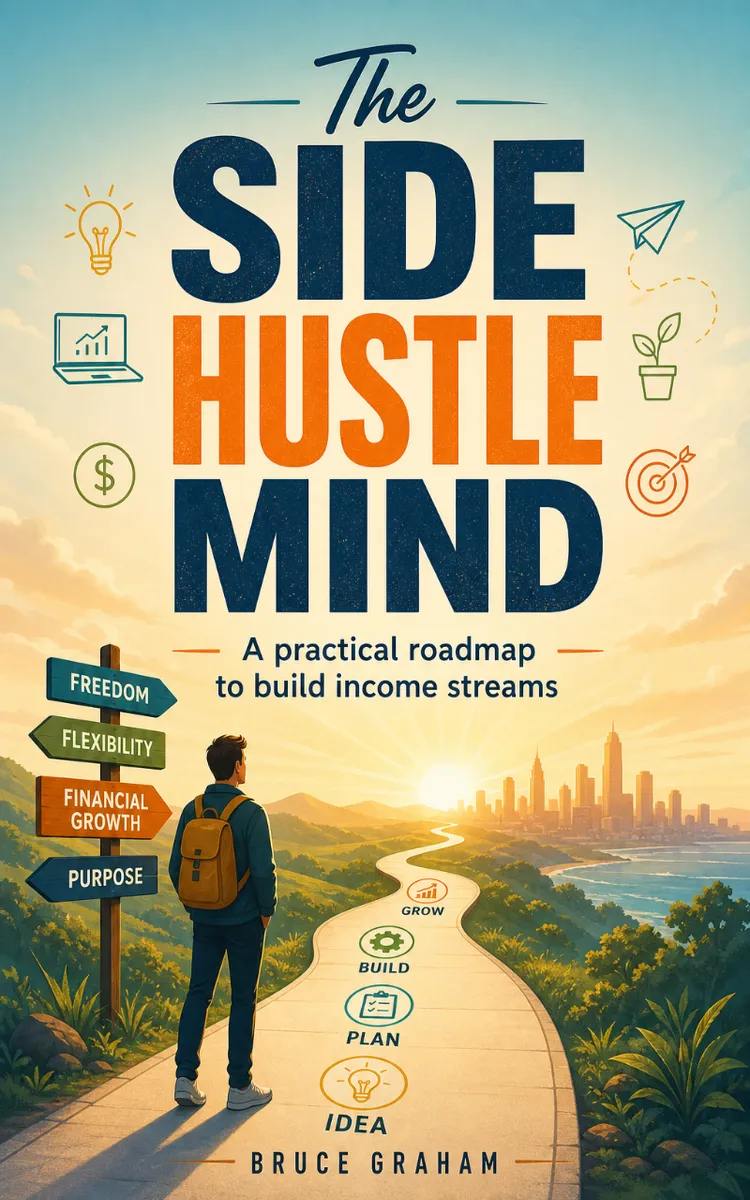
"The Side Hustle Mind" is a self-help book by Bruce Graham with 30 chapters and approximately 47,157 words. Entrepreneurial mindset and practical guidance for side hustles.
This book was created using Inkfluence AI, an AI-powered book generation platform that helps authors write, design, and publish complete books. It was made with the AI Self-Help Book Writer.
Frequently Asked Questions
What is "The Side Hustle Mind" about?
Entrepreneurial mindset and practical guidance for side hustles
How many chapters are in "The Side Hustle Mind"?
The book contains 30 chapters and approximately 47,157 words. Topics covered include Be the Entrepreneur Before Income, Kill the ‘Lucky’ Myth Fast, Spot Opportunities Like a Hawk, Choose Problems People Pay For, and more.
Who wrote "The Side Hustle Mind"?
This book was written by Bruce Graham and created using Inkfluence AI, an AI book generation platform that helps authors write, design, and publish books.
How can I create a similar self-help book?
You can create your own self-help book using Inkfluence AI. Describe your idea, choose your style, and the AI writes the full book for you. It's free to start.
Write your own self-help book with AI
Describe your idea and Inkfluence writes the whole thing. Free to start.
Start writingCreated with Inkfluence AI


