
Read the first chapter
The whole of chapter one, free. About 7 min. Turn the pages with the arrows, your keyboard, or a swipe.
Chapter 1
Days 1-6: Clear Friction Fast
The Open Tabs You Carry All Day
> “What’s making this harder than it needs to be?”
You wake up already behind. Not because you chose a busy day, but because your brain is holding yesterday’s dishes, an unanswered message, a bill you meant to pay, three browser tabs, a half-finished work task, and the appointment you vaguely remember booking.
You walk past the laundry basket and feel a small jolt of guilt. You open your phone to check the time and notice a notification. Ten minutes later, you’re reading a message thread while the original question - “What do I need to do first?” - has vanished. By lunchtime, the room looks the same, your screen looks worse, and your mind feels like it has twelve sticky notes stuck to it.
Then comes the familiar conclusion: I’m failing at basic life stuff.
But the problem isn’t that you don’t care. The problem is that your brain is trying to remember, sort, decide, and begin while surrounded by visible reminders and unfinished signals. Every object, tab, and notification quietly asks for attention. None of them tells you which one matters most. Does this pattern feel familiar?
The Question That Changes the Starting Line
What if the first thing to fix isn’t your discipline, but the number of open loops demanding attention?
An open loop is anything unfinished that your brain keeps trying to remember. “Email the landlord.” “Find the insurance card.” “Put away the clean towels.” “Reply to that person.” Even when you aren’t actively working on these tasks, your mind keeps checking them. That background checking creates friction before you’ve done anything.
The first move is not to judge the mess or build a perfect system. It’s to create a non-judgment baseline. You’re taking a snapshot of what’s currently pulling at you, without turning the snapshot into a character assessment. A crowded desk means your desk is crowded. It doesn’t mean you’re careless. Forty unread messages mean forty unread messages. They don’t mean you’re doomed to stay disorganized.
Try this before changing anything: set a timer for five minutes and write down every open loop that comes to mind. Don’t organize the list. Don’t decide whether each item is important. Just get it out of your head. Before the brain-dump, you may keep circling “call the dentist” while searching for a missing document. Afterward, both tasks are visible in one place. The situation hasn’t magically disappeared, but your brain no longer has to act as the storage unit.
That is the beginning of the Friction-to-Freedom Baseline Loop: notice what is creating drag, capture it outside your head, remove one source of noise, and check how the next action feels. You’re not chasing a spotless life. You’re lowering the number of things that interrupt your start.
How Noise Turns Into Avoidance
1. When you see a crowded desk, a full Downloads folder, and several phone notifications, your brain receives multiple unfinished signals at once. 2. You feel pressure, confusion, and a vague sense that everything is urgent. 3. So you avoid choosing, switch tasks, or reach for something easier, such as scrolling or checking email. 4. Which leads to more unfinished tasks, more visible clutter, and stronger self-criticism.
Now try the alternative chain:
1. When you notice the noise, you name it without judgment and capture the open loops in one brain-dump. 2. You feel a little less responsible for remembering everything at once. 3. So you choose one small clearing action, such as moving loose desktop icons into an Archive Folder or closing all browser tabs except active work tabs. 4. Which leads to fewer interruptions, a clearer starting point, and more evidence that your environment can support your brain.
The clearing action matters because attention follows cues. A pile beside your laptop can keep asking for a decision. A phone notification can pull you into a different task before you’ve finished the first one. Removing the cue doesn’t solve every problem, but it stops the cue from repeatedly reopening the problem.
You don’t need to become a different person; you need fewer things shouting at you at once.
Your Honest Baseline Check
Use these questions to rate the current situation, not your worth. Choose the first answer that feels true.
1. On a scale of 1-10, how crowded does your mind feel with unfinished tasks right now? A lower number may mean you already have a reliable capture place. A higher number suggests your brain is carrying too many reminders without an external home.
2. On a scale of 1-10, how much does visible clutter interrupt your ability to start? A low number means visual noise may not be your main friction point. A high number means one clear surface could create noticeable relief.
3. Yes or no: Do you have one place where you capture every open loop, instead of scattering reminders across notes, texts, and memory? “Yes” shows you have a starting container, even if it needs cleanup. “No” explains why tasks keep resurfacing in unpredictable places.
4. On a scale of 1-10, how often do notifications or open tabs pull you away from what you meant to do? A low number suggests your digital environment is mostly quiet. A high number points to a useful first target: reduce incoming signals before demanding more focus from yourself.
For a quick interpretation, look for your highest number or your “no.” That is your baseline friction point. You don’t need to work on all four areas today. Start where the drag is loudest. A brain-dump helps when memory is overloaded. A clear surface helps when visual cues keep interrupting. Digital decluttering helps when your devices keep reopening unfinished business.
The Five-Minute Friction Sweep
Action: Empty the noise before you organize it.
1. Brain-dump the open loops - 5 minutes, Medium difficulty. Set a five-minute timer. Use paper or one digital note. Write every unfinished task, worry, reminder, and “I need to remember…” thought. Keep moving. If you think of “buy printer ink” while writing “send invoice,” write it down. Don’t sort, rank, or fix the list yet.
2. Clear one visual and one digital hotspot - 10 minutes, Easy to Medium difficulty. Choose one visible area, such as the space directly in front of your keyboard. Move anything that doesn’t belong there. Then choose one digital hotspot: drag loose desktop icons into an Archive Folder, close all browser tabs except active work tabs, or turn off non-human notifications on your smartphone. Stop when the timer ends. The goal is reduced noise, not a dramatic makeover.
3. Record the after-effect - 2 minutes, Easy difficulty. Look at the cleared area and your quieter screen. Rate your mental pressure again from 1-10. Write one sentence: “Starting feels easier because…” or “I still feel stuck because…” This check matters because it teaches you which changes actually help your brain, rather than which changes look impressive.
You’ll know it’s working when:
• [ ] You can name your open loops without mentally scanning the whole house or phone. - [ ] Your eyes land on one usable surface instead of several competing piles. - [ ] You can begin one task without first checking a notification, unrelated tab, or random reminder.
If the challenge feels harder than expected, shrink it. Brain-dump for two minutes. Clear only the keyboard area. Close three tabs instead of all of them. A smaller completed reset gives you better information than a perfect plan you avoid.
Start Lighter, Not Perfect
A clear baseline is not proof that you’ve finally got your life together. It’s a starting point you can trust.
The Friction-to-Freedom Baseline Loop works because it replaces vague self-blame with useful information. You notice the drag. You capture what your brain is carrying. You remove one source of noise. Then you check what changed. That loop gives you something more practical than motivation: feedback.
• Open loops create pressure even when you aren’t actively working on them. - A non-judgment brain-dump moves remembering out of your head and onto a visible list. - One cleared surface can reduce visual decisions and make starting less demanding. - Digital noise deserves the same attention as physical clutter: tabs, icons, and notifications all compete for focus.
Don’t wait until your desk, phone, or mind feels completely out of control. Use the next small pocket of time to remove one signal that keeps pulling you away. Once the outside world is quieter, what will you notice about the task you’ve been trying to avoid?
End of chapter one. 4 more chapters in the full book.
Swipe or use the arrows to turn the page
What's inside: 5 chapters
- 1. Days 1-6: Clear Friction Fast
- 2. Days 7-13: Start and Stay Focused
- 3. Days 14-19: One List, Real Priorities
- 4. Days 20-25: Close Loops and Reset Weekly
- 5. Days 26-30: Sustain With Toolkit and Blueprint
About this book
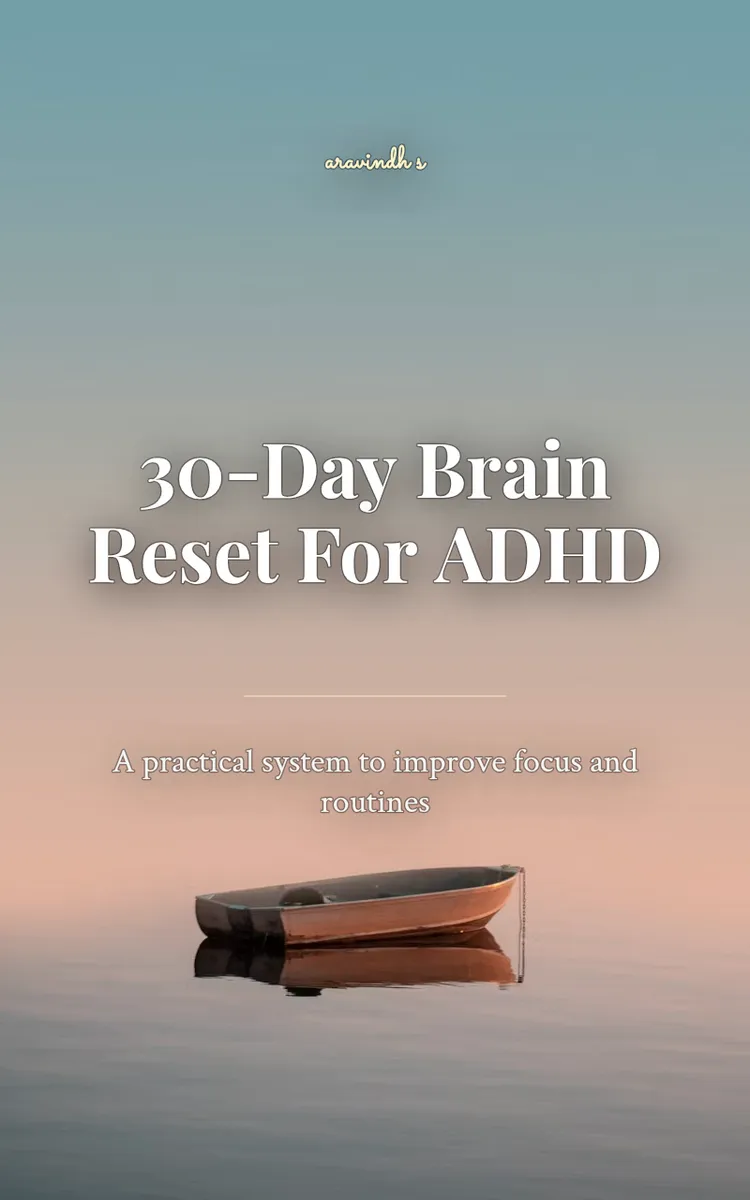
"30-Day Brain Reset For ADHD" is a self-help book by Pavalar with 5 chapters and approximately 7,220 words. 30-day workbook system for adult ADHD focus, organization, habits.
This book was created using Inkfluence AI, an AI-powered book generation platform that helps authors write, design, and publish complete books. It was made with the AI Self-Help Book Writer.
Frequently Asked Questions
What is "30-Day Brain Reset For ADHD" about?
30-day workbook system for adult ADHD focus, organization, habits
How many chapters are in "30-Day Brain Reset For ADHD"?
The book contains 5 chapters and approximately 7,220 words. Topics covered include Days 1-6: Clear Friction Fast, Days 7-13: Start and Stay Focused, Days 14-19: One List, Real Priorities, Days 20-25: Close Loops and Reset Weekly, and more.
Who wrote "30-Day Brain Reset For ADHD"?
This book was written by Pavalar and created using Inkfluence AI, an AI book generation platform that helps authors write, design, and publish books.
How can I create a similar self-help book?
You can create your own self-help book using Inkfluence AI. Describe your idea, choose your style, and the AI writes the full book for you. It's free to start.
Write your own self-help book with AI
Describe your idea and Inkfluence writes the whole thing. Free to start.
Start writingCreated with Inkfluence AI


