
Read the first chapter
The whole of chapter one, free. About 7 min. Turn the pages with the arrows, your keyboard, or a swipe.
Chapter 1
Quiet the Noise to Hear Yourself
When Everyone Else’s Voice Gets in the Room
At 8:17 on a Tuesday morning, you’re standing in the kitchen with your phone in one hand and a half-made coffee in the other. You’ve got a business idea, a career decision, or a quiet wish you haven’t said out loud yet. Then the messages start.
Your partner thinks it’s risky. Your family thinks it’s impractical. Someone online says people who do that are selfish, unrealistic, or already ten steps ahead of you. Within minutes, your own thought is buried under everybody else’s reaction. You’re no longer asking, “What do I want?” You’re asking, “What will they think?”
That’s how noise works. It doesn’t always shout. Sometimes it sounds like sensible advice, concern, ambition, or responsibility. But if you can’t tell the difference between what belongs to you and what belongs to the outside world, your real desires never get a fair hearing.
Are you making your life from the inside out - or letting the outside world make it for you?
The Shift From Borrowed Wants to Real Desires
Old Belief: If a desire feels uncertain, inconvenient, or unpopular, it probably isn’t the right choice.
New Reality: Uncertainty often means you’re hearing your own desire without the usual approval attached to it.
A desire can be internal, while the pressure around it is external. The desire might be, “I want to work fewer evenings.” The external noise might say, “Serious business owners don’t leave early.” The desire might be, “I want to move closer to my sister.” The noise might say, “That sounds like giving up.” Both voices can feel convincing, but they don’t come from the same place.
This distinction matters because external pressure usually speaks in consequences. What will people think? What if I fail? What if I disappoint someone? What if I lose status, money, or certainty? Internal truth tends to sound quieter and more personal. I’m tired of this. I miss that. I want room to breathe. I keep coming back to this for a reason.
Take a gym owner who tells himself he wants to open a second location. On paper, it sounds like the obvious next move. More members, more revenue, more proof that he’s succeeding. But when he gets honest, he realizes he doesn’t want another location. He wants the freedom to coach more and manage less. The second gym is an external symbol of success. The desire for a simpler schedule is internal. Confusing the two can keep him building a life he doesn’t actually want.
The Noise Filter Map helps you separate the voices. One side holds what is happening inside you: your energy, values, curiosity, limits, and genuine wants. The other side holds what comes from outside: opinions, expectations, comparison, deadlines, money pressure, and imagined judgment. You don’t have to reject the outside world. You just need to stop treating it as the owner of your decisions.
Learn Which Voice Is Yours
Your mind collects outside messages quickly. A parent’s warning can become your inner critic. A customer’s complaint can become your entire view of your work. A polished stranger’s social media post can turn your ordinary Tuesday into evidence that you’re behind.
The goal isn’t to empty your mind. That’s not realistic, and frankly, it sounds exhausting. The goal is to label the noise accurately. “This is my fear.” “This is my friend’s preference.” “This is a financial fact.” “This is an old rule I inherited.” Once you name a voice, it loses some of its power. You can listen without obeying.
Use these signs to spot when an external pattern is running your life:
1. You change your answer depending on who’s in front of you. Alone, you want one thing. With family, clients, or friends, you suddenly want something safer or more impressive.
2. You explain your decision before you’ve made it. You’re already preparing a courtroom defense: “I know it sounds strange, but…” That often means you’re seeking permission rather than checking your own truth.
3. Your goal looks good from the outside but feels heavy in private. The promotion, expansion, house, or relationship earns approval, yet you feel dread when you picture living it.
4. You can describe what you don’t want more clearly than what you do. That’s often a sign that other people’s expectations have filled the space where your own preferences should be.
The Noise Filter Map: Name the Source Before You Follow the Thought
Write the thought down, then mark it Internal, External, or Mixed. “I want to leave my job” may be internal. “I must leave before people think I’m failing” is external. “I want more freedom, but I need a realistic income plan” is mixed. That small act of sorting turns a blur into something you can work with.
Questions That Strip Away the Static
1. If nobody could praise, criticize, or even know about this choice, what would I want? Don’t rush to a dramatic answer. It might be as simple as taking Fridays off, learning a trade, or spending more time at home. Private desires are often more honest than public goals.
2. Which part of this decision is a fact, and which part is a prediction about someone’s reaction? “I can’t afford the move this month” is a fact you can measure. “My family will think I’m irresponsible” is a prediction. Treating predictions like facts gives them too much authority.
3. When did I first start wanting this - and whose approval became attached to it later? Maybe you loved designing kitchens before turning it into a business plan. Maybe you wanted a quieter life before someone called it unambitious. Look for the desire before it picked up baggage.
4. What am I afraid this choice will say about me? You may not fear the decision itself. You may fear being seen as selfish, ordinary, difficult, or unsuccessful. Naming that fear helps you stop disguising it as practical advice.
5. What would I choose if I trusted myself to handle the next step, without needing the whole path mapped out? You don’t need perfect certainty to identify a real desire. You need enough honesty to admit the direction, then enough courage to take one grounded step.
Answer these with pen and paper, not just in your head. Your mind is excellent at editing uncomfortable truths before you finish the sentence. Give yourself ten quiet minutes. No music, no scrolling, no asking anyone else what they think. Let the first answer be messy. Messy is still information.
The Seven-Day Noise Filter Map Challenge
For the next 7 days, sort one decision or desire each day into Internal, External, or Mixed.
• Choose one real thought each morning, such as “I should take that job,” “I need to post more,” or “I want to move.” - Write the thought at the top of a page. - Under it, list what you feel, what you know, and what you fear others may think. - Label each line Internal, External, or Mixed. - At night, circle one internal truth you noticed and take one small action that respects it. - Keep the action modest: protect an hour of quiet, ask for a quote, decline one unnecessary commitment, or research the course you keep mentioning.
Expected difficulty: Medium
This may feel uncomfortable because the map can expose how often you’ve called pressure a preference. That isn’t a reason to quit. It’s the point. You’re not trying to make a life-changing decision in seven days. You’re learning to hear the source of your thoughts before you hand them the steering wheel.
You’ll know it’s working when...
• You catch yourself saying, “That’s their opinion, not my instruction.” - You can separate a financial limit from a fear of judgment. - You feel less urgency to explain your choices. - One desire becomes clearer after the outside voices are written down. - You take one small action because it feels right, not because it looks impressive.
Let Your Own Voice Set the Direction
Your real desires become visible when you stop confusing outside pressure with inner truth.
• You learned to separate internal wants from external opinions, expectations, and predictions. - You saw why uncertainty doesn’t automatically mean a desire is wrong. - You used the Noise Filter Map to label thoughts before obeying them. - You turned self-awareness into a seven-day practice with real, manageable actions.
The point isn’t to ignore every opinion or pretend practical concerns don’t matter. The point is to put them in their proper place. Advice can inform you. Facts can guide you. Other people can care about you. None of them gets to decide what makes your life feel like yours.
Once you can hear your own voice, the next question becomes sharper: what does that voice actually value? That’s where confidence starts - not with having every answer, but with finally knowing which answers came from you.
End of chapter one. 7 more chapters and about 12,293 words in the full book.
Swipe or use the arrows to turn the page
What's inside: 8 chapters
- 1. Quiet the Noise to Hear Yourself
- 2. Unmask Your People-Pleasing Beliefs
- 3. Choose Your Non-Negotiables in Life
- 4. Define What You Want Without the How
- 5. Kick Others’ Opinions to the Curb
- 6. Build Habits That Match Your Happiness
- 7. Handle Anxiety With the Guts Practice
- 8. Live Your Purpose Through Weekly Alignment
About this book
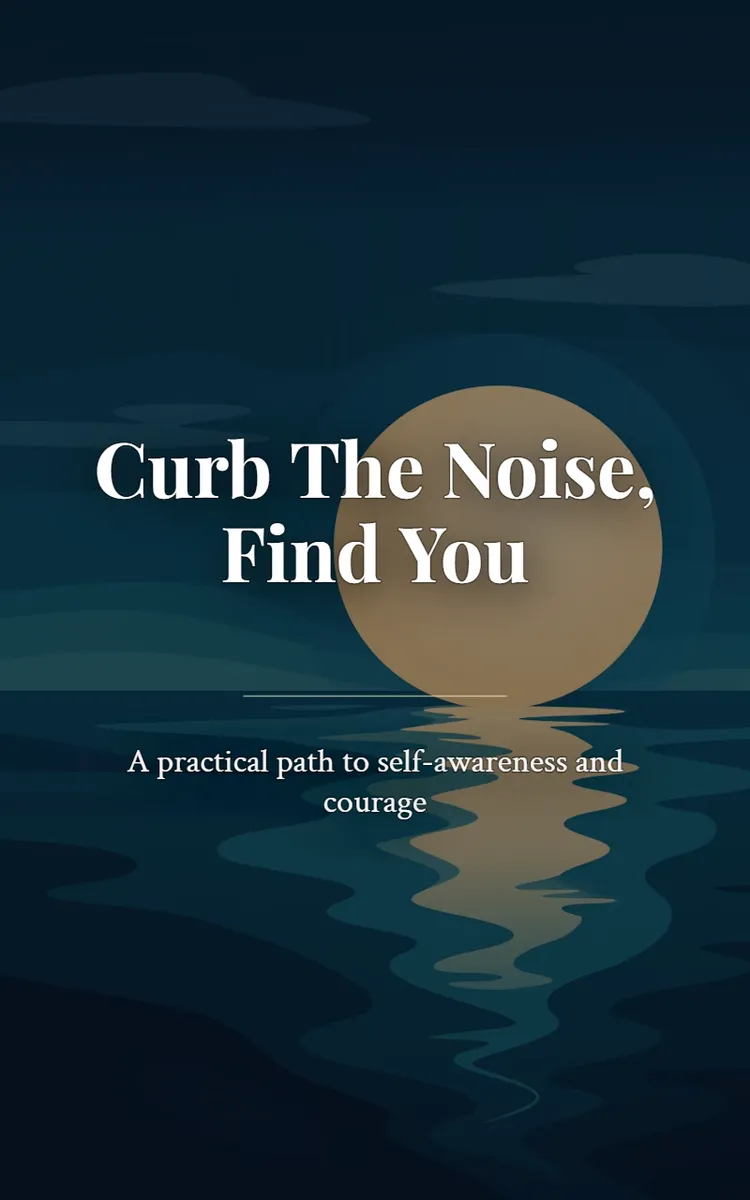
"Curb The Noise, Find You" is a self-help book by Anonymous with 8 chapters and approximately 12,293 words. Self-awareness, values clarity, and reducing worry about outcomes.
This book was created using Inkfluence AI, an AI-powered book generation platform that helps authors write, design, and publish complete books. It was made with the AI Self-Help Book Writer.
Frequently Asked Questions
What is "Curb The Noise, Find You" about?
Self-awareness, values clarity, and reducing worry about outcomes
How many chapters are in "Curb The Noise, Find You"?
The book contains 8 chapters and approximately 12,293 words. Topics covered include Quiet the Noise to Hear Yourself, Unmask Your People-Pleasing Beliefs, Choose Your Non-Negotiables in Life, Define What You Want Without the How, and more.
Who wrote "Curb The Noise, Find You"?
This book was written by Anonymous and created using Inkfluence AI, an AI book generation platform that helps authors write, design, and publish books.
How can I create a similar self-help book?
You can create your own self-help book using Inkfluence AI. Describe your idea, choose your style, and the AI writes the full book for you. It's free to start.
Write your own self-help book with AI
Describe your idea and Inkfluence writes the whole thing. Free to start.
Start writingCreated with Inkfluence AI


