
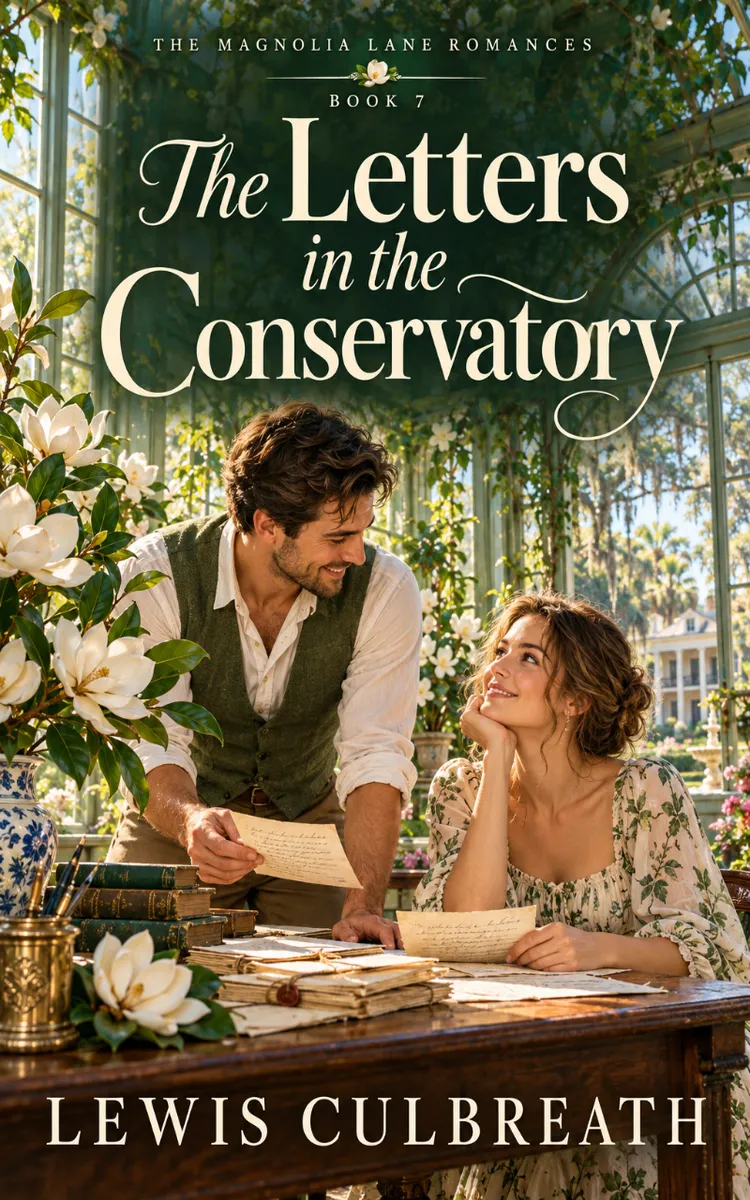

Read the first chapter
The whole of chapter one, free. About 10 min. Turn the pages with the arrows, your keyboard, or a swipe.
Chapter 1
The Desk Beneath the Glass
The desk had swollen shut around something important.
Julia Ellis ran her fingertips along the warped drawer, feeling the ridges where Florida’s heat and damp had lifted the wood. Dust softened the brass pull, and the conservatory smelled of rain-wet soil, old varnish, and the green, peppery leaves of the citrus trees crowding the glass walls. Outside, a group of students laughed near the fountain while Theo Grant’s voice rose above them, warm and steady as he explained how to ask an older resident about a place without turning the conversation into an interrogation.
Julia glanced toward the open doors.
She wanted him to come inside.
Not because she needed help. The desk was part of her cataloguing assignment, and she had opened stubborn furniture before. But Theo had a way of making history feel inhabited rather than arranged behind glass. If he stood beside her, perhaps the conservatory would stop feeling like a room she had to conquer alone.
The drawer refused to move.
Julia braced one hand against the desk and tried again. The wood gave a dry groan. A small shower of dust drifted onto her sleeve.
“Would you like me to pretend that looked easy?” Theo asked.
She turned. He stood just inside the conservatory, one shoulder against the doorframe, a notebook tucked beneath his arm. His pale blue shirt was rolled to the elbows, and a smudge of soil marked one cuff. Behind him, two students were interviewing Clara Bennett near the fountain, their phones held out like microphones.
“I would like you to pretend you didn’t see it,” Julia said.
“That is outside my teaching certification.”
His smile was quick, but his attention had already shifted to the desk. He crossed the tiled floor, his shoes clicking softly over the uneven squares. Heat pressed against the glass overhead, though a breeze moved through the louvered windows and stirred the hanging fern.
“This is the one Clara mentioned?” he asked.
“The one Daniel Hayes said should be left alone until he can assess the hinges.”
“Daniel says that about anything older than I am.”
“Daniel says it because people keep forcing things that need patience.”
Theo looked at her hand on the drawer. “And yet you were giving it a firm educational experience.”
Julia withdrew her fingers. “I was testing resistance.”
“Of course.”
He said it lightly, but the word landed with enough amusement to make her look at him. Theo’s eyes were brown, attentive, and far too aware of her. He had been doing that lately - watching her as if her clipped answers contained a second conversation beneath them.
She turned back to the desk. “The exhibition needs records connected to the conservatory. Planting plans, maintenance notes, anything that shows how the space was used before Magnolia House became what it is now.”
“And this desk?”
“Possibly an office desk. Possibly a writing desk. Possibly a poor decision made by someone with a fondness for ornate furniture.”
Theo crouched beside it. “There’s a gap here.”
Julia knelt opposite him. Their shoulders nearly touched, and the narrow space beneath the desk held the cool, dusty scent of wood. Theo pointed to the lower panel, where the grain did not quite align.
“A false front,” he said.
“Or a repair.”
“Your optimism is inspiring.”
“My caution is what keeps fragile records from becoming confetti.”
His gaze lifted to hers. “That sounds personal.”
The question was gentle enough to invite an answer. Julia felt the old reflex rise - the impulse to offer a professional explanation, something clean and unassailable. She had spent years learning how to stand between the past and the people who wanted to possess it.
Before she could respond, one of the students called from outside, “Mr. Grant, Mrs. Bennett says the fountain used to have blue tiles!”
Theo looked toward the door. “Write that down, Maya. And ask whether she remembers who installed them.”
His voice changed when he spoke to the students, becoming patient without losing its firmness. Julia watched him rise, then saw the slight wince he tried to hide as his knee straightened.
“You all right?” she asked.
“Fine.”
“That was not a fine movement.”
“It was a movement with character.”
“Your knee disagrees.”
“My knee has always been dramatic.”
She almost smiled. “You can go supervise your historians.”
“They’re collecting stories, not excavating a hidden compartment.”
“And if they find one?”
“Then I’ll ask you how not to ruin it.”
The warmth in his expression unsettled her more than the desk. He trusted her expertise without treating it as a wall between them. She did not know what to do with that.
Theo crouched again. “There’s a keyhole.”
Julia leaned closer. The brass plate was nearly invisible beneath grime, but a narrow slot showed in the center. She reached for the canvas tool roll at her side.
“I have picks,” she said.
“Are you allowed to say that in front of a teacher?”
“I’m a historical researcher, not a thief.”
“I’m relieved.”
She selected a thin probe and eased it into the lock. The metal caught. She adjusted the angle, listening to the tiny internal clicks. Theo held a flashlight over her shoulder, close enough that the warmth of his arm brushed hers.
“Don’t breathe on it,” she murmured.
“I’m breathing on you.”
“That is precisely the problem.”
For one suspended second, neither moved. The rain began tapping against the glass roof, soft at first, then more insistently. Theo’s hand tightened around the flashlight.
“Julia,” he said.
The way he said her name made the air feel smaller.
She drew the probe back. “Hold the light steady.”
His mouth curved, but he obeyed.
The lock released with a faint snap.
The drawer did not open.
Theo shifted closer. “Together?”
“I can manage.”
“I know.”
The answer stopped her. He did not say it as a challenge. He said it as if her capability were settled, and his offer had nothing to do with doubting it.
Julia placed her hand beneath the drawer’s edge. Theo’s fingers closed around the brass pull beside hers. The wood resisted, then lurched forward. A sharp scrape sounded through the room.
Something inside slid against the back panel.
They both froze.
Theo lowered the flashlight. “That was not a planting plan.”
“No.”
Julia eased the drawer open another inch. Beneath a layer of brittle brown cloth lay a narrow compartment, its edges hidden beneath the desk’s false front. Inside rested a bundle of papers tied with faded blue ribbon.
The rain drummed harder overhead.
Theo whispered, “Letters?”
Julia reached for her gloves. “Don’t touch them.”
He lifted both hands. “I’ve learned something today.”
She pulled on the cotton gloves, then carefully removed the bundle. The ribbon crumbled at the first touch, releasing a faint scent of lavender and dust. The papers beneath it were thin, cream-colored, and browned at the edges. Several bore the soft impressions left by folding and refolding.
Theo’s students had gone quiet outside. Julia could hear the fountain spilling into its basin and Clara speaking in a low voice.
“Courtship letters,” Theo said.
“You don’t know that.”
The top page was covered in slanted handwriting.
My dearest - Julia stopped reading.
The words were not addressed to a name. There was no signature beneath the final line, only a flourish that might have been a careless stroke or an unfinished thought.
Theo leaned nearer, though he kept his hands at his sides. “How many?”
“Six. Maybe seven.” She lifted the next page with a rigid strip of archival paper. “The sheets are folded differently. Some are more fragile than the others.”
“Can we show them to the students?”
“No.”
He looked at her. “Not even one?”
“Not until we know what they are, when they were written, and who owns them.”
“They’re in Magnolia House.”
“That does not make them public.”
The words came out sharper than she intended. Theo’s expression changed - not hurt exactly, but guarded.
“I didn’t say public,” he replied. “I said the students could help.”
“They can help with volunteered stories. They cannot handle private correspondence because it happens to be hidden in an estate desk.”
“The whole point of their project is to connect community history to the people who lived it.”
“And the whole point of the exhibition is to preserve history without taking what was never offered.”
A student appeared in the doorway, a notebook pressed to her chest. “Mr. Grant? Maya found someone who remembers the blue tiles.”
Theo kept his eyes on Julia for one moment longer. “I’m coming.”
The student hurried away.
He looked back at the letters. “You think someone hid these here?”
“I think someone put them somewhere they believed was safe.”
“That is different from somewhere they believed was private.”
“Yes.”
The word settled between them.
Julia understood why he wanted the students involved. Theo was not trying to turn the letters into a spectacle. He wanted his students to see that history belonged to ordinary people, not only famous names and official documents. But she had spent enough time with family papers to know that discovery could feel like trespass when the discoverer forgot there had once been a person on the other side of the page.
She placed the letters on a clean archival sheet. “I’ll photograph the desk and document the compartment. Then I’ll seal the pages for stabilization.”
Theo’s brow tightened. “Seal them away?”
“Protect them.”
“You always say that when you mean control.”
The accusation was quiet. It still found its mark.
Julia looked at him. “You always say ‘community’ when you mean access.”
His mouth parted, then closed.
The rain softened, leaving the conservatory full of dripping leaves and the faint tick of water against the panes. Theo set the flashlight on the desk.
“My students have had people tell them their questions don’t matter,” he said. “They ask about a neighborhood changing, and someone gives them a brochure. They ask what a place sounded like, and someone tells them to look it up. I want them to understand that the details people carry are worth keeping.”
Julia’s fingers rested beside the letters. “So do I.”
“Then why do you look at me as if I’m about to damage something?”
“Because you keep reaching for things before you know whether they’re yours.”
His gaze dropped to the papers. “And you keep deciding that no one can be trusted with them.”
The truth of it moved through her with uncomfortable precision.
She had learned caution from watching institutions turn personal lives into evidence. A photograph labeled incorrectly. A diary displayed without context. A family’s private grief reduced to a caption. She had promised herself she would never contribute to that kind of harm.
But Theo was not an institution. He was standing in a humid conservatory with soil on his cuff, asking for permission to help.
“I’m afraid,” she said.
The admission surprised them both.
Theo’s expression gentled. “Of what?”
“That I’ll put something on display because it seems historically valuable, and someone will recognize themselves in it.” She swallowed. “Or recognize someone they love. I don’t want to make a person feel exposed just because I found a beautiful piece of the past.”
For a moment, Theo said nothing. Then he nodded once.
“That is a reasonable fear.”
Julia had expected an argument. His acceptance left her more vulnerable than disagreement would have.
He reached toward the letters, stopped before touching them, and lowered his hand. “I’m afraid my students will learn that careful means silent. That protecting people means keeping them out of their own history.”
She looked at his hand, at the deliberate restraint in it. “Then we’ll have to find another way.”
The word we arrived before she could examine it.
Theo noticed. His eyes lifted to hers.
Outside, Clara called for him again, and a student answered with excited news about the blue tiles. The ordinary world pressed back into the room, but the bundle between them had altered its shape. It was no longer merely an item to catalog. It was a question, and now they were both responsible for asking it properly.
Julia slid the letters into an archival folder and wrote the date across the label.
“Not for display,” she said. “Not until provenance is established. And no student sees the pages.”
Theo considered her. “But I can help trace the desk’s history?”
“You can help identify who used this room and when. You can ask for stories, not names attached to secrets.”
“That sounds like a narrow assignment.”
“It is a careful one.”
He picked up his notebook. “Careful, then.”
His shoulder brushed hers as he passed. The contact lasted less than a second, but Julia felt it long after he reached the doorway.
Theo paused there. “Julia?”
She looked up.
“If we find the writers, we ask permission. We don’t assume discovery gives us ownership.”
Her throat tightened. “Agreed.”
He left to rejoin his students.
Julia remained beside the desk, listening to their voices mingle with the rain. The letters rested safely beneath their folder, hidden again but no longer lost. She had wanted a record for the exhibition. Instead, she had found a private archive with no signatures, no clear date, and a living question attached to every page.
Through the glass, Theo glanced back at her.
Julia lowered her eyes to the label she had written, then to the place where his hand had touched the desk beside hers.
For the first time that afternoon, cataloguing felt like the easier work.
End of chapter one. 29 more chapters in the full book.
Swipe or use the arrows to turn the page


What's inside: 30 chapters
- 1. The Desk Beneath the Glass
- 2. Two Plans for One Archive
- 3. A Date Without a Name
- 4. The Conservatory’s Hidden Route
- 5. The Cost of Being Certain
- 6. The Schoolroom Goes Quiet
- 7. The Ledger’s Missing Page
- 8. Rain Across the Glass
- 9. An Unasked Question
- 10. The Interview That Unravels
- 11. Eleanor’s Careful Memory
- 12. Henry’s Garden Boundary
- 13. The Line Julia Won’t Cross
- 14. The Open House Misstep
- 15. The Names in the Margin
- 16. The Cottage Door Stays Shut
- 17. Julia’s Unsent Apology
- 18. The Exhibition Board Comes Down
- 19. Henry’s Story of Silence
- 20. A Locked Room of Memories
- 21. Theo’s Fear of Letting Go
- 22. The Fundraiser Proposal Falters
- 23. The Empty Exhibition Wall
- 24. No Permission, No Exhibition
- 25. The Glasshouse in the Heat
- 26. Stories Offered Freely
- 27. What Julia Chooses to Share
- 28. A Kiss Beneath the Ferns
- 29. The Letters Stay Sealed
- 30. A Future Under Restored Glass
About this book
"The Letters In The Conservatory" is a romance book by Lewis Culbreath with 30 chapters and approximately 73,304 words. A historical researcher and teacher uncover private courtship letters at a Florida estate.
This book was created using Inkfluence AI, an AI-powered book generation platform that helps authors write, design, and publish complete books. It was made with the AI Romance Novel Writer.
Frequently Asked Questions
What is "The Letters In The Conservatory" about?
A historical researcher and teacher uncover private courtship letters at a Florida estate
How many chapters are in "The Letters In The Conservatory"?
The book contains 30 chapters and approximately 73,304 words. Topics covered include The Desk Beneath the Glass, Two Plans for One Archive, A Date Without a Name, The Conservatory’s Hidden Route, and more.
Who wrote "The Letters In The Conservatory"?
This book was written by Lewis Culbreath and created using Inkfluence AI, an AI book generation platform that helps authors write, design, and publish books.
How can I create a similar romance book?
You can create your own romance book using Inkfluence AI. Describe your idea, choose your style, and the AI writes the full book for you. It's free to start.
Write your own romance book with AI
Describe your idea and Inkfluence writes the whole thing. Free to start.
Start writingCreated with Inkfluence AI


