
Read the first chapter
The whole of chapter one, free. About 9 min. Turn the pages with the arrows, your keyboard, or a swipe.
Chapter 1
The Separate Self That Won’t Stay
The Room Where Watts Disappeared
Alan Watts could hold five hundred people in a state of concentrated attention, then lose that same ease in the presence of one person who loved him. The contradiction was not a minor inconsistency between public image and private habit; it was the central drama of his life.
In a lecture hall, Watts’ voice moved without strain. He could make Buddhist emptiness, Taoist spontaneity, and the instability of the ego sound almost obvious. The audience asked nothing intimate of him. It received his words, laughter, timing, and intelligence, but did not require him to remain emotionally available after the applause ended.
Closeness changed the conditions. A spouse, unlike an audience, brings history, expectation, disappointment, and need. The separate self that seemed transparent in public could become defensive in private. Through Carl Jung’s language of the shadow, this difference becomes easier to name: what a person can understand and perform consciously may remain divided from what he cannot bear to feel, admit, or sustain.
What if Watts’ failure to live his teaching was not a side note to his philosophy, but the place where its deepest truth became visible?
The Lecture Hall and the Living Room
Watts’ public ease depended partly on distance. A lecture is an unusual human arrangement: one person speaks while hundreds listen, and the relationship is concentrated into a temporary form. The speaker does not have to negotiate every interruption, repair every misunderstanding, or respond to the private emotional demands of each listener. Attention flows in one direction.
That arrangement suited Watts’ gifts. He had a rare ability to make complex ideas feel immediate. The “separate self,” in his account, was not a solid object hidden inside the body but a process assembled through memory, language, habit, and social recognition. The self felt separate because life kept organizing itself around the story of “me.”
Onstage, Watts could loosen that story. He was not required to present himself as a husband, father, priest, or dependable companion. For an hour, he could become the voice explaining why the attempt to control life produces more tension. The role was not entirely false. It expressed something he genuinely understood. But it was also protected by the structure of performance.
Private intimacy removes that protection. The other person is close enough to notice the gaps between insight and conduct. They remember yesterday’s promise. They know when eloquence has replaced an answer. They can ask for something that cannot be solved by a beautiful explanation.
Watts’ three marriages ended within a pattern of restlessness and withdrawal. The biographical details matter because they show the contradiction in ordinary scale. His philosophy described freedom from compulsive self-maintenance, while his personal life repeatedly returned to avoidance, dissatisfaction, and retreat into his own interior world. The man who could describe the ego’s trap could still become caught in the practical machinery of attachment.
Jung’s shadow offers a useful distinction here. The shadow is not simply the “bad” part of a person. It includes whatever the conscious personality does not recognize as belonging to itself: dependency, resentment, fear, vanity, aggression, longing, or weakness. A person may build a public identity around spaciousness and spontaneity while disowning the ordinary needs that make intimacy possible.
The more strongly Watts identified with effortless awareness, the more difficult it may have been to acknowledge the effort required by love. Intimacy is not effortless in the everyday sense. It involves repetition, limits, apology, patience, and the willingness to remain present when no elegant insight appears.
The Split-Spot Mirror
The Split-Spot Mirror names the point at which a person’s public capacity and private difficulty reveal each other. It is not a diagnosis and not a moral verdict. It is a way of looking at the sharp difference between where someone appears most free and where they become most defended.
For Watts, the split-spot lay between public presence and intimate responsibility. The lecture hall gave him a field in which attention could expand. The marriage required attention to contract around one particular person, repeatedly and concretely. One form of presence felt liberating; the other exposed obligations that his philosophy could not dissolve.
This pattern is not unique to philosophers. A surgeon may remain calm during an emergency operation yet panic when a partner asks whether the relationship is secure. A manager may speak confidently to a staff of twenty and freeze when one employee expresses hurt. The public role supplies structure. The private encounter removes the script.
Psychology has long recognized that social performance and intimate attachment draw on different capacities. Public interaction can be governed by role, skill, and feedback. Close relationships activate older expectations about dependence, rejection, control, and safety. The nervous system does not respond to a spouse as it responds to an audience. An audience may evaluate a performance; an intimate partner can threaten the identity beneath it.
The Split-Spot Mirror therefore turns Watts’ contradiction into a question about organization rather than hypocrisy alone. Which parts of the self were allowed into the light? Which were kept outside the official picture? The answer may explain why a person can speak convincingly about surrender while privately resisting the conditions that surrender requires.
The Shadow of Effortlessness
Watts’ most famous reflections on insecurity emerged during a period he later described as his most effortful. The Wisdom of Insecurity was written amid the wreckage of his priesthood and first marriage, not from a calm life untouched by conflict. Its central subject was the impossibility of securing the present by mentally possessing the future.
That context does not cancel the book’s insight. It complicates it. Watts was not reporting from a position of completed mastery. He was writing near the wound.
This is where his statement to a journalist in 1971 becomes especially revealing. He said he was “the last person equipped to live what I teach,” not that he was unable to teach it. The distinction is precise. Teaching gave form to truths that his own life did not reliably embody. He believed that “knowing better and doing better are two different problems,” and that teaching was what he himself most needed to hear.
The shadow lens makes this confession more than an appealing piece of humility. It suggests that the teacher’s public wisdom and private struggle were not separate compartments. They were connected by tension. The philosophy may have been, in part, an attempt to bring into consciousness what remained difficult to inhabit.
Yet consciousness does not automatically reorganize behavior. A person can understand the mechanics of jealousy and still feel jealous. They can recognize the ego’s demand for control and still use withdrawal to regain it. Insight can illuminate a pattern without removing its emotional force.
Watts’ drinking belongs to this same landscape. The man associated with the “watercourse way” - the Taoist image of moving with rather than against reality - drank scotch heavily throughout much of his adult life. Alcohol could temporarily soften the friction between the public self and the private one, but it did not reconcile them. It offered relief from tension while preserving the conditions that produced it.
A striking fact sits at the center of the matter: the person who explained the danger of clinging was himself repeatedly attached to habits that narrowed his freedom.
That is not an argument against his philosophy. It is an argument against confusing explanation with transformation. The shadow often survives by borrowing the language of consciousness. A person may describe detachment so fluently that detachment itself becomes part of the defense.
The Unexpected Problem with Being Seen
The surprising connection is this: Watts may have found crowds easier precisely because crowds did not see him closely enough. Public admiration can feel less threatening than private love because admiration confirms a role, while love reaches toward the person beneath it.
This changes how his public brilliance should be understood. His ease before an audience was genuine, but it was not evidence that he possessed the same ease in every human setting. In some cases, performance can protect spontaneity by giving it boundaries. The speaker knows where the encounter begins and ends; the intimate partner does not.
Jung’s idea of individuation helps clarify the cost. Individuation is not the polishing of a consistent public identity. It is the difficult process of becoming more whole by recognizing disowned parts of oneself. The shadow does not disappear when it is named. It becomes available for relationship with consciousness.
Watts’ language often dissolved the separate self into a larger process: body, world, sensation, and thought arising together. But his private difficulties show that the separate self is not merely an idea to be disproved. It is also a defensive arrangement. It protects a person from exposure, dependence, and shame. Telling someone that the self is an illusion does not necessarily make the defenses unnecessary.
In fact, a philosophy of selflessness can become another identity. “I am the person who sees through the ego” is still a position from which the ego can operate. The shadow may hide not only in greed or anger, but in spiritual superiority, cultivated detachment, and the wish to remain untouched by ordinary demands.
This is why Watts’ contradictions remain psychologically interesting rather than merely scandalous. His public teachings and private habits were not random opposites. They circled the same question from different sides: what happens when the self tries to escape the burden of being a self?
Nora at the Edge of the Conversation
A modern example helps bring the pattern down from philosophy to the scale of an ordinary room. Nora, thirty-four, works as a hospice nurse. In the ward and at staff meetings, she appears composed. She can speak to families in crisis, coordinate with doctors, and remain steady while other people are overwhelmed. Groups give her a role and a task. Her attention has somewhere to go.
One-on-one conversations are different. When a close friend asks how she is doing, Nora often says she is fine before she has checked whether it is true. If the friend continues, she may freeze, lose access to words, or feel an urgent need to end the exchange. Her difficulty is not a lack of compassion. Her work demonstrates the opposite. The problem appears when compassion is directed toward her, when she is no longer the capable person holding the situation together.
Nora’s Split-Spot Mirror lies between public steadiness and private exposure. In a group, her competence is visible and useful. Alone with someone who loves her, competence cannot answer every question. The encounter asks for uncertainty, need, and trust - parts of experience that her working identity may have taught her to set aside.
Her pattern does not make her public care false. Nor does it prove that her private freezing is deliberate. It shows how different contexts call different selves forward. The hospice nurse can remain present beside another person’s dying because the role gives shape to the encounter. A partner asking for emotional closeness may touch the shadow of dependency, helplessness, or fear of disappointing someone.
Watts’ life had a larger cultural stage, but the structure was recognizable. He could offer an audience a spacious account of existence while struggling with the repeated, unglamorous demands of closeness. Nora’s situation makes the mechanism easier to see because no mythology surrounds it. The same person can be deeply capable in one form of relationship and divided in another.
What the Split Reveals
The separate self is not only an intellectual mistake, as Watts sometimes suggested. It is also a practical shelter, built from roles that help people function and defenses that help them avoid what feels unbearable. When the shelter is challenged by intimacy, the shadow appears - not as a monster outside the self, but as the part that public competence could not include.
Watts’ contradiction therefore resists a simple conclusion. He was neither a fraud whose private life invalidated his teaching nor a sage whose failures were irrelevant. He was a man whose clearest public vision stood beside an incomplete private integration.
Perhaps the deepest irony is that the lecture hall allowed Watts to speak about dissolving the self, while love asked him to inhabit one fully enough to remain. The question left behind is not whether he knew the truth, but what kind of truth can pass through a person without yet becoming a life.
End of chapter one. 7 more chapters in the full book.
Swipe or use the arrows to turn the page


What's inside: 8 chapters
- 1. The Separate Self That Won’t Stay
- 2. Intimacy Triggers the Shadow Withdrawal
- 3. Scotch as a Private Metaphysics
- 4. Effortful Writing in the Wrong Weather
- 5. Knowing Better vs Doing Better
- 6. When Teaching Becomes Confession
- 7. Individuation Through the Unlived Lesson
- 8. Effortless Living Without the Escape
About this book
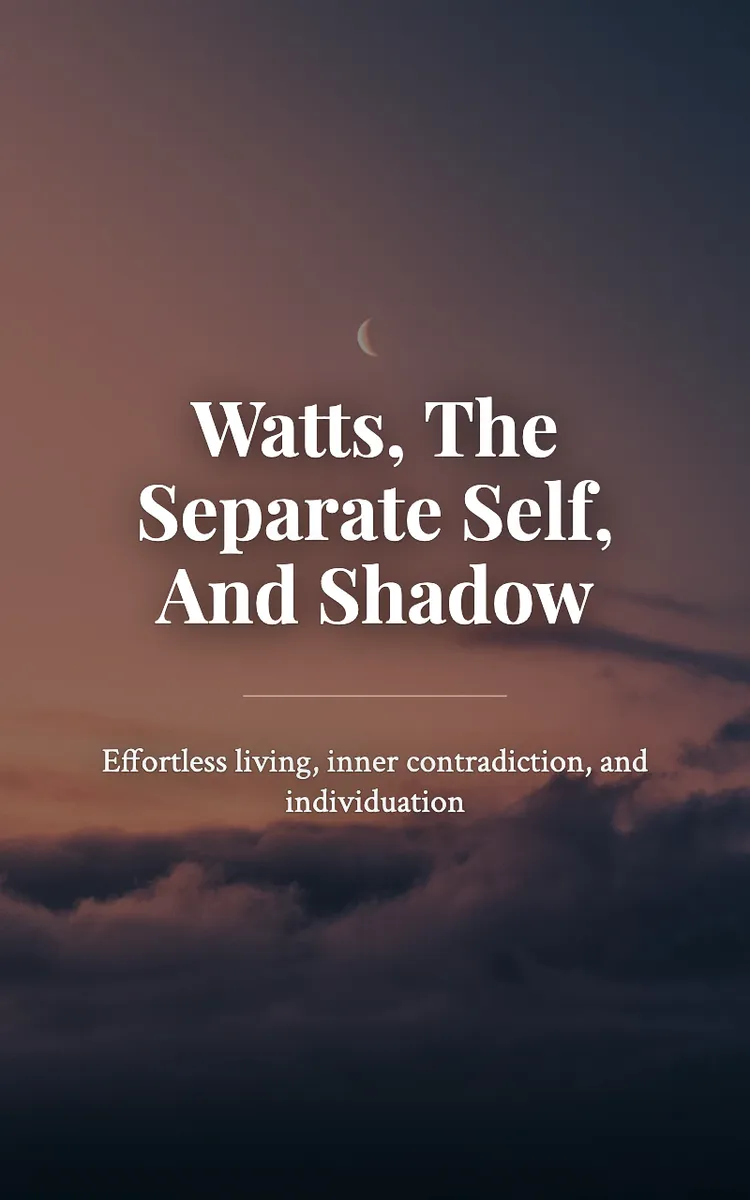
"Watts, The Separate Self, And Shadow" is a curiosity book by Brad Tollefson with 8 chapters and approximately 13,800 words. Alan Watts’ contradictions through Jungian shadow and individuation.
This book was created using Inkfluence AI, an AI-powered book generation platform that helps authors write, design, and publish complete books.
Frequently Asked Questions
What is "Watts, The Separate Self, And Shadow" about?
Alan Watts’ contradictions through Jungian shadow and individuation
How many chapters are in "Watts, The Separate Self, And Shadow"?
The book contains 8 chapters and approximately 13,800 words. Topics covered include The Separate Self That Won’t Stay, Intimacy Triggers the Shadow Withdrawal, Scotch as a Private Metaphysics, Effortful Writing in the Wrong Weather, and more.
Who wrote "Watts, The Separate Self, And Shadow"?
This book was written by Brad Tollefson and created using Inkfluence AI, an AI book generation platform that helps authors write, design, and publish books.
Write your own curiosity book with AI
Describe your idea and Inkfluence writes the whole thing. Free to start.
Start writingCreated with Inkfluence AI


