
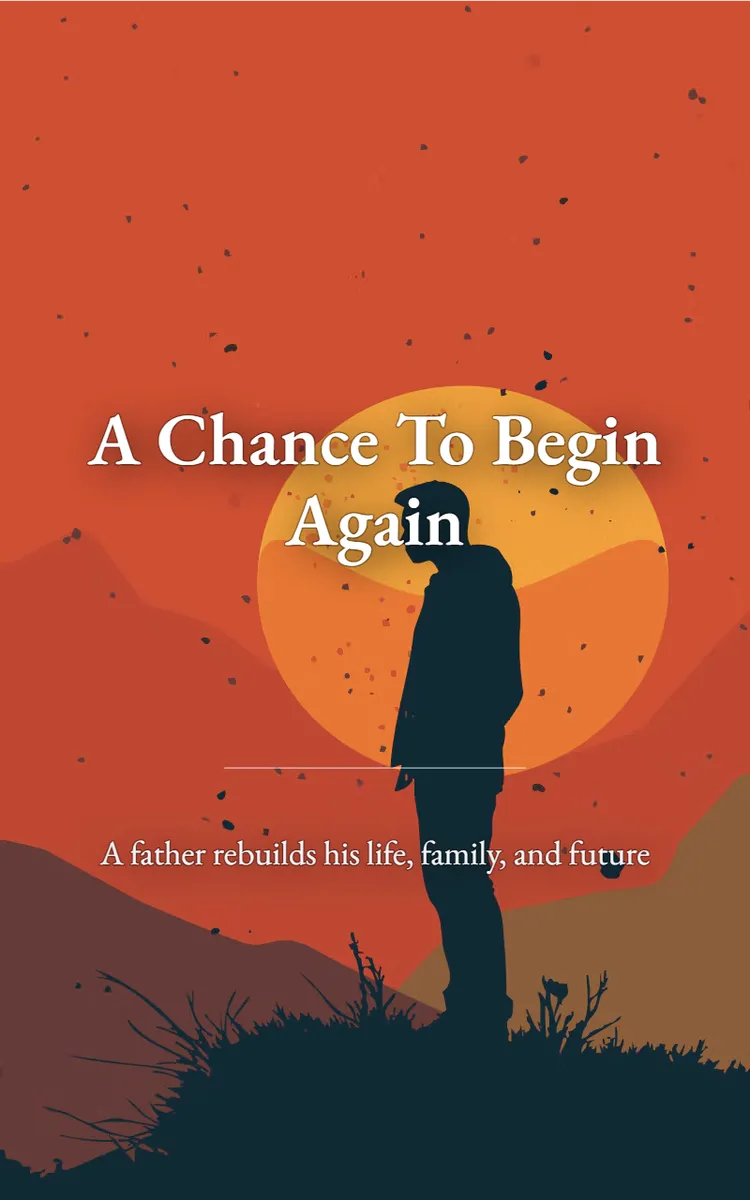
Read the first chapter
The whole of chapter one, free. About 8 min. Turn the pages with the arrows, your keyboard, or a swipe.
Chapter 1
Leaving the Classroom Behind
The plywood ramp shuddered beneath Daniel’s boots as the forklift rolled past, carrying a stack of wall frames toward the unfinished house. Below him, hammers struck in uneven bursts, and a saw screamed through a board before falling silent.
“Don’t stand there watching,” his father called. “Grab the other end.”
Daniel climbed down from the frame and crossed the packed dirt. Dust clung to his jeans. He reached for the long board his father had pointed toward, but the weight pulled hard against his shoulder.
“Lift with your legs,” his father said.
“I know how to lift.”
“Then show the board.”
Daniel bent again, set his feet, and raised his end. The wood scraped over the ground. For a moment, he felt like a student being corrected in front of a class, and heat climbed his neck.
He had left the school with a cardboard box in his hands and no clear place to go. He had lost his teaching job. In the divorce and custody fight, he had lost his sons, too. Now he stood on a construction site wearing a borrowed yellow helmet, trying to prove he belonged beside men who could read a set of plans faster than he could read his own future.
His father took the board from him at the wall.
“Set it here.”
Daniel lowered his end. The board landed crooked.
His father looked at it, then at him. “Again.”
Daniel’s jaw tightened. “I heard you.”
The site spread across the lot in a confusion of beams, ladders, cords, and half-built rooms. Nails glittered in the dirt. A radio played somewhere behind the framing, its music breaking apart whenever a saw started. Daniel had spent years arranging desks, lessons, and children into something that made sense. Here, nothing seemed to stay still long enough to understand.
His father pointed toward a pile of lumber. “Bring me the two-by-fours marked blue.”
Daniel found the pile and knelt beside it. The boards were rough beneath his palms, their edges catching at his skin. Several had blue marks. He picked up two and carried them back.
“These are the wrong ones,” his father said.
Daniel looked at the boards. “They’re marked blue.”
“Blue means the second wall section. I need the ones with the long mark.”
“You didn’t say that.”
His father’s face softened, but his voice did not. “The worksite won’t always say everything twice.”
The words landed harder than they should have. Daniel glanced toward the road, where cars passed beyond the orange cones. He imagined one of them carrying him back to the school, back to the classroom where he had known every corner and every voice. Then he remembered the empty desk, the closed door, and the silence after the accusation.
His father took the boards from him. “Go sit in the truck for a minute.”
“I’m not taking a break.”
“I didn’t say you were. I said go sit down before you make a mistake that costs somebody a finger.”
Daniel stepped away. The truck’s cab was hot, but the seat steadied him. He pulled off his gloves and stared at the red marks across his palms. His hands had once held books, dry-erase markers, and papers covered in children’s handwriting. Now they shook from carrying lumber.
His father opened the passenger door and climbed in.
“You don’t have to do this,” he said.
Daniel kept looking at his hands. “Do what?”
“Work for me.”
“I need a job.”
“You need more than a job.”
Daniel laughed once, without humor. “That’s easy to say when you still have one.”
His father leaned back. Outside, a nail gun popped three times.
“I know you’re hurting,” he said.
“No, you know I’m not teaching anymore. That’s different.”
“I know you lost your boys.”
Daniel turned toward the window. The words pressed against the place he had tried hardest not to touch.
“They’re still my sons,” he said.
“I know.”
“But I don’t get to wake them up. I don’t get to hear about school. I don’t even know what they’re eating half the time.”
His father waited.
Daniel rubbed his palms together. “And now I can’t even carry a board without being told I’m doing it wrong.”
“You’re doing it wrong because you’re new.”
“I taught for years.”
“This isn’t a classroom.”
“I noticed.”
His father looked toward the half-built house. “Then let it be something else. You don’t have to be good at it today. You have to show up, listen, and finish what’s in front of you.”
Daniel wanted to argue. Instead, he looked at the open walls, the bare studs reaching toward the bright sky. There was no door yet, no room to hide in, no familiar bell telling him when one part of the day ended and another began.
“What do you need me to do?” he asked.
His father nodded toward the foundation. “The crew is setting the first-floor frames. You’ll help brace them. Keep them straight until they’re secured.”
“That’s all?”
“That’s enough.”
Daniel climbed out of the truck.
The next hour moved slowly. He held one frame upright while his father checked the level. The bubble drifted left.
“Push at the top,” his father said.
Daniel pushed. The frame shifted too far.
“Back.”
He eased it back.
“Hold it.”
His arms began to tremble. Sweat ran beneath the edge of his helmet and down the side of his face. The wall looked simple, but every adjustment changed the angle of the next piece. When the frame finally stood straight, his father drove the first brace into place.
“Good,” his father said.
The word was small, but Daniel felt it.
Then the wind rose across the open lot. The frame leaned, pulling against Daniel’s shoulder.
“Hold it!” his father shouted.
Daniel planted his boots. The wood pressed into his collarbone. Dust whipped across the foundation, stinging his eyes. The brace groaned.
“I’ve got it!” Daniel called.
His father grabbed a second brace and drove it into position. Another worker rushed over with a hammer. Together they secured the frame before the wind could take it down.
When it was safe, Daniel stepped back, breathing hard.
His father checked the brace. “That’s the part that matters.”
“What part?”
“Staying with it when it starts moving.”
Daniel looked at the wall. It was not finished. It did not resemble a home yet. But it stood.
At lunch, the crew gathered beneath a temporary shade canopy. Daniel sat at the end of a wooden table with a sandwich his father had packed. The bread was flattened, and the mustard had soaked through the paper. Across from him, two workers talked about a truck that had broken down. Daniel listened without joining in.
His phone rested beside his knee.
He checked it once. No messages.
He checked it again.
His sons were still hundreds of miles away. His ex-wife lived 500 miles away, and the distance had become more than a number. It was the space between birthdays missed, calls that ended too soon, and a father trying to remain present through a screen.
“Waiting on somebody?” his father asked.
Daniel locked the phone. “No.”
His father unwrapped his own sandwich. “You don’t have to pretend with me.”
Daniel studied the dirt beneath the table. “I don’t know what I’m supposed to do now.”
“Work today.”
“And tomorrow?”
“Work tomorrow.”
“That can’t be the whole answer.”
“No,” his father said. “But it can be the next answer.”
A truck backed toward the site, beeping sharply. The sound cut through the conversation. Daniel stood before his father could say anything else.
“I’ll get the path clear.”
He moved stacks of scrap wood away from the truck’s tires, then waved the driver into place. The work was plain and heavy. It gave his mind fewer places to wander.
By late afternoon, his shoulders ached. The crew had raised three walls, and Daniel had helped brace each one. His gloves were torn at the thumb. A thin scrape crossed his forearm where a board had caught him.
His father handed him a broom. “Clear the floor.”
Daniel stared at it. “After all that?”
“After all that.”
He swept sawdust and wood chips toward a growing pile. The broom rasped over the plywood. Sunlight slanted through the open walls, turning the dust into bright, floating specks. For a few minutes, the site became quiet enough for him to hear the rhythm of his own breathing.
He found a small red plastic car buried beneath the scraps.
Daniel picked it up. One wheel was missing.
His father saw it in his hand. “Probably left by one of the crews.”
Daniel turned the toy over. His youngest son had once carried a red car everywhere. He had slept with it beside his pillow and cried when one wheel broke.
Daniel closed his fingers around the toy.
“Put it in the truck,” his father said gently.
Daniel did.
When the last worker left, the house stood in the fading light, open to the sky. Daniel removed his helmet and set it on the hood of the truck. His hair was damp, his back hurt, and his hands were too sore to close fully.
His father stood beside him. “You finished your first shift.”
Daniel looked at the unfinished walls. “I didn’t teach anybody.”
“No.”
“I didn’t fix anything with my sons.”
“No.”
“I didn’t get my life back.”
His father rested a hand on the truck’s hood. “No. But you worked.”
Daniel looked down at the red toy car inside the cab. The job had given him a place to stand, a task to finish, and a reason to return in the morning. It had not given him the classroom back. It had not filled the empty space where his sons belonged.
He picked up his helmet.
“Tomorrow,” he said.
His father nodded. “Tomorrow.”
Daniel climbed into the truck, sore and grieving, but no longer standing still.
End of chapter one. 8 more chapters and about 18,927 words in the full book.
Swipe or use the arrows to turn the page
What's inside: 9 chapters
- 1. Leaving the Classroom Behind
- 2. A Gym Full of Possibility
- 3. The Superintendent’s Answer
- 4. Three Sons Come Home
- 5. A Father’s Place at Home
- 6. Welcome at Their Father’s School
- 7. The Doubt Before the Ballot
- 8. Seventy-Five Percent
- 9. A Future Built Together
About this book
"A Chance To Begin Again" is a fiction book by Anonymous with 9 chapters and approximately 18,927 words. A former teacher rebuilds his confidence, reunites with his children, and enters politics.
This book was created using Inkfluence AI, an AI-powered book generation platform that helps authors write, design, and publish complete books. It was made with the AI Novel Writer.
Frequently Asked Questions
What is "A Chance To Begin Again" about?
A former teacher rebuilds his confidence, reunites with his children, and enters politics
How many chapters are in "A Chance To Begin Again"?
The book contains 9 chapters and approximately 18,927 words. Topics covered include Leaving the Classroom Behind, A Gym Full of Possibility, The Superintendent’s Answer, Three Sons Come Home, and more.
Who wrote "A Chance To Begin Again"?
This book was written by Anonymous and created using Inkfluence AI, an AI book generation platform that helps authors write, design, and publish books.
How can I create a similar fiction book?
You can create your own fiction book using Inkfluence AI. Describe your idea, choose your style, and the AI writes the full book for you. It's free to start.
Write your own fiction book with AI
Describe your idea and Inkfluence writes the whole thing. Free to start.
Start writingCreated with Inkfluence AI


