
Read the first chapter
The whole of chapter one, free. About 7 min. Turn the pages with the arrows, your keyboard, or a swipe.
Chapter 1
Choosing Present-Moment Identity
Choosing Present-Moment Identity: Where Is Your “You” Right Now?
What if the “you” you’re carrying around isn’t the truest one - just the one that’s loudest from yesterday? Not the soul-you that knows it’s infinite, but the story-you that learned how to survive in a particular moment and then never stopped replaying the tape.
For most of us, the past doesn’t just live in memory. It becomes identity. A mistake turns into “I’m that kind of person.” A loss turns into “I’ll never recover.” A compliment turns into “I have to keep proving I’m worthy.” And somewhere inside all that, you forget a simple spiritual fact: you’re not a linear being. You’re a multi-dimensional being living a multi-dimensional existence in one infinite moment of infinite possibilities. The question isn’t whether the past happened. It did. The question is whether you’re letting it name you.
This Chapter Is For You If... - You catch yourself saying “I am who I was back then,” even when you can feel yourself changing. Expect a shift from identity-as-history to identity-as-presence. - You feel stuck in repeating emotions (regret, resentment, grief, shame) that keep acting like a decision you’re making in real time. Expect softer boundaries with those emotions. - You’re spiritual but still notice your mind living like it has a “rewind” button. Expect a practical reframe you can actually use mid-day. - You’re ready for renewal that doesn’t require you to pretend the past didn’t hurt. Expect grounded presence, not denial.
The Now-Name Reframe: Stop Letting Yesterday Speak in Your Voice
The Now-Name Reframe is the practice of naming what’s true in this moment - without borrowing identity from the past.
Here’s the core move: when your mind tries to define you using a past label, you interrupt the naming. Not with force. With clarity. You ask, “What is true right now?” Then you let that truth be the name you wear.
Let me show you what that looks like in real life. Talia - 34, a hospice nurse and steady meditator - knows what it means to hold other people’s endings with reverence. Her work trains her to stay present… and still, life finds ways to pull her into old grooves. A few weeks after a tough shift, she noticed a familiar story rising: You’re not doing enough. You’re going to miss something. You’ll be responsible.
It wasn’t a brand-new thought. It was an old one dressed in new clothes.
The past was acting like a manager. It spoke in certainty. It made her feel “obligated” to carry the outcome. But during meditation, she started noticing a subtle moment before the story fully landed - the pause where she could choose her identity. She didn’t argue with the mind. She observed it. Then she applied the Now-Name Reframe.
She named the present truth instead of accepting the old identity: “Right now, I’m feeling pressure.” Not “Right now, I am incompetent.” “Right now, I’m carrying responsibility that belongs to the past.” Not “Right now, I’m failing.”
In that naming, the story lost its grip. Not because the story was “wrong,” but because it was no longer the one speaking as her.
And when she kept returning to that reframe - especially after work - she realized something important: the past can inform you, but it doesn’t get to define you. You can learn. You can grieve. You can integrate. But you don’t have to live inside yesterday’s identity.
In Practice, This Means... - You replace “I am _ (old identity)” with “Right now, I’m noticing _ (present experience).” - You stop treating emotions as proof of your character and start treating them as signals. - You catch the moment you start “being” the past and re-enter the moment you’re actually in. - You let your spiritual presence be a choice, not just something you access during meditation.
Daily Actions That Make Present-Moment Identity a Habit
The Now-Name Reframe works because you’re not trying to out-think your mind. You’re training your attention to land in the present, then letting the present name you.
Here are simple daily actions you can actually do - no special equipment, no dramatic transformation required.
1. Morning (30 seconds, before you check anything): Ask: “What identity am I assuming today?” Then add one sentence: “Today, I name myself by what’s true in this moment.” If your mind says, “I’m still the person who failed last time,” you respond: “Right now, I’m remembering. That’s different.”
2. Midday reset (2 minutes, especially after a trigger): When you feel the past surge - tight chest, sharp tone, sudden dread - pause and do the Now-Name Reframe out loud (even quietly). Use the formula: “Right now, I’m noticing ___.” Then: “Therefore, I can choose my next action from presence.”
3. Evening (3 minutes, after work or after a hard conversation): Write down one past-identity phrase you believed that day (example: “I’m behind,” “I’m too much,” “I’ll always be like this”). Then re-write it as a present-truth sentence: “Right now, I’m tired / I’m activated / I’m processing.”
4. One decision rule (whenever you’re tempted to “be” the past): If you catch yourself using always, never, forever, treat it as a sign you’ve slipped into historical identity. Bring it back to the present: “This is what the mind is telling me. What is true right now in my body and attention?”
The practice isn’t about eliminating the past. It’s about relocating authority - from yesterday’s narrative to today’s lived reality.
Real-Life Scenario: Talia’s Shift After the “I Missed Something” Story
Before: After a demanding hospice shift, Talia felt a familiar tightening in her chest. Her mind replayed details from earlier in the day, then concluded, You missed something. You’re responsible. You’re not enough. The identity came first, then the emotion followed - panic, self-criticism, and a weird sense of urgency that didn’t match reality.
Action: She used the Now-Name Reframe the moment she noticed the identity landing. She didn’t fight the thought. She named what was actually happening: - “Right now, I’m activated.” - “Right now, I’m remembering.” - “Right now, I’m afraid of being responsible again.”
Then she made one grounded choice from presence: she wrote one clear fact down (not a story) and followed it with one next step - checking what she needed to check, then letting the rest go. She also returned to a single breath pattern for 6 cycles, just to anchor attention back into the body.
Result: The fear didn’t vanish instantly, but it changed. It stopped being “my identity” and became “a feeling I can hold.” The story still showed up, but it no longer ran the whole room. She felt more spaciousness, and her nervous system calmed enough to rest - without having to win an argument with her mind.
That’s the point. The Now-Name Reframe doesn’t erase memory. It relocates you from being the past to meeting the present.
Time to Reflect: Questions That Expose Old Identity in Real Time
Reflection works best when it’s specific. These prompts are designed to help you notice the exact moment you start identifying with the past - then choose a different name.
1. Where in my body do I feel the past trying to become my identity? You’re looking for a location: throat tightness, stomach drop, jaw clench. When you can name the sensation, you can stop treating it like a character flaw.
2. What past phrase do I keep repeating as “truth”? Examples might be “I always mess things up,” “I’m not safe unless I control,” or “I should’ve known.” If it ends with certainty, it’s probably masquerading as identity.
3. When the story returns, what present truth am I avoiding? Sometimes the present truth is simple: “I’m tired,” “I’m grieving,” “I need rest,” “I’m lonely.” Honest answers often feel almost embarrassingly plain.
4. What would my next action look like if I refused to be the past? Not the perfect action. Just the next one. Even one small step - texting someone, taking a walk, finishing a task you can complete - reclaims presence.
5. What name do I want to wear today - based on what’s true right now? Try: “I’m learning,” “I’m steadying,” “I’m available,” “I’m gentle,” or “I’m listening.” Names like these don’t deny history; they guide attention.
Let your answers be real, not pretty. The goal isn’t to “think positive.” The goal is to stop outsourcing your identity to yesterday’s evidence.
Next Step: Complete This One Action Today
Pick one moment today when you feel yourself slipping into past identity - before it fully becomes a belief. Then do this in under ten minutes:
1. Write one sentence: “Right now, the past is trying to name me: __.” 2. Write the Now-Name Reframe sentence: “Right now, I’m noticing.” 3. Choose one present-grounded action: “So next, I will for the next __ minutes.” (Even 5 minutes counts.)
Time needed: 7-10 minutes. You will know it worked when... you feel at least a small shift - like your shoulders drop, your breathing steadies, or the story loses a little authority. You don’t have to feel bliss. Just notice that you’re back in the moment you’re already living.
One infinite moment is waiting underneath every thought that tries to define you. When you name what’s true right now, you step into that moment - and the possibilities widen, quietly, immediately.
End of chapter one. 7 more chapters in the full book.
Swipe or use the arrows to turn the page


What's inside: 8 chapters
- 1. Choosing Present-Moment Identity
- 2. Breaking Linear Time Stories
- 3. Practicing Infinite Possibility Attention
- 4. Letting Resistance Become Guidance
- 5. Integrating Contradictions Without Splitting
- 6. Choosing Alignment Over Outcomes
- 7. Healing the Timeline Through Forgiveness
- 8. Living One Infinite Moment Daily
About this book
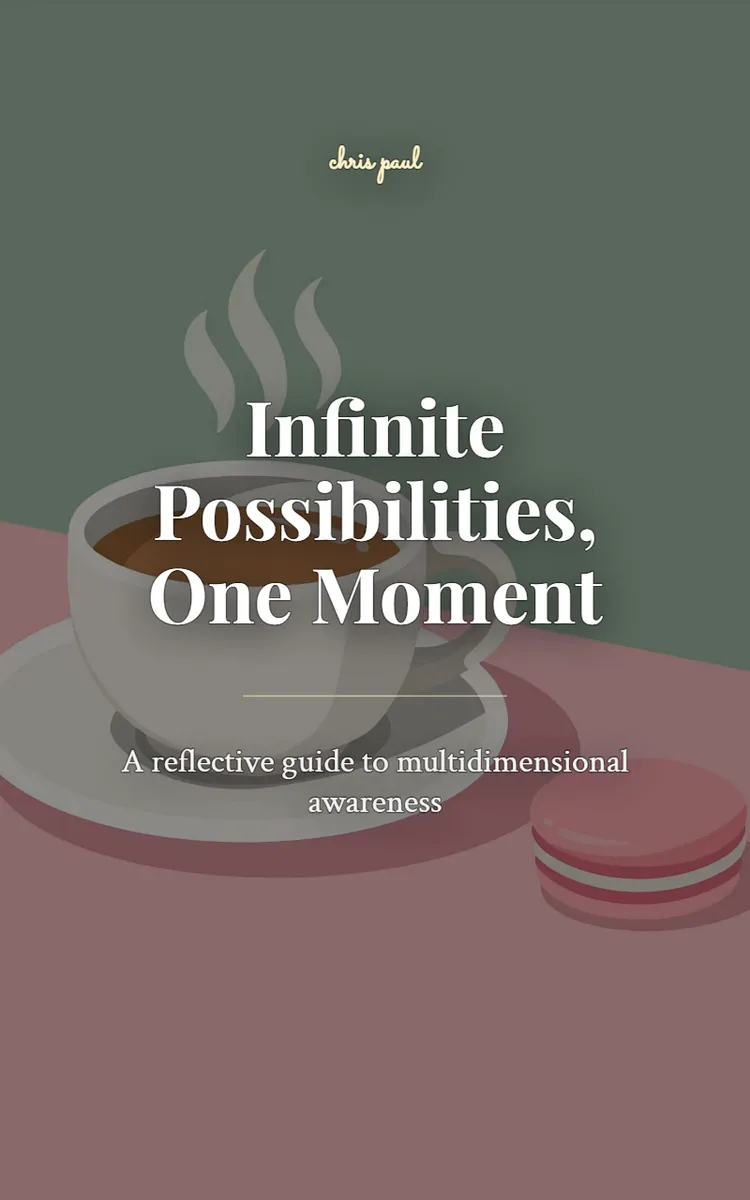
"Infinite Possibilities, One Moment" is a inspirational book by chris paul with 8 chapters and approximately 12,873 words. Spiritual reflection on infinite possibilities and nonlinearity.
This book was created using Inkfluence AI, an AI-powered book generation platform that helps authors write, design, and publish complete books. It was made with the AI Inspirational Book Writer.
Frequently Asked Questions
What is "Infinite Possibilities, One Moment" about?
Spiritual reflection on infinite possibilities and nonlinearity
How many chapters are in "Infinite Possibilities, One Moment"?
The book contains 8 chapters and approximately 12,873 words. Topics covered include Choosing Present-Moment Identity, Breaking Linear Time Stories, Practicing Infinite Possibility Attention, Letting Resistance Become Guidance, and more.
Who wrote "Infinite Possibilities, One Moment"?
This book was written by chris paul and created using Inkfluence AI, an AI book generation platform that helps authors write, design, and publish books.
How can I create a similar inspirational book?
You can create your own inspirational book using Inkfluence AI. Describe your idea, choose your style, and the AI writes the full book for you. It's free to start.
Write your own inspirational book with AI
Describe your idea and Inkfluence writes the whole thing. Free to start.
Start writingCreated with Inkfluence AI


