
Read the first chapter
The whole of chapter one, free. About 7 min. Turn the pages with the arrows, your keyboard, or a swipe.
Chapter 1
First Lessons of Anibaba’s Kitchen
The charcoal fire had settled into a red glow by the time I reached for the wooden spoon. Smoke clung to the rafters of Anibaba’s kitchen, and the smell of onions, pepper, and warm oil filled the small room. I knew where everything belonged: the pot near the back of the stove, the water in the covered container, the clean plates stacked beneath the shelf. In that familiar order, I trusted that the day would hold together.
I was still young then, young enough to believe that a well-swept floor and a covered pot could protect a household from uncertainty. Anibaba moved through the kitchen with the calm attention that made even ordinary work feel important. She was Olufunmilayo Oladuni Anibaba, my mother, and I watched her closely because watching her was how I learned.
She did not hurry without reason. She measured rice in the palm of her hand, checked the fire with a small movement of the iron rod, and wiped the rim of the pot before covering it. Her care was practical, but it was never cold. Even when the kitchen was crowded with heat, she noticed whether I had eaten. Even when her hands were occupied, she noticed when my face had changed.
“Stay close,” she told me.
I understood the instruction without asking what it meant. Staying close meant keeping out of the way, but it also meant remaining available. It meant watching for the next task and learning before I was asked. In Anibaba’s kitchen, love was rarely announced. It appeared in the food she set aside, the water she kept ready, and the quiet rules that guided our movements.
I passed her the bowl she needed. She accepted it with a nod and continued stirring. The spoon scraped gently against the pot. Outside, voices drifted across the compound, mixed with the distant sounds of movement along the road. Inside, the kitchen carried its own rhythm.
I wanted to know how she managed everything. I wanted to understand how she remembered what each person needed, how she stretched ingredients, how she kept the house orderly without making the work seem larger than the day. I stayed near her because closeness made the household legible. If I watched long enough, I believed I would discover the secret.
Then the power went out.
The change was immediate. The electric light disappeared, leaving the kitchen dependent on the fire and the fading daylight. The fan stopped, and the heat gathered around us. For a moment, the room seemed smaller. The familiar arrangement remained, but its ease had been disturbed.
Anibaba did not panic. She reached for the lantern and checked it before lighting it. The match flared briefly, illuminating her face and the shelves behind her. She placed the lantern where its light could reach the work surface without standing too close to the flame.
“Bring the lantern nearer,” she said.
I moved it, careful not to knock the container beside it.
“Not there,” she added. “Keep it away from the cloth.”
I shifted it again. The warning was firm, but there was no anger in it. In that moment, I understood that the rules of the kitchen were not meant to limit us. They were meant to keep small difficulties from becoming larger ones.
The darkness outside deepened. The fire gave off a dry heat, and the smell of smoke grew stronger. I tried to continue as though nothing had changed, but the spoon slipped in my hand. A little of the food spilled onto the side of the pot.
I froze.
Anibaba looked at the spill, then at me. She took the spoon from my hand and wiped the pot with a damp cloth.
“Clean it,” she said.
I reached for the cloth.
“Carefully.”
That second word stayed with me. She was not asking for perfection. She was asking me to remain steady after a mistake. I cleaned the side of the pot, and she returned the spoon to me. The meal continued, though the routine had become more demanding.
Before we could settle again, a family visitor arrived. The sound of footsteps crossed the compound, followed by a greeting from outside. Anibaba answered and made space in the kitchen, though there was hardly any space to spare. The visitor entered with the tiredness of someone who had travelled and looked around at the dim room.
The visitor asked about the electricity. Anibaba answered simply. I remained near the pot, listening while I worked.
The visitor noticed the food and asked whether there was enough for everyone. Anibaba looked at the pot before answering. She did not complain. She did not explain the amount of rice or the cost of the ingredients. She only adjusted the fire and began to consider what could be added without weakening the meal.
“Bring the water,” she told me.
I carried it over. The container felt heavier than I expected, and I held it with both hands. Anibaba poured carefully, watching the pot as though she could calculate its final quantity by sight. She added what was necessary and nothing more.
The visitor continued speaking about prices and the difficulty of finding money during that period. The words were ordinary, but they changed the air in the kitchen. Until then, I had thought of food as something that appeared because Anibaba knew what to do. I had not understood that every meal carried a decision.
She counted portions without counting aloud. She considered who had arrived, who would eat later, and what would remain for the next morning. Her hands continued their work, but I saw the thought behind each movement. The kitchen was not only a place of cooking. It was a place where tomorrow was protected from today.
I wanted to help her, but I was afraid of making another mistake. I watched the fire and adjusted the wood when it burned too low. Smoke rose into my eyes. I blinked and kept working.
“Do not let it go out,” Anibaba said.
“I will not,” I answered.
The words came quickly, and I felt their weight after I spoke them. I could not promise that the fire would obey me, but I could promise to pay attention. I leaned closer, using the iron rod as she had shown me, and moved the charcoal until the heat returned beneath the pot.
The kitchen grew warmer. The lantern cast a yellow circle over the food, the bowls, and Anibaba’s hands. The visitor sat nearby, still speaking, but I no longer followed every word. My attention had narrowed to the meal and the fire. I understood that the work had to continue whether the electricity returned or not, whether money was sufficient or not, whether anyone praised the effort or noticed it.
Anibaba watched me for a while. When the fire held steady, she took the spoon and tasted the food. She added a small amount of seasoning, then looked at me.
“You have learned to watch,” she said.
It was not a grand compliment. She did not smile broadly or pause to celebrate it. Yet I felt the approval in the way she handed the spoon back to me. I had stayed close. I had made a mistake and corrected it. I had helped preserve the meal when the kitchen no longer felt secure.
The food was served. The portions were modest, but no one was left without a place at the table. Anibaba moved between the kitchen and the other room, carrying plates and returning for what was needed. I remained behind to watch the fire. My earlier comfort had changed into responsibility, and responsibility made the room look different.
The visitor’s remarks about money returned to me as I worked. I began to notice what I had previously overlooked: how carefully Anibaba used each ingredient, how she avoided waste, how she kept certain things for later. Her quietness was not ignorance of hardship. It was one of the ways she carried it.
I had wanted to learn how she ran the home. That evening, I learned that running a home meant holding many uncertainties at once without allowing them to frighten everyone else. It meant making choices that children might not see until they were old enough to understand the cost of comfort.
Looking back, I now understand that Anibaba’s motherhood was formed through these repeated acts of attention. She taught me with instructions, but also with pauses, glances, and the order in which she completed her work. She showed me that firmness did not need cruelty. A correction could protect dignity. A rule could be an expression of care. A meal could be both nourishment and a carefully guarded promise that the family would manage another day.
The power returned later, but the kitchen did not return to its earlier innocence. I had entered it trusting the routine to hold everything together. I left that evening knowing that the routine held because Anibaba held it, and because she quietly taught me to hold a small part of it too.
The visitor’s words had exposed a worry I could not yet solve. Money had entered my understanding of motherhood, not as an abstract concern but as something present in the pot, the portions, and the decisions behind them. Anibaba had kept the meal going, and I had helped. Her approval warmed me.
Still, beneath that warmth was a new awareness: even in the kitchen I knew best, there were burdens my mother carried beyond my sight.
End of chapter one. 7 more chapters and about 14,056 words in the full book.
Swipe or use the arrows to turn the page
What's inside: 8 chapters
- 1. First Lessons of Anibaba’s Kitchen
- 2. Learning Patience Through Discipline
- 3. Market Days and Mother’s Secret Savings
- 4. The School Fee Question No One Answers
- 5. When Anibaba Sells Her Best Pot
- 6. The Day Amina Breaks Quietly
- 7. Anibaba’s Borrowed Promise at Sunrise
- 8. Motherhood Traits That Outlast Hard Years
About this book
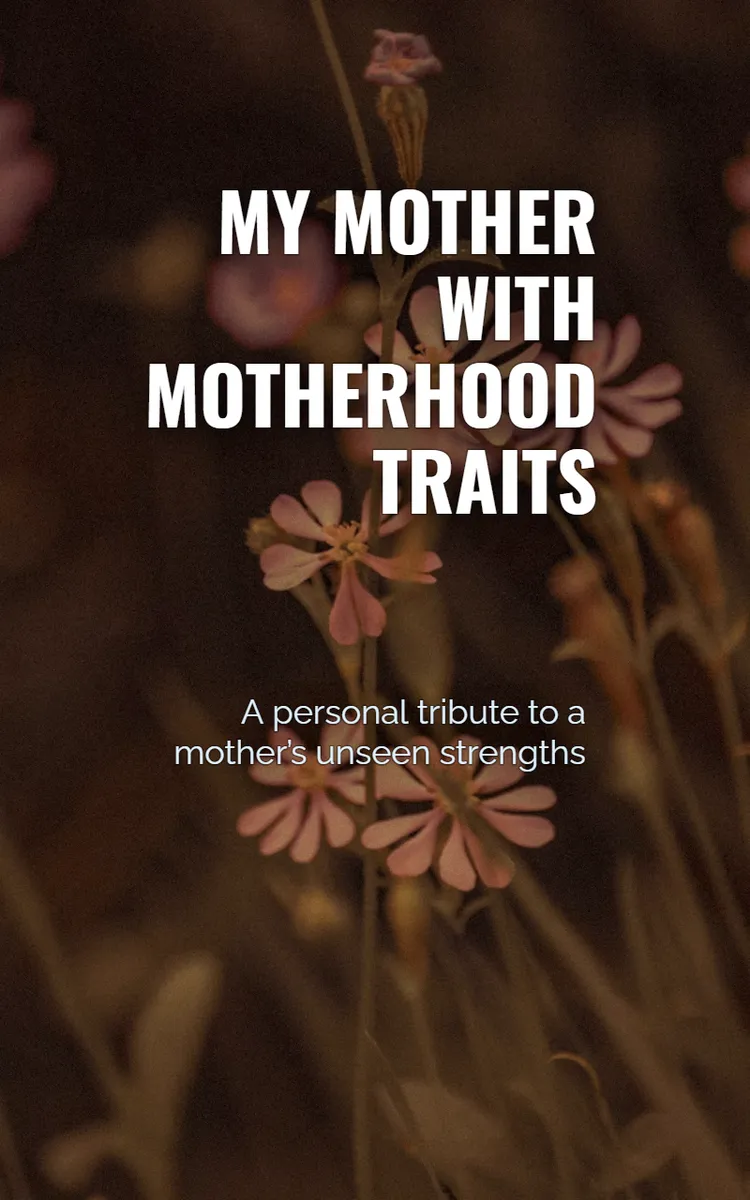
"My Mother With Motherhood Traits" is a biography book by Anonymous with 8 chapters and approximately 14,056 words. A memoir honoring a mother and her unique motherhood traits.
This book was created using Inkfluence AI, an AI-powered book generation platform that helps authors write, design, and publish complete books. It was made with the AI Biography Writer.
Frequently Asked Questions
What is "My Mother With Motherhood Traits" about?
A memoir honoring a mother and her unique motherhood traits
How many chapters are in "My Mother With Motherhood Traits"?
The book contains 8 chapters and approximately 14,056 words. Topics covered include First Lessons of Anibaba’s Kitchen, Learning Patience Through Discipline, Market Days and Mother’s Secret Savings, The School Fee Question No One Answers, and more.
Who wrote "My Mother With Motherhood Traits"?
This book was written by Anonymous and created using Inkfluence AI, an AI book generation platform that helps authors write, design, and publish books.
How can I create a similar biography book?
You can create your own biography book using Inkfluence AI. Describe your idea, choose your style, and the AI writes the full book for you. It's free to start.
Write your own biography book with AI
Describe your idea and Inkfluence writes the whole thing. Free to start.
Start writingCreated with Inkfluence AI


