
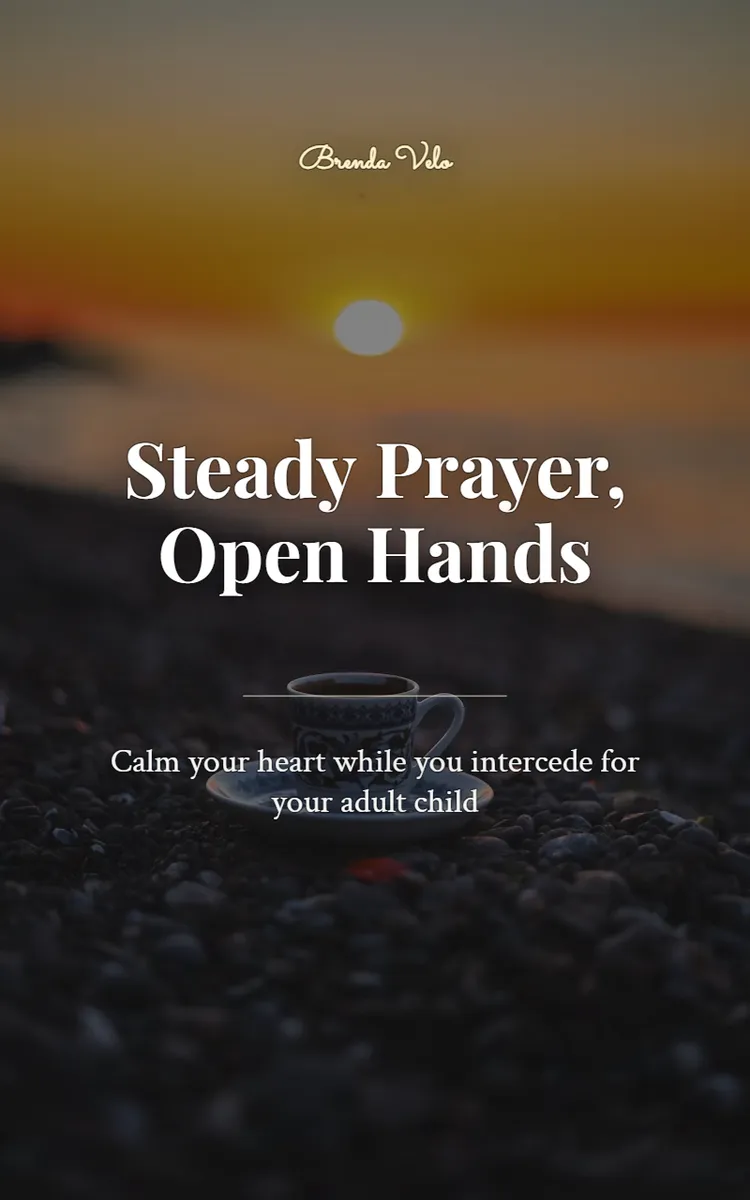
Steady Prayer, Open Hands
Created with Inkfluence AI
🔀 Remixed from Praying For Your Adult Child
A practical self-help guide for replacing panic with grounded, compassionate prayer as you support your adult child’s journey.
Table of Contents
- 1. Swap Panic for Trust
- 2. Release Expectations Before You Ask
- 3. Submit Your Mind, Not Just Your Child
- 4. Pray With Wisdom, Not Alarm
- 5. Bless Their Decisions, Guard Your Peace
- 6. Walk Forward on Straight Paths
Preview: Swap Panic for Trust
A short excerpt from “Swap Panic for Trust”. The full book contains 6 chapters and 6,463 words.
Chapter 1: Swap Panic for Trust
Fear often arrives before facts do.
A late-night message goes unanswered. Your adult child shares troubling news. You notice a change in tone, a missed appointment, or a decision you do not understand. Within seconds, your mind may begin building a frightening story. You imagine what could go wrong, replay past conversations, and search for the perfect words that might finally make everything better.
That reaction does not mean you are weak or faithless. It means you love someone whose life is no longer fully within your control. That is one of the hardest transitions a parent can face.
Prayer can help in those moments, but panic can quietly take over the prayer. Instead of bringing your child to God, you may find yourself trying to manage the outcome through worry, repeated messages, advice, research, or mental rehearsals. The goal is not to stop caring. The goal is to pause long enough to let trust lead before fear does.
The difference between concern and control
Concern notices a problem and responds with appropriate care. Control assumes that if you think hard enough, speak carefully enough, or intervene quickly enough, you can guarantee the result.
Concern may lead you to call, offer help, set a boundary, or seek wise counsel. Control keeps you checking your phone, sending one more message, or trying to predict every possible outcome. Concern can act with love. Control is usually driven by fear.
When your adult child makes choices you would not make, your responsibility is not to become the manager of their life. Your responsibility is to remain honest, loving, prayerful, and faithful to your own boundaries. God can work in places you cannot reach and in ways you cannot anticipate.
Trust begins with a pause
Proverbs 3:5-6 calls us to trust God wholeheartedly rather than depending entirely on our own understanding. This does not ask you to ignore facts or abandon good judgment. It invites you to admit that your view is limited.
You may not know what your child is thinking. You may not see the whole situation. You may not understand why a door has closed or why a difficult season continues. Trust means placing those unanswered questions in God's hands instead of treating uncertainty as proof that everything is falling apart.
Try this three-step pause when fear rises:
Name what is happening. Say, “I am afraid because I do not know what will happen.” Naming fear reduces its hidden power.
Separate facts from predictions. Write down what you actually know. Then identify what your mind is assuming. A missed call is a fact. “Something terrible has happened” is a prediction.
Release the outcome. Pray, “God, I place my child, this situation, and my need for certainty in Your care. Show me the next faithful step.”
Sometimes the next faithful step is action. Sometimes it is waiting. Sometimes it is sending a calm message instead of five anxious ones. Sometimes it is asking for help, resting, or setting a necessary boundary. Trust does not always tell you the entire plan. It gives you enough steadiness to take the next right step.
Pray from surrender, not panic
There is a meaningful difference between praying, “God, make my child do what I want,” and praying, “God, guide my child, protect what needs protection, and help me respond with wisdom.” The first prayer tries to control the outcome. The second recognizes God's care while remaining open to His timing and methods.
Before asking God to change your adult child's direction, place your own expectations in His hands. Ask yourself:
Am I asking for my child's good, or mainly for relief from my own anxiety?
What outcome am I insisting must happen?
What would loving faithfulness look like if the situation does not change quickly?
Is there something I need to do, or is this a moment to wait?
These questions are not meant to shame you. They help uncover the fear beneath your urgency. Once fear is visible, it can be surrendered.
Practice: The open-hands prayer
Find a quiet place and place your hands palms down. Name your child and the situation that concerns you. Tell God what you hope will happen and what you fear might happen. Then turn your palms upward and pray:
“God, I love my child, and I cannot carry this alone. I give You my fear, my expectations, and my need to control the outcome. Give me wisdom for what is mine to do, courage for what is difficult, and peace for what I must place in Your hands. Guide my child, and guide me too.”
Remain still for one minute. You do not need to force a feeling of
peace. The goal is not to make anxiety disappear on command. The goal is to practice staying present with God instead of obeying every alarming thought.
When the minute is over, write one sentence answering this question: What is mine to do today? Keep the answer small and specific....
About this book
"Steady Prayer, Open Hands" is a self-help book by Brenda Velo with 6 chapters and approximately 6,463 words. A practical self-help guide for replacing panic with grounded, compassionate prayer as you support your adult child’s journey..
This book was created using Inkfluence AI, an AI-powered book generation platform that helps authors write, design, and publish complete books. It was made with the AI Self-Help Book Writer.
Frequently Asked Questions
What is "Steady Prayer, Open Hands" about?
A practical self-help guide for replacing panic with grounded, compassionate prayer as you support your adult child’s journey.
How many chapters are in "Steady Prayer, Open Hands"?
The book contains 6 chapters and approximately 6,463 words. Topics covered include Swap Panic for Trust, Release Expectations Before You Ask, Submit Your Mind, Not Just Your Child, Pray With Wisdom, Not Alarm, and more.
Who wrote "Steady Prayer, Open Hands"?
This book was written by Brenda Velo and created using Inkfluence AI, an AI book generation platform that helps authors write, design, and publish books.
How can I create a similar self-help book?
You can create your own self-help book using Inkfluence AI. Describe your idea, choose your style, and the AI writes the full book for you. It's free to start.
Write your own self-help book with AI
Describe your idea and Inkfluence writes the whole thing. Free to start.
Start writingCreated with Inkfluence AI


