
Read the first chapter
The whole of chapter one, free. About 7 min. Turn the pages with the arrows, your keyboard, or a swipe.
Chapter 1
Claim Your Boundary Identity
The Moment You Realize Your Yes Has Become Automatic
What do you say when a customer calls at 6:45 p.m., your manager adds “one quick thing” at the end of a long day, or a family member assumes you’ll handle the weekend plans? If your mouth says yes before you’ve even checked your energy, you may not have a time-management problem. You may have an identity problem.
You’ve learned to be the reliable one. The flexible one. The person who can “just make it work.” That reputation can feel good - until your calendar is full, your patience is thin, and your own priorities keep getting pushed to the bottom.
Who are you when protecting your time, energy, and values disappoints someone else?
From Being Helpful to Being Self-Respecting
Old Belief: A good person stays available, explains every limit, and avoids making other people uncomfortable.
New Reality: A grounded person knows what they can offer, says it clearly, and lets other people manage their own disappointment.
This shift matters because boundaries aren’t only sentences. They’re evidence of how you see yourself. If you believe your value comes from being endlessly useful, every limit feels like a threat. You may over-explain, soften the message until it disappears, or agree now and resent it later.
The Boundary Identity Map gives you a different starting point. Instead of asking, “How do I get them to approve of my boundary?” you ask, “What do I protect, and what kind of person protects it?” Your map has three parts: time, energy, and values. Time answers what you’re available for. Energy answers what you can realistically carry. Values answer what you refuse to trade away just to keep the peace.
Take a small business owner who closes at 5 p.m. but keeps answering work messages until bedtime. The old identity says, “If I don’t respond, I’m letting people down.” The new identity says, “I run a dependable business, and I also protect the hours that keep me healthy enough to run it.” The boundary might be simple: “I respond to messages during business hours and will get back to you tomorrow.” The power comes from the identity behind it. This isn’t a temporary mood. It’s how the business operates.
You don’t need to become cold, rigid, or difficult. You’re defining the terms under which your generosity can keep going. A yes that comes from choice feels different from a yes squeezed out by fear.
The Boundary Identity Map in Real Life
Your identity often reveals itself through repeated behavior, not private intentions. You may tell yourself that family matters, yet keep giving every Saturday to unpaid tasks. You may value careful work, yet accept rushed deadlines that make quality impossible. The gap between what you say matters and what your calendar protects is useful information - not a reason to shame yourself.
A boundary becomes easier to hold when it connects to something specific. “I need more balance” is hard to act on. “I don’t schedule work calls after 6 p.m. on weekdays” gives your identity a shape. It tells you what to do when the familiar pressure arrives.
Look for these signs that your old identity is running your life:
1. You answer before checking. Someone asks for your time, and “Sure” comes out before you look at your schedule or notice how tired you are.
2. You explain your limit like a court case. You offer five reasons, three apologies, and a promise to make up for saying no.
3. You feel anger after agreeing. The resentment isn’t random. It may be pointing to a yes that violated your time, energy, or values.
4. You keep boundaries private. You know what you need, but you haven’t told anyone clearly enough for them to respond to it.
Your identity becomes visible through what you consistently protect.
Try mapping one recurring pressure today. Write down the request, then complete these three lines:
• I protect: the part of my time, energy, or values that matters here. - I am someone who: the identity you’re practicing. - So I will say: the clear limit that follows.
For example: “I protect my evening recovery. I am someone who doesn’t make every work problem an after-hours emergency. So I will say, ‘I’ll review this first thing tomorrow.’”
That sentence may feel uncomfortable at first. Discomfort doesn’t automatically mean you’re doing something wrong. Sometimes it means an old role is losing control.
Questions That Show You Who You’re Becoming
1. Where do you repeatedly give away time you claim you need? Look at the last seven days, not your ideal week. If you said you needed rest but accepted three extra tasks after work, your calendar is showing you where your boundary identity needs support.
2. Which request makes you feel responsible before you’ve even agreed? Maybe it’s a coworker’s deadline, a parent’s errands, or a customer who expects immediate access. Notice the story underneath: “If I don’t handle this, everything falls apart.” Is that fact, or an old role?
3. What value are you protecting when you say no? A limit around late-night messages might protect rest. A limit around rushed jobs might protect quality and safety. Naming the value helps you stand firm without turning the boundary into a personal attack.
4. What do you fear people will call you if you stop over-giving? Write the exact word: selfish, unreliable, difficult, lazy. Then ask whether the behavior you’re stopping is actually generosity - or whether it’s an attempt to stay safe from criticism.
5. What would a clear yes look like if it didn’t include self-abandonment? You might agree to help for one hour instead of giving away the whole afternoon. You might take the job with a later deadline. A boundary doesn’t always remove your help; it puts your help inside a limit you can live with.
Honest answers may feel less flattering than the usual story. That’s okay. The goal isn’t to prove you’ve always protected yourself perfectly. The goal is to notice where your choices can start matching the person you want to be.
The Seven-Day Boundary Identity Challenge
Challenge: Practice One Protected Promise
For the next seven days, choose one area to protect: a weekday closing time, a lunch break, one evening without work, a weekly family commitment, or a value such as quality over speed.
• Write your protected promise in one sentence: “I don’t take work calls after 6 p.m.,” or “I don’t agree to a deadline before checking the job properly.” - Tell the people most likely to test it, using plain language and no long apology. - When a request arrives, pause for ten seconds before answering. Check your time, energy, and value. - If the request fits, say yes deliberately. If it doesn’t, use: “I can’t take that on within those limits, but I can offer ___.” - Record each attempt in a note on your phone. Write what you said, how it felt, and what happened next. - At the end of seven days, review the note. Look for proof that you can be clear without becoming cruel.
Expected difficulty: Medium
You’ll know it’s working when...
• You pause before automatically agreeing. - Your boundary takes one or two sentences instead of a full defense. - You notice discomfort without treating it as an emergency. - At least one person adjusts because you were clear. - You feel less resentment after making a deliberate choice.
The challenge isn’t to make everybody happy with your limit. That would put your identity back in their hands. The challenge is to behave like someone whose time, energy, and values count - even when someone else would prefer unlimited access.
Become the Person Your Boundaries Describe
Your boundary identity isn’t a label you earn after you become confident. It grows through small, repeatable choices. Every time you check your capacity before answering, you strengthen it. Every time you state a limit without apologizing for existing, you make it more familiar. Every time you allow someone to be disappointed without rushing to rescue them, you learn that discomfort can pass.
You learned that:
• Your boundaries are shaped by the identity you practice, not just the words you use. - The Boundary Identity Map connects your limits to time, energy, and values. - Automatic yeses, over-explaining, resentment, and hidden needs reveal where your old identity is still in charge. - A clear boundary can protect what matters without turning you into an uncaring person.
You are not selfish for protecting what allows you to show up with honesty, strength, and choice.
The next step is turning that identity into language you can use in real conversations - at the desk, on the phone, in the kitchen, and when somebody says, “But it’ll only take a minute.”
End of chapter one. 7 more chapters in the full book.
Swipe or use the arrows to turn the page


What's inside: 8 chapters
- 1. Claim Your Boundary Identity
- 2. Unpack Your Boundary Beliefs
- 3. Choose Limits With the 3-Lens Test
- 4. Say No Using the Pause-Name-Offer Script
- 5. Handle Pushback With the Boundary Breathe Technique
- 6. Set Work Boundaries With the Calendar Contract
- 7. Protect Home Peace With Role Clarity Agreements
- 8. Build Boundary Resilience and Follow-Through
About this book
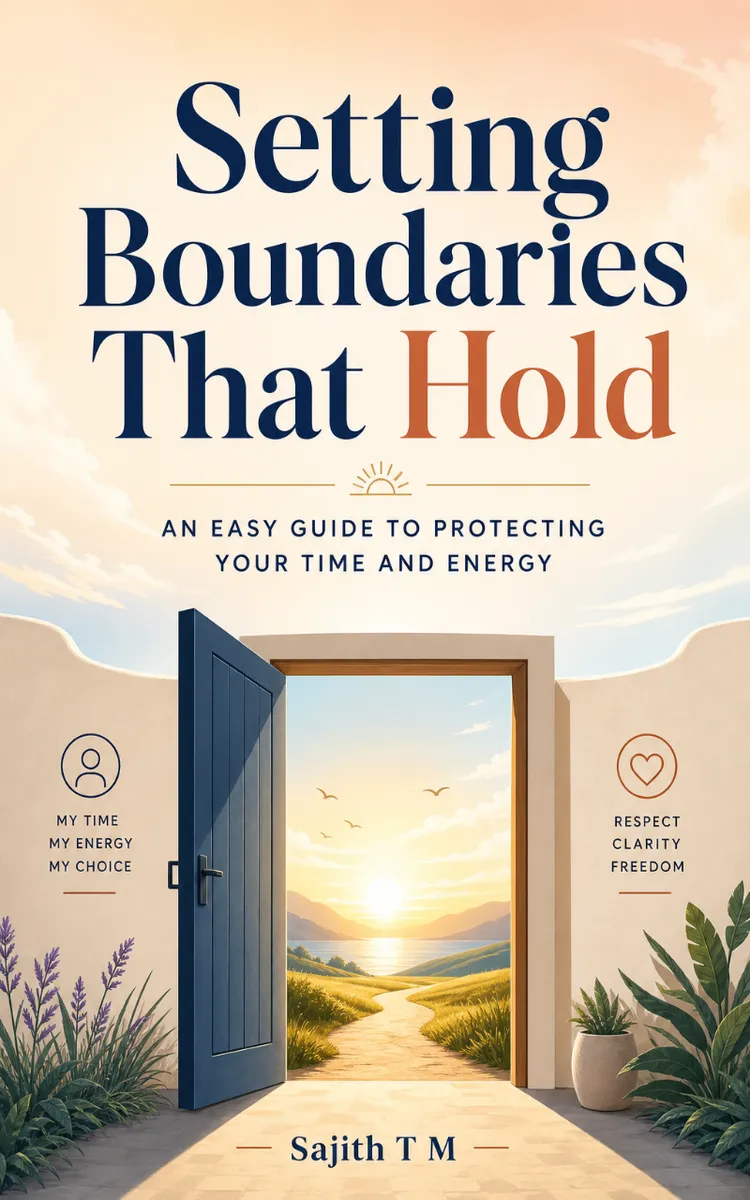
"Setting Boundaries That Hold" is a self-help book by Sajith T M with 8 chapters and approximately 11,884 words. Set boundaries that actually hold, at work and at home, without over-explaining or feeling guilty. This practical guide helps you move from automatic yes to self-respecting clarity by showing you what to change inside your thinking and what to say in real conversations.
This book was created using Inkfluence AI, an AI-powered book generation platform that helps authors write, design, and publish complete books. It was made with the AI Self-Help Book Writer.
Frequently Asked Questions
What is "Setting Boundaries That Hold" about?
Set boundaries that actually hold, at work and at home, without over-explaining or feeling guilty. This practical guide helps you move from automatic yes to self-respecting clarity by showing you what to change inside your thinking and what to say in real conversations. You will learn to spot the moment you agree without checking the cost, uncover the hidden beliefs that turn limits into moral emergencies, and use the 3-lens test to evaluate every request through time, energy, and values. Then you will translate those decisions into grounded communication that lets others manage their own disappointment. If you want practical ways to communicate limits, this is your step-by-step path to stronger self-respect and calmer relationships.
How many chapters are in "Setting Boundaries That Hold"?
The book contains 8 chapters and approximately 11,884 words. Topics covered include Claim Your Boundary Identity, Unpack Your Boundary Beliefs, Choose Limits With the 3-Lens Test, Say No Using the Pause-Name-Offer Script, and more.
Who wrote "Setting Boundaries That Hold"?
This book was written by Sajith T M and created using Inkfluence AI, an AI book generation platform that helps authors write, design, and publish books.
How can I create a similar self-help book?
You can create your own self-help book using Inkfluence AI. Describe your idea, choose your style, and the AI writes the full book for you. It's free to start.
Write your own self-help book with AI
Describe your idea and Inkfluence writes the whole thing. Free to start.
Start writingCreated with Inkfluence AI


