

Read the first chapter
The whole of chapter one, free. About 8 min. Turn the pages with the arrows, your keyboard, or a swipe.
Chapter 1
Whiteout Over Broad Pass
The windsock at Talkeetna Airport had frozen straight out, pointing east into the storm.
Skip Jackson watched it snap against its pole while snow hissed across the apron. Beyond the hangars, spruce trees vanished and reappeared behind curtains of white. Inside Ace Flying Service, the radio cracked.
“Broad Pass crew to Talkeetna,” a voice said. “We’re down to emergency rations. Generator’s failing. Need fuel, batteries, and medical supplies.”
Neil looked up from the weather printout. “They can wait until morning.”
“They’ve been waiting since yesterday,” Skip said.
“The pass is closing.”
Skip glanced through the window at the Cessna parked beside the fuel truck. Snow already clung to its wings. He wanted the flight because the survey crew needed him now, not because the weather made it interesting. Still, the familiar pull was there - the same hard invitation that had taken him through mountain gaps other pilots would not enter and across frozen rivers when the clouds pressed low enough to scrape the ridgelines.
Neil folded the report. “Don’t give me that look.”
“What look?”
“The one that ends with me explaining to the insurance company why my chief pilot is scattered across the Alaska Range.”
Skip pulled on his flight jacket. “I’ll be back before dark.”
Neil gave a humorless laugh. “It’s already dark in Broad Pass.”
The cargo took ten minutes to load. Fuel cans, batteries, medical packs, and two cases of canned food went into the rear compartment. Skip checked every tie-down himself, then walked around the aircraft with his gloved hand brushing struts, tires, and control surfaces. Ice had formed along the elevator hinge.
Neil followed him onto the ramp. “You see that?”
“I see it.”
“You’re not going.”
Skip chipped the ice away with the edge of a tool. “Then tell the crew to eat the weather report.”
“Skip.”
The wind shoved snow against them. Skip leaned into it and reached for the cockpit door.
Neil caught his sleeve. “You push the envelope every time.”
“Only when there’s something on the other side.”
“This isn’t one of your stories.”
Skip looked at him.
Neil’s grip loosened. “The time you threaded that canyon near McGrath, you had daylight. The ridge flight over the Kuskokwim, you had a working radio. And the landing on that frozen lake - ”
“The fishermen were out of fuel.”
“You nearly lost an engine.”
“But they got home.”
Neil stared toward the blurred runway. “One day, getting home won’t be part of the plan.”
Skip climbed into the aircraft. “Today it is.”
The engine turned reluctantly, coughing blue smoke into the wind. Skip waited until the oil temperature began to rise, then taxied toward the runway lights. They were dim behind the snow, small yellow beads floating in a gray world.
At the threshold, he paused. The compass swung, settled, then swung again as the aircraft shuddered beneath a gust.
“Talkeetna traffic, Ace Four-One departing east,” he called.
Neil’s voice came through the radio. “Ace Four-One, keep it short.”
Skip pushed the throttle forward.
The aircraft gathered speed. Snow streaked across the windshield. For several seconds there was no horizon, only the runway centerline sliding beneath the nose. Then the wheels lifted, and Talkeetna fell away into a smother of white.
Skip climbed by instruments, keeping his hands light on the controls. The storm pressed against the aircraft from every side. Ice ticked against the windshield. The altimeter rose. The artificial horizon held steady.
Broad Pass lay ahead, a long cut through the mountains where weather could turn a clear route into a trap. Skip had flown it in crosswinds that kicked the aircraft sideways and in sleet that turned the windshield opaque. He had learned to trust the instruments without surrendering his judgment to them. Instruments told him where the airplane believed it was. The mountains waited to tell him whether that belief was correct.
Twenty minutes out, the radio broke through.
“Talkeetna, Ace Four-One. I’m entering the pass.”
Static answered.
Skip adjusted the frequency and watched the heading. The pass should have opened ahead, but the storm had erased every landmark. White filled the windshield, flat and depthless. He reduced power and descended carefully, using the terrain map clipped beside his knee.
A sudden downdraft dropped the aircraft two hundred feet.
Skip corrected, jaw tight.
The cargo shifted behind him with a heavy thump.
“Stay put,” he muttered, though the crates could not hear him.
Another gust rolled the wings. He leveled them, then turned five degrees south to avoid the worst of the wind. The aircraft trembled but answered. The pass narrowed on the map. Somewhere beyond the white, ridges rose thousands of feet.
The survey crew’s beacon appeared as a faint pulse on the navigation receiver. Skip followed it deeper into the storm.
“Broad Pass crew, this is Ace Four-One. I’m three minutes out.”
A voice crackled back. “We can’t see you.”
“Good. I can’t see you either.”
“That’s not reassuring.”
“It wasn’t meant to be.”
The beacon flickered. Skip checked his altitude. Too high for the landing strip, too low to circle safely. He reduced power and began a shallow descent, watching airspeed and heading. The wind slapped the aircraft from the left. He held opposite rudder until the nose pointed toward the invisible runway.
Then a dark line appeared beneath the clouds.
The pass.
It surfaced for one breath, a black ridge cutting through the white, and vanished again.
Skip pulled up slightly, cleared the ridge by less than he wanted, and dropped toward the survey camp. The runway was a packed strip beside a frozen creek. He knew its direction from the map, but the storm had erased the ground.
“Crew, light the strip.”
“We’ve got lanterns.”
“Anything brighter.”
A pause. “We’ll try.”
Skip circled once, relying on the beacon and the shape of the creek beneath the snow. On the second approach, three points of amber appeared ahead. Lanterns, barely visible. He aligned with them, corrected for the crosswind, and held the aircraft just above the surface.
The wheels touched hard.
The aircraft slewed left. Skip cut power, pressed the rudder, and rode the skid until the tires straightened. Snow burst over the wings. He stopped twenty yards from the camp.
Men in heavy parkas ran toward him, bent against the wind.
Skip opened the door, and cold struck his face like thrown gravel.
“Where’s the fuel?” one of the men shouted.
“Unload it before the storm buries the airplane.”
They worked without ceremony. Cases came out of the rear compartment and disappeared into the low buildings. A man with a red scarf clambered onto the wing.
“Generator’s nearly dead,” he said. “We thought we had another day.”
“You had another hour.”
The man looked toward the pass. “Can you get back?”
Skip glanced at the sky. The storm had thickened while he unloaded. The lanterns were already fading behind sheets of snow.
“I can get airborne.”
“That wasn’t the question.”
Skip shut the cargo door. “Get the batteries inside.”
He climbed back into the cockpit and started the engine. The propeller spun, flung snow into the air, and caught. For a moment, the aircraft seemed ready to fight its way home.
Then the radio came alive.
“Skip, don’t take off.”
It was Neil.
Skip reached for the microphone. “Go ahead.”
“Weather station reports the pass is closed. Wind’s gone above - ” Static swallowed the rest.
“Neil, repeat.”
Nothing.
Skip looked through the windshield. The lanterns had disappeared. The runway was gone. The camp lights were gone. Beyond the glass, the world had become a moving wall.
The red-scarfed man stood beside the wing, pounding on the window. Skip opened the door.
“You can’t see the strip,” the man said.
“I noticed.”
“You’ll hit the creek.”
“Then mark the edge.”
“With what?”
Skip looked past him at the camp. “Everything you’ve got.”
The crew moved. Headlamps appeared first, then flashlights, then burning signal flares thrust into the snow. They formed a crooked line toward the runway, but the wind tore the smoke away and buried the flames almost instantly.
Skip watched the line vanish.
Neil’s voice broke through again, faint and distorted. “Skip, stay down. There’s no visual route.”
Skip keyed the microphone. “I’m staying.”
The words left his mouth, but the decision had already settled inside him. The supplies were delivered. The crew had fuel and batteries. His objective should have been complete.
Yet the aircraft sat in a place where the storm was closing faster than any rescue team could reach it. Remaining on the ground meant waiting for the pass to disappear entirely. Taking off meant entering a white void with no safe visual route home.
A burst of static followed.
Then another voice came through, thin and frightened.
“Talkeetna, this is Kuskana settlement. We need medical evacuation.”
Skip froze with his hand on the throttle.
Neil answered first. “State the emergency.”
“Our child is critically ill. Tessa Ward. She needs transport now.”
The radio hissed. Wind hammered the aircraft. Somewhere beyond the windows, the survey crew shouted as they dragged another vehicle toward the buried runway.
Neil’s voice returned, sharper. “Kuskana, your runway lights?”
“Not working. The storm took them out.”
“How are we supposed to land?”
“We’ll light it.”
“With what?”
“Everything.”
Skip pictured pickups lining a strip of snow, snow machines facing into the dark, four-wheelers throwing their headlights across the runway. He pictured a sick child waiting while the storm erased the village.
Neil came through again. “Skip, don’t even think about it.”
Skip looked at the blank windshield, then at the compass trembling above the panel.
“Neil,” he said, “tell Kuskana to keep their radios open.”
“Skip.”
The engine growled beneath his boots.
“Tell them to get every pickup, snow machine, and 4-wheeler onto that runway.”
“Your return route is gone.”
Skip pushed the throttle forward just enough to keep the propeller turning cleanly.
“I know,” he said. “That’s why I’m not returning.”
Outside, the survey crew’s lights vanished one by one, swallowed by the whiteout. The aircraft began to roll toward the place where the runway had been.
End of chapter one. 32 more chapters and about 62,498 words in the full book.
Swipe or use the arrows to turn the page


What's inside: 33 chapters
- 1. Whiteout Over Broad Pass
- 2. Neil's Grounding Order
- 3. The Child at Kuskana
- 4. Ice on the Taxiway
- 5. The Pilot Who Waits
- 6. A Missing Fuel Cache
- 7. The Broken Radio Trail
- 8. The Ridge Without a Pass
- 9. The Cost of Being First
- 10. The Storm Closes In
- 11. The Signal in the Static
- 12. The Frozen Creek Crossing
- 13. The Line He Won't Cross
- 14. The Hangar Power Failure
- 15. Who Cut the Relay
- 16. The Pass of Spindrift
- 17. The Village's Light Plan
- 18. Neil Takes the Keys
- 19. The Runway That Disappeared
- 20. The False Wind Report
- 21. The Frozen Lake Shortcut
- 22. The Promise to Turn Back
- 23. The Village Goes Dark
- 24. The Last Transmission
- 25. The Turnback Decision
- 26. The Canyon of Crosswinds
- 27. Neil Hands Over Control
- 28. The Lights Through Snow
- 29. A Runway Made of Headlights
- 30. The Flight for Tessa
- 31. The Mountain's Return Gift
- 32. The Chief Pilot's New Rule
- 33. Another Call at Dusk
About this book
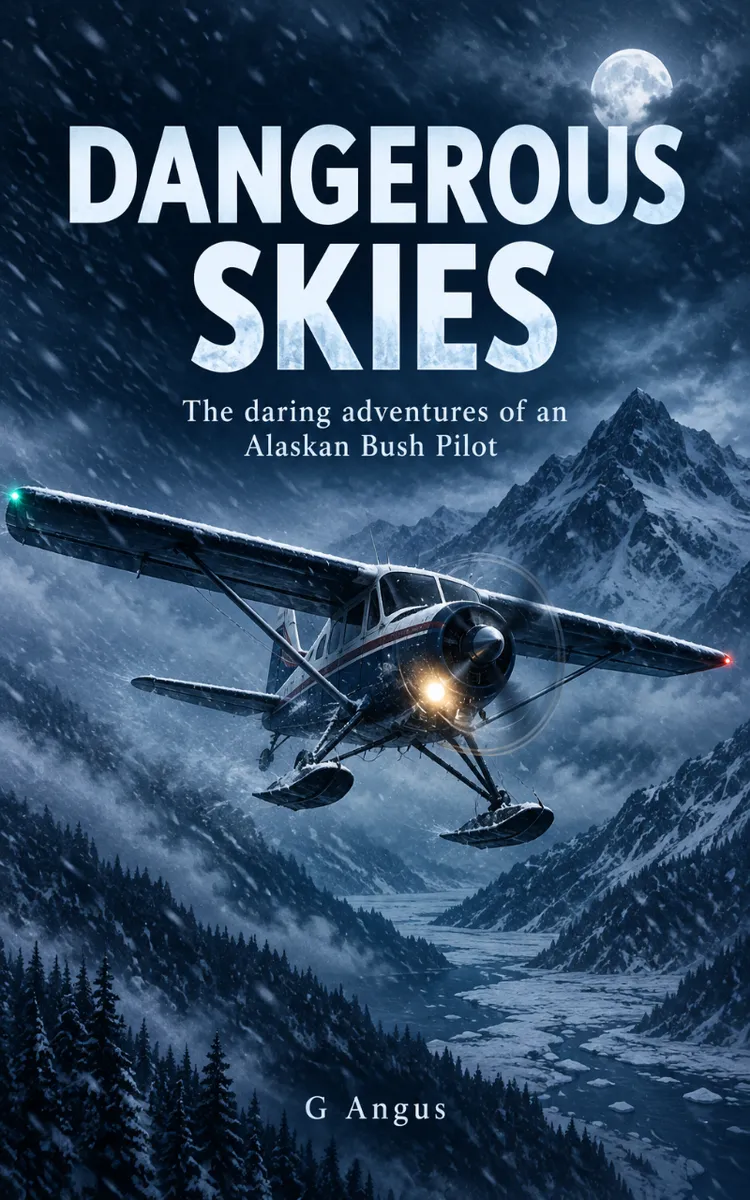
"Dangerous Skies" is a fiction book by G Angus with 33 chapters and approximately 62,498 words. A daring Alaskan bush pilot risks winter flights to rescue people in remote communities.
This book was created using Inkfluence AI, an AI-powered book generation platform that helps authors write, design, and publish complete books. It was made with the AI Novel Writer.
Frequently Asked Questions
What is "Dangerous Skies" about?
A daring Alaskan bush pilot risks winter flights to rescue people in remote communities
How many chapters are in "Dangerous Skies"?
The book contains 33 chapters and approximately 62,498 words. Topics covered include Whiteout Over Broad Pass, Neil's Grounding Order, The Child at Kuskana, Ice on the Taxiway, and more.
Who wrote "Dangerous Skies"?
This book was written by G Angus and created using Inkfluence AI, an AI book generation platform that helps authors write, design, and publish books.
How can I create a similar fiction book?
You can create your own fiction book using Inkfluence AI. Describe your idea, choose your style, and the AI writes the full book for you. It's free to start.
Write your own fiction book with AI
Describe your idea and Inkfluence writes the whole thing. Free to start.
Start writingCreated with Inkfluence AI


