

Read the first chapter
The whole of chapter one, free. About 8 min. Turn the pages with the arrows, your keyboard, or a swipe.
Chapter 1
The Trail Breaks
The first spruce vanished at arm’s length.
Karl Niderts stopped with one mitten raised, the whiteout swallowing the flat so completely that the trees behind him seemed to have been erased from the world. Snow hissed across his hood and packed itself into the folds of his coat. Somewhere beneath his boots, the winter trail ran toward the cabin, but the storm had covered every mark.
He turned his face toward the faint gray shape of the sun. It was already sinking.
“Not today,” he said.
The wind tore the words away.
Karl had been trapping in remote Alaska since he was 20. At forty-nine, he knew this spruce flat by the bend of its creek, by the low places where overflow froze beneath the snow, by the crooked black spruce that marked the safe crossing. He had crossed it in darkness, in rain, and once with a fever that made the trees sway like reeds.
Now the flat had become a blank sheet.
His cabin waited beyond the valley, less than an hour away if the route held. The stove would be cold. The water pail would be frozen solid. But the cabin meant walls, a roof, and the battered radio he had been trying to repair for three nights. He needed to reach it before dark settled over the valley.
Karl lowered his arm and leaned into the wind.
The storm drove needles of ice against his cheeks. He kept one hand on the wooden handle of his walking staff and searched for the trail with his boots. The packed line should have been beneath him, a shallow firmness under the loose snow. Instead his right foot plunged to the knee.
He lurched sideways.
The staff snapped through a crust and struck something hard below. Karl froze, weight balanced over the buried depression. A creek channel. The safe crossing had been somewhere ahead, where the spruce grew close together. He could hear water moving under the ice, a dull, trapped mutter.
He backed away one careful step at a time.
The wind rose, flattening his coat against his ribs. He could not remain in the open. The valley had no mercy for a man who waited to become certain.
Karl pulled a compass from his breast pocket. Its needle trembled, then steadied. He held it beneath his mitten, shielding it from the snow, and took a bearing toward the cabin.
The direction led straight into the trees.
He moved.
Branches clawed at his hood and shoulders. Snow slid from their limbs in heavy curtains, filling the space between one trunk and the next. Karl counted paces, stopping at twenty to check the compass. The numbers blurred in the storm. He wiped his goggles with a sleeve and saw only a pale wall.
At forty paces, the ground dropped.
He caught himself against a spruce and felt the bark scrape through his mitten. Beneath the snow, the earth sloped sharply toward the creek. His old route should have kept him on higher ground, but the storm had made every rise feel like the next.
Karl pulled a length of red cloth from his pocket. He had tied it to a branch that morning, a small marker meant for his return. It should have been near the crossing.
The branch beside him held no cloth.
He looked up. The spruce tops bent and thrashed, their needles rattling like dry bones. The marker might have been buried. It might have torn loose. It might be hanging from a tree fifty yards away, useless as a memory.
For the first time that day, uncertainty entered him coldly.
He thought of the cabin’s walls. He had built them from spruce logs when he was twenty-three, after three winters sleeping wherever he could find a roof. He had patched the chinking with moss, replaced the door twice, and learned to live with the silence pressing against the windows. The place had held him through failed seasons, broken snowshoes, empty flour sacks, and the long years when speaking aloud felt like an unnecessary expense.
He had chosen isolation because the world beyond the trees had asked too much of him. The cabin had asked only that he split wood and keep moving.
Karl tightened his grip on the staff.
“Find the high ground,” he told himself. “Then find home.”
A gust struck him from the side and drove him against the trunk. His shoulder flared with pain. He waited until the blow passed, then pushed uphill through the trees.
The spruce flat seemed to shift around him. The wind filled every hollow, erased every sound, and turned familiar distances into guesses. Karl stopped often to listen. Once he heard the creek to his left. The next moment it seemed to run behind him.
He took out his watch. The hands showed twenty minutes past four.
Darkness would come quickly.
He could turn back toward the line he had followed in, but that line no longer existed. The only shelter nearby was a stand of dense spruce ahead, where the branches might break the wind. If he reached it, he could wait until morning.
Morning meant cold. It meant the stove untouched, the cabin unreachable, and the possibility that the storm would bury the route entirely.
Karl stepped forward.
His left boot broke through a crust. He dropped hard, one knee striking ice beneath the snow. Pain shot up his leg. The staff spun away.
For several seconds he stayed bent over, breathing through clenched teeth. Snow gathered on his back. His knee throbbed, but it held when he tested it.
The staff lay two yards away.
He crawled for it, dragging the injured leg behind him, and pulled himself upright against a trunk. His glove had torn across the palm. Blood appeared as a dark line, then vanished beneath blowing snow.
“Still here,” he muttered.
The words sounded thin.
He forced himself to look beyond the nearest trees. Through the white, a darker mass rose ahead. Not spruce. A ridge.
The ridge was wrong for the trail, but it offered a choice. If he climbed high enough, he might see the valley’s far wall and find the cabin’s direction. If he stayed low, he risked the creek and the drifts gathering in its bends.
Karl turned toward the rise.
Each step cost him more than the last. Snow filled the space behind his boots as soon as he made it. He used the staff like a third leg, driving it deep and leaning on it until the surface held.
At the crest, the wind struck full force.
Karl crouched and looked down into the valley. The storm had swallowed everything except three black spruce tops and, far beyond them, a faint amber glow.
The cabin window.
He almost laughed. Instead he wiped his goggles again and stared until the glow disappeared behind the snow.
He knew its direction now. The cabin lay below, across the creek, beyond the flat.
Karl descended.
The slope delivered him into a drift up to his waist. He fell forward, arms buried, and for one terrible instant could not find the surface. Snow pressed into his collar and filled his sleeve. He kicked, twisted, and broke free onto his side.
His breath came raggedly.
The storm had changed the route from a path into a series of traps. He could no longer trust speed. He could trust only the next solid place.
He crawled until the snow firmed beneath him, then rose again.
A spruce branch struck his face. He smelled its sharp resin beneath the cold. He followed the trees downhill, feeling for the creek. When his staff punched through and met running water, he shifted right, searching for a narrower place.
There - a line of trees bent together, their roots gripping both banks. The crossing.
Karl tested the first step. The ice groaned.
He waited.
The sound faded beneath the wind.
He placed one boot down, then the other. Halfway across, the ice sagged under him. Black water flashed through a split.
Karl threw himself forward.
His chest struck the far bank. One leg remained behind, boot dipping into the creek. He seized a root and hauled himself up, water soaking the lower half of his trousers. The cold bit through the wool at once.
He lay still until the trembling stopped.
Then he crawled away from the bank.
The cabin stood less than a hundred yards ahead, hidden behind snow-laden spruce. Karl saw the chimney first, a dark crooked finger against the white. He staggered toward it, one wet leg stiffening with every step.
The door was buried nearly to the latch.
Karl dug with his hands. Snow packed beneath his fingernails and scraped his knuckles. He cleared a narrow space, found the iron handle, and pulled.
The door opened six inches before the drift stopped it.
He rammed his shoulder against the gap.
Wood groaned. Snow spilled inward. Karl struck again, then a third time, until the door gave and he fell across the threshold.
Inside, darkness held the stale scent of ash, wool, and old pine smoke.
He kicked the door shut and leaned against it while the storm battered the walls. For a few breaths, he listened to the cabin creak around him. The familiar sounds steadied him. He had reached it. The route had failed, but he had not.
Karl crawled to the stove and found yesterday’s coals beneath the ash. His hands shook too badly to strike a match. On the fourth try, a flame caught the kindling. He fed it slivers of spruce, then thicker wood, watching the fire take hold.
Warmth began at his knees.
He stripped off the wet boot and wrapped his foot in a dry cloth. The cabin seemed to settle as the stove grew brighter. Karl reached for the lamp.
A heavy thump sounded overhead.
He looked up.
Another followed, deeper this time. Snow slid across the roof with a muffled rush. Dust sifted from the rafters.
Karl stood, forgetting his knee.
The roof beam above the stove had bowed downward. A long crack ran along its edge, black as a cut. Snow pressed against the roof in a thick, uneven weight. The storm had piled the valley onto his shelter.
Karl moved beneath the beam and placed his palm against it. The wood trembled.
For decades, the cabin had been the answer to every question the wilderness asked of him. Tonight it gave him warmth, but not safety. Outside, the trail was gone. Inside, the roof had begun to sag.
He glanced toward the battered radio on the shelf, its loose wires and opened casing catching the firelight.
Then the beam creaked again.
Karl reached for his coat.
The cabin had carried him this far. Now he would have to keep it standing.
End of chapter one. 32 more chapters and about 64,623 words in the full book.
Swipe or use the arrows to turn the page


What's inside: 33 chapters
- 1. The Trail Breaks
- 2. A Voice on the Radio
- 3. Tracks Beneath the Drift
- 4. The Creek Gives Way
- 5. The Cabin He Chose
- 6. The Roof Comes Down
- 7. The Missing Marker
- 8. The Ravine Wall
- 9. The Names He Forgot
- 10. The Broken Ice Route
- 11. The Signal at Dusk
- 12. The Spruce Maze
- 13. The Price of Silence
- 14. The Wind Takes the Cache
- 15. The Map’s False Promise
- 16. The Ridge in Whiteout
- 17. The Surveyor’s Hidden Note
- 18. The Old Grudge Returns
- 19. The Radio Goes Quiet
- 20. Who Moved the Marker?
- 21. The Frozen Waterfall
- 22. The Cabin in His Mind
- 23. The Campfire Signal
- 24. The Record Cache
- 25. The Night Without Fire
- 26. The Avalanche Chute
- 27. The Choice to Call
- 28. The Empty Camp
- 29. The Voice in the Ice
- 30. The Story He Tells
- 31. The Pass Beyond Camp
- 32. A Place at the Fire
- 33. The Cabin’s Open Door
About this book
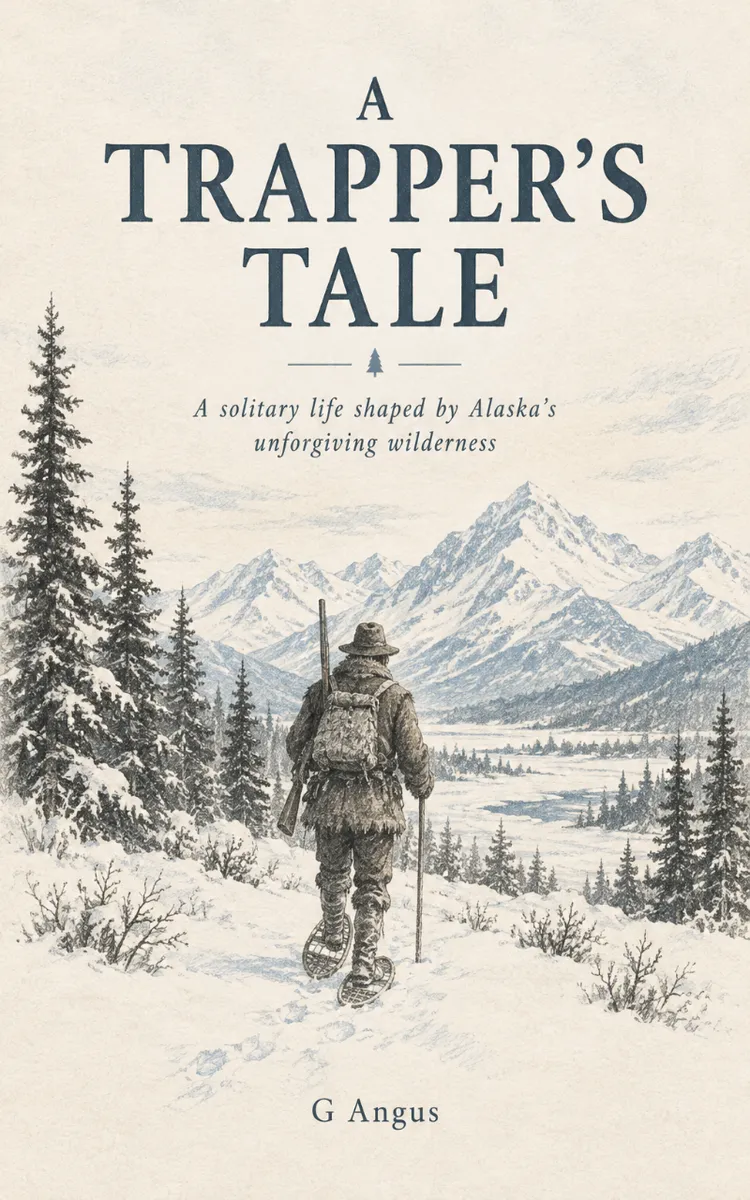
"A Trapper's Tale" is a fiction book by G Angus with 33 chapters and approximately 64,623 words. A hermit trapper's life, isolation, hardships, and resilience in remote Alaska.
This book was created using Inkfluence AI, an AI-powered book generation platform that helps authors write, design, and publish complete books. It was made with the AI Novel Writer.
Frequently Asked Questions
What is "A Trapper's Tale" about?
A hermit trapper's life, isolation, hardships, and resilience in remote Alaska
How many chapters are in "A Trapper's Tale"?
The book contains 33 chapters and approximately 64,623 words. Topics covered include The Trail Breaks, A Voice on the Radio, Tracks Beneath the Drift, The Creek Gives Way, and more.
Who wrote "A Trapper's Tale"?
This book was written by G Angus and created using Inkfluence AI, an AI book generation platform that helps authors write, design, and publish books.
How can I create a similar fiction book?
You can create your own fiction book using Inkfluence AI. Describe your idea, choose your style, and the AI writes the full book for you. It's free to start.
Write your own fiction book with AI
Describe your idea and Inkfluence writes the whole thing. Free to start.
Start writingCreated with Inkfluence AI


