
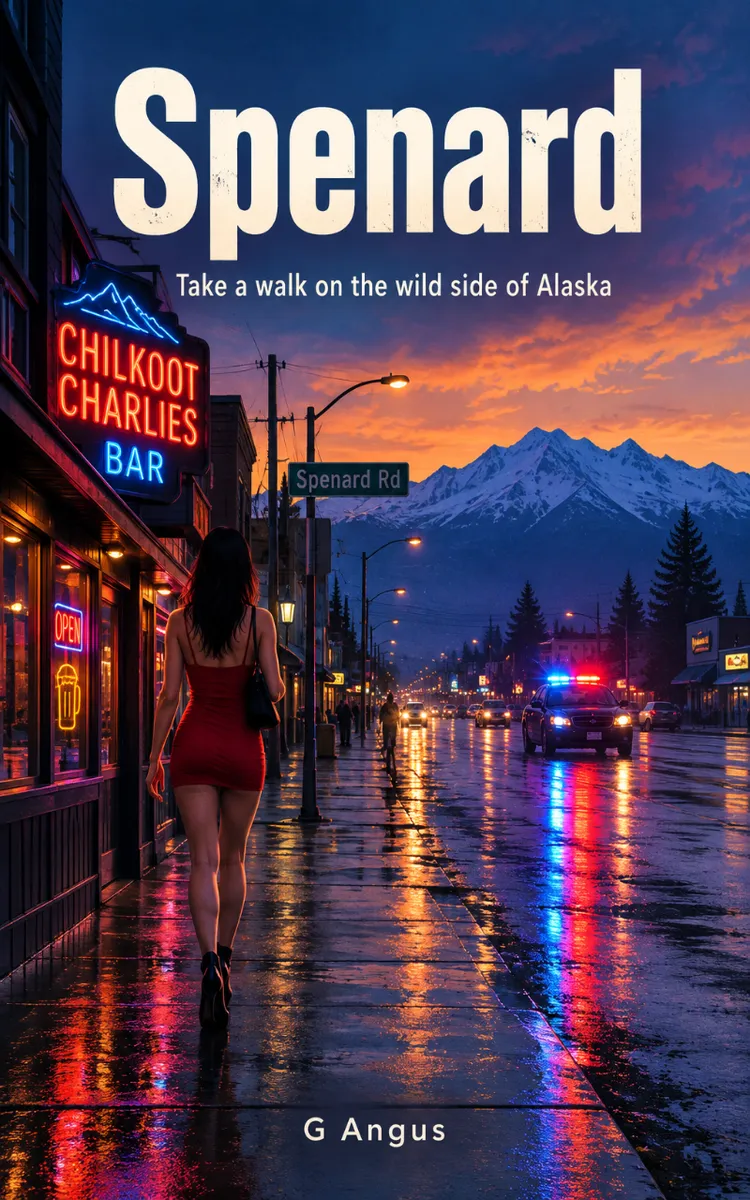

Read the first chapter
The whole of chapter one, free. About 8 min. Turn the pages with the arrows, your keyboard, or a swipe.
Chapter 1
Daylight Doesn’t Mean Safety
The neon moose above Chikoot Charlies flickered against a sky that refused to darken. Kellen Rourke stood beneath it with one hand in his jacket pocket and the other wrapped around a paper cup gone cold, watching traffic crawl north on Spenard Road.
Early evening looked like afternoon here. Summer daylight washed the road flat and merciless, catching every cracked windshield, every needle mark in the skin of an arm, every face that turned away too late.
Kellen needed to get to the airport end of the strip without anybody remembering him.
Four miles. Chikoot Charlies right to the airport. A straight line on a map, but Spenard had never been a straight line for anyone walking it. The road bent around bars, pawnshops, motels, liquor stores, and lots where busted cars sat nose-down in gravel. Street walking hookers worked the shoulders in denim and cheap jackets. Drug deals moved in the gaps between traffic lights. Robberies happened fast enough to look like accidents.
Kellen took the cup to a trash can and dropped it in.
A woman leaning against the bus shelter watched him do it. She had red hair chopped at her jaw and a bruise yellowing beneath one eye.
“Going somewhere?” she asked.
“Trying to.”
“Everybody’s trying to.”
She smiled without warmth. A pickup rolled past, its passenger window down. The driver whistled. The woman lifted two fingers, not waving. The truck slowed.
Kellen kept walking.
He stayed on the east side of the road, where the storefronts gave him glass to check behind him. He wore a dark work jacket, faded jeans, and boots still carrying white dust from a construction site. Nothing memorable. That was the idea. His face had been forgettable most of his life, and tonight he needed the gift.
At the next corner, two men stood beside a dumpster. One had a backpack pressed against his thigh. The other kept scanning the traffic.
“Not here,” the backpack man said.
“It’s here or nothing.”
“Then nothing.”
Kellen crossed the street before he reached them. A bus hissed at the curb, blocking his view. When it pulled away, the men were gone, but a woman in a silver blouse had stepped into his path.
“Hey, handsome.”
Kellen angled around her.
“Don’t be rude.”
“I’m not buying.”
“I didn’t say what I was selling.”
Her perfume followed him for half a block, sharp and sweet over gasoline and hot pavement. Behind him, she called to another passerby. A car door slammed. Somebody laughed too loudly.
He passed a liquor store with bars over the windows. A man came out holding a bottle in a brown paper bag. Two teenagers followed him, close enough to be friends and close enough to be trouble. One bumped his shoulder.
“Watch it,” the man said.
The taller teenager grabbed the bag.
The bottle hit the sidewalk and burst. The man cursed. The shorter kid drove a fist into his ribs. Kellen kept moving, but the sound of shoes scraping behind him made him glance back.
The man had gone down on one knee. The teenagers ran toward an alley.
“Help me,” the man called.
Kellen stopped.
The man looked at him through one watering eye. Blood ran from his mouth. His hand was clamped around a small black pouch that had fallen from inside his jacket.
Kellen knew that pouch.
Not the leather. Not the broken zipper. The weight of it, even from six feet away. The trouble attached to it.
The man saw recognition cross Kellen’s face.
“You,” he said.
Kellen turned and walked.
“Hey! Rourke!”
The name struck harder than the shout.
A bus roared between them. Kellen went through the first open doorway he saw, into a laundromat bright with fluorescent tubes. Washers turned in rows. A little boy slept across three plastic chairs while his mother stared at a phone.
Kellen moved to the back, past the detergent machines, and looked through the front glass.
The robbed man had disappeared. So had the teenagers.
Across the road, a thin man in a baseball cap stood beneath a dead motel sign. He wasn’t looking at the broken bottle. He was looking at the laundromat.
Kellen waited until the man turned his head, then slipped through a rear door into an alley.
The alley smelled of wet cardboard and old fryer grease. A dumpster blocked the far end. He climbed onto a milk crate, caught the top of the fence, and hauled himself over. His palm tore on the wire. He landed behind a row of parked cars and crouched until the pain settled into something useful.
A woman’s voice came from the other side of the fence.
“You lose somebody?”
Kellen looked through the links. The red-haired woman from the bus shelter stood in the alley mouth, smoking.
“Maybe.”
“Man with the black pouch?”
Kellen said nothing.
She exhaled smoke toward the bright sky. “That’s not yours.”
“I know.”
“Funny. He thought you owed him.”
“Who?”
“Depends who’s asking.”
A siren wailed somewhere south. The woman glanced toward it, then flicked ash onto the pavement.
“Name’s Tessa,” she said.
“I didn’t ask.”
“No. You look like a man who waits until asking gets expensive.”
Kellen stepped away from the fence. “What was in the pouch?”
“Something small enough to steal and valuable enough to kill over.”
“That narrows it down.”
“Not around here.”
She studied him, weighing his clothes, his hands, the way he kept his back to the wall.
“Your friend got robbed because he was careless,” she said. “You’re going to get robbed because you’re pretending you don’t know him.”
“He’s not my friend.”
“That’s worse.”
Kellen heard footsteps at the alley entrance. Tessa heard them too. Her cigarette vanished beneath her boot.
“Go,” she said.
“Why help me?”
“I’m not helping. I’m protecting my corner.”
She moved toward the street, hips loose, face bored. Kellen went the other way, through a gap between a motel and a tire shop. He came out behind a row of dumpsters and found himself beside a pay phone with its cord ripped out.
A black sedan rolled slowly past the alley.
The man in the baseball cap sat in the passenger seat.
Kellen lowered his head and walked south instead of north, back toward the road he had just left. The car continued, brake lights glowing at the next intersection.
He needed to cross the strip, but the strip had begun crossing him.
At every corner, somebody seemed to recognize the shape of him. A woman stood outside a bar, watching him in the reflection of the window. A pair of men traded a packet beneath a newspaper near a bus bench. A kid with a shaved head followed Kellen for half a block, then peeled away when a patrol car passed.
The patrol car crawled through the intersection. Kellen kept his hands visible and his pace ordinary.
He had spent enough nights learning what police noticed. Panic. Sudden turns. Hands buried in pockets. A man trying too hard to look innocent.
He passed a pawnshop where a sign promised CASH TODAY. Inside, a clerk examined a gold chain while a customer watched the door. On the sidewalk, a woman screamed that somebody had stolen her purse. Nobody stopped. A man in a green hoodie jogged away with it swinging from his fist.
Robberies and almost everything else imaginable moved along Spenard with the traffic.
Kellen cut behind a closed restaurant and came out at a corner where three men stood around a parked sedan. The trunk was open. One man held a small glass pipe. Another had a folded bill pinched between two fingers.
Drug deals on most every corner. Sometimes the merchandise changed. The posture didn’t.
Kellen saw the only open route: a narrow strip between the sedan and a chain-link fence.
The man with the folded bill saw him.
“Rourke,” he said.
Kellen stopped.
The street noise pressed around him - engines, tires, a bus kneeling at the curb, music leaking from a bar. The man with the pipe smiled.
“Thought you were gone.”
“Wrong guy.”
“You always say that?”
“Only when it’s true.”
The man nearest the trunk shut it. His hand disappeared beneath his shirt.
Kellen looked past them at the traffic light. Twelve seconds until the walk signal. Too long.
The lookout stood on the far side of the sedan, young, narrow-faced, with a tattoo climbing his neck. He watched Kellen as if trying to place a debt.
“What did he take?” Kellen asked.
The man with the bill frowned. “What?”
“The guy you robbed.”
Nobody moved.
Kellen took one step backward.
The lookout’s eyes sharpened. “You know about the pouch?”
There it was. Not a guess anymore.
Kellen turned and ran.
He crossed against traffic as a horn blasted inches from his hip. A taxi swerved and clipped a trash bin. Metal crashed across the sidewalk. Kellen ducked behind a city bus, feeling the heat of its exhaust against his face.
Someone shouted after him.
He pushed through the bus’s rear doors just as they began to close. The driver hit the brakes.
“Hey!”
Kellen stumbled down the aisle. Passengers turned, irritated and curious. He moved to the back and crouched behind a seat as the bus pulled away.
Through the window, the tattooed lookout stood in the intersection. He wasn’t chasing. He didn’t need to. He had seen Kellen’s direction.
The bus carried Kellen three blocks north, then stopped beside a motel with a vacancy sign burning red in the daylight. He got off with the other passengers and walked through the lobby.
The clerk looked up. “Room?”
“Just passing through.”
“Everybody is.”
Kellen went out the rear exit.
A service lane ran behind the motel, opening onto another stretch of Spenard. He waited beside a stack of broken pallets, listening.
No footsteps.
No shouting.
He crossed the lane and came out near a corner store. The road ahead ran clear for half a block. He could make the next bus stop, catch a ride, and disappear into the movement.
Then he saw the black sedan parked beneath the store’s faded awning.
The passenger door opened.
Kellen stepped back.
The tattooed lookout got out alone. He checked the traffic, then looked directly at Kellen.
Not searching now. Watching.
Kellen turned toward the airport, toward the long strip of daylight and the four miles still between him and open ground. He walked fast enough to gain distance and slow enough not to run.
Behind him, a car door shut.
The lookout followed.
Kellen had crossed the corner deal without getting touched. He had kept out of the hospital, at least for the moment, and the cops hadn’t taken him in.
But the road had stopped treating him like a passerby.
Under the white summer sky, somebody had put a price on his back.
End of chapter one. 32 more chapters in the full book.
Swipe or use the arrows to turn the page


What's inside: 33 chapters
- 1. Daylight Doesn’t Mean Safety
- 2. The Cash-Only Knockdown
- 3. Who the Stash Belongs To
- 4. The Trap Door Under the Neon
- 5. Kellen’s No-Hospital Promise
- 6. The Daylight Chase by the Creek
- 7. A Receipt Hidden in a Bra
- 8. Chikoot Charlies Too Busy
- 9. Tessa Brackett Names the Boss
- 10. The Robbery That Hits Kellen
- 11. Following Footprints Through Motel Light
- 12. The Runner’s Phone Goes Dark
- 13. Yvette Calder Sells a Shortcut
- 14. A Gunshot Sends Everyone Running
- 15. The Question in a Stolen Jacket
- 16. In the Hallway of Mercer’s Place
- 17. The Midday Lie That Works
- 18. Rowan Fenn Turns the Key
- 19. The Almost-Hospital Break-In
- 20. Chasing the Runner’s Vanishing Act
- 21. A Hooker’s Signal on the Corner
- 22. Marlo Vance’s Robbery Offer
- 23. The Airport-Run Gets Pulled Forward
- 24. The Receipt That Names the Cop
- 25. Kellen Breaks Under the Bright
- 26. Running the Four-Mile Strip
- 27. Kellen Uses the Hooker Network
- 28. The Wrong Vehicle, The Right Man
- 29. Mercer’s Deal Goes Loud
- 30. The Proof That Doesn’t Stay
- 31. Spenard’s Last Corner Turns
- 32. Kellen Chooses Who He Becomes
- 33. Daylight Ends the Wild Side
About this book
"Spenard" is a fiction book by G Angus with 33 chapters and approximately 62,210 words. A gritty single-night crime story on Spenard Road, Anchorage.
This book was created using Inkfluence AI, an AI-powered book generation platform that helps authors write, design, and publish complete books. It was made with the AI Novel Writer.
Frequently Asked Questions
What is "Spenard" about?
A gritty single-night crime story on Spenard Road, Anchorage
How many chapters are in "Spenard"?
The book contains 33 chapters and approximately 62,210 words. Topics covered include Daylight Doesn’t Mean Safety, The Cash-Only Knockdown, Who the Stash Belongs To, The Trap Door Under the Neon, and more.
Who wrote "Spenard"?
This book was written by G Angus and created using Inkfluence AI, an AI book generation platform that helps authors write, design, and publish books.
How can I create a similar fiction book?
You can create your own fiction book using Inkfluence AI. Describe your idea, choose your style, and the AI writes the full book for you. It's free to start.
Write your own fiction book with AI
Describe your idea and Inkfluence writes the whole thing. Free to start.
Start writingCreated with Inkfluence AI


