

Read the first chapter
The whole of chapter one, free. About 7 min. Turn the pages with the arrows, your keyboard, or a swipe.
Chapter 1
Rewriting the Introvert Dating Story
When “Quiet” Turns Into a Dating Script
Talia, 31, an introverted UX researcher, knew how to read a room - she just didn’t love being in the room. At a small work mixer, she’d stayed near the snacks, listening more than talking, nodding like a polite little lighthouse. She’d even enjoyed herself… until someone asked, “So, are you always this quiet?”
She smiled. “Yeah, I guess,” she said, like it was a fact she couldn’t change. Later, in her apartment, she replayed it like a bug report: Why did I sound awkward? Why didn’t I just say something better? The next day, she decided she’d probably “never be good at dating,” because quiet people apparently weren’t built for the back-and-forth rhythm that made other couples look effortless.
That question - are you always this quiet? - doesn’t just describe you. It can quietly write your dating story for you, especially if you’ve been carrying the belief that your personality is the problem rather than your communication needs.
How do you stop “I’m too quiet” from becoming the identity that runs your dating life?
The Introvert Identity Reframe: Quiet Isn’t a Problem to Fix
Old Belief: “I’m too quiet, so I need to talk more (or act different) to be dateable.”
New Reality: “My quiet is part of how I connect. I’m not broken - I just need an identity that supports how I actually communicate.”
Here’s what changed for Talia: the next time someone asked about her quietness, she didn’t treat it like a verdict. She treated it like a starting point. She tried a simple reframe in her own head first - I’m not failing at being social; I’m choosing a slower pace that lets me listen well. Then she tested it out in real life. When a match messaged her, she didn’t force herself into constant chatting. She asked a question that mattered to her, one that invited depth instead of speed.
For example, instead of “Hey, how’s your day?” (which made her feel like she had to perform), she wrote: “What’s something you’ve been thinking about lately, even if it’s small?” It wasn’t a dramatic transformation. It was just aligned. And because the questions matched her natural style, she felt less like she was “trying to be a different person,” and more like she was being honest sooner.
That’s the core of the Introvert Identity Reframe: you’re not trying to become louder. You’re replacing the story that says your quietness is a limitation with a story that says your quietness is information - about what helps you feel safe, what helps you focus, and what helps you connect.
Why This Identity Shift Makes Dating Calmer (Not Just “Better”)
Quiet often gets treated like a flaw with a fix button. But the real problem usually isn’t quiet itself. It’s what your quietness gets assigned to - like you must be uninterested, unconfident, or “not enough.” When you believe that assignment, you start managing your presence instead of communicating your needs.
So your brain does this fun little thing: it turns every interaction into a performance review. You monitor your volume. You scan for awkward pauses. You wonder if your messages are “too short,” or if your response times make you look like you don’t care. Even if you’re genuinely interested, you end up distracted by self-defense. That’s exhausting - and it’s exactly what makes dating feel louder than it needs to be.
Talia noticed her shift when her dates started to feel less like auditions. The biggest difference wasn’t that she talked more. It was that she stopped interpreting her natural pace as evidence that she was failing. She also got more specific about what she wanted. If a person seemed to prefer fast, constant texting, she didn’t assume she had to compete. She looked for match quality instead - someone who could handle a slower, more thoughtful exchange.
Signs This Pattern Is Running Your Life 1. You translate “slow” into “wrong.” If you take time to reply, you assume it means you’re not good at dating - even when you’re simply thinking. 2. You over-explain your personality. You catch yourself saying things like, “Sorry, I’m just quiet,” as if your baseline needs an apology label. 3. You perform your interest. You send extra messages to prove you care, then feel drained and resentful later. 4. You avoid honest pacing. You choose people who match your effort level instead of choosing people who can match your communication style.
The summary that matters When you reframe quiet as part of your connection style, you stop chasing approval and start choosing clarity.
Questions That Help You Rewrite “Too Quiet”
Answer these like you’re talking to a friend - short and honest. No courtroom arguments required.
1. Where did the belief “I’m too quiet” first start feeling true? Was it a comment in school, a dating experience, or a moment you felt misunderstood? If you’re not sure, pick the earliest memory that still makes your chest tighten.
2. What do you think people will assume if you’re quiet? “They’ll think I’m disinterested” is a common one. Write the assumption down exactly, even if it feels harsh - because that’s the belief you’re trying to replace.
3. What part of quiet is actually helping you connect (when it’s going well)? Maybe you notice details, you ask meaningful questions, or you can stay present without filling silence. Describe the “good quiet” without shrinking it.
4. What do you do to “fix” quiet in dating - message length, speed, or forced conversation? Be specific. For Talia, it was adding extra small talk when she felt herself pausing. Your pattern might look different, but it’s usually a predictable habit.
5. If your quiet wasn’t a problem, what would you do differently on a first date? Would you choose a calmer setting, ask deeper questions, or be more transparent about your communication pace? Even one small change counts.
If your answers feel messy, that’s normal. Rewriting an identity doesn’t happen all at once - it happens when you stop treating your own nature like a flaw that needs constant repair.
Start Today: 7 Days of Identity-Backed Dating Prompts
Your challenge is simple: prove to yourself that your quiet doesn’t need fixing - it needs alignment.
Challenge Title: The Quiet-Truth Messages (7 Days)
• Day 1: Write two messages you’d actually send - one “small talk” version and one “quiet-truth” version. Compare how each one feels in your body (lighter, tighter, energized, drained). - Days 2-4: Send one quiet-truth message to a match or someone you’re dating. Keep it to 1-3 sentences, but make it honest and specific (ask a real question, share a real preference, or name a gentle boundary). - Day 5: When you feel the urge to apologize for being quiet, replace it with a neutral statement about pacing or style. Example: “I’m a slower texter, but I’m consistent.” - Days 6-7: After each interaction, do a 2-minute check-in: - What did I do that matched my identity? - What did I do to perform? - What would I try next time?
Expected difficulty rating: Medium
You’ll know it’s working when... - You feel less pressure to “fill every gap” and more comfort leaving space. - You notice a change in your internal language - from “I should be better” to “this is how I connect.” - Your messages start reflecting your real preferences (calm, thoughtful, direct), not your fear of being judged.
If you don’t get the outcome you wanted (no reply, awkward vibe, or a mismatch), that’s not proof you’re wrong. It’s proof that identity alignment helps you sort faster, not perform longer.
What You Carry Into Dating Changes What You Receive
Talia didn’t suddenly become a social butterfly. She stopped treating quiet like a defect that needed constant correction. When she re-framed her identity, she stopped trying to “win” conversations and started choosing conversations that fit. That shift made boundaries feel less like walls and more like natural temperature controls - how you keep things comfortable enough for real connection to happen.
Your quiet isn’t the obstacle - your identity story about it is.
• You can replace “I’m too quiet” with an identity that supports your natural communication style. - Calmer dating starts when you stop performing and start communicating your pace and needs. - Small, honest messages built on your quiet-truth matter more than louder effort. - Boundaries don’t have to be harsh; they can be the clearest way to be yourself.
Next, we’ll turn that new identity into practical communication - so your boundaries don’t feel like awkward interruptions, but like the easiest way to be understood.
End of chapter one. 7 more chapters in the full book.
Swipe or use the arrows to turn the page

What's inside: 8 chapters
- 1. Rewriting the Introvert Dating Story
- 2. Building Social Confidence in Small Steps
- 3. Using the Two-Message Warm-Up
- 4. Saying What You Mean Without Over-Explaining
- 5. Setting Boundaries With the Kind-Direct Script
- 6. Handling Pushback When You Need Space
- 7. Choosing Dates That Match Your Energy
- 8. Staying Open While Protecting Your Heart
About this book
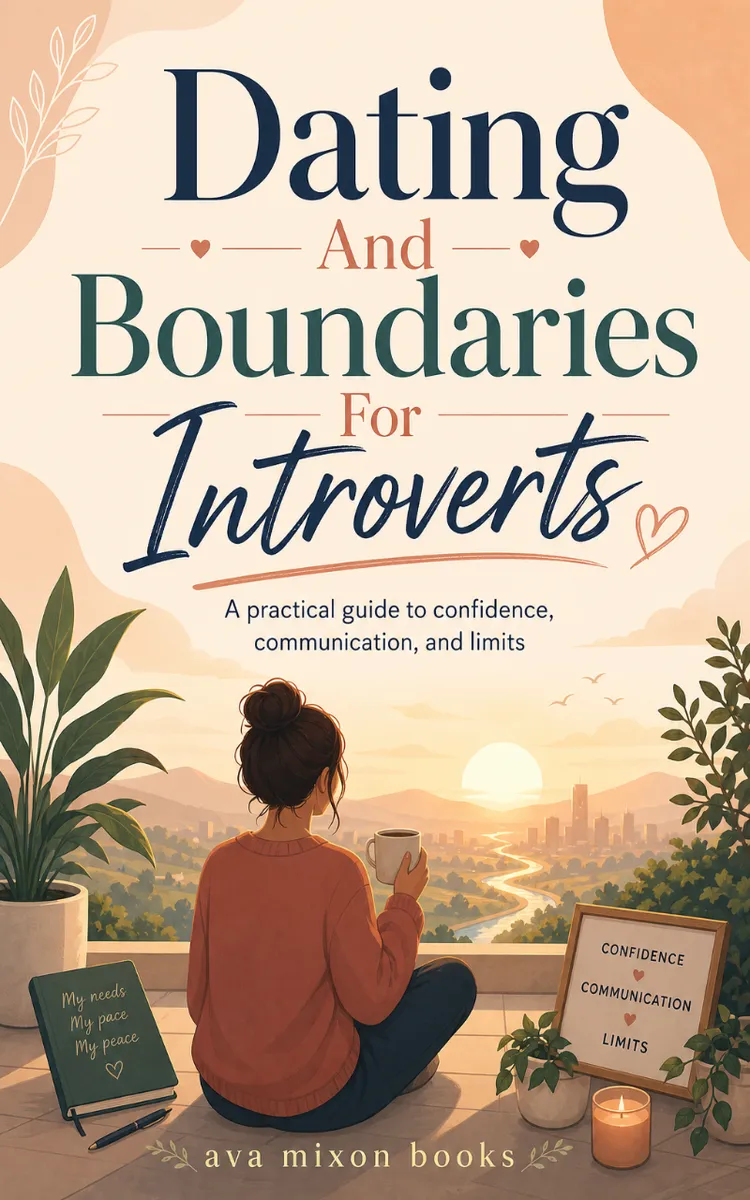
"Dating And Boundaries For Introverts" is a self-help book by ava mixon books with 8 chapters and approximately 13,021 words. Introvert-focused dating advice on boundaries and social confidence.
This book was created using Inkfluence AI, an AI-powered book generation platform that helps authors write, design, and publish complete books. It was made with the AI Self-Help Book Writer.
Frequently Asked Questions
What is "Dating And Boundaries For Introverts" about?
Introvert-focused dating advice on boundaries and social confidence
How many chapters are in "Dating And Boundaries For Introverts"?
The book contains 8 chapters and approximately 13,021 words. Topics covered include Rewriting the Introvert Dating Story, Building Social Confidence in Small Steps, Using the Two-Message Warm-Up, Saying What You Mean Without Over-Explaining, and more.
Who wrote "Dating And Boundaries For Introverts"?
This book was written by ava mixon books and created using Inkfluence AI, an AI book generation platform that helps authors write, design, and publish books.
How can I create a similar self-help book?
You can create your own self-help book using Inkfluence AI. Describe your idea, choose your style, and the AI writes the full book for you. It's free to start.
Write your own self-help book with AI
Describe your idea and Inkfluence writes the whole thing. Free to start.
Start writingCreated with Inkfluence AI


