

Read the first chapter
The whole of chapter one, free. About 10 min. Turn the pages with the arrows, your keyboard, or a swipe.
Chapter 1
Gold Dust on Hope River
The first sign of summer in Hope was not the sun but the tourists.
Eli Taylor found their boot prints pressed into the wet gravel beside Hope River, sharp enough to show the tread. One set led toward the Taylor family’s sluice boxes. Another veered into the alder thicket, where the claim boundary ran uphill toward the cabin.
He crouched and touched the nearest print. Water gathered in the hollow and trembled with the river’s vibration.
“Damn it.”
The river shoved gray snowmelt around the rocks, loud enough to swallow a person’s voice. Across the channel, the mountains still carried white in their folds, but the lower slopes had gone green and crowded with fireweed. Summer had arrived in Hope, Alaska, bringing long daylight, loose hikers, and trouble with no sense to keep it off private ground.
Eli straightened and looked toward the cabin. Its red roof showed between the spruce trunks. He had left before breakfast with one job: check the old boundary marker and run the tourists off before they reached the working cut. The Taylor family had held the claim for decades. His grandfather’s hand-cut posts still marked the upper line, though half the country seemed to believe a riverbank belonged to whoever found it first.
He followed the tracks.
The old trail narrowed where the alders leaned over it. Branches scraped his jacket, leaving wet streaks on the canvas. Somewhere uphill, a raven gave one harsh call and then another. Eli stopped.
The tourist prints continued ahead.
Beyond them, the ground dipped toward a sandbar. A blue nylon pack lay beside a fallen spruce, half open. A woman’s bright yellow rain shell hung from a branch. No people.
Eli reached for the bear spray on his belt.
“Hello?” he called.
The river answered. Then came a low, wet huff from the brush.
The alders moved.
Eli backed away as a black bear pushed through the leaves, its coat dark with river water. It was young, broad-shouldered, and close enough that he could see the pale scar crossing its muzzle. The bear lowered its head toward the abandoned pack.
Eli kept his hands visible. “Easy. I’m leaving.”
The bear snorted and took one step toward him.
He did not run. Every instinct urged him to turn, but the animal’s ears were forward, its attention fixed on the pack. Eli shifted sideways, placing the fallen spruce between them. His boot slid on mud. A branch cracked under his heel.
The bear swung its head.
Eli pulled the spray free but did not raise it. The canister felt small and useless in his palm.
“Not today,” he whispered.
The bear made a short charge.
Eli fired.
Orange mist burst across the space between them. The bear bellowed, wheeled, and crashed into the alders. Eli stumbled backward, coughing as the spray blew into his face. His eyes flooded. He dropped to one knee, the river roaring beside him.
For several seconds there was only thrashing brush and the sharp chemical burn in his throat.
Then the woods went still.
Eli wiped his eyes with his sleeve. The abandoned pack remained by the spruce, one zipper hanging open. He could see a crushed granola bar inside.
Tourists. Food. A bear driven toward the claim trail.
He rose, blinking through the tears, and backed away from the sandbar. The route to the old marker ran along the river, but the bear had made that impossible. Eli turned uphill instead, climbing through wet grass and loose stones. He would circle above the claim, confirm the marker, then find the visitors and get them back toward town.
At the top of the rise, the trees thinned.
A new orange flag snapped from a spruce on the opposite side of the ravine.
Eli stopped.
The marker should have been forty yards east, beside a split boulder shaped like a kneeling man. He knew that rock. He had fished beneath it as a boy and watched his father measure the claim line from its edge. The Taylor boundary post had stood there since before Eli was born.
Now the orange flag hung beyond the boulder, closer to the working cut.
Below it, three people moved along the riverbank.
A woman in a gray survey vest held a rod against the gravel. Two men followed with shovels and a metal case. Their voices drifted uphill between the trees.
Eli crouched behind a spruce.
The woman raised an arm. “Set it there.”
One of the men drove a fresh wooden stake into the ground.
The hammering reached Eli in dull, steady blows.
He looked toward the old marker. The post was gone.
For a moment, the only thing he could hear was the blood beating in his ears. Then anger steadied him. He pulled his phone from his pocket, but the screen showed one bar, flickering. He took a photograph of the new stake. Another of the orange flag. Then he opened the map app and watched the blue dot wander uselessly across the screen.
The woman below turned.
Eli recognized her from the general store. Mara Stephens. The Stephens family had bought the adjacent claim at the start of the season, a purchase people in Hope had discussed over coffee and beer. At first, everyone had called it good news. New owners meant money, repairs, perhaps work for locals.
The hammering continued.
Mara saw him.
“Eli Taylor,” she called. “You planning to stand up there all day?”
He stepped from behind the spruce. “Move your marker.”
The two men looked at each other. One rested both hands on his shovel.
Mara planted the survey rod in the gravel. “This is Stephens ground.”
“That post was on Taylor ground.”
“It was rotten and leaning into the river.”
“It was still the marker.”
She glanced toward the new stake. “We replaced it.”
“You shifted it.”
The river surged between them, brown water flashing around stones. Eli descended the slope, careful with each step. His eyes still burned from the spray, and every breath carried the bitter sting of it. Mara watched him come closer but did not move aside.
“Where are the tourists?” she asked.
“Upstream. Your crew left food beside the trail.”
One of the men frowned. “That wasn’t ours.”
“Your people are the ones working through a bear corridor.”
Mara’s expression tightened. “We’re not responsible for every fool who walks in from town.”
“You’re responsible for what you bring onto a claim.”
“Not yours.”
Eli reached the new stake. It had been cut clean, the wood pale and fresh. A strip of orange tape circled it twice. He knelt and examined the ground around the base. The soil was loose. Beneath the disturbed gravel, he found a small splinter of the old post, darkened by years of rain.
He picked it up.
Mara’s gaze dropped to his hand. “That doesn’t prove the line.”
“It proves you pulled it.”
“We had a survey.”
“By who?”
“Stephens family hired someone qualified.”
“Name.”
Mara’s jaw worked once. “You can speak to our office.”
Eli laughed without humor. “The Stephens family has an office now?”
“Some of us intend to build something.”
The words struck harder than they should have. Eli looked past her at the metal case, the new stakes, the men waiting with their shovels. The Taylor family’s claim had been worked carefully, season by season. They took what the river offered and left the banks standing. There had never been enough gold to make anyone rich, but there had been enough to keep the cabin roofed and the equipment running.
Mara looked at the cut below. “The old line wastes good ground.”
“There it is.”
“What?”
“Why you moved it.”
Her face flushed. “We didn’t move anything.”
A sharp crack sounded from the trees above them.
Everyone turned.
The black bear stood at the edge of the trail, orange spray staining its muzzle. It had followed the slope, drawn by the same food and noise that had brought it toward the claim. Its head swung between the people and the metal case.
One of the men lifted his shovel.
“Don’t,” Eli said.
The man froze.
Eli raised one hand. “Back away from the river. Slow.”
Mara’s eyes stayed on the bear. “How far?”
“Behind me. Keep together.”
The bear stepped onto the gravel. It sniffed the air. The river battered the shore, and the new stake trembled in its hole.
Eli backed toward the men, never turning his shoulders. “Mara, take them uphill.”
“What about you?”
“Go.”
The bear made another short advance. Eli lifted the spray. The canister was nearly empty, but he held it ready.
Mara grabbed the nearest man by the sleeve. “Up the slope.”
They retreated. Stones rolled beneath their boots. The second man stumbled, catching himself on the survey rod. The metal tip clanged against the new stake.
The bear lunged toward the sound.
Eli fired again.
The last orange cloud struck the bear’s face. It roared and swung away, clawing at its muzzle. Eli shouted and slapped the side of his leg, driving the animal toward the open bank rather than the trees where the tourists had gone. The bear plunged into the brush and vanished downhill.
No one moved.
Then Mara pulled in a shaking breath. “You had one chance left.”
“I know.”
“You could have warned us.”
“I did.”
She stared at him. The anger had not left her, but fear had cut through it. For a second she looked less like the confident owner of a new claim and more like someone who had discovered the mountain did not care what papers she carried.
From upstream came a distant shout.
Eli turned. “The tourists.”
He ran before Mara could answer.
The trail narrowed toward the sandbar, and the air filled with the sour chemical bite of bear spray. Eli found the woman in the yellow shell crouched behind a spruce, her hands over her face. A man in a red cap stood beside her, waving both arms.
“The bear went that way!” the man shouted.
“Stop waving,” Eli snapped. “Get down the trail. Now.”
“We were taking pictures.”
“You can take them from town.”
The woman looked past him. “Is it gone?”
“For the moment.”
Mara came up behind Eli with the two workers. “Everyone stays together,” she said. Her voice had lost its edge. “No food out. No running.”
The tourists gathered their packs with clumsy hands. Eli saw the granola bar wrapper near the roots and kicked it into the open bag.
“Move,” he said.
They started toward the cabin, stumbling over roots and wet stones. Eli stayed at the rear, watching the brush. Every few steps, he looked back toward the river and the fresh orange flag.
The bear did not follow.
At the cabin, Eli sat on the porch and rinsed his eyes with water from a metal cup. The tourists crowded near the steps, apologizing in turns. Mara stood apart, her survey rod tucked under one arm.
“You got their names?” Eli asked.
Mara nodded. “They’re heading back to town.”
“And the marker?”
Her mouth hardened again. “It stays.”
Eli set the cup down. His vision had cleared enough for the river to come into focus. He took photographs of the old post splinter, the empty hole beside the boulder, and the new stake below. He recorded the time and location in his phone, then opened the camera and filmed the marker from the river to the ridge.
Mara watched him.
“You’re documenting a misunderstanding,” she said.
“I’m documenting a boundary change.”
“We have authorization.”
“From whom?”
“From the Stephens family’s surveyor.”
“That isn’t authorization to move a Taylor marker.”
“It wasn’t a Taylor marker.”
Eli looked at her through the last of the burning in his eyes. “Then why did you replace it?”
Mara did not answer at once. Downriver, one of the workers called her name. She turned toward the sound, then back to Eli.
“The line was wrong,” she said. “We corrected it.”
“Your correction puts your dig through our sluice channel.”
“We’re not digging through anything.”
“Not yet.”
The phone in Eli’s hand finished saving the video. He checked the file twice, then sent it to the Taylor family’s old email account and to the local land office. The message included the photographs, the coordinates, and three words in the subject line: Marker moved today.
Mara saw the screen. “You think that makes you right?”
“No,” Eli said. “It makes a record.”
The river carried a flash of gold-colored gravel past the cabin steps and swallowed it in the current.
Mara stepped closer. “The Stephens family was told this ground belonged to us.”
“Then whoever told you lied.”
“Or your family has been holding more than it owns.”
Eli felt the old claim beneath his boots - the porch boards repaired by his father, the cabin walls cut from trees on the ridge, the river that had paid for every winter’s fuel. He wanted to answer with certainty. Instead, he saw the new stake below, pale and straight, standing where the old marker had stood.
Mara lifted her survey rod.
“We’ll be back tomorrow,” she said. “With the rest of the crew.”
Eli watched her walk toward the river.
The photograph remained open on his phone: orange tape, fresh wood, disturbed gravel. Behind the stake, the mountains rose over Hope, bright beneath the long summer light.
He saved the image again, then looked toward the trail where the tourists had disappeared.
The claim was no longer quiet.
End of chapter one. 32 more chapters in the full book.
Swipe or use the arrows to turn the page


What's inside: 33 chapters
- 1. Gold Dust on Hope River
- 2. The Stephens Survey Line
- 3. A Map That Doesn’t Match
- 4. Bear Tracks Behind the Cabin
- 5. Eli’s Promise to Keep Peace
- 6. The Mediation That Turns Ugly
- 7. Who Stole the Deed Page?
- 8. Tourists Found in the Cut
- 9. Nora Chooses the Hard Truth
- 10. The River Road Washout
- 11. Attorney Kellan’s Uncomfortable Question
- 12. The Cabin Fire That Isn’t an Accident
- 13. Eli Finds Mara’s Hidden Ledger
- 14. A Bear Mauls the Wrong Man
- 15. The Ledger’s Tour Ticket Trail
- 16. Storm Locks the Ridge Pass
- 17. The Mid-Summer Witness Appears
- 18. Nora Breaks With Kellan Rusk
- 19. Eli Risks Everything for the Envelope
- 20. The Smudged Name Finally Reads
- 21. Tessa Marrow Offers a Deal
- 22. Eli’s Concession Costs the Claim
- 23. The Second Bear Incident
- 24. The Court Date Approaches Fast
- 25. Nora Loses the One Proof
- 26. Ridge Search for the Burn Origin
- 27. Nora’s Confession to the Witness
- 28. The Tour Operator’s Phone Call
- 29. Mara’s Claim Expands Overnight
- 30. Hope River Held Again
- 31. The Judge Credits the Witness
- 32. Eli Chooses Hope Over Gold
- 33. A Summer Ending With Tracks
About this book
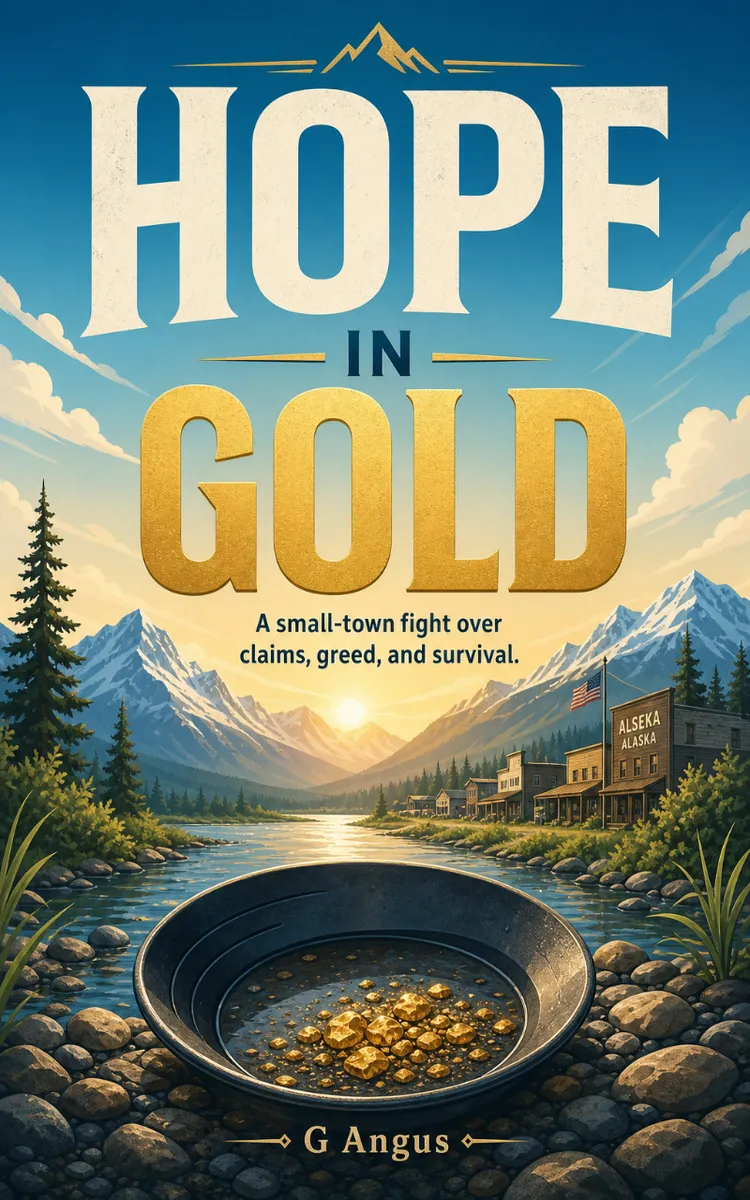
"Hope In Gold" is a fiction book by G Angus with 33 chapters and approximately 66,160 words. A family dispute over mining claims in Hope, Alaska..
This book was created using Inkfluence AI, an AI-powered book generation platform that helps authors write, design, and publish complete books. It was made with the AI Novel Writer.
Frequently Asked Questions
What is "Hope In Gold" about?
A family dispute over mining claims in Hope, Alaska.
How many chapters are in "Hope In Gold"?
The book contains 33 chapters and approximately 66,160 words. Topics covered include Gold Dust on Hope River, The Stephens Survey Line, A Map That Doesn’t Match, Bear Tracks Behind the Cabin, and more.
Who wrote "Hope In Gold"?
This book was written by G Angus and created using Inkfluence AI, an AI book generation platform that helps authors write, design, and publish books.
How can I create a similar fiction book?
You can create your own fiction book using Inkfluence AI. Describe your idea, choose your style, and the AI writes the full book for you. It's free to start.
Write your own fiction book with AI
Describe your idea and Inkfluence writes the whole thing. Free to start.
Start writingCreated with Inkfluence AI


