
Read the first chapter
The whole of chapter one, free. About 6 min. Turn the pages with the arrows, your keyboard, or a swipe.
Chapter 1
The Invisible Storm Inside
When Your Mind Turns Into a Storm
Have you ever been lying in bed, trying to rest, when one small thought suddenly opens the door to twenty more? What if I made the wrong choice? What if something goes badly tomorrow? What if I can’t handle it? Your body tightens before you’ve even finished the thought. Your chest feels crowded, your stomach turns, and your mind starts searching for an answer that never quite arrives.
By morning, you may be exhausted from a night spent thinking rather than sleeping. You might check a message again, avoid a difficult conversation, rehearse every possible outcome, or keep busy so you don’t have to feel what’s happening inside. None of this means you’re weak or broken. It means an anxiety cycle has begun - and it can be mapped.
The storm feels like you, but it is a pattern moving through you.
From “This Is Me” to “This Is Happening”
Old Belief: If my thoughts feel frightening or convincing, they must reveal who I am or what will happen.
New Reality: Thoughts, emotions, physical sensations, and behaviors can form an anxiety cycle without defining you or predicting the future.
This shift matters because anxiety often hides its pattern. A thought appears - I’m going to mess this up - and quickly feels like a fact. Your emotions respond with fear or shame. Your body joins in with a racing heart, tight shoulders, or a restless stomach. Then your behavior tries to reduce the discomfort: you check, avoid, seek reassurance, overprepare, or replay the situation. The temporary relief teaches your mind to repeat the cycle next time.
Consider receiving a short message from someone you care about: “Can we talk later?” The thought might be, They’re upset with me. Your chest tightens. You feel dread. You reread the message, send several follow-ups, or spend the afternoon reviewing everything you said recently. Those actions may calm you for a few minutes, but they also keep the original thought important. You’ve treated a possibility as an emergency.
The Anxiety Cycle Map gives you a different place to stand. Instead of asking, “Why am I like this?” you can ask, “What happened first? What did my mind say? What did my body feel? What did I do next?” That curiosity creates space. You don’t have to approve of the thought or force it away. You’re simply noticing the chain, and that’s a powerful beginning.
Reading the Anxiety Cycle Map
Anxiety usually moves through four connected parts: thoughts, emotions, physical sensations, and behaviors. They don’t always appear in a neat order. A body sensation can come first, followed by a frightening explanation. A behavior such as checking can create a new thought. The important point is that each part can strengthen the others.
A thought might be a prediction, question, memory, image, or harsh judgment. An emotion might be fear, embarrassment, anger, sadness, or helplessness. Physical sensations can include a pounding heart, shallow breathing, muscle tension, dizziness, heat, nausea, or exhaustion. Behaviors are what you do in response - avoidance, checking, withdrawing, arguing, overthinking, distracting yourself, or asking someone to reassure you.
When you map the cycle, you’re not putting yourself on trial. You’re gathering information. The goal isn’t to prove that your anxiety is unreasonable. The goal is to see how it operates, especially when you’re caught inside it.
Signs the Pattern Is Running Your Life
• You treat every “what if” as a problem requiring immediate action.
A possibility about tomorrow steals your attention from what’s actually happening today.
• You keep searching for certainty but feel less certain afterward.
You reread messages, replay conversations, or ask for reassurance, yet your mind soon produces another doubt.
• Your body reacts before you understand why.
Your shoulders rise, your stomach knots, or your breathing changes, and then your mind rushes to explain the sensation.
• Your choices are organized around avoiding discomfort.
You postpone a call, stay silent, cancel plans, or overprepare - not because those choices fit your values, but because they briefly reduce fear.
The map doesn’t judge the storm; it shows you where the storm is moving.
Once you can name the parts, the experience becomes less like a single overwhelming truth. “I’m in danger” can become “I’m noticing a danger thought, a wave of fear, tightness in my chest, and an urge to check.” That wording may feel small, but it separates you from the cycle. You’re still experiencing anxiety, but you’re no longer completely fused with it.
Questions That Reveal Your Pattern
• What was the first thought, image, or sensation before the anxiety grew?
Try to identify the earliest piece rather than the loudest one. It might have been a brief thought such as, I hope I didn’t sound foolish, or a physical shift you noticed while waiting for a reply.
• What emotion followed that first thought?
Naming the feeling can make it more specific. Instead of “I feel bad,” you might discover fear of rejection, embarrassment, disappointment, or helplessness.
• Where did anxiety show up in your body?
Notice one location and describe it plainly: tightness behind the ribs, buzzing in the hands, a clenched jaw, or heaviness around the eyes. You don’t need to make the sensation disappear to observe it.
• What did you do to get relief?
Be honest without criticizing yourself. Maybe you checked your phone twelve times, avoided opening an email, searched for answers online, or asked someone, “Are you sure everything’s okay?”
• What did that behavior protect you from feeling or facing?
Anxiety often tries to protect you from uncertainty, rejection, failure, conflict, or the feeling of being out of control. Understanding the protective aim doesn’t mean obeying the anxiety; it helps you respond with more patience and choice.
You might write four short lines in a notebook: Thought / Emotion / Body / Behavior. For a message-related worry, it could read: They’re angry with me / dread / tight chest / reread the conversation and ask for reassurance. That simple record can turn a blur into a pattern you can work with.
The Seven-Day Anxiety Cycle Map Challenge
For the next 7 days, map one anxiety cycle each day without trying to fix it immediately.
• Choose a consistent time, such as after dinner, and spend five minutes writing the four parts: thought, emotion, physical sensation, and behavior.
• Use one specific moment rather than describing the whole day.
• Add one final sentence: “What might this anxiety have been trying to protect me from?”
• When the cycle appears during the day, pause for one slow breath and silently say, “This is a thought, a feeling, a body sensation, and an urge to act.” Then continue with your next reasonable step.
• At the end of seven days, look for repeated beginnings and repeated behaviors. You may notice that uncertainty, waiting, criticism, or tiredness starts the cycle more often than you realized.
Difficulty: Medium
You’re not being asked to eliminate anxiety or produce perfect notes. Some days, you may remember the cycle only afterward. That still counts. Here’s how to make it easier: keep the notes app open on your phone or place a small card beside your bed with the four words written on it.
You’ll know it’s working when...
• You can describe an anxious episode without calling yourself the problem.
• You notice the urge to check, avoid, or overthink before acting on it.
• You can separate “I’m having the thought that…” from “This is definitely true.”
• You recover your attention a little sooner after the cycle begins.
• You recognize what anxiety is trying to protect you from, even when its method isn’t helpful.
Seeing the Storm Without Becoming It
Anxiety may create thoughts, feelings, sensations, and urges - but none of them is your identity or a guaranteed forecast.
• You learned to use the Anxiety Cycle Map to trace thoughts, emotions, physical sensations, and behaviors.
• You saw how temporary relief from checking, avoidance, or reassurance can keep the cycle going.
• You practiced observing the pattern without shame or judgment.
• You found a concrete way to notice what anxiety may be trying to protect you from.
The next time your mind begins racing, you don’t have to win an argument with every thought. Start by locating yourself on the map. Once you can see the cycle, you’ve already created a little room inside it - and that room is where a different response can begin.
End of chapter one. 7 more chapters in the full book.
Swipe or use the arrows to turn the page
What's inside: 8 chapters
- 1. The Invisible Storm Inside
- 2. Your Mind Generates Stories
- 3. Meet the Observer, Not the Thought
- 4. When You Fight, It Gets Louder
- 5. Anxiety Lives in the Future
- 6. Ground Your Attention to the Present
- 7. Stop Believing Every Story
- 8. Act With Anxiety, Choose the Observer
About this book
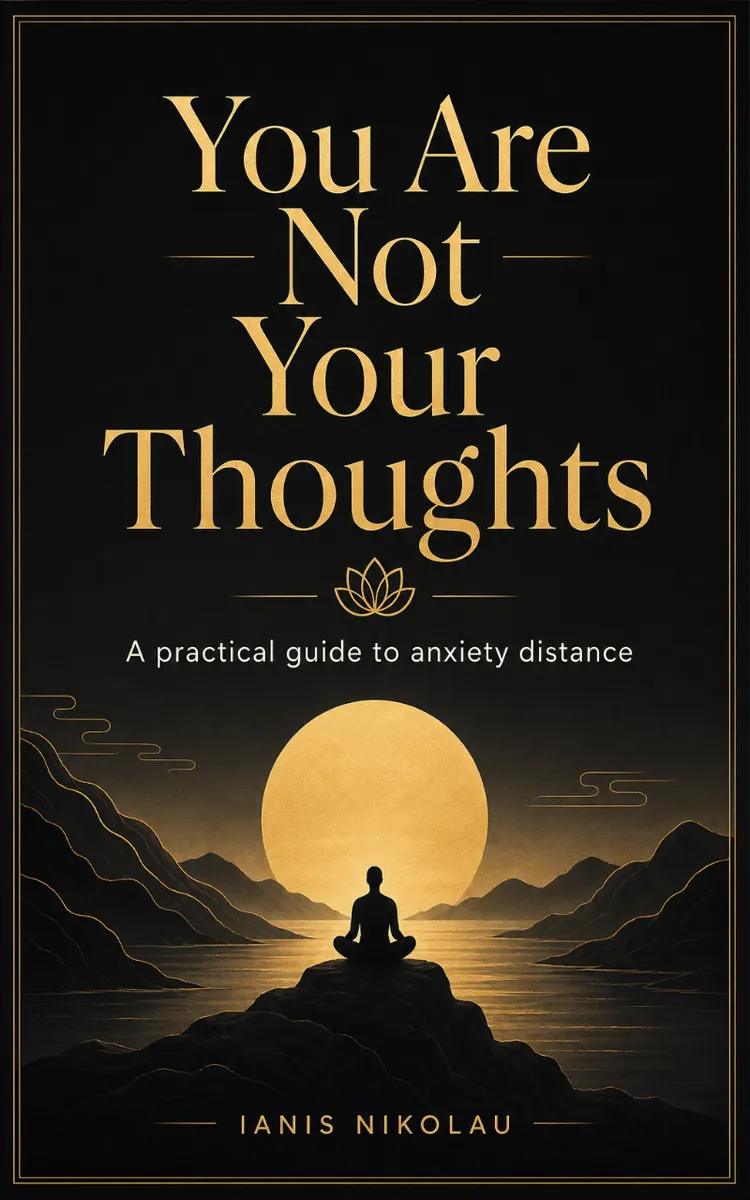
"You Are Not Your Thoughts" is a self-help book by Anonymous with 8 chapters and approximately 12,013 words. Learn to observe anxious thoughts as mental events, not facts or identity—then return to the present with calm, practical tools..
This book was created using Inkfluence AI, an AI-powered book generation platform that helps authors write, design, and publish complete books. It was made with the AI Self-Help Book Writer.
Frequently Asked Questions
What is "You Are Not Your Thoughts" about?
Learn to observe anxious thoughts as mental events, not facts or identity—then return to the present with calm, practical tools.
How many chapters are in "You Are Not Your Thoughts"?
The book contains 8 chapters and approximately 12,013 words. Topics covered include The Invisible Storm Inside, Your Mind Generates Stories, Meet the Observer, Not the Thought, When You Fight, It Gets Louder, and more.
Who wrote "You Are Not Your Thoughts"?
This book was written by Anonymous and created using Inkfluence AI, an AI book generation platform that helps authors write, design, and publish books.
How can I create a similar self-help book?
You can create your own self-help book using Inkfluence AI. Describe your idea, choose your style, and the AI writes the full book for you. It's free to start.
Write your own self-help book with AI
Describe your idea and Inkfluence writes the whole thing. Free to start.
Start writingCreated with Inkfluence AI


