

Read the first chapter
The whole of chapter one, free. About 3 min. Turn the pages with the arrows, your keyboard, or a swipe.
Chapter 1
Days 1-4: Set Up Your System
What if your planner isn’t failing because you lack discipline, but because using it takes too much effort? The Frictionless Setup Sprint removes the tiny obstacles that make planning disappear from your day.
Over these four days, you’ll choose one visible home for your plan, build a short daily template, add useful reminders, and test the setup in real life. Keep it simple. A system you use imperfectly beats a beautiful system you avoid.
Day 1: Choose One Home Base
Tip of the Day:
Your plan needs one obvious home. Not three apps, a notebook, loose sticky notes, and a reminder buried under twelve notifications. Pick the place you’ll check most reliably: a paper planner on the kitchen counter, a notes app pinned to your phone, or a calendar you already open every day.
Make it visible and easy to reach. If you use paper, leave it open beside your keys or coffee mug. If you use your phone, place the app on the first screen. Your goal isn’t to create the perfect setup. It’s to stop asking your brain, “Where did I put the plan?”
Today's Action:
Choose one planning home, put it in a visible spot, and remove any competing planning tools from your usual workspace.
---
Day 2: Build Your Tiny Daily Template
Tip of the Day:
A daily plan should tell you what matters without becoming another project. Use three parts: one must-do task, two should-do tasks, and a short list of appointments or fixed commitments. That’s enough structure to give your day a shape.
Write tasks as visible actions, not vague categories. “Work on invoices” is harder to start than “Send the three overdue invoices.” “Clean up” is foggy; “Put dishes in the dishwasher” gives your brain a first move. Keep the template short enough to finish while your coffee is still hot.
Today's Action:
Create a daily template with these labels: Must Do, Should Do, and Fixed Time, then fill it in for tomorrow using no more than four tasks.
---
Day 3: Add Cues That Catch You
Tip of the Day:
A reminder only helps if you notice it at the right moment. “Remember to plan” at 7:00 a.m. may be useless if you’re rushing, searching for socks, or already handling a problem. Attach your planning cue to something that already happens, such as brushing your teeth, opening your laptop, or locking up at work.
Use a physical cue too. Put the planner on your keyboard, place a bright card near the door, or set your phone alarm with a clear label like “Open planner and choose one task.” The cue should tell you what to do next. A vague alert creates another decision, and decisions are where many plans quietly vanish.
Today's Action:
Place one visible cue beside an existing routine and set one labeled reminder for your daily planning time.
---
Day 4: Run a Real-Life Test
Tip of the Day:
Today, use your setup during an actual day instead of judging it from the sidelines. Notice where the plan helps and where it creates friction. Did you forget to check it? Was the writing too small? Did one “must-do” task secretly contain five separate jobs? These aren’t failures. They’re useful instructions.
Make one adjustment only. Move the planner, shorten the template, change the reminder time, or rewrite a task in smaller pieces. Resist the urge to rebuild everything. The Frictionless Setup Sprint works through small repairs, not dramatic system makeovers (those are fun for about twenty minutes).
Today's Action:
Use your daily template once today, then write down one obstacle and make one practical change before tomorrow.
---
Your setup now has a home, a shape, a cue, and a test behind it. That’s enough to begin. The aim isn’t to control every minute; it’s to make the next useful action easier to see and easier to start.
End of chapter one. 7 more chapters and about 5,685 words in the full book.
Swipe or use the arrows to turn the page


What's inside: 8 chapters
- 1. Days 1-4: Set Up Your System
- 2. Days 5-8: Build Focus Blocks
- 3. Days 9-12: Master the 3-List Method
- 4. Days 13-16: Handle Time Blindness
- 5. Days 17-20: Use Friction Killers
- 6. Days 21-24: Build Momentum with Wins
- 7. Days 25-28: Plan for Setbacks
- 8. Days 29-30: Lock In Your Long-Term Plan
About this book
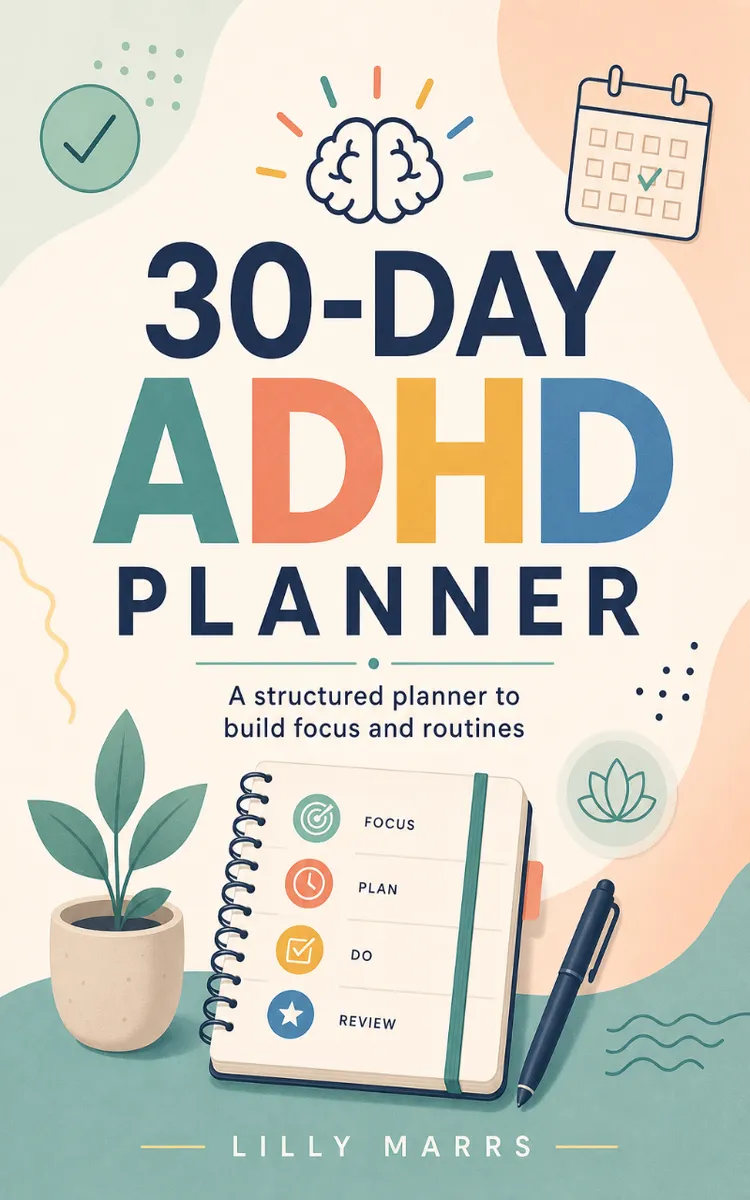
"30-Day ADHD Planner" is a day challenge book by Lilly Marrs with 8 chapters and approximately 5,685 words. 30-day planner for managing ADHD habits and organization.
This book was created using Inkfluence AI, an AI-powered book generation platform that helps authors write, design, and publish complete books.
Frequently Asked Questions
What is "30-Day ADHD Planner" about?
30-day planner for managing ADHD habits and organization
How many chapters are in "30-Day ADHD Planner"?
The book contains 8 chapters and approximately 5,685 words. Topics covered include Days 1-4: Set Up Your System, Days 5-8: Build Focus Blocks, Days 9-12: Master the 3-List Method, Days 13-16: Handle Time Blindness, and more.
Who wrote "30-Day ADHD Planner"?
This book was written by Lilly Marrs and created using Inkfluence AI, an AI book generation platform that helps authors write, design, and publish books.
Write your own day challenge book with AI
Describe your idea and Inkfluence writes the whole thing. Free to start.
Start writingCreated with Inkfluence AI


