
Read the first chapter
The whole of chapter one, free. About 13 min. Turn the pages with the arrows, your keyboard, or a swipe.
Chapter 1
The Shelter That Won’t Hold
A loose sheet of tin snapped against a bent beam as Mara eased the shelter door wider, and the sound made her flinch harder than the cold did. The neighborhood around her had gone quiet in the ways that weren’t peace - no birds, no distant engines, only the thin ticking of metal cooling after the day’s last heat. Inside, darkness pressed close until her eyes found the familiar landmarks she’d memorized on the way in: the soot-stained wall where someone had once painted a children’s mural, the sagging row of bunks with their mattresses long gone, the corner where rain always pooled when the roof didn’t.
Her group had been scattered since morning. One pair had slipped away after a distant argument. Another person had chased a scrap of radio static and didn’t come back. Mara had stayed because she’d found this shelter on the map-like scrawl she carried in her head - partially collapsed, but roofed. Partially intact. Something she could claim as hers for the night, something her people could stand under without thinking about the open streets.
“Keep your voice down,” she said, and her words sounded too loud in the dim. She didn’t know who would be listening. She didn’t know if anyone would answer. Still, she spoke like the shelter could hear her and decide to hold.
She stepped carefully over a mat of broken plaster and glass. Her boots crunched, then sank where the floor had given up and turned into uneven rubble. The air carried damp earth and old smoke, a smell that reminded her of wet ash and the way it clung to everything - cloth, hair, the inside of your throat. She crouched by the inner partition and ran her fingers along a crack in the wall. The plaster flaked away in flakes the color of bone.
“Is there anyone here?” a voice rasped from somewhere deeper, thin as paper.
Mara turned toward it, relief and caution wrestling in the same breath. “If you can stand, come closer. I’ve got light.”
A figure emerged from behind a collapsed column, shoulders hunched inside a coat that had once been some other color. The person’s face was smeared with soot, and their eyes kept darting past Mara to the ceiling like they expected it to fall in the next second.
“You found it?” they asked. Their voice held hunger, not just for food - for shelter that could be trusted.
“I found it,” Mara said. She didn’t promise. Promises were expensive now. “We can make it for the night. Tell me what you’ve got.”
The answer came with a glance at Mara’s empty hands. “Nothing.” Then, softer, “I thought it would stop. The ground. The shaking.”
Mara listened. The silence after a tremor was never clean; it had a residue, a lingering vibration that lived in the bones. She had felt the aftershocks since dawn, the way the world kept testing itself. Now, there was only the faint metallic creak of beams working under stress, and somewhere close, water dripped into a bucket that had been left there too long ago.
“I’ll fix what I can,” Mara said, and moved fast before doubt could spread. She pulled a tarp from where it had been wedged against a support post and shook dust loose. The cloth came away gritty. She dragged it across the floor, laying it to catch the drips. When she lifted the corner, the bucket shifted, and a dark stream ran over the tarp like ink.
The first aftershock hit like a hand closing around the shelter. The metal groaned. Something above her dropped with a heavy, muffled thud. Mara’s spine locked; she tasted grit on her tongue that she hadn’t breathed in.
The figure behind her swore under their breath. “It’s coming down.”
Mara grabbed the nearest beam with both hands and shoved against it, feeling the wood flex. The whole structure didn’t collapse - yet - but the ceiling shifted, and the crack in the plaster widened enough to show a seam of darkness like a wound. Dust rained down in a soft, constant fall.
“Hold on,” she said, though she wasn’t sure who she was telling. Her group needed morale, yes. They also needed truth shaped into something they could survive.
She guided the person toward the inner partition where the roof looked sturdier, wedging the tarp there too. Their hands were shaking as they helped. Mara noticed how their fingers kept moving as if they could see the next failure coming and wanted to outrun it.
The aftershock faded, leaving the shelter with a new kind of quiet. Not safety - just a pause.
Mara checked the ceiling again. The leak had worsened. Water had started to seep through a gap near the beam, spreading into a thin sheet that made the floor slick. She touched it with two fingers and pulled them back quickly. It was cold, colder than the air, and it smelled faintly of chemicals - the sour edge of something that didn’t belong in drinking water.
The person watched her face. “Is it bad?”
Mara didn’t want to say yes. She wanted to say the shelter was just tired, that she could patch it and carry on. But her eyes caught the dark specks in the water, glittering where the light from her improvised flame-stand struck it.
“It’s not for drinking,” she said. She forced the words to be steady. “We can catch it for washing, maybe. If it doesn’t get worse.”
The figure swallowed. “We don’t have washing water.”
Mara’s stomach tightened at the bluntness. She’d planned to trade. She’d planned to barter a night’s steadiness in exchange for anything she could give - extra bandage cloth, a strip of cured meat from her pack, her own time spent searching. She’d pictured her group gathered under a roof, laughing at how close they’d come to sleeping in the street.
Plans were only paper now.
She heard movement outside: footsteps on rubble, a muffled scrape like a cart being dragged without wheels. Voices followed - two people, arguing over something small and sharp. Then a third voice, quieter, calling Mara’s name with the careful hope of someone who didn’t want to be wrong.
Her heart lurched. She stepped out into the corridor between collapsed houses where the air was colder and the sky looked too wide. A gust of wind pushed dust through the street like a slow sandstorm. Mara held the edge of the doorframe and called back, “Bring them this way. Inside. We might have a chance.”
The three survivors arrived in a stagger - one limping, one carrying a bundle of cloth, one with a face so blank it made Mara fear they’d already run out of something important. They moved with the practiced caution of people who’d learned what danger sounded like.
The limping person looked past Mara into the shelter and stopped. “It’s shaking.”
“It’s done for now,” Mara said, and hated how thin it sounded. She turned to the person who’d brought the first warning and caught their eye. “How many drips?”
The answer came quickly. “Enough to make the floor shine. And it keeps widening.”
Mara felt the shelter listening to her fear. She could almost see the beams’ stress lines, the way the structure had been holding itself together with luck and old repairs. She had believed luck could be counted on. That was the lie she’d carried when she decided to stay.
She guided the newcomers inside anyway, because the alternative - out in the open - meant spending the night under whatever the sky decided to drop. She set the tarp so it could catch the leak, then she wedged more fabric into the crack where water seeped in, using strips she tore from the tarp itself. The cloth absorbed quickly, turning from dull gray to darker, heavier fabric.
“Is there dry space?” the limping person asked.
Mara pointed to the far corner where the ceiling had held the longest. “There. Not dry, but less wet.”
They settled there with the kind of gratitude that didn’t feel like gratitude. It felt like survival bargaining with itself.
After they were positioned, Mara stepped back and listened to the shelter’s small noises. Beams creaked. Water dripped. Somewhere deeper in the rubble, metal tapped metal as if the neighborhood were still remembering impact.
“Who are we waiting on?” someone asked. The blank-faced survivor’s eyes were on Mara’s hands, as though they expected her to produce a miracle from torn fabric.
Mara didn’t have an answer that would satisfy. “No one,” she said. “We make do until morning. Then we move if we have to.”
The blank-faced survivor blinked slowly. “Move where?”
Mara wanted to say, Somewhere safer. Somewhere that doesn’t fail. The truth was that safety had become a rumor. Still, she forced her mind into motion. If the shelter kept collapsing, then clinging to it would only waste strength and time. Hope couldn’t be static; it had to move like a living thing.
Outside, the wind shifted, and the sound of distant sirens - or what might have been sirens once - rose and fell. No one reacted to it. That was almost worse than fear. It meant the noise blended into the new normal.
Another aftershock came without warning. The ground thumped, a deep, dull punch through the bones, and the shelter shuddered. This time the tarp tore as the beam above shifted. Water surged into the new gap and sheeted across the floor. Mara lunged, grabbing the torn edge and dragging it back, but the motion was slow compared to the structure’s sudden giving way.
The limping person grabbed her arm. “Stop. It’s - ”
“I’m not done,” Mara snapped, and then softened her tone because anger was another kind of waste. “Help me.”
They pulled together. Fabric dragged over wet rubble, and Mara’s palms stung from cold. The shelter’s interior filled with the slick smell of damp plaster and something harsher beneath it, like burned plastic remembered as a scent.
Mara shoved the tarp into the corner and wedged it against a broken wall. For a moment it held. The water slowed.
Then she saw what she hadn’t wanted to see: the floor wasn’t just wet. It was contaminated. Tiny dark flecks clung to the tarp’s edge, and when she wiped them with her thumb, the residue left a faint smear on her skin that looked like ash but didn’t behave like ash.
She pulled her hand back and stared at it. The blank-faced survivor watched the smear like it was a verdict.
“Is it in the air too?” the person asked.
Mara shook her head, but not because she was sure. “Not sure.” The shelter’s leaks had become a conduit. The crack in the roof let water in and carried something with it. If it was in the water, it could be on the surfaces, in the dust that drifted when beams shifted.
Her group shifted as if the floor had suddenly become an animal. No one wanted to sit on a verdict.
Mara’s throat tightened. She could keep patching. She could keep hoping the shelter would settle. But hope that required repairs and luck wasn’t hope - it was denial with a tarp over it.
She made a choice, and the choice had weight immediately. She turned to the newcomers. “We can’t stay. Not here.”
The limping person’s face tightened. “Where else? We don’t have time to look for - ”
“There’s a sturdier section nearby,” Mara said, and it was the first time she said it with certainty. She’d walked these streets earlier, when they were still scattered and the roads still felt like roads. She remembered a half-standing building wedged between two collapsed shells, its roof less broken, its walls angled to shed rain. She remembered seeing a doorway intact behind a collapsed car.
She had been saving that memory for later, like later would arrive on schedule. Now it didn’t matter. Now later was a different word for survival.
The blank-faced survivor stood too quickly, swaying. “Contamination,” they said. Not a question. A hard fact. “If it’s here - ”
Mara nodded. “Then we get out before it spreads through our clothes and skin.”
The person with the bundle of cloth stepped forward. “We’ll lose what we’ve gathered.”
“We’ll lose what we can carry,” Mara corrected. Her voice came out rougher than she expected. “We can’t carry this place.”
For a breath, no one moved. The shelter creaked. Water dripped. The sound felt like counting.
Then the limp in the limping person’s step flared as they moved toward the pack bundle. “Fine,” they said, and the word sounded like they were swallowing pain. “We go.”
Mara started hauling the tarp and the small things that could be useful - fabric strips, a cooking pot if it hadn’t cracked, the bundle of cloth that might be dry enough to wrap. She didn’t try to salvage everything. Her mind kept returning to the smear on her thumb and the way it wouldn’t wash away with simple rinsing. She didn’t want their night to become a slow poisoning.
Outside, the air was harsher, dustier, and the wind cut through the torn doorway like a knife. Mara led them along the cracked street, holding her flame-stand low because the light made shadows jump and made the rubble look fresh. Her boots slid on gritty patches where rain had soaked and evaporated, leaving behind a thin film of something that clung to soles.
They reached the sturdier section faster than she thought they could. It wasn’t safe - nothing was safe - but its roof held without sagging. Its doorway was jammed with debris, and the wind hissed through a gap in the wall. Mara wedged a plank into the opening and used another piece to prop it so the air would move without flooding the interior.
They crowded in, dripping water from their clothes onto the floor. Mara watched it darken the dust there too, watched the same kind of residue cling to their boots when they stepped carefully inside.
“We’re just moving it,” someone whispered, and Mara heard the fear behind the complaint.
Mara crouched and lifted a corner of the floor debris. Underneath, the dust was darker. Not just damp - mixed. The contamination wasn’t gone. It had followed them like a shadow they couldn’t outrun.
She felt something inside her shift anyway. Not relief. Not victory. Something harder: acceptance that hope required mobility, that staying still could be another kind of death even when the walls looked strong.
“Listen,” Mara said. She kept her voice low, not because she feared the shelter would hear but because she feared the group would. “We’ll make the safest pocket we can. Then we’ll move again before morning if the air gets worse.”
The blank-faced survivor stared at the wall where the wind hissed. “How do you know it won’t collapse too?”
Mara looked up at the roof beams. They were scarred, yes, but they didn’t sag. The cracks were older. The structure hadn’t shifted with the last tremor. She couldn’t guarantee anything.
“I don’t,” she admitted. The honesty tasted like metal. “But this one held through the aftershock. That’s something.”
The limping person let out a breath that sounded like a laugh without humor. “Something,” they echoed.
Mara gathered the cloth and laid it where it would catch drips from the doorway gap, then she wiped her thumb on a strip of fabric until the smear dulled. Her skin still felt cold where the residue had touched. She didn’t know what it meant for their lungs, for their blood, for tomorrow. She only knew the shelter they’d left had been failing, and the failing had demanded a cost.
Outside, the wind scraped along the building’s edges. Inside, the group sat close, shoulder to shoulder in the dim. Mara could hear their breathing, the unevenness of it, the way their bodies tried to settle into a rhythm that didn’t trust the world.
Then a new sound cut through - faint, distant, wrong. Not the tremor. Not the wind. A scraping, like metal dragged over concrete far down the block.
Mara’s head snapped toward the doorway. The blank-faced survivor’s eyes widened. The limping person’s hand moved to the cloth bundle as if it could become a weapon.
“What is that?” someone asked.
Mara listened until the sound resolved into footsteps that weren’t theirs. Slow at first, then faster, as if whoever was coming had decided speed mattered more than silence.
She thought of the route she’d memorized and the hope she’d been clinging to like a rope. Moving had brought them here, but it hadn’t put them alone.
The sturdier section held - for now.
The footsteps kept coming, and Mara realized the night had already started to charge interest.
End of chapter one. 14 more chapters in the full book.
Swipe or use the arrows to turn the page


What's inside: 15 chapters
- 1. The Shelter That Won’t Hold
- 2. Trading Water for a Map
- 3. Finding Meaning in the Ashes
- 4. The Bridge That Refuses Passage
- 5. Choosing Who to Carry
- 6. Radio Static and the Missing Call
- 7. The Garden That Breathes Again
- 8. A Map of Trust in Dust
- 9. When Promises Become Leverage
- 10. The Water Cache That Turns Bitter
- 11. Mara’s Doubt in the Empty Square
- 12. The Signal’s Coordinates Are Wrong
- 13. The Firebreak Promise
- 14. Rebuilding Rules from Scars
- 15. Ashes After The Storm, Again
About this book
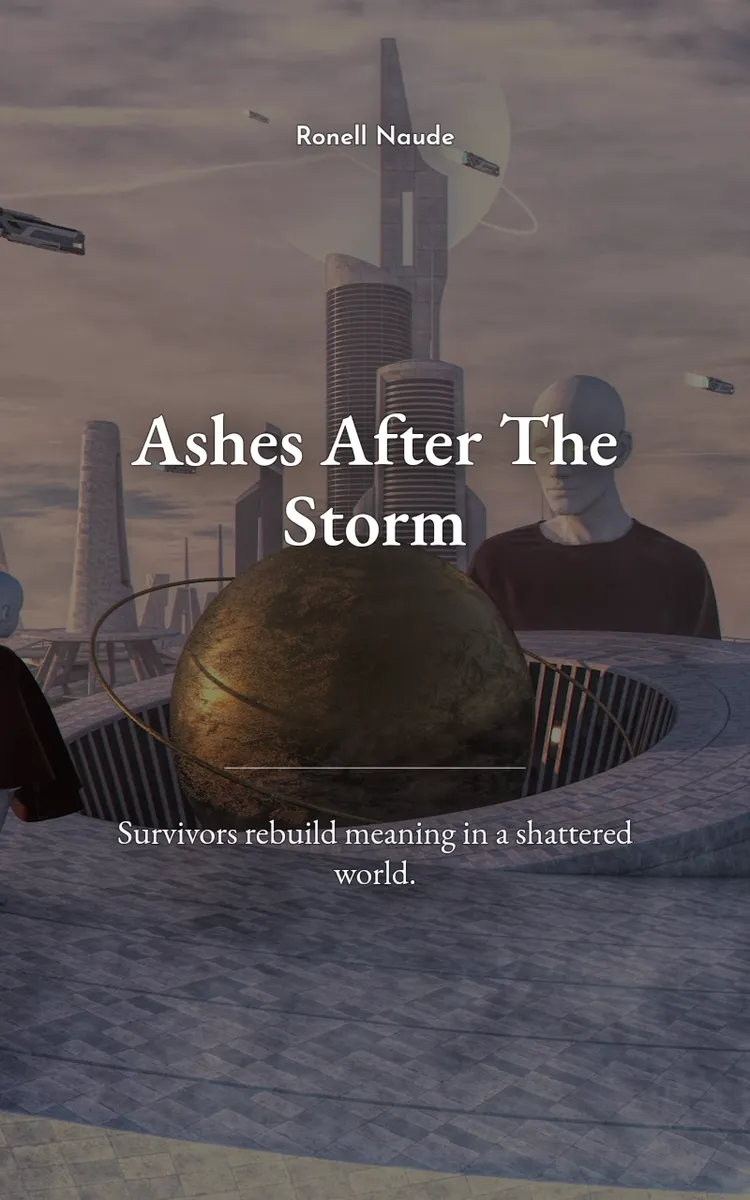
"Ashes After The Storm" is a fiction book by Ronell Naude with 15 chapters and approximately 43,674 words. Post-nuclear war survivors searching for hope and rebuilding life.
This book was created using Inkfluence AI, an AI-powered book generation platform that helps authors write, design, and publish complete books. It was made with the AI Novel Writer.
Frequently Asked Questions
What is "Ashes After The Storm" about?
Post-nuclear war survivors searching for hope and rebuilding life
How many chapters are in "Ashes After The Storm"?
The book contains 15 chapters and approximately 43,674 words. Topics covered include The Shelter That Won’t Hold, Trading Water for a Map, Finding Meaning in the Ashes, The Bridge That Refuses Passage, and more.
Who wrote "Ashes After The Storm"?
This book was written by Ronell Naude and created using Inkfluence AI, an AI book generation platform that helps authors write, design, and publish books.
How can I create a similar fiction book?
You can create your own fiction book using Inkfluence AI. Describe your idea, choose your style, and the AI writes the full book for you. It's free to start.
Write your own fiction book with AI
Describe your idea and Inkfluence writes the whole thing. Free to start.
Start writingCreated with Inkfluence AI


