
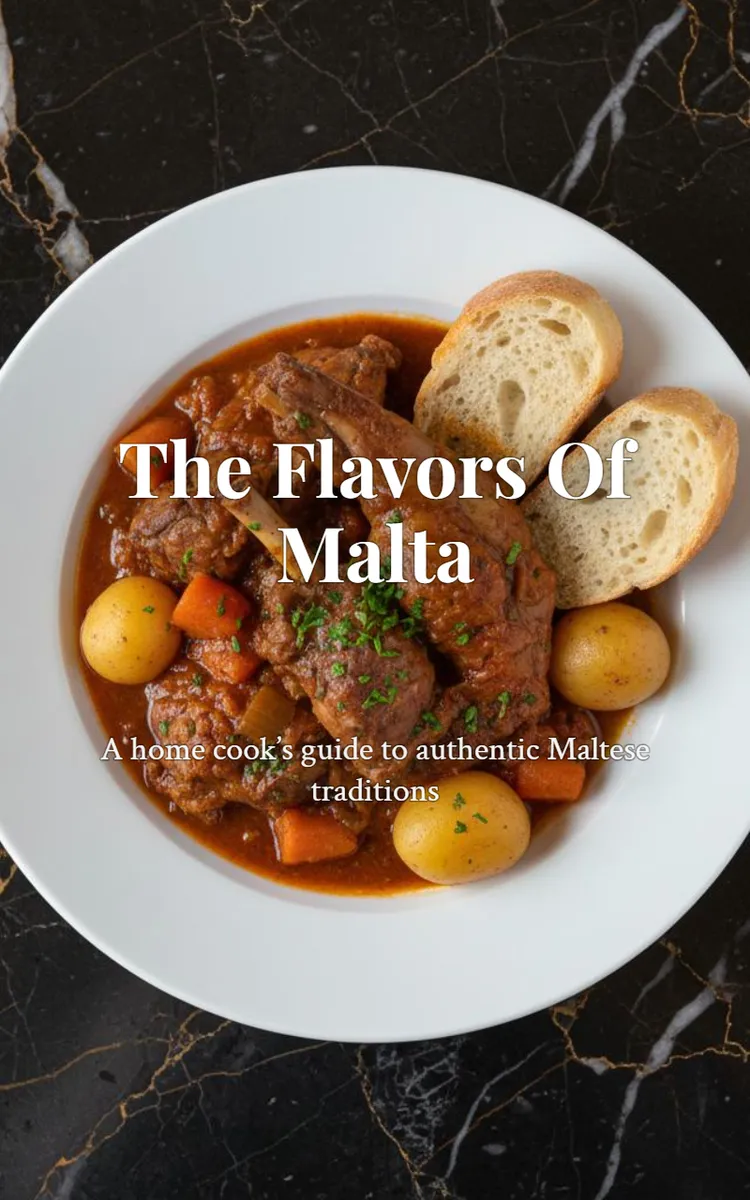
Read the first chapter
The whole of chapter one, free. About 8 min. Turn the pages with the arrows, your keyboard, or a swipe.
Chapter 1
The Story of Maltese Cuisine
On Malta, food carries the marks of every power that has shaped the islands. A pot of stew may contain the practical habits of rural families, the flavours of North Africa, the methods of southern Italy, and ingredients brought through Mediterranean trade. Maltese cuisine is not the product of one uninterrupted tradition. It is a record of contact, adaptation, and daily necessity.
The islands sit between Sicily and the North African coast, in a position that made them both a crossroads and a prize. Their small size, dry climate, limited freshwater, and dependence on imported goods encouraged cooks to use what was available carefully. Food developed not through luxury, but through resourcefulness: bread stretched across several meals, vegetables preserved for lean months, and slow cooking used to make modest ingredients satisfying.
Malta’s Position at the Centre of the Mediterranean
Malta’s location explains much about its kitchen. The archipelago lies close to Sicily, yet faces toward Tunisia and Libya, with the wider Mediterranean connecting it to Spain, Greece, the Levant, and beyond. Ships passed through these waters carrying grain, oil, wine, spices, dried fruit, and unfamiliar cooking ideas. Some influences arrived through conquest; others came through trade, migration, and the movement of sailors and workers.
The islands’ history includes long periods under different rulers, including the Phoenicians and Carthaginians, the Romans, Arabs, the Normans, the Knights of St John, the French, and the British. Each period left traces, although not every modern dish can be assigned neatly to a single source. Culinary traditions rarely travel in sealed containers. An ingredient may arrive from one culture, a technique from another, and a local habit may transform both.
The Arab period, beginning in the ninth century, had a particularly lasting effect on Malta’s agriculture and food vocabulary. Irrigation methods, citrus cultivation, almonds, dates, and new approaches to combining sweet and savoury flavours became part of the islands’ environment. The Maltese language itself preserves strong Arabic influence, and food names often reveal the same layered past.
Later connections with Sicily reinforced the importance of wheat, pasta, tomatoes, ricotta, and baked dishes. Italian influence is visible in both ingredients and words, but Maltese cooks made these elements their own. British rule introduced further changes, including new imported foods and habits, while the port of Valletta brought people and provisions from many parts of the empire. What emerged was not a copy of any neighbouring cuisine, but a local cooking tradition shaped by repeated exchange.
How Scarcity Shaped the Maltese Table
Maltese food makes particular sense when viewed through the islands’ natural limits. Arable land is scarce, rainfall is seasonal, and summers are hot and dry. Historically, households could not assume a steady supply of fresh meat, abundant firewood, or a wide range of produce throughout the year. Preservation and careful use were essential parts of ordinary cooking.
Bread became a central food because wheat could be stored and milled, then turned into something filling and dependable. Olive oil, onions, garlic, tomatoes, beans, and seasonal vegetables provided flavour and substance. Pulses offered nourishment when meat was expensive or unavailable. Eggs, cheese, and preserved fish helped bridge the gaps between fresh supplies.
This economy of ingredients encouraged dishes in which time did much of the work. Slow simmering softened tougher cuts, thickened sauces, and joined separate flavours into a single meal. A family did not need a large quantity of meat if it was cooked with vegetables, wine, stock, or pulses. The result was food designed to feed people efficiently without tasting austere.
Preservation extended the calendar. Salted fish, dried beans, sun-dried tomatoes, olives, capers, and stored grains allowed households to cook beyond the short period when each ingredient was at its best. Pickling added sharpness to otherwise simple meals and helped protect seasonal produce. These methods were practical, but they also created the strong contrasts associated with Maltese cooking: salty against fresh, sour against rich, and sweet alongside savoury.
The climate influenced the shape of meals as well. In hot weather, cooks relied on ingredients that travelled well and could be prepared without elaborate equipment. In cooler months, baked dishes and substantial stews made good use of the oven and provided food for a household at once. The kitchen responded to the weather long before modern ideas about seasonal eating gave that habit a name.
The Arabic and Sicilian Threads
Maltese cuisine is often described through its neighbouring influences, yet its character lies in the way those influences overlap. Arabic foodways helped establish a taste for citrus, almonds, dates, fragrant spices, and combinations that move between sweet and savoury. Sicilian connections strengthened the use of pasta, ricotta, tomatoes, and wheat-based cooking. These strands did not remain separate.
The clearest evidence appears in the balance of flavours. Maltese dishes may use garlic and olive oil in a manner familiar across the Mediterranean, while also pairing them with preserved ingredients, citrus, or gentle sweetness. The effect is not always strongly spiced. Instead, flavour often comes from layering: browning an onion, adding herbs, using a concentrated tomato base, and allowing the dish to cook slowly.
Language offers another clue. Maltese is the only Semitic language written in the Latin alphabet, and its vocabulary reflects centuries of contact. Words connected with agriculture, food, and household life may carry Arabic roots, Italian forms, or later English influence. A recipe passed through generations therefore contains more than instructions. Its name may preserve a fragment of the island’s political and cultural history.
The relationship with Sicily has also been continuous rather than purely historical. The two islands are close enough for people, goods, and ideas to move between them. Yet Maltese cooks adapted borrowed foods to local conditions. A dish that began as an outside influence could acquire a different texture, seasoning, or role at the table after generations of home preparation.
Food, Family, and the Village Calendar
For much of Malta’s history, cooking belonged to the rhythm of the household. Meals were shaped by what families grew, bought from local sellers, preserved in summer, or received from relatives who kept animals or worked at sea. Recipes were rarely fixed in the modern sense. Quantities changed according to the size of the family, the contents of the pantry, and the season.
The village was an important setting for this food culture. Markets, bakeries, parish celebrations, and household kitchens connected food with local identity. A dish could be associated with a particular town, a family method, or the time of year when its ingredients were available. Differences between local versions were not signs of error; they reflected the ordinary way recipes develop.
Religious observance also influenced what people ate and when. Catholic feast days structured the calendar, while periods of fasting encouraged meals based on vegetables, pulses, grains, and fish. Feast days, by contrast, created occasions for richer cooking and special sweets. Food marked the difference between an ordinary day and a communal celebration.
The village festa made this connection visible in public. Streets, churches, band clubs, and family homes became part of a shared calendar in which cooking helped express belonging. Certain foods were prepared because the occasion required them, not simply because they were convenient. Their importance came from repetition: the same kinds of dishes returning each year, carrying memories of relatives and places.
Family knowledge was transmitted in the same practical way. A cook learned how long a sauce should reduce by watching its texture, how much salt suited a preserved ingredient, and when bread had reached the right crust by sight and touch. Such knowledge may not appear in a written recipe, but it is central to the tradition. Maltese cuisine survives through these small judgments as much as through named dishes.
From Household Cooking to Modern Malta
The twentieth century brought major changes to Maltese food. Improved transport, refrigeration, supermarkets, tourism, and changing work patterns widened access to ingredients and reduced the need for some traditional preservation methods. Families had less time for long preparation, while imported foods became easier to obtain throughout the year.
These changes did not erase older cooking. Instead, they altered when and why it was prepared. Some dishes moved from everyday meals to weekends, holidays, or restaurant menus. Others remained common because they suited modern households or could be adapted without losing their identity. A recipe may now be prepared with purchased stock, modern ovens, or ingredients from outside Malta while retaining its familiar structure.
Tourism has made Maltese food more visible, but it has also encouraged questions about authenticity. A dish served to visitors may be presented as a national symbol, even though the home versions are varied. There is no single kitchen that represents every Maltese family. Regional differences, personal habits, and changing ingredients have always been part of the story.
Modern Maltese cooks therefore work with two forms of inheritance. One is the remembered method: the dish made by a parent or grandparent, with its particular texture and seasoning. The other is the broader historical pattern of adaptation, in which outside ingredients are accepted and reshaped. Both belong to the cuisine.
What Maltese Food Reveals
The history of Maltese cuisine is visible in its contrasts. A dry island depends on careful cultivation; a maritime society relies on both local fishing and imported goods; a crossroads absorbs foreign ideas while protecting a distinct language and identity. The food reflects all of these conditions without being reduced to any one of them.
Its deepest tradition is not a single ingredient or recipe. It is the habit of making a complete meal from what the island, the market, and the season provide. Grains become bread or pasta, vegetables gain depth through slow cooking, preserved foods bring intensity, and modest portions of meat or fish are made to serve a household. The technique is practical, but the result is expressive.
To understand Maltese food is to see history at the level of the kitchen: in the citrus tree descended from older cultivation, the wheat-based meal shaped by scarcity, the sweet-and-savoury combination carried across the sea, and the family recipe adjusted to suit a new generation. Malta’s cuisine remains recognisably its own because it has always known how to absorb change without surrendering memory.
End of chapter one. 11 more chapters and about 16,828 words in the full book.
Swipe or use the arrows to turn the page
What's inside: 12 chapters
- 1. The Story of Maltese Cuisine
- 2. Traditional Maltese Bread & Street Food
- 3. Traditional Maltese Starters & Dips
- 4. Traditional Maltese Soups
- 5. Traditional Maltese Meat Dishes
- 6. Traditional Maltese Fish & Seafood
- 7. Traditional Maltese Pasta & Oven-Baked Dishes
- 8. Traditional Maltese Vegetables & Side Dishes
- 9. Traditional Maltese Desserts & Sweet Pastries
- 10. Traditional Maltese Festive Food
- 11. Traditional Maltese Ingredients & Cooking Techniques
- 12. Bringing Malta to Your Kitchen
About this book
"The Flavors Of Malta" is a curiosity book by Anonymous with 12 chapters and approximately 16,828 words. Maltese cuisine, its history, regional traditions, ingredients, cooking techniques, and recipes.
This book was created using Inkfluence AI, an AI-powered book generation platform that helps authors write, design, and publish complete books.
Frequently Asked Questions
What is "The Flavors Of Malta" about?
Maltese cuisine, its history, regional traditions, ingredients, cooking techniques, and recipes
How many chapters are in "The Flavors Of Malta"?
The book contains 12 chapters and approximately 16,828 words. Topics covered include The Story of Maltese Cuisine, Traditional Maltese Bread & Street Food, Traditional Maltese Starters & Dips, Traditional Maltese Soups, and more.
Who wrote "The Flavors Of Malta"?
This book was written by Anonymous and created using Inkfluence AI, an AI book generation platform that helps authors write, design, and publish books.
Write your own curiosity book with AI
Describe your idea and Inkfluence writes the whole thing. Free to start.
Start writingCreated with Inkfluence AI


