

Read the first chapter
The whole of chapter one, free. About 13 min. Turn the pages with the arrows, your keyboard, or a swipe.
Chapter 1
The A Train Appears Again
The platform speakers crackled with a looped announcement in three languages, then died mid-sentence as the rails outside Kestrel Junction began to hum - low at first, like a train drawing breath, then louder, until the metal under Mara Ellison’s boots felt alive through the soles. She’d timed her arrival for the last ten minutes before the A-train was due, because waiting made her thoughts snag. Waiting let people look too long. Waiting made it easier for the platform to notice her.
Under the looping station ads - women smiling beside products that never existed in her apartment’s grocery line, men in tailored coats holding up lottery tickets that couldn’t be cashed - an old concrete arch framed the once-a-year platform like a mouth. The ceiling above it was painted with peeling safety numbers, and somewhere in that paint, a familiar mark had been scratched by someone who knew better than to leave a name. Mara saw it between two poster frames as she stepped through the tide of bodies: a small, angular A - like a stylized arrowhead - tucked into the seam of the tiled wall.
Her ticket was warm from her pocket. The paper wasn’t paper, not really; it had a faint give like skin and a security thread that caught the light when she tilted it. She touched the thread with her thumb anyway, as if reassurance could be coaxed out of the fibers. The symbol had been on her father’s old envelope, the one he’d kept sealed with wax and never explained. She’d found it after he vanished - after the year he didn’t come back - and she’d carried the envelope from city to city like a curse she couldn’t put down.
Now the A was here, on the platform wall, and the rails were finally singing.
“Ellison!” a voice barked behind her.
Mara didn’t turn right away. The crowd was dense enough to make every movement a negotiation. People pressed shoulder to shoulder, coats brushing her forearms, the air thick with cheap perfume and wet wool. She caught the scent of engine oil from somewhere near the track and the sharp tang of ozone that always came before something electrical decided to become real.
She turned on the sound of her name. A man in a maintenance vest stood half in the flow and half against it, like he’d been poured there. The vest had a badge with no readable letters, only a strip of gray that looked like it had been scratched away. His hand was out, palm up, and he held a clipboard that didn’t match any city form.
“Your time’s short,” he said. His eyes slid to her ticket, and something in his face hardened. “Show it.”
Mara’s throat tightened. “I have it.”
“Not anymore.” He said it like a fact he’d recited too often. “That marking - see? - that’s already been used.”
Her ticket pulsed once against her fingers, not with heat this time but with a subtle vibration that traveled up her wrist. The security thread didn’t glitter the way it had when she’d checked it at the station gate. The ink on her seat number looked… less confident. Like it had been overwritten while she wasn’t looking.
She pulled the ticket free, angling it toward him. The paper’s surface caught the overhead fluorescent strips and revealed a new stamp across the bottom corner: CLAIMED.
It hadn’t been there on the train platform entrance. It hadn’t been there in the cab. She knew the shape of every smudge on her own ticket.
“That’s not - ” she began.
The man’s clipboard tilted. “Ellison Mara?” he asked, not as a question, but as a way of pinning her to the page. “Passenger list says you boarded last year. You didn’t return.”
“I didn’t - ” Her voice came out thin, like she’d been inhaling dust. “I’m here.”
“Everybody says they’re here.” He leaned closer, lowering his voice under the roar of the approaching rails. “Listen. You can try to fight it, but the platform doesn’t like delays. It likes closure.”
Mara stared at his badge again. The gray strip looked like erased letters, but the shape beneath it - when the overhead lights flashed - was the same angular A she’d seen in the wall seam.
She’d spent years believing the symbol was a key. Now it looked like a brand.
The sound outside sharpened into the unmistakable metallic rhythm of an oncoming train. People turned as if tugged by one invisible cord. The ads above them kept looping - faces smiling, promises repeating - while the platform underfoot vibrated harder, shaking loose grit from the concrete.
Mara’s mind moved faster than her body. If the ticket was claimed, it meant someone else had walked into the same certainty she’d carried. Someone else had stepped onto the A train and never come back. And if the platform said she’d boarded last year, then the thing that took people didn’t just erase them; it rewrote the story until it fit.
“I don’t care what your list says,” she said, and surprised herself with the steadiness in her own tone. “I’m getting on.”
The maintenance man shifted his weight. His clipboard came up between them like a barrier. “You can’t. The car doors will see a discrepancy and - ”
“And what?” Mara snapped. The crowd pressed around her, and somewhere to her left, a woman cried out as a man tried to shove ahead. The sound of it got lost in the train’s growing roar.
The maintenance man’s gaze flicked past her shoulder, to the track end where the tunnel mouth should have opened. “And then you’ll be detained until tracking clears you,” he said. “Until they’re sure you’re not… a repeat.”
Mara’s stomach turned cold. “Tracking?”
He hesitated, just long enough to betray that he’d been instructed not to say certain words. Then the rails hit a pitch that made teeth ache. The tunnel ahead flared with light, and the A train emerged - sleek and unfamiliar in the way nightmares were familiar. No advertisements on its sides. No city branding. Only a dark paneling that swallowed the platform lights and a single bright emblem above the doors: the same angular A.
The crowd surged toward the cars. People moved with a practiced desperation, like they’d been here before in dreams. Mara felt the pull in her ribs, the sensation of gravity turning toward the train.
She couldn’t let the ticket stamp become true.
She stepped sideways, squeezing between two bodies. A man’s elbow caught her ribs. She tasted copper where her breath caught wrong. She ignored it. Her hand tightened on the ticket until the security thread bit into her skin.
“Ellison!” the maintenance man called again, but the sound got swallowed by the crowd. “Wait - ”
Mara reached the doors as the first car stopped with a hiss that sounded like breath released through a mask. The metal threshold was cold enough to sting through her shoes. She looked for the conductor she’d seen in old footage - if footage could be trusted. What she found instead was a man in a dark coat with a silver band around his sleeves. His eyes were sharp, his expression set like he’d already decided who belonged to the train.
He didn’t look at her face. He looked at her ticket.
The stamp CLAIMED flashed under the door’s light.
His mouth tightened. “That isn’t valid for this dispatch.”
“It was valid,” Mara said. “I came when I was told.”
The conductor’s gaze flicked to the crowd behind her, to the way bodies surged and pressed. “The platform makes corrections,” he said. “It always does.”
Mara leaned in, forcing her voice to cut through the hiss of opening doors and the distant roar of the tunnel beyond. “Then correct it back.”
His eyes narrowed at the insistence in her tone, and for a moment she saw something else there - recognition, or the imitation of recognition. He lifted his clipboard - one sheet, no stamp, only a list of names that looked like it had been printed and then erased and printed again.
He scanned it. “You’re flagged,” he said. “For tracking.”
Mara’s skin prickled. “By who?”
The conductor’s jaw worked once. “By the missing passenger list.”
The words hit like a door slamming. Mara had heard rumors that the platform kept records - names, dates, seat numbers - like it needed paperwork to justify theft. She’d dismissed it as people trying to make the impossible feel bureaucratic. Now a conductor was using the phrase missing passenger list like it was a tool in his pocket.
“If I’m flagged,” she said, “then the train knows I’m supposed to be here.”
“It knows you’re supposed to have been here,” he corrected, and his voice softened just enough to sound cruel. “Last year.”
Mara’s thoughts stumbled, trying to catch up to the implications. Last year she’d lost her father. Last year she’d found the envelope with the angular A. Last year she’d sworn she’d come back if she ever got another chance at answers. Last year - if the platform had rewritten the story - she might have boarded and then been erased from the world’s memory.
But she was standing in front of him now, lungs burning, hands shaking around a ticket with a stamp that shouldn’t exist.
She drew in a breath and did the only thing she could do with a situation that refused to behave.
She pushed past the conductor’s line of sight and stepped into the doorway before the train could decide she wasn’t real enough to belong.
The interior hit her like a wall of sound. The air was cool and dry, smelling faintly of ozone and polished metal. Seats lined the car in neat rows, upholstered in dark fabric that felt too smooth, like it had never been sat on. A low hum ran through the floor, vibrating her bones in time with the train’s movement.
The conductor didn’t stop her immediately. He turned his clipboard sideways as if he was checking the page for errors. Then his gaze snapped up.
“Mara Ellison,” he said, voice carrying over the car’s mechanical hush. “Stop.”
Mara kept walking, because stopping was how the platform won. She found her seat number - she knew it by heart from the envelope’s markings and the way her ticket had been folded - and slid into it.
The fabric accepted her weight with a soft sigh.
For a heartbeat, everything felt normal. The train rocked once as it gathered speed. The windows ahead showed nothing but shifting blur of tunnel lights. The ads outside didn’t reach in here; the only light came from panels above the aisle, steady and pale.
Then her ticket changed again.
Mara’s thumb brushed the security thread, and the ink on the corner rearranged itself with a subtle, sickening certainty. The CLAIMED stamp faded. In its place, a new mark appeared - black lettering that looked like it had been written by a pen that had learned her name.
REWRITE IN PROGRESS.
Her skin went numb. She stared at the ticket so hard her eyes watered.
Across the aisle, a man looked up from a seat as if he’d heard his own name. He was younger than Mara, with a shaved head and a scar that split his eyebrow. His hands were empty, but his posture was tense, like he’d been holding something invisible.
He watched her the way someone watched a door that had opened twice.
A conductor voice crackled from somewhere deeper in the car. “Passenger manifest is adjusting. Please remain seated.”
Mara’s mouth went dry. The train didn’t just take people. It recalculated them. It rewrote the manifest to make the theft fit.
The man across the aisle stood halfway, hesitant. “You have one of those too,” he said quietly, not looking away from her ticket.
Mara swallowed. “Have what?”
He held his hands up, palms out. In the overhead light, she saw his fingers were ink-stained with the same angular A symbol, as if someone had pressed a stamp into him. “I thought I was the only one,” he said. “I - ” His voice caught. “I saw my name on the missing list.”
Mara’s lungs tightened. She tried to keep her voice steady. “That’s what they told me. That I’m flagged.”
He nodded once, sharply. “Then you know the problem.” His eyes flicked toward the aisle. “They don’t just track. They correct. They decide which version of you gets to stay on the rails.”
Mara stared at him, mind racing, and then the memory hit with the force of a thrown object: the torn page in her father’s envelope, the one she’d kept folded so long the paper had started to thin. A passenger description. A date. A seat number that didn’t match any timetable she’d ever seen. The handwriting on it had been shaky, like whoever wrote it had been running out of time.
She hadn’t recognized the page as relevant until now - until she’d seen the angular A in the wall seam and felt the train’s vibration through the soles of her boots.
The man across the aisle shifted, and she saw something else: his eyes were ringed red, not from crying but from sleepless terror. Like he’d been awake inside a moving nightmare, watching for the moment the manifest turned against him.
A soft click sounded behind Mara. The conductor from the doorway had moved down the aisle, his footsteps measured. He stopped at her seat but didn’t touch her. He didn’t have to. The air seemed to tighten around him.
“Passenger Ellison,” he said, and this time he used her full name like a warning. “Your seat assignment has been overwritten to match the current dispatch.”
Mara didn’t look away. “So I’m supposed to be here,” she said. “That means I get to stay.”
The conductor’s gaze dropped to her ticket again. His expression didn’t change, but his eyes did - focused, narrowed, as if he were reading something only he could see. “Your presence triggers additional monitoring,” he replied. “There’s a discrepancy involving a missing passenger entry that corresponds to your identity.”
“Identity,” Mara repeated, bitter. “So I’m a file.”
The conductor’s mouth twitched, almost a smile, almost a flinch. “On this train,” he said, “everyone is a file. Some of you are just harder to sort.”
Mara’s hand tightened on the armrest. The seat’s upholstery felt suddenly too smooth, too prepared. She could hear her heartbeat over the hum, a frantic drum.
Then, from the pocket of her coat, her fingers brushed the envelope she’d brought without thinking. She hadn’t taken it out yet, because she’d been afraid of what its weight would do to her courage. Now the envelope seemed to pulse against her palm.
A thought sharpened: If the train was rewriting the manifest, it might also be rewriting memory. The missing passenger list might include her - but it might also include something else, something her father had tried to leave behind.
The conductor leaned slightly, as if he could sense the movement. “Don’t reach for - ”
Mara moved anyway. She pulled the envelope out and tore it open with her thumb, the wax seal giving way with a brittle crack. Inside, the torn logbook page lay folded smaller than she remembered, edges frayed as if it had been ripped and re-ripped in different timelines.
The handwriting on it was hers to recognize. Her father’s hand, uneven and urgent. At the top, an angular A had been drawn like a compass point.
Beneath it, a line of text matched the seat number Mara had been assigned.
And beneath that, a sentence that made her stomach drop:
Mara Ellison boarded, but the manifest will rewrite itself. If you see your ticket marked claimed, don’t stay in the seat. Don’t trust the conductor. Find the logbook. It’s the only page that survives.
Mara stared until the words blurred. The hum of the train became a roar in her ears. She could feel sweat cooling at the back of her neck.
Across the aisle, the younger man’s face went pale. “You have it,” he whispered.
Mara’s voice came out hoarse. “He wrote this.” She looked up at the conductor. “You’re not supposed to have let this happen.”
The conductor’s eyes flashed. For the first time, his control wavered. “That page isn’t possible,” he said.
Mara didn’t wait for him to decide what she was allowed to be. She shoved the torn logbook page back into the envelope, stood up hard enough that her knees knocked the underside of the seat, and stepped into the aisle.
The train swayed. Overhead panels flickered once, and the lights held steady again - like the system had been interrupted and then forced back into place.
The conductor raised a hand toward her, but instead of stopping her, he turned his clipboard slightly toward the aisle, and Mara saw the screen’s surface glow with a fresh entry.
Mara Ellison - TRACKING ENABLED.
A cold clarity settled over her fear. She’d wanted to board. She’d gotten on. Now the train had decided she was a problem that needed watching, not a passenger that could vanish quietly.
The doors at the end of the car hissed softly as if preparing to open to a corridor she hadn’t been told about. Somewhere beyond that door, footsteps moved - measured, purposeful - like someone had been assigned to meet her before the train even started to leave the platform behind.
End of chapter one. 40 more chapters and about 109,804 words in the full book.
Swipe or use the arrows to turn the page


What's inside: 41 chapters
- 1. The A Train Appears Again
- 2. A Seat That Isn’t Yours
- 3. The Conductor’s Missing Page
- 4. When the Lights Go Yearly-Red
- 5. Mara Chooses Who to Save
- 6. The Key Opens a Locked Memory
- 7. Jonas Knows the Wrong Year
- 8. A Door That Only Opens Once
- 9. The Ticket Stamp That Predicts Death
- 10. Bays Seven Through Twelve Are Empty
- 11. A Chalk Map to Nowhere
- 12. The Projected Year Lies to Her
- 13. A Passenger With a Second Name
- 14. The Slip Leads to a Burned Door
- 15. Trust the One Who Waits
- 16. The Impostor Opens the Wrong Exit
- 17. Mara Refuses the Train’s Bargain
- 18. The Booth Shows Jonas as an Archive
- 19. Year Lock Activated by Her Pulse
- 20. The Archive Lists a Future Boarding
- 21. Mara’s Choice Creates a Doppelganger
- 22. The Console Burns Out During Retrieval
- 23. The Timestamp Fragment Points to Tessa
- 24. Pocket Watch Opens a Locked Chapel
- 25. Mara Sings Back to the Terminals
- 26. The Corridor Leads to a False Platform
- 27. Alarm Chasers Corner the Wrong Mara
- 28. The Containment Key Opens a Prison Car
- 29. The Jolt Reveals a Hidden Transfer Track
- 30. Mara Breaks, Then Chooses Again
- 31. The Gate Shows Jonas’s Last Recorded Breath
- 32. Wrong-Year Route Leads to a Storm Tunnel
- 33. Tessa Confesses the Train’s Real Bargain
- 34. The Broadcast Triggers a Counter-Train
- 35. Mara Stops the Yearly Selection
- 36. She Walks Out, But Not Alone
- 37. The Station Says Tomorrow’s A Train
- 38. Eidolon Authority Erases Mara’s Proof
- 39. The Pocket Watch Names the Next Victims
- 40. Mara Sends the Message Anyway
- 41. Final Platform Choice
About this book
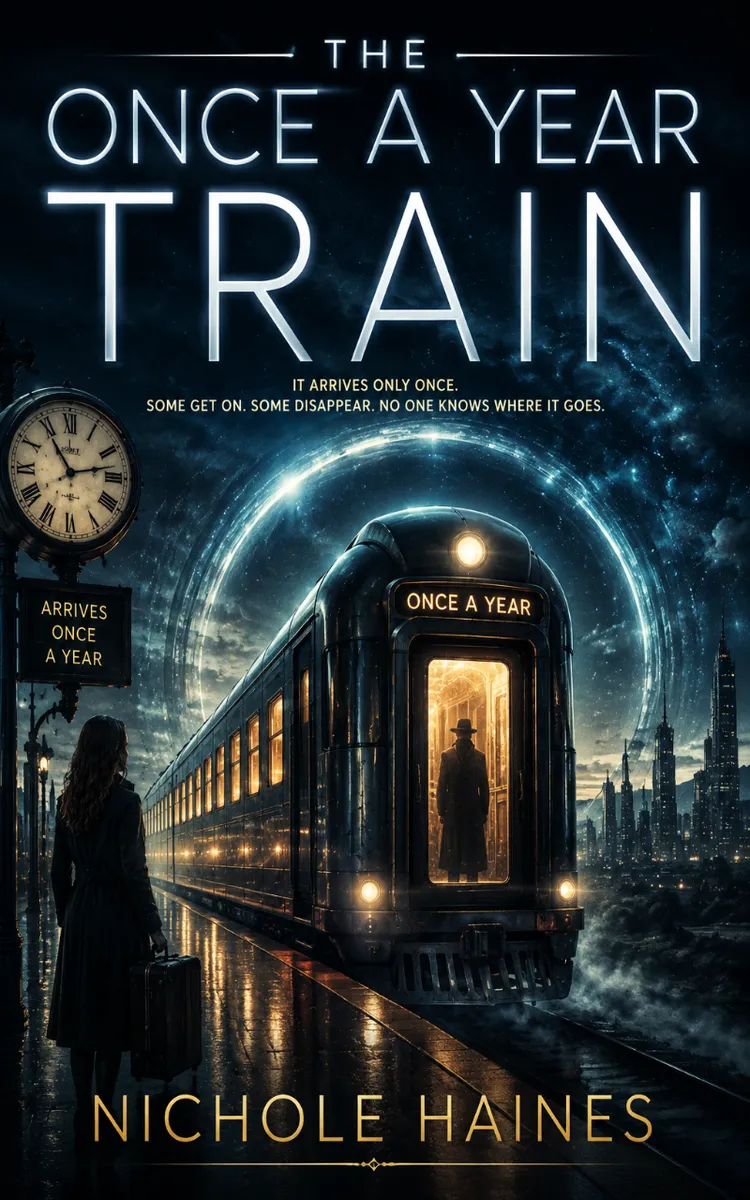
"The Once A Year Train" is a fiction book by Nichole Haines with 41 chapters and approximately 109,804 words. A mysterious annual train abducts people who vanish forever.
This book was created using Inkfluence AI, an AI-powered book generation platform that helps authors write, design, and publish complete books. It was made with the AI Novel Writer.
Frequently Asked Questions
What is "The Once A Year Train" about?
A mysterious annual train abducts people who vanish forever
How many chapters are in "The Once A Year Train"?
The book contains 41 chapters and approximately 109,804 words. Topics covered include The A Train Appears Again, A Seat That Isn’t Yours, The Conductor’s Missing Page, When the Lights Go Yearly-Red, and more.
Who wrote "The Once A Year Train"?
This book was written by Nichole Haines and created using Inkfluence AI, an AI book generation platform that helps authors write, design, and publish books.
How can I create a similar fiction book?
You can create your own fiction book using Inkfluence AI. Describe your idea, choose your style, and the AI writes the full book for you. It's free to start.
Write your own fiction book with AI
Describe your idea and Inkfluence writes the whole thing. Free to start.
Start writingCreated with Inkfluence AI


