
Read the first chapter
The whole of chapter one, free. About 5 min. Turn the pages with the arrows, your keyboard, or a swipe.
Chapter 1
Day 1-3: Your AI Side Hustle Blueprint (Outcome-Based, Not Prompt-Collections)
Overview
A digital product sells when it helps a specific person reach a clear result - not when it contains a large pile of AI prompts. This chapter sets up your The 30 Day AI Side Hustle Starter Kit mindset through five decisions: choosing a customer problem, checking whether it is worth solving, defining the result, matching the right product, and using AI as a helper rather than the product itself.
By the end, you should have one focused customer, one painful problem, and one simple product direction. Ask yourself: What useful result could someone achieve within the next 7 to 30 days with my help?
The Breakdown
#1: Choose One Customer With One Repeated Problem
Problem: “Small business owners” is too broad to guide a product. A gym owner, plumber, and wedding photographer may all want more customers, but they need different tools, examples, and daily actions.
Solution: Choose a narrow customer group and write down one problem they face repeatedly. Use this sentence: “I help [specific customer] solve [specific problem] so they can [measurable result].” For example: “I help independent personal trainers create four weeks of simple social media content so they can attract more local inquiries.” Choose a problem that appears often in Facebook groups, Reddit discussions, customer conversations, or search results.
Result: Your product becomes easier to explain and create because every page serves one type of buyer. A focused promise also makes your sales message clearer than “AI tools for business.”
#2: Confirm the Problem Before Building Anything
Problem: Beginners often spend two weeks creating a product that nobody asked for. A problem may sound useful but still be too minor, too expensive to solve, or already covered by free information.
Solution: Look for evidence before writing. Review at least 20 real comments, questions, reviews, or posts from your target customers. Record the exact words people use, how often the issue appears, and what they have already tried. You can organize your notes in a simple table:
| What to record | Example | |---|---| | Customer | Local personal trainer | | Repeated complaint | “I never know what to post” | | Current workaround | Reusing old posts | | Desired result | A month of ready-to-edit content |
Use AI to group your notes and identify repeated themes, but check the original comments yourself. AI can summarize research; it cannot prove that people will pay.
Result: You reduce the risk of building a product based on a guess. You also collect the real language that can later improve your title, product description, and social media posts.
#3: Define the Customer’s Finish Line
Problem: A product promise such as “learn AI” or “get better at marketing” is too vague. Buyers need to know what they will be able to do after using the product and how long the process should take.
Solution: Turn the problem into a visible outcome with a deadline and a useful measurement. For example, replace “learn to make social media posts” with “create and schedule 20 local gym posts in five days.” List the steps needed to reach that finish line, such as choosing topics, writing captions, adding calls to action, and creating a posting schedule. Keep the first product outcome small enough to complete without special software.
Result: Your ebook, workbook, or template has a clear job. Buyers can quickly decide whether it fits their need, and you can remove pages that do not help them reach the promised result.
#4: Match the Product Format to the Problem
Problem: The wrong format creates extra work for you and frustration for the buyer. A long ebook is a poor solution for someone who mainly needs ready-to-use worksheets, while a template alone may not help someone who needs step-by-step instruction.
Solution: Match the format to the customer’s action:
• Use an ebook for explanation and a guided process. - Use a checklist for a task with a clear beginning and end. - Use a template when the buyer needs a starting structure. - Use a spreadsheet for tracking money, tasks, or measurements. - Use a bundle only when each part supports the same outcome.
For the personal trainer example, a practical product could combine a short guide, a 30-day content calendar, caption templates, and a simple inquiry tracker. Do not add unrelated items merely to make the bundle look larger.
Result: The product feels useful immediately instead of overwhelming. A smaller, connected product can often be finished and tested faster than a large collection of unrelated files.
#5: Use AI to Accelerate the Outcome
Problem: AI can produce pages quickly, but fast production does not guarantee useful information. Generic AI output may contain incorrect advice, repeated ideas, or language that does not sound natural to the target customer.
Solution: Give AI a clear job connected to the customer’s result. Ask it to organize research, suggest examples, create a first draft, simplify instructions, or turn one idea into several formats. A useful instruction might be: “Create 20 Instagram post ideas for independent personal trainers who want more local trial-session inquiries. Each idea must include a short hook, practical tip, and one clear call to action. Avoid medical claims and exaggerated promises.” Then review every output, add your experience, test the steps, and remove anything inaccurate.
Your product should be the complete outcome-based system: the explanation, action steps, examples, templates, and checks that help a buyer complete the task. AI is the production assistant - not the reason the buyer pays.
Result: You create a product that solves a specific customer problem instead of selling a generic prompt collection. The buyer receives a usable path from problem to result, while you save time during research, drafting, editing, and repurposing.
The key decisions are now set: one customer, one proven problem, one measurable finish line, and one product format that supports it. Before moving on, write your product promise in one sentence and check that a real customer could understand it without knowing anything about AI.
What Comes Next
The next chapter turns your chosen outcome into a practical build plan: the product sections, files, and first tasks you will complete during the opening days. You will move from a validated problem to a simple version that can be created, reviewed, and prepared for sale.
End of chapter one. 9 more chapters in the full book.
Swipe or use the arrows to turn the page


What's inside: 10 chapters
- 1. Day 1-3: Your AI Side Hustle Blueprint (Outcome-Based, Not Prompt-Collections)
- 2. Day 4-6: Niche Selection + Offer Design That Customers Actually Buy
- 3. Day 7-10: Build Your Digital Product Fast (eBook-Style Starter)
- 4. Day 11-13: Product Listing Assets (Titles, Descriptions, Pricing, and Pages)
- 5. Day 14-17: Social Media Content Engine (TikTok + Instagram Calendars)
- 6. Day 18-20: 100 Niche-Specific AI Prompts (Used as a System, Not a Library)
- 7. Day 21-24: Digital Product Ideas + Choose the Best One to Scale
- 8. Day 25-27: Launch Readiness (Checklist + First $100 Action Plan)
- 9. Day 28-29: Simple Income/Expense Tracking + Optimization Loop
- 10. Day 30: Tool Stack + Next 30 Days Roadmap (Keep Building, Don’t Stop)
About this book
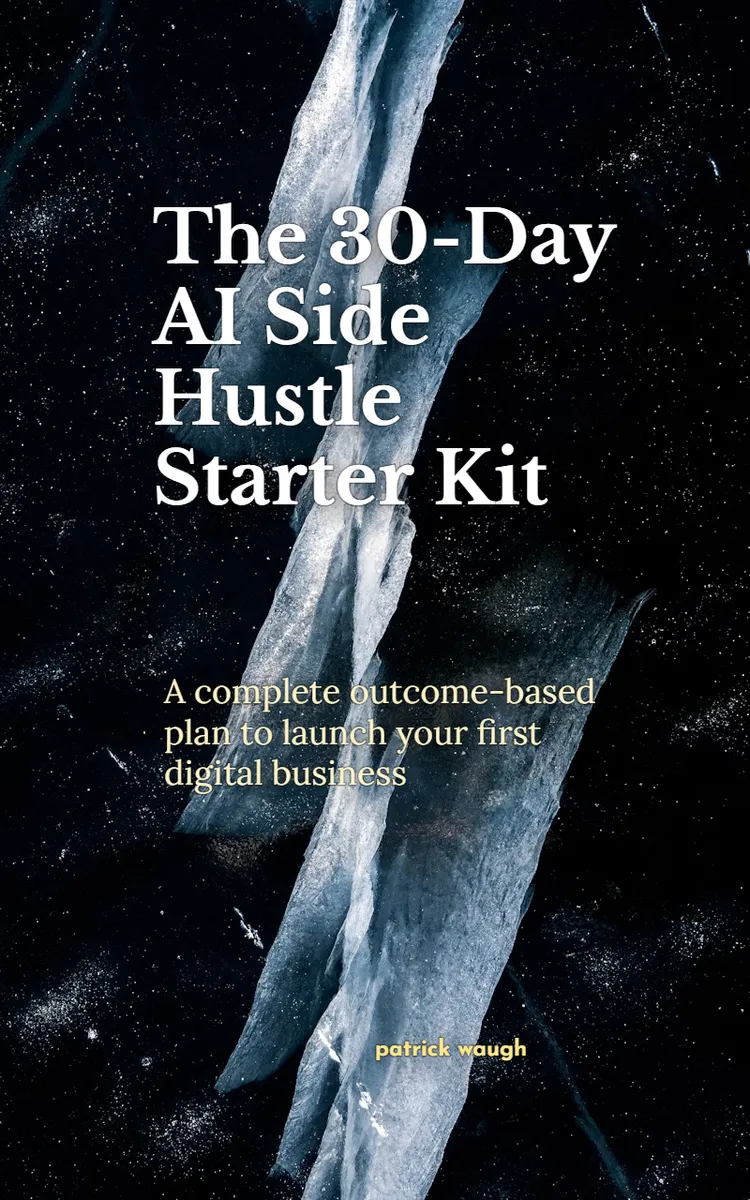
"The 30-Day AI Side Hustle Starter Kit" is a list book by patrick waugh with 10 chapters and approximately 9,737 words. 30-day AI-powered plan to start an online digital side hustle.
This book was created using Inkfluence AI, an AI-powered book generation platform that helps authors write, design, and publish complete books.
Frequently Asked Questions
What is "The 30-Day AI Side Hustle Starter Kit" about?
30-day AI-powered plan to start an online digital side hustle
How many chapters are in "The 30-Day AI Side Hustle Starter Kit"?
The book contains 10 chapters and approximately 9,737 words. Topics covered include Day 1-3: Your AI Side Hustle Blueprint (Outcome-Based, Not Prompt-Collections), Day 4-6: Niche Selection + Offer Design That Customers Actually Buy, Day 7-10: Build Your Digital Product Fast (eBook-Style Starter), Day 11-13: Product Listing Assets (Titles, Descriptions, Pricing, and Pages), and more.
Who wrote "The 30-Day AI Side Hustle Starter Kit"?
This book was written by patrick waugh and created using Inkfluence AI, an AI book generation platform that helps authors write, design, and publish books.
Write your own list book with AI
Describe your idea and Inkfluence writes the whole thing. Free to start.
Start writingCreated with Inkfluence AI


