
Read the first chapter
The whole of chapter one, free. About 7 min. Turn the pages with the arrows, your keyboard, or a swipe.
Chapter 1
Claim Your Confidence Identity
Picture This: When Your Confidence Vanishes at the Exact Wrong Moment
You’re doing fine right up until the moment it counts. Maybe it’s Talia - 31, nurse manager - walking into the morning huddle with her team. She’s organized, capable, and people usually trust her judgment. But today? Someone raises a question she doesn’t expect. A coworker looks at her like she should have the answer already. Her stomach tightens. Her brain scrambles for “what if I mess this up?”
The funny part is she knows the work. She’s been doing it for years. She can handle crises, manage schedules, and calm down anxious staff. Yet somehow her confidence flips like a light switch the second she feels watched. Afterward, she’ll replay the moment like a highlight reel of everything she did “wrong” - even though, objectively, she handled it. She just didn’t feel like herself while she was doing it.
So here’s the real tension: if confidence is supposed to show up consistently, why does it only feel available when you’re not under pressure?
If your confidence disappears when you need it most, what identity do you think you’re acting from?
---
The Identity Ladder Method: Define Confidence as Who You Are, Then Act from That
Old Belief: Confidence is something you either “have” or “don’t have,” and when you don’t feel it, you should wait until you do. New Reality: Confidence is an identity you claim - then you prove it with small actions, even before you feel ready.
Talia’s shift starts with a simple question she used to avoid: “Who am I when I’m not performing?” Not “How do I sound right now?” Not “How do I make them think I’m smart?” But who she is when she’s steady.
In the Identity Ladder Method, you stop treating confidence as a mood and start treating it like a role you can step into. Think of it like climbing down from “I hope I’m good enough” to “I’m the kind of person who handles this.” Each rung is a small identity cue - something you can do on purpose, not something you wait to feel.
Here’s what it looks like in real life for someone like Talia. When she walks into a huddle and feels that familiar tightening in her chest, she doesn’t argue with the feeling or pretend it’s not there. She chooses an identity cue for that moment - something physical and specific. For example: before she speaks, she takes one slow breath, makes eye contact, and asks one clarifying question. That action tells her body and mind, I’m in charge of my next move. Not perfect. Not flawless. Just grounded.
The result? Her confidence stops being “a feeling that sometimes shows up.” It becomes “a way of operating” that she can access daily - even when her nerves show up early.
---
The Mindset Shift: Why Identity Beats Mood (and What It Looks Like When It’s Working)
Here’s the psychology you can feel in your own life: your brain will do whatever it can to protect you. When you’re under pressure, it goes into scanning mode - looking for danger, embarrassment, mistakes. If your confidence is based on emotion, your brain will treat a shaky feeling as proof that you’re in danger. Then it tries to fix the feeling by shutting you down or making you overthink.
But if your confidence is defined as who you are, your brain has a different job. It still notices nerves (because nerves are real), but it doesn’t treat them as a verdict. Instead, it treats them as background noise while you move through a pre-decided identity cue.
That’s why the Identity Ladder Method matters: it helps you separate signal from story. Nerves are a signal. They’re not the story. The story is what you decide about yourself right then.
Signs this pattern is running your life: 1. You only feel confident after you’ve “checked the boxes” - like when you’ve rehearsed, prepared, or gotten reassurance. 2. The second you’re unsure, you start negotiating with yourself: “Maybe I’m not cut out for this,” or “They’ll see I don’t know.” 3. You measure your competence by how you felt during the moment, not by what you actually did. (That’s a sneaky one.) 4. Your confidence depends on the room - who’s watching, who agrees with you, whether you feel liked or respected.
Identity cues turn nerves into direction.
And for Talia, it’s not about becoming fearless. It’s about becoming consistent. The moment she starts treating confidence as her identity, she shifts from “Will I mess up?” to “What does my identity do next?” That single move changes her choices in real time.
---
Going Deeper: Build Your Identity Ladder with Honest Self-Checks
This is where you stop guessing and start getting specific. Because if you don’t define the identity, your brain will define it for you - usually based on fear.
Try these questions and answer them like you’re writing to yourself, not performing for someone else. Keep it simple. Keep it true.
1. When I feel my confidence drop, what exact thought shows up first? An honest answer might sound like: “They’re going to think I’m incompetent,” or “I’m about to get exposed,” or “If I don’t know, I’ll look stupid.” Name it plainly.
2. What identity does that thought assume I am? If the thought is “I’ll be exposed,” the identity underneath might be “I’m not safe unless I’m perfect.” That’s the real identity driving the moment.
3. What would an identity cue look like if I acted as the person I want to be for just 30 seconds? Example: one slow breath, one clarifying question, one sentence that starts with “Here’s what I know…,” or asking for a moment to check a detail.
4. Where do I keep trying to earn confidence instead of claiming it? You might notice it in patterns like waiting to speak until you feel “ready,” or rewriting your message until it feels safer. Spot the place where you delay your own authority.
5. What evidence do I already have that I can operate from that identity - even on messy days? This could be small: you handled a difficult conversation, you managed a shift smoothly, you supported someone without falling apart. Your job is to collect proof, not invent it.
When you answer these, you’re not forcing positivity. You’re building clarity. And clarity is what makes the next action feel natural instead of forced.
---
Growth Challenge: Claim Your Confidence Identity in 7 Days (Identity Cues Only)
You don’t need a full personality makeover. You need a starting rung.
Challenge Title: The 7-Day Identity Cue Sprint
How to do it (start today): - Pick one confidence situation you’re facing soon (a meeting, shift handoff, client call, a tough conversation - something real). - Write one sentence that defines the identity you’re claiming in that moment. Example format: “In high-pressure moments, I am the kind of person who ____.” - Choose one identity cue you can do within 10 seconds (physical or verbal). Examples: one slow breath, feet grounded, “Let me clarify that,” or “Here’s my next step.” - For the next 7 days, use the cue once per day in your chosen situation even if you don’t feel confident yet. - After each use, record one line: “I felt, and I did, and the outcome was _.” Keep it honest and short.
Expected difficulty rating: Medium (because the “even if I don’t feel confident” part will challenge you)
You’ll know it’s working when… - You can tell the difference between nerves and your identity. Nerves show up, but they don’t steer the car. - You start predicting your confidence drop less - and responding to it faster. - Your notes stop sounding like blame and start sounding like data: “I did the cue, and I moved forward.”
If you miss a day, don’t turn it into a guilt spiral. Just resume. The point is training your identity access, not achieving a perfect streak.
---
Key Takeaway: Confidence Becomes Unstoppable When It’s Claimed Before It’s Felt
Here’s the core truth Talia eventually learned: confidence doesn’t arrive first. It follows identity. When you act from who you are - using simple identity cues - you stop begging for a feeling and start building a dependable way of operating.
Confidence gets unstoppable the moment you stop waiting for your mood to approve your identity.
• You can define confidence as who you are, not what you feel. - Identity cues are small actions that teach your mind what role you’re playing. - Your nerves aren’t a verdict - they’re a signal. - The Identity Ladder Method helps you respond quickly, even under pressure.
Next, you’ll take that claimed identity and make it practical - so it shows up not just in one situation, but across the whole rhythm of your day.
End of chapter one. 9 more chapters in the full book.
Swipe or use the arrows to turn the page


What's inside: 10 chapters
- 1. Claim Your Confidence Identity
- 2. Rewire Limiting Beliefs Fast
- 3. Break the Perfectionism Trap
- 4. Practice Self-Trust With Micro-Promises
- 5. Build Boundaries Without Guilt
- 6. Turn Fear Into Action Steps
- 7. Create Confidence Habits That Stick
- 8. Communicate Assertively, Not Aggressively
- 9. Build Resilience After Setbacks
- 10. Live Purpose-Driven Confidence Daily
About this book
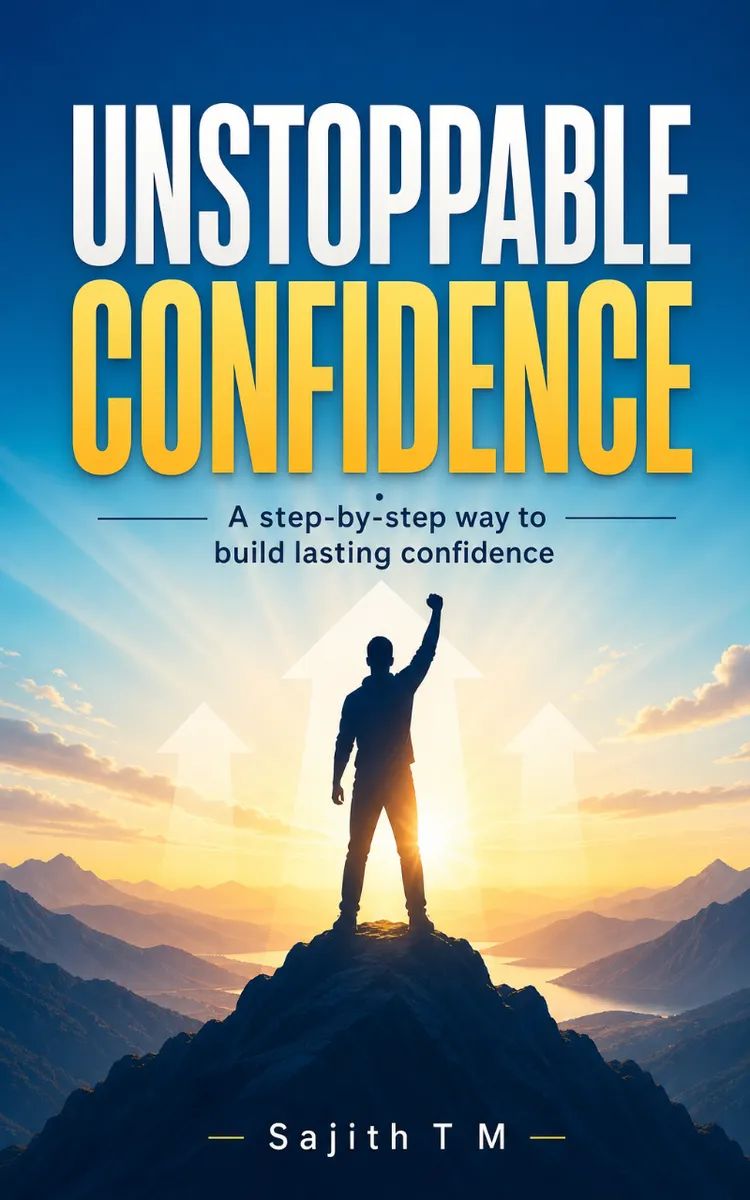
"Unstoppable Confidence" is a self-help book by Sajith T M with 10 chapters and approximately 15,952 words. Confidence vanishes the exact wrong moment, and you can feel it in your body before you can explain it. You know your stuff, you’ve handled worse, but the second you’re watched, judged, or expected to perform, your brain switches into panic mode, replaying every “mistake” after the fact.
This book was created using Inkfluence AI, an AI-powered book generation platform that helps authors write, design, and publish complete books. It was made with the AI Self-Help Book Writer.
Frequently Asked Questions
What is "Unstoppable Confidence" about?
Confidence vanishes the exact wrong moment, and you can feel it in your body before you can explain it. You know your stuff, you’ve handled worse, but the second you’re watched, judged, or expected to perform, your brain switches into panic mode, replaying every “mistake” after the fact. Unstoppable Confidence gives you a fast, practical way to rebuild confidence from the inside out. You will learn how to define confidence as an identity you can access under pressure, rewire the limiting stories that steer your choices, and break perfectionism so you can ship real work, not perfect fantasies. If you want confidence you can actually use, not just hope for, start here.
How many chapters are in "Unstoppable Confidence"?
The book contains 10 chapters and approximately 15,952 words. Topics covered include Claim Your Confidence Identity, Rewire Limiting Beliefs Fast, Break the Perfectionism Trap, Practice Self-Trust With Micro-Promises, and more.
Who wrote "Unstoppable Confidence"?
This book was written by Sajith T M and created using Inkfluence AI, an AI book generation platform that helps authors write, design, and publish books.
How can I create a similar self-help book?
You can create your own self-help book using Inkfluence AI. Describe your idea, choose your style, and the AI writes the full book for you. It's free to start.
Write your own self-help book with AI
Describe your idea and Inkfluence writes the whole thing. Free to start.
Start writingCreated with Inkfluence AI


