
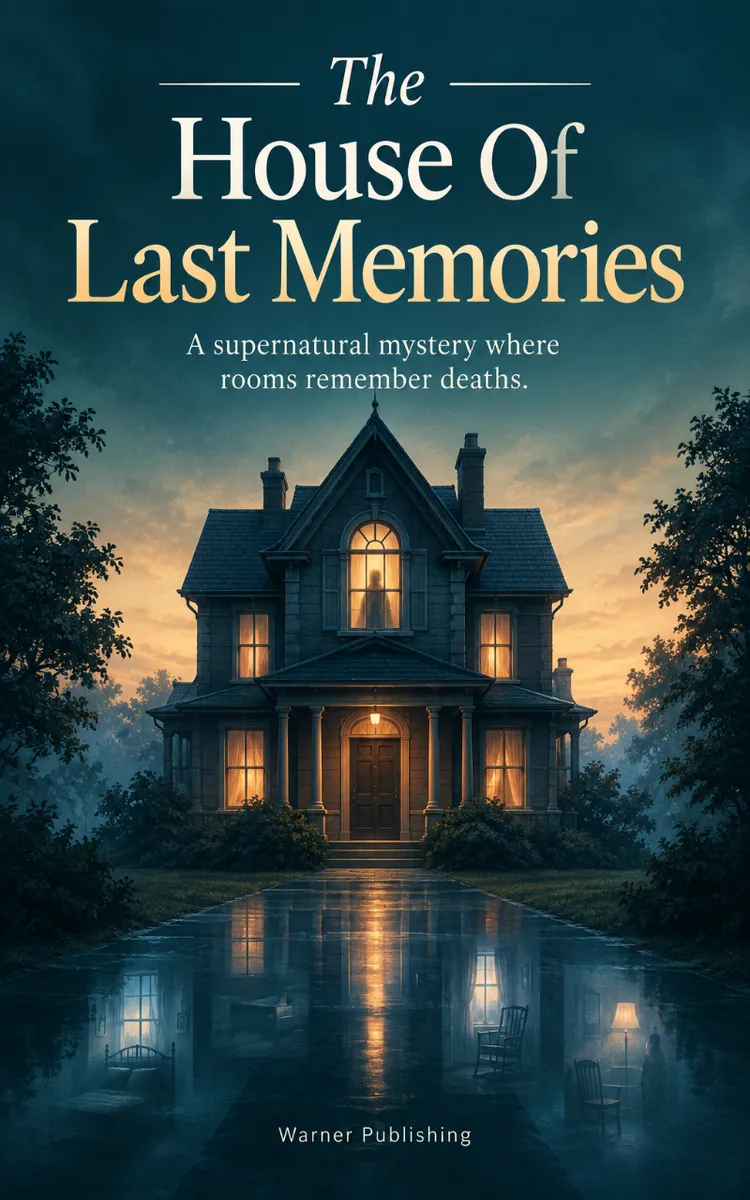

Read the first chapter
The whole of chapter one, free. About 10 min. Turn the pages with the arrows, your keyboard, or a swipe.
Chapter 1
Clara Enters Her Inherited Mansion
Rain struck the windshield hard enough to blur the mansion into a smear of black stone and pale windows.
Clara Bennett killed the engine and sat with both hands on the steering wheel. Beyond the glass, the iron gates leaned open beneath a sky the color of bruised metal. The house waited at the end of the drive, three stories of narrow towers and steep roofs, its chimneys cutting into the fog.
Her mother had died there six days ago.
The thought arrived without an image. Clara had trained herself not to picture Margaret’s body, not to imagine the room where they had found her, not to ask why a woman of fifty-eight had locked every door before dying alone.
She reached for the envelope on the passenger seat instead. The solicitor’s letter had one sentence that mattered: the mansion now belonged to her.
A gust shook the car. Somewhere beyond the gates, metal groaned.
Clara picked up her camera bag, stepped into the rain, and locked the car behind her.
The gravel shifted under her boots as she crossed the drive. Water ra n from her hair down the back of her neck. She kept her eyes on the front doors, on the brass knocker shaped like a closed hand.
At the bottom step, she stopped.
Her mother’s funeral had ended two hours ago. Elias was still at the cemetery, speaking with the officers who had handled Margaret’s death. He had promised to come after he finished asking questions.
“I’m going in,” Clara had told him.
“You don’t have to.”
“I do.”
He had looked at the mansion then, not at her. “Wait for me.”
Clara had heard what he meant. Don’t make decisions while you’re grieving. Don’t touch anything. Don’t let the house turn you into her.
She climbed the steps.
The key from the solicitor was cold and heavy in her palm. When she fitted it into the lock, the mechanism resisted. She leaned into it until something inside the door gave with a dull, reluctant click.
The front hall smelled of wet stone, old wood, and the faint medicinal sweetness of lilies. Funeral flowers filled the parlor beyond the archway, their white heads bowed over a table crowded with cards. Margaret’s black coat still hung from the peg beside the umbrella stand.
Clara shut the door behind her.
The sound traveled through the house.
It did not fade so much as sink, floor by floor, into the walls.
She stood beneath the chandelier, listening to rain drum against the tall windows. Her reflection hovered in the dark glass: twenty-nine years old, narrow-faced, soaked hair tucked behind one ear, black dress wrinkled from the drive. The camera strap crossed her chest like a second line of mourning.
She had come for Margaret’s belongings. The photographs, journals, hard drives - anything that might explain why her mother had spent the last year refusing to answer calls and keeping the mansion sealed.
Elias would arrive soon. If he saw her standing in the hall, he would take the keys and begin making rules.
Clara moved toward the parlor.
A floorboard creaked behind her.
She turned.
Nothing stood at the foot of the staircase. Only the umbrella stand, the coat, and a thin trail of rainwater she had left across the tiles.
“Get a grip,” she whispered.
Her voice sounded too small for the hall.
She entered the parlor and found the desk where Margaret had kept household papers. The drawers were locked, but Clara had expected that. Her mother had hidden important things in plain sight and left the rest behind doors with complicated mechanisms. Margaret had believed privacy was a form of survival.
Clara set down her camera bag and searched the desk.
A brass key lay beneath a stack of unopened mail.
She recognized it immediately. Margaret had worn it on a chain around her neck when Clara was a child. Clara remembered the key flashing against her mother’s sweater as Margaret bent to tie her shoes, remembered asking what it opened.
“A room you’ll never need,” Margaret had said.
Clara closed her fingers around it.
From the hall came a soft click.
Not the front door. A latch.
She looked toward the parlor entrance. The corridor beyond it was narrow and unlit, running toward the west side of the house. Clara knew the layout from the estate plans attached to the solicitor’s papers. The corridor ended at a linen closet and a service stair.
There was no room beyond the wall.
Another click sounded.
Clara took the brass key and stepped out of the parlor.
At first, the corridor appeared unchanged. Wallpaper peeled in long strips beneath framed landscapes. A runner lay flat over the floorboards. At the far end, a dark wooden door stood where the wall should have been.
Clara stopped so quickly the camera struck her ribs.
She knew that wall. She had photographed the exterior of the mansion three times over the years, once for a magazine assignment and twice because Margaret had asked her to document the house. The corridor had never extended that far. The door had never existed.
Rainwater ticked from Clara’s coat onto the floor.
The new door was narrow, painted the same gray-green as the parlor walls. No knob showed, only a brass keyhole.
She glanced back at the front hall.
The house seemed larger from this angle. The chandelier’s light failed to reach the corridor, leaving the entrance washed in a weak yellow glow. Her mother’s coat hung in the distance like a person waiting with its back turned.
Clara lifted the key.
The lock accepted it.
Before she could turn it, footsteps sounded outside.
Elias.
She looked again toward the hall. A car door slammed beyond the front entrance. He had arrived.
“Clara?” his voice called through the house. “Where are you?”
She should have answered. She should have left the corridor and let him enter first.
Instead, the key turned.
The door opened inward.
Warm candlelight spilled over Clara’s shoes.
There were no candles in the corridor. No electricity ran beyond the threshold, yet the room beyond glowed with dozens of flames arranged along the walls and on the floor. Their light trembled across a small chamber lined with dark wood.
A man stood in the center.
Clara forgot to breathe.
He was not transparent. He was not a shadow. He wore a brown wool coat darkened with rain, one hand pressed against his side. Blood seeped between his fingers. His face was turned toward a second door at the back of the room.
“Please,” he said.
The voice was low, raw with terror.
Clara gripped the doorframe.
The man looked toward her.
His eyes passed through her as if she were smoke.
A woman’s voice answered from behind the second door. “You shouldn’t have come back.”
The man staggered toward it. His boots left wet marks across the floorboards. One candle guttered as he passed, then flared blue.
Clara heard Elias calling again, farther away now.
“Clara!”
She tried to step backward.
Her heel would not move.
The air had thickened around her ankle, not gripping her exactly, but holding the moment in place. The room smelled of hot wax, wet wool, and iron. Every detail pressed against her senses with impossible clarity.
The man reached the second door and pounded on it.
“I remember,” he said. “I know what you did.”
Something struck the other side.
The door shook in its frame.
The man stumbled back. A thin line of blood appeared at his mouth. He wiped it with the back of his hand and stared at the red on his skin.
Clara knew this was not happening now. No part of her mind could accept it as the present. Yet the fear on his face was immediate, alive enough to make her stomach twist.
The door opened.
No one stepped through.
Darkness filled the doorway, deeper than the unlit corridor behind Clara. The man backed away from it until his shoulders touched the wall.
A figure appeared in the darkness.
A woman in white.
Her dress was old-fashioned, its hem soaked and gray. Her face remained turned away. She raised one hand toward the man, not reaching for him but warning him.
The man saw her.
His expression changed from fear to recognition.
“No,” he whispered. “Not you.”
The woman in white turned her head toward Clara.
For one instant, Clara saw a pale profile and a dark hollow where an eye should have caught the candlelight.
Then the figure vanished.
The man cried out.
Every candle went black at once.
The room plunged into darkness except for a single flame beside the door. Its light revealed a knife on the floor, though Clara had not seen it before.
The man looked down.
A sharp, wet sound came from his chest.
He folded slowly, one hand sliding along the wall until he reached the floor. The knife remained several feet away. No attacker stood near him. No hand touched him. He simply fell, as if the memory had reached the point it could not pass.
Clara felt the room release her ankle.
She lurched backward into the corridor.
The door slammed shut.
For several seconds she heard only rain and her own breathing.
Then Elias seized her shoulder.
“Clara.”
She spun toward him. He stood beneath the weak hall light in his dark police jacket, rain beading on his hair. At thirty-two, he had the same sharp cheekbones she remembered from childhood, though grief had tightened his face.
“What happened?” he demanded.
She pointed at the door.
Elias looked past her.
There was no door.
Only the original wall, covered in faded wallpaper.
His hand tightened on her shoulder. “What are you pointing at?”
Clara turned back.
The corridor ended where it always had, at the linen closet. The floor runner lay undisturbed. No candlelight showed beneath the wall. No wet footprints marked the boards.
“I saw a room,” she said.
Elias released her. “You’ve been in the house alone for five minutes.”
“I know how long I’ve been here.”
“Then tell me what you saw.”
She looked toward the parlor. Her camera bag sat beside the desk, black and ordinary. The brass key was still in her hand, its teeth biting into her palm.
“A man,” she said. “He was bleeding.”
Elias’s expression hardened, not with disbelief but with the professional patience he used on witnesses in shock.
“Was there anyone else?”
“A woman. In white.”
“Did she hurt him?”
“No.”
“Did you see a weapon?”
“A knife. But it was already on the floor.”
“Clara.”
“I’m not confused.”
“I didn’t say you were.”
“You’re thinking it.”
He glanced toward the front door. “You need to get out until I can check the place.”
She almost laughed. The sound caught in her throat.
“I came here to secure Mom’s things.”
“You came here straight from her funeral.”
“And you came here to treat me like a crime scene.”
His jaw shifted. For a moment, the detective disappeared, and her brother stood in his place - twelve years old, furious at Margaret for leaving them alone during storms, older than Clara by three years and already pretending he could protect her.
“I’m trying to keep you safe,” he said.
The wall behind Clara gave a faint, hollow knock.
Both of them heard it.
Elias turned. His hand went to the weapon beneath his jacket.
Clara stepped closer to the wallpaper.
Another knock came from inside the wall.
Then something slid down behind the plaster with a soft scrape.
Elias drew his flashlight and swept the beam across the corridor. “Stay behind me.”
Clara ignored him. She pressed her fingertips to the wall. The paper was cold and damp. Near the baseboard, one section had lifted away from the plaster.
She pulled it back.
A small black-and-white photograph slipped free and landed facedown on the floor.
Elias crouched first, but Clara reached it before he could pick it up. The paper was thick, its edges browned with age. On the back, written in a hand she recognized, were four words:
For the room that remembers.
Clara turned the photograph over.
The image showed the candlelit chamber.
The same narrow walls. The same door. The same dark stain spreading across the floor beside the dead man.
In the lower corner, almost hidden by shadow, stood the woman in white.
Clara’s fingers began to shake.
Elias stared at the photograph. “Where did you get this?”
She looked at the blank wall, then at the picture again.
The room had shown her one final memory.
And now it had left something behind.
End of chapter one. 35 more chapters and about 69,073 words in the full book.
Swipe or use the arrows to turn the page


What's inside: 36 chapters
- 1. Clara Enters Her Inherited Mansion
- 2. The First Memory Room Rules
- 3. Elias Calls It Family Trauma
- 4. A Door That Was Never There
- 5. Clara’s Camera Captures a Ghost
- 6. The Candle That Won’t Burn Out
- 7. Daniel Graves Returns With Old Records
- 8. The West Door Opens to Ash
- 9. Clara’s Childhood Friend Knows Too Much
- 10. Elias Finds the Locket’s Ledger
- 11. The House Demands a Confession
- 12. A Memory That Shows Margaret’s Hands
- 13. The Tile Map Under the Carpet
- 14. Daniel Breaks the Sealed Room Lock
- 15. The Council Room’s Final Argument
- 16. The Woman in White Names the Witness
- 17. Clara Climbs Toward the Attic Memory
- 18. Midpoint: The Negatives Show Clara’s Death
- 19. Elias Locks the House Against Her
- 20. The Blackout Erases the Map
- 21. Daniel Confesses His Family’s Contract
- 22. The Room That Refuses to Show
- 23. Margaret’s Letter in the Wall
- 24. The Return Room’s Hidden Trigger
- 25. Clara Reaches Her Future Death Room
- 26. The House Freezes Time for One Breath
- 27. Elias Sees the Woman in White
- 28. Clara Finds the Scattered Clues
- 29. The Memory Room Becomes a Stage
- 30. Margaret’s Sacrifice Explained
- 31. Clara Refuses the Witness Inheritance
- 32. The House Releases Margaret’s Last Memory
- 33. Elias Breaks the Evidence Chain
- 34. Daniel Returns the Missing Page
- 35. Clara Photographs the House’s Silence
- 36. One Room Remembers Clara’s Ending
About this book
"The House Of Last Memories" is a fiction book by Warner Publishing with 36 chapters and approximately 69,073 words. A mansion that remembers is worse than a haunting. Clara Bennett inherits a house her mother died in, and the first thing it gives her is proof.
This book was created using Inkfluence AI, an AI-powered book generation platform that helps authors write, design, and publish complete books. It was made with the AI Novel Writer.
Frequently Asked Questions
What is "The House Of Last Memories" about?
A mansion that remembers is worse than a haunting. Clara Bennett inherits a house her mother died in, and the first thing it gives her is proof. A photograph appears where no room should exist, inscribed with a warning her mother seemed to know. Elias, the man who promised to handle the aftermath, calls it evidence, then calls it danger. The house answers anyway, replaying final memories that feel too specific to be imagination. Every new “room” pulls Clara closer to the truth Margaret tried to lock away, and every answer raises a sharper question: what, exactly, is the house asking Clara to remember? Step inside before the memories decide what happens next.
How many chapters are in "The House Of Last Memories"?
The book contains 36 chapters and approximately 69,073 words. Topics covered include Clara Enters Her Inherited Mansion, The First Memory Room Rules, Elias Calls It Family Trauma, A Door That Was Never There, and more.
Who wrote "The House Of Last Memories"?
This book was written by Warner Publishing and created using Inkfluence AI, an AI book generation platform that helps authors write, design, and publish books.
How can I create a similar fiction book?
You can create your own fiction book using Inkfluence AI. Describe your idea, choose your style, and the AI writes the full book for you. It's free to start.
Write your own fiction book with AI
Describe your idea and Inkfluence writes the whole thing. Free to start.
Start writingCreated with Inkfluence AI


