
Read the first chapter
The whole of chapter one, free. About 6 min. Turn the pages with the arrows, your keyboard, or a swipe.
Chapter 1
Fear Arrives Before Facts
Fear often arrives before facts do.
A late-night message goes unanswered. Your adult child shares troubling news. You notice a change in tone, a missed appointment, or a decision you do not understand. Within seconds, your mind may begin building a frightening story. You imagine what could go wrong, replay past conversations, and search for the perfect words that might finally make everything better.
That reaction does not mean you are weak or faithless. It means you love someone whose life is no longer fully within your control. That is one of the hardest truths of loving another person.
When the facts are incomplete, the mind dislikes the empty space. It rushes to fill it. Sometimes it fills that space with reasonable possibilities. More often, when we are tired or afraid, it fills the space with the worst possibility it can imagine.
A delayed reply becomes a sign of danger. A short answer becomes proof of anger. A changed plan becomes evidence that something is falling apart. One unanswered question leads to five more. Before long, you are no longer responding to what you know. You are reacting to a story your fear has written.
The mind’s fast-moving story
Most anxious spirals follow a familiar pattern:
• Something changes or remains unknown.
• Your mind assigns a meaning to that change.
• Your body responds as though the meaning were certain.
• You begin trying to prevent, fix, or control the imagined outcome.
Consider a simple example. You send a message and receive no reply. The fact is small and clear: There has been no reply yet. The interpretation may be very different: Something is wrong. They are upset with me. I should have said something else. Perhaps they are making a terrible decision.
Then the body joins in. Your chest tightens. Your stomach turns. You check your phone again. You reread the message. You send another message, then wonder whether the second message sounded demanding. You may call someone else for reassurance, search for clues, or begin planning how to handle a crisis that may not exist.
This can happen in a matter of minutes. Anxiety is efficient that way. It does not wait for a complete report.
Fear is not always a reliable interpreter of silence. Silence may mean someone is busy, asleep, driving, overwhelmed, or unsure what to say. A changed tone may reflect exhaustion rather than rejection. A delayed decision may mean careful thought rather than hidden trouble. The point is not that nothing is wrong. Sometimes something is wrong. The point is that uncertainty is not the same as danger.
Why love makes this harder
Concern for someone we love can feel like responsibility for that person. We may believe that if we worry hard enough, stay alert enough, or find the right words, we can keep them safe. This is especially strong when the person is an adult child, a spouse, a close friend, or someone whose choices affect the whole family.
Love naturally wants to move toward action. It wants to protect, explain, repair, and rescue. Those desires are not bad. They become exhausting when we assume that every problem is ours to solve.
There is a difference between being available and being in control. You can listen without taking over. You can offer wisdom without forcing a decision. You can pray, check in, and speak honestly without carrying another person’s entire future on your shoulders.
That difference is central to the journey of Steady Prayer, Open Hands. Steady prayer does not mean pretending to be calm when you are not. It means bringing the actual fear to God instead of allowing fear to become your guide. Open hands do not mean you stop caring. They mean you stop claiming ownership of what was never yours to control.
What the spiral costs
An anxious spiral can be emotionally expensive. It drains attention from the present moment. You may be sitting with one person while mentally chasing another problem. You may lose sleep over conversations that have not happened. You may become irritable, distracted, or unable to enjoy good news because you are waiting for the next threat.
Fear can also affect relationships. When we act on assumptions, we may ask accusatory questions, give unwanted advice, or send repeated messages. Our attempts to help can feel like pressure to the person we love. Then their distance confirms our fear, and the cycle grows stronger.
There is a spiritual cost as well. Anxiety can quietly turn prayer into an emergency control room. We present the same situation again and again, not because we are honestly returning to God, but because we are trying to force certainty through repetition. We may read every delay as abandonment or every difficulty as punishment. We may judge our faith by how quickly our fear disappears.
But fear does not prove that your faith is failing. A frightened heart can still pray. A confused person can still trust one small step at a time. Faith is not the absence of alarm. Often, faith begins when we admit, “I am alarmed, and I do not know what to do with this.”
Separate what you know from what you fear
One practical way to interrupt the spiral is to separate facts from interpretations. Take a piece of paper and make two columns.
In the first column, write What I know. Keep the statements simple and observable:
• “The appointment was missed.”
• “I have not received a reply since yesterday.”
• “They said they are considering a change.”
• “Their voice sounded different during our call.”
In the second column, write What I am afraid this means:
• “They may be in serious danger.”
• “They must be angry with me.”
• “This decision will ruin everything.”
• “I have failed them.”
This exercise does not dismiss your concerns. It gives them proper names. Facts deserve attention. Fears deserve compassion and examination. When you put them in separate columns, you may notice that the most painful conclusions are possibilities, not proven realities.
Then ask three gentle questions:
• What else could be true?
• What is mine to do today?
• What must I release because it is outside my control?
The answers may be modest. Perhaps you need to send one clear message and then wait. Perhaps you need to gather accurate information before offering advice. Perhaps you need to call a professional, set a healthy boundary, or make a safety plan. Or perhaps your next faithful step is to eat, sleep, breathe, and stop rehearsing the future for tonight.
A prayer for the unknown
When fear arrives before facts, try praying with the uncertainty instead of arguing with it:
God, I do not know the whole story. You do. I am afraid of what this may mean, and I confess that I am trying to control what I cannot control. Help me respond to what is true, not to every possibility my mind can imagine. Show me what is mine to do, and help me place the rest in your hands. Give me patience while I wait for clearer facts. Amen.
You may need to pray this more than once. Repetition is not failure. Each return is a small act of reorientation. You are turning from imagined certainty toward the God who is present even when your information is incomplete.
Fear may still arrive first. That is part of being human. But fear does not have to make the first decision. Before you send the extra message, assume the worst, or demand an answer that cannot yet be given, pause. Name the fact. Name the fear. Breathe. Pray. Then choose the next honest, loving, limited step.
Trust often begins there: not with a feeling of complete calm, but with open hands in the middle of what you still do not know.
End of chapter one. 6 more chapters and about 9,361 words in the full book.
Swipe or use the arrows to turn the page

2. Praying Through the Waiting

Successful Christian Business Leadership

When the devil whispers to you
What's inside: 7 chapters
- 1. Fear Arrives Before Facts
- 2. Your Love Makes You Vulnerable
- 3. The Moment Prayer Can Begin
- 4. Open Hands: Letting God Be God
- 5. From Replaying to Releasing
- 6. Trust Doesn’t Mean No Action
- 7. A Steady Practice for Unsteady Days
About this book
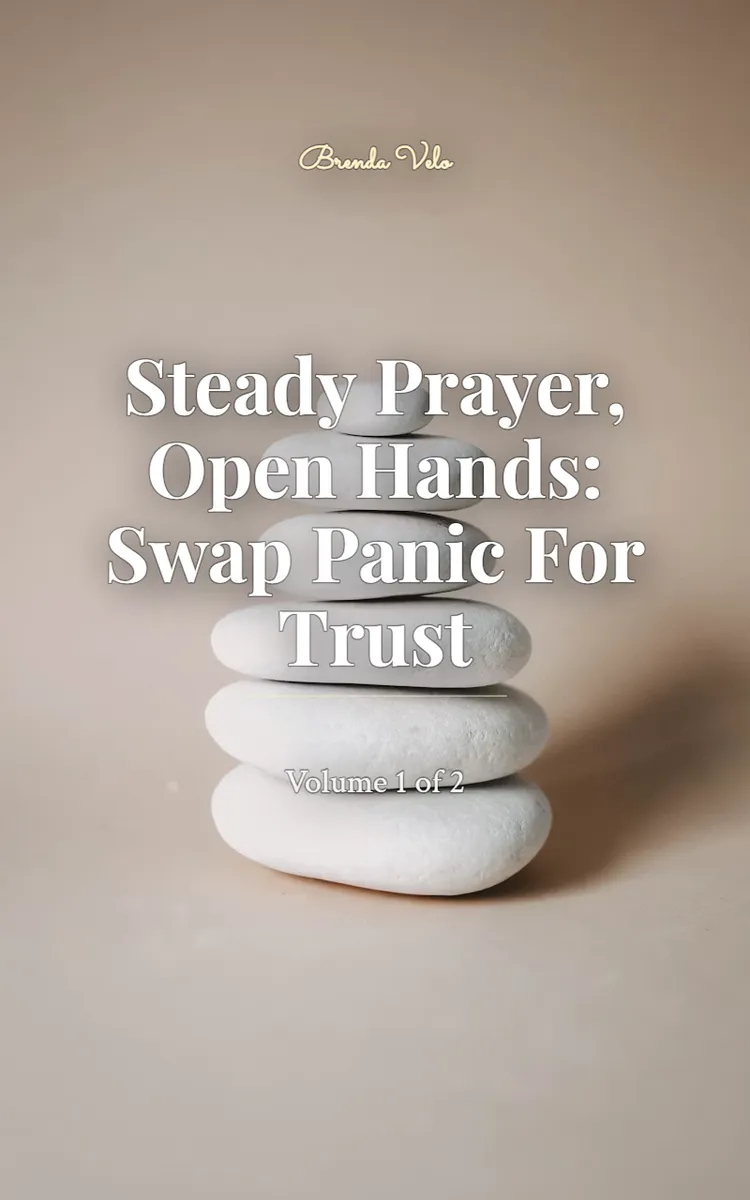
"Steady Prayer, Open Hands: Swap Panic for Trust" is a self-help book by Brenda Velo with 7 chapters and approximately 9,361 words. Volume 1 helps you recognize fear’s first response, replace it with steady prayer, and practice open-handed trust in the moments when control slips away..
This book was created using Inkfluence AI, an AI-powered book generation platform that helps authors write, design, and publish complete books. It was made with the AI Self-Help Book Writer.
Frequently Asked Questions
What is "Steady Prayer, Open Hands: Swap Panic for Trust" about?
Volume 1 helps you recognize fear’s first response, replace it with steady prayer, and practice open-handed trust in the moments when control slips away.
How many chapters are in "Steady Prayer, Open Hands: Swap Panic for Trust"?
The book contains 7 chapters and approximately 9,361 words. Topics covered include Fear Arrives Before Facts, Your Love Makes You Vulnerable, The Moment Prayer Can Begin, Open Hands: Letting God Be God, and more.
Who wrote "Steady Prayer, Open Hands: Swap Panic for Trust"?
This book was written by Brenda Velo and created using Inkfluence AI, an AI book generation platform that helps authors write, design, and publish books.
How can I create a similar self-help book?
You can create your own self-help book using Inkfluence AI. Describe your idea, choose your style, and the AI writes the full book for you. It's free to start.
Write your own self-help book with AI
Describe your idea and Inkfluence writes the whole thing. Free to start.
Start writingCreated with Inkfluence AI


