

Read the first chapter
The whole of chapter one, free. About 13 min. Turn the pages with the arrows, your keyboard, or a swipe.
Chapter 1
The Courtroom That Broke Eli
The bailiff’s voice snapped through the oak-paneled hush like a stapler gun. “All rise. Court is now in session.”
Eli Mercer stood with the rest of them, his knees complaining in the cold air that seeped under the doors of Hawthorne County Courthouse. Courtroom 3B smelled of old paper and disinfectant, the kind they used when they wanted the past to sit still. His briefcase felt heavier than it should, leather softened by years, the latch worn smooth from hands that used to be steady.
Judge Alan Rusk came in without hurry, robe trailing, jaw set the way it always was when he thought someone was lying. And beside him - close enough that the judge didn’t have to look to know where he was - stood his son, Carter Rusk, in a crisp suit that made the cheap carpet look even cheaper. The prosecutor’s table had already shifted to accommodate him. A folder lay there with Carter’s name on it in neat black block letters, as if the case had been filed under family.
Eli kept his gaze on the jury box, on the rows of strangers whose eyes turned toward him the moment he sat. He’d practiced that motion for weeks - face neutral, shoulders down, hands still - because there was one thing he couldn’t risk in a room full of people.
Someone recognizing what he’d done.
He adjusted his tie with two fingers, then let his hands fall into his lap. “Mr. Mercer,” the bailiff said, and Eli heard the strange politeness in it, like they were all trying not to call him anything else. “Counsel for the victim’s family.”
Eli’s throat tightened. The victim’s family - Marlowe Whitaker’s mother and father, her brother, and a cousin who always wore gloves even when there was no need. They’d found him through a chain of referrals that felt less like professional networking and more like a dare. They wanted their daughter’s death put on trial again, wanted someone held accountable even if the court could only offer them paper and procedure.
And Eli wanted to get through the first day without his past crawling into the light.
He rose as the judge called his case, voice booming off the high ceiling. “Hawthorne County versus - ” The judge paused just long enough for attention to sharpen. “ - Carter Rusk.”
Eli’s stomach turned over. Not because Carter Rusk was the name everyone whispered in the same breath as Marl - Marlowe’s name, the name that had stopped being a girl’s and started being a headline. Because the judge didn’t say it like an accusation.
He said it like a fact already decided.
Eli stepped to the lectern and opened his file. The paper inside was crisp, too crisp, like someone had replaced it between midnight and morning. His legal pad waited blank. The courtroom clock ticked loud enough to be heard over the rustle of coats.
Judge Rusk leaned forward. “Mr. Mercer, your opening statement will be brief. The court appreciates your cooperation.”
Cooperation. Eli tasted the word like metal. He glanced at the prosecutor’s table. Carter Rusk sat with his hands folded, eyes bright and unmoved, like the case was a chessboard and the pieces were already positioned. He looked younger than the rumors suggested. That was always the trick with boys who grew into monsters - they still carried the face of someone you might have seen at a graduation ceremony.
“Brief,” Eli repeated silently, then nodded once as if he agreed.
He began carefully, speaking about Marlowe Whitaker’s life - what the family had told him, what police reports had confirmed. He mentioned her love of music, her habit of leaving notes on the fridge. He kept his tone measured, a lawyer’s tone, a man’s tone that didn’t tremble.
But every sentence bent around one unspoken detail: Eli had once sat at a defense table, trying to argue away a crime that had already happened. He’d told himself it wasn’t his job to feel. His job was only to win.
His job was to keep a verdict from landing on someone’s head who deserved it.
That was the part he couldn’t say out loud, not here.
When he finished, the judge nodded toward Carter. “Mr. Rusk. The court is ready.”
Carter stood like he’d been waiting all morning to stretch. He didn’t look at Eli. He looked at the jury, and his voice carried a practiced warmth. “Members of the jury. You’re going to hear about a young woman who didn’t deserve what happened to her. You’re going to hear about the man who did it.”
He paused. His eyes flicked to the courtroom gallery - past the Whitakers, past the cousin’s gloves, past the aunt who wiped her face too often - and landed on Eli for a single beat.
Eli felt it like a fingertip pressed to a bruise.
“And you’re going to hear,” Carter continued, “about how the truth always finds its way back into the light.”
The words were clean, almost poetic. They would have sounded harmless from a stranger. From Carter Rusk, they landed like a threat wrapped in silk.
Eli sat back down and forced his breathing even. He pictured the night - years ago now, but still sharp - when evidence had been shifted and a case had turned on a single missing piece. He pictured himself telling a client’s family to trust the process. He pictured the moment the judge’s decision had landed and his life had split into before and after.
He’d never been in Hawthorne County when Marlowe Whitaker was killed, but the court file had his name on it anyway. Not officially. Not legally. Just in the way things lingered in the corners of records, in the way a signature could haunt a system.
The judge called the first witness. A detective took the stand, voice gravelly, hands steady. Carter led him through the timeline - time of last sighting, time of discovery, the physical evidence that made the room tighten around itself.
Eli watched the jury’s faces. He watched the way people flinched at descriptions they had no right to hear. He watched the Whitaker family hold onto each other like a rope.
He didn’t look at Carter again until the judge asked for a sidebar.
“Counsel,” Judge Rusk said, too loud for the comfort of the gallery, “approach.”
Eli stood, walked to the judge’s bench, and felt the courthouse air change as he stepped into the narrow space where sound carried differently. The bailiff’s steps shifted behind him. Carter joined them without being asked.
Judge Rusk lowered his voice. “Mr. Mercer. You’ve been given access to the initial discovery packet. I expect you to use it responsibly.”
“Your Honor,” Eli began.
Judge Rusk held up a hand. “You’ll refrain from asking questions that stray into irrelevant matter. The court will not tolerate theatrics.”
Eli swallowed. He kept his eyes on the judge’s robe, on the gold trim. “I’m prepared to proceed within the bounds of admissibility.”
Carter leaned in, close enough that Eli could smell his aftershave - something sharp and expensive, a scent that didn’t belong in a courtroom. “It’s good to hear you’re prepared,” Carter said. His voice was almost friendly. “Because today isn’t about your past.”
Eli’s fingers tightened around his file.
Carter continued, still quiet. “It’s about the Whitakers and what you’re going to do for them. So don’t waste the court’s time.”
The judge’s gaze stayed on Eli. “Do you understand?”
Eli nodded. “Yes, Your Honor.”
They straightened and returned to their tables like a rehearsed dance. Eli sat again, opened his file, and tried to read without seeing all the other things in his head.
Then the bailiff brought the next evidence item into the courtroom. A clerk held a sealed evidence bag up for the judge to see, then set it on the witness stand’s edge. The bag looked ordinary, clear plastic and zip-tied like everything else in the system.
Eli’s eyes snagged on the label.
Not the Whitaker case. Not yet.
Another case number.
Another victim.
Carter’s case strategy was already moving like it had been set in motion weeks ago, and Eli’s stomach sank as the detective began to speak. “We received confirmation this morning of additional evidence tied to the Whitaker homicide. It links the methodology to the most recent attack.”
Carter stood again. “May I approach with Exhibit A?”
Judge Rusk nodded. Carter took the exhibit and held it up so the jury could see. The camera in the ceiling recorded everything, indifferent. Eli’s skin prickled beneath his collar.
He watched Carter describe the latest victim - young, female, found in a location so public it made the horror feel deliberate. He watched the detective confirm what Eli already feared.
The serial killer’s latest victim wasn’t just another stranger.
She was family.
The cousin - gloved, silent until now - let out a small sound. It wasn’t a sob. It was the kind of breath someone makes when their body doesn’t know how to react fast enough. The aunt’s hand flew to her mouth. Even the brother’s face went blank, like words had been scraped off it.
Eli felt the courtroom tilt.
Carter’s voice turned toward the jury, smooth as ever. “This will show continuity. The pattern. The killer doesn’t just take lives - he takes from the people who think they’re safe.”
Eli’s pulse hammered in his ears. Continuity. Pattern. Those words belonged to a textbook, not to a family watching their own become the next exhibit.
He stared at the gloves on the cousin’s hands. They’d always been there, Eli realized suddenly, not as a fashion choice. As a barrier. Something she’d been taught to keep between herself and the world since the first time the police came and asked questions that sounded too much like accusations.
He’d been told Marlowe’s death tore them apart. He hadn’t been told what else it had reached for.
Carter sat down, satisfied. Judge Rusk leaned back, letting the moment settle into the room like dust.
Eli forced himself to look at the Whitakers. The cousin met his eyes, and for a fraction of a second Eli saw the request in her stare: Don’t lie to us with your silence. Don’t pretend you don’t know where this is going.
Eli’s mouth went dry.
He had tried to avoid this kind of link - avoid realizing his buried crime wasn’t buried deep enough. But the court had a way of dragging the past up by the collar.
When the judge called for cross-examination, Eli stood because his body moved before his mind could bargain. The judge’s eyes followed him, sharp and unkind.
Carter’s expression didn’t change. He sat as if he already knew what Eli would ask and how it would fail.
Eli walked to the witness stand. He didn’t speak right away. He let the detective’s hands settle on the rail, let the courtroom noise thin enough that his voice could carry.
“Detective,” Eli said, and his tone sounded steadier than he felt, “you said the latest victim was - ”
The detective hesitated, then nodded. “Family. Same extended family as the Whitakers.”
Eli felt his chest tighten. “Who specifically identified her as family?”
The detective glanced toward the Whitakers. “A relative. The cousin. She provided the connection.”
The cousin’s gloved hands trembled, almost imperceptibly, but Eli saw it. Her eyes stayed locked on Eli, and Eli understood the shape of the trap.
In court, facts didn’t care about innocence. Facts just waited for someone to place them in the right order.
Eli took a breath. “Do you have the statement?”
Judge Rusk’s gaze sharpened. Carter’s head turned slightly, like a dog hearing a command. Eli’s instincts screamed to stop, to pivot, to keep the past from showing its teeth.
But the statement was already in the air. It had been mentioned. The witness had nodded. The courtroom was watching Eli decide what kind of man he was going to be.
Eli made himself move.
“Yes,” Eli said, and his voice didn’t crack even though he wanted it to. “Where is it in the evidence packet?”
Carter rose before the detective could answer. “Objection. Counsel is attempting to - ”
Judge Rusk cut Carter off with a raised hand. “Overruled. Answer the question, Detective.”
The detective swallowed. “It’s in the initial evidence file. Marked with the Whitaker case number.”
Eli’s fingers dug into the edge of the lectern as he turned his head toward his chair. The file sat there, closed, waiting like a locked door.
He hadn’t asked for that statement yet. He hadn’t wanted to. He’d been rehearsing detachment all morning, telling himself he could navigate this place without touching the parts of his life that had turned him into someone he despised.
Now he couldn’t avoid it.
“May I have it?” Eli asked.
Judge Rusk’s mouth tightened. “Mr. Mercer, the court has already provided you with access to the initial discovery.”
Eli forced a calm nod. “Then I’m requesting the statement referenced by the witness.”
Carter’s eyes flashed. “Your Honor, the defense - ”
“The defense,” Judge Rusk repeated, as if tasting the word and finding it bitter. “Mr. Mercer is counsel for the victim’s family. The court will not permit confusion.”
Eli heard his own name in the judge’s tone, heard how the judge wanted it to sound. Not a lawyer returning for justice. A lawyer returning for obedience.
The judge stared at Eli for a long moment. Then he lifted his hand toward the clerk. “Provide counsel with the statement.”
The clerk moved quickly, too quickly for how careful they’d been with every other piece of evidence. A folder slid across the table toward Eli. It was thin, but when Eli opened it, the paper inside seemed to weigh a ton.
He scanned the first lines, eyes catching on handwriting and then printed text. Names. Dates. A description of what the cousin had said when the police came. A narrative Eli recognized in the way you recognize your own handwriting even if you’ve tried to forget the act.
He kept reading because stopping would have been worse.
Then he saw the signature line and the family connection spelled out in cold, official language.
The latest victim wasn’t just related to the Whitakers.
She was Eli Mercer’s blood.
The courtroom blurred around him - the murmur of breath behind seats, the scrape of a chair as someone shifted, the detective’s steady voice continuing at the witness stand. Eli’s hands went numb around the paper, as if the text had sucked heat from his skin.
He stared at the words until they stopped being words and became something else: a doorway he’d spent years not opening.
Carter watched him.
Eli could feel it, the way Carter’s attention tightened like a noose. The judge’s posture stayed rigid, but Eli saw satisfaction there too, buried under authority like a blade under cloth.
Judge Rusk leaned forward. “Mr. Mercer?”
Eli blinked. The folder shook slightly in his hands. He forced his voice out, careful and low. “I… see.”
Carter’s smile was almost invisible. “You do.”
The judge’s gaze stayed on Eli, and the room felt suddenly smaller, like the courthouse itself had decided to trap them all inside this revelation. “Proceed,” the judge said, as if Eli hadn’t just found a piece of his own life sitting in a sealed folder.
Eli looked down at the statement again, at the name he knew too well, and felt the decision slam into him with the force of a closing door.
He could keep pretending this was just strategy. He could keep his past locked away behind legal language and courtroom procedure.
Or he could tell the family what the court had just linked to their grief.
Eli’s fingers tightened on the page until the paper creased. He lifted his head toward the witness stand, and his mouth formed the first words of his next question - words that would either protect him or expose him.
Behind the judge’s bench, Carter Rusk’s eyes gleamed, certain the trap would close. Eli turned the folder slightly, trying to hide the name from the jury while still keeping it in view from his own mind.
The detective waited. The Whitakers waited.
And Eli realized with sick clarity that he’d gotten what he came for - access to the evidence - only to find it carried his own blood like a signature on the end of a confession he hadn’t made yet.
End of chapter one. 7 more chapters and about 22,381 words in the full book.
Swipe or use the arrows to turn the page


What's inside: 8 chapters
- 1. The Courtroom That Broke Eli
- 2. Confession He Can’t Afford
- 3. The Evidence Locker Opens Wrong
- 4. The Timeline That Doesn’t Fit
- 5. A Motion Filed at Gunpoint
- 6. The Guilty Man Loses His Voice
- 7. When the Judge’s Son Breaks
- 8. Truth Costs Eli Everything
About this book
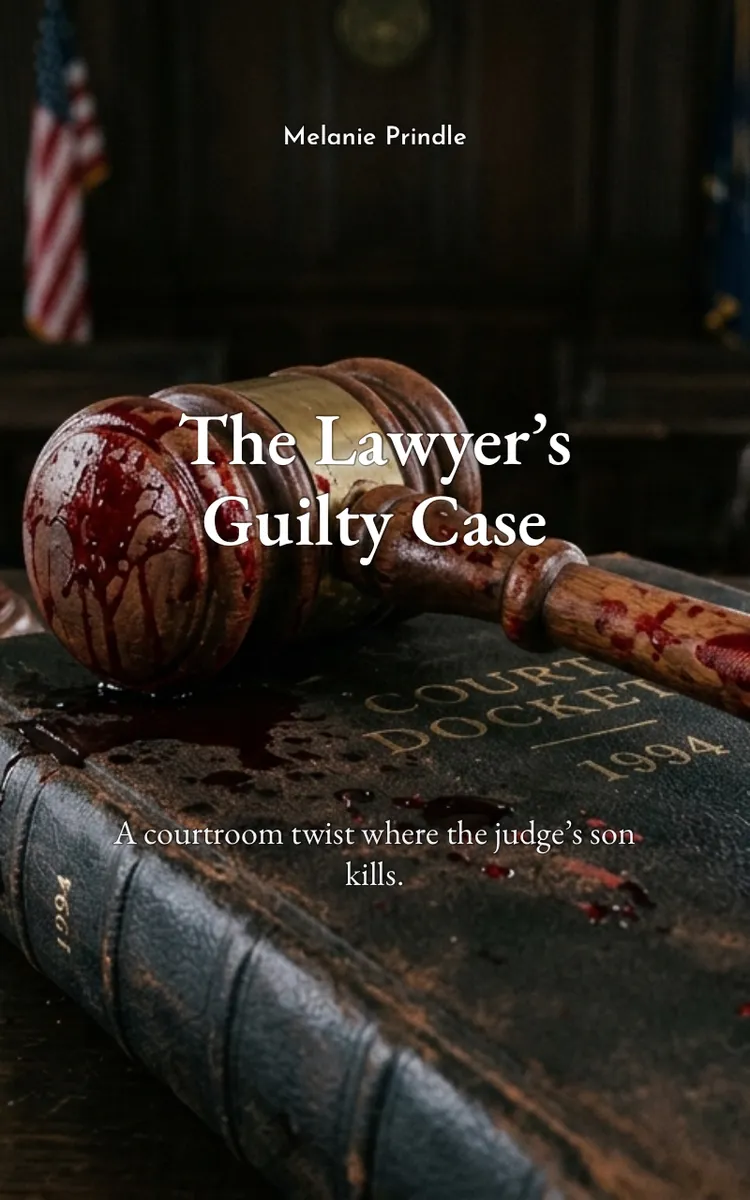
"The Lawyer’s Guilty Case" is a fiction book by Melanie Prindle with 8 chapters and approximately 22,381 words. Suspense thriller about a disgraced lawyer and a serial killer.
This book was created using Inkfluence AI, an AI-powered book generation platform that helps authors write, design, and publish complete books. It was made with the AI Novel Writer.
Frequently Asked Questions
What is "The Lawyer’s Guilty Case" about?
Suspense thriller about a disgraced lawyer and a serial killer
How many chapters are in "The Lawyer’s Guilty Case"?
The book contains 8 chapters and approximately 22,381 words. Topics covered include The Courtroom That Broke Eli, Confession He Can’t Afford, The Evidence Locker Opens Wrong, The Timeline That Doesn’t Fit, and more.
Who wrote "The Lawyer’s Guilty Case"?
This book was written by Melanie Prindle and created using Inkfluence AI, an AI book generation platform that helps authors write, design, and publish books.
How can I create a similar fiction book?
You can create your own fiction book using Inkfluence AI. Describe your idea, choose your style, and the AI writes the full book for you. It's free to start.
Write your own fiction book with AI
Describe your idea and Inkfluence writes the whole thing. Free to start.
Start writingCreated with Inkfluence AI


