

Read the first chapter
The whole of chapter one, free. About 16 min. Turn the pages with the arrows, your keyboard, or a swipe.
Chapter 1
The Ash Market’s False Ledger
The Ash Market’s sky-dome had a fist-sized fracture near the eastern arch, and every time the wind worried the metal ribs, daylight spilled in like a blade. Mara Voss timed her steps to the shuddering groan overhead, keeping her shoulder low beneath the hanging soot-sheets so the guards wouldn’t clock her face through the gaps. When the dome flexed, the whole place seemed to inhale and exhale - coal dust sliding along the beams, lanterns flickering, voices rising and dropping with the rhythm of the break.
Her basket cut into her palm where she gripped it too tight. Inside were two ration tags she’d traded for last week’s flour and a folded cloth with her family’s seed packets wrapped in it. Not enough, not with the next ration draw due before the week turned. Her little brother’s cough had tightened into a wet rattle that made her mother’s eyes go hard whenever anyone mentioned medicine. If she didn’t bring back seed rations and something for his chest, the household would be counted as falling behind before the market even opened its evening ledger.
At the line of stalls under the dome’s broken light, a woman in a scorched registry sash called out loudly enough to carry. “Seed draw, third bell. Medicine coupons only for eligible claims.”
Mara didn’t stop walking. She’d learned the market’s rules the hard way: the people who shouted the loudest were often the ones with the most to hide, and the clerks who smiled too easily tended to mark names in ink that never washed out. She slipped between a man bargaining for salt and a pair of women arguing over thread, stepping around an overturned crate that had been filled with ash instead of grain. The smell wasn’t ash so much as old soot and damp paper - ledger books kept too close to damp stone, the pages softening at the edges.
A guard at the inner gate blocked her path with a spear butt that clicked against the floor. The metal was scratched with old tally marks where other hands had been forced back. His uniform was clean at the collar and grime-brown everywhere else, like someone had tried to scrub the idea of authority without touching the rest of him.
“Token,” he said.
Mara held out her stamped tag with two fingers, careful not to let her thumb cover the seal. The seal meant she was allowed to barter within the women-majority district lanes. It didn’t mean she could buy everything. It didn’t mean she could ask questions.
The guard glanced at it, then at her basket. His eyes flicked, quick as a knife, to the thin band around her left wrist where eligibility markers sat beneath the skin - an old custom from before the meteor changed the world’s math. He didn’t need to touch her. The barbs were visible if you knew where to look.
“You’re late,” he added. “Third bell’s half spent.”
“I walked from the floodworks,” Mara said, and kept her voice steady. Floodworks meant water channels and locked gates, meant the settlement’s bones. It meant she’d had to pay in favors just to get through the day’s ration checks.
The guard’s mouth tightened. “Still late.”
Behind him, the corridor to the ration clerks narrowed into a throat. Stamped paper and shuffling feet echoed under the dome. A loudspeaker - powered by a crank someone had turned too long - crackled with a recorded announcement about compliance and order, the words warped by the broken sky. Mara could feel the sound in her teeth.
She forced herself to breathe through her nose instead of her mouth. The damp paper smell grew stronger near the clerks’ counter, and with it the faint metallic tang of ink. That ink was never just ink in the Ash Market. It was a decision that could strip a family of seed and medicine in the time it took for a stamp to dry.
The ration clerks sat behind a counter of reinforced glass. Each clerk wore a ring of colored thread around their wrist - blue for seed, grey for medicine, red for claims that could be revoked. Mara pressed up to the glass, ignoring the woman beside her whose hands shook as she fumbled for her documents.
“Name,” the clerk said without looking up. A man, younger than most, with hair cropped close like he’d been issued a haircut along with his job.
“Mara Voss.” She kept her palm on the basket handle so the tremor in her fingers didn’t show. “I need seed rations and medicine coupons. My draw’s due before dawn.”
The clerk finally lifted his gaze. His eyes didn’t go to her face so much as to the wrist band beneath her sleeve. He read her like a ledger reads ink.
“You’re drawing under district lane three,” he said.
“Yes.”
“Eligible status is under review,” he added, and slid a thin booklet toward her. The paper was already smudged where other hands had turned it. “No medicine without cross-check.”
Mara leaned in. The glass was cold enough to make her knuckles sting. “Cross-check with what?”
“With the government selection register.” The clerk’s voice stayed flat, but his fingers tapped the booklet’s edge twice, like a code. “Medicine can’t be issued for claims that don’t match reproductive eligibility.”
Mara felt her throat tighten. Her mother had explained the new rules in careful language, as if careful language could keep the meteor’s damage from turning into cruelty. Women were the majority now, but the atmosphere had stolen what it could from the human body. Bearing children was harder. The market didn’t just sell seed. It decided who deserved the chance to be counted as future stock.
“My brother is sick,” Mara said. “His cough started after the last cold front. I’m not asking for charity. I’m asking for medicine coupons.”
The clerk’s eyes flicked to the side where a guard stood with a clipboard and a face like stone. The guard didn’t move, but the air around him seemed heavier. “Bring proof of claim,” the clerk said. “And your seed ration request needs a matching ledger stamp.”
Mara pulled her seed packets from the basket, the wrapped cloth rough against her fingers. “I have my ration tags. I have last month’s purchase receipts.”
“Receipts don’t override the ledger.” The clerk slid the booklet closer and tapped a page without letting her see it fully. “This market has a false ledger enforcement clause. If your stamps don’t align, your request is denied. If you attempt purchase under mismatched claim, guards will confiscate your token.”
False ledger. The words landed like a warning and a threat disguised as procedure.
Mara forced herself to stay calm. She’d heard whispers - how some traders swapped numbers, how others printed counterfeit seals on paper thin as ash. But she wasn’t a counterfeiter. She’d traded for what she could, wrapped what she bought, stretched what her household had. She’d never tried to cheat the system. Not until now.
She looked past the clerk at the shelves behind him. The medicine coupons were stacked in tidy bundles, each bundle tagged with a colored strip. Seed ration canisters sat in rows, metal lids stamped with district markings. Everything looked orderly. Everything looked like it had always been that way.
“Show me the cross-check,” Mara said.
The clerk’s mouth twitched, almost a smile. “You can’t view selection registers at the counter.”
“I’m standing here with my claim.” Mara kept her voice low so it wouldn’t draw the guard’s attention fully, but she didn’t soften it. “I’m not leaving without seed and medicine.”
The guard shifted his weight. Leather creaked. “You can leave,” he said. “Or you can wait. Either way, you follow the lines.”
Mara’s eyes burned. She wanted to push her hand through the glass and grab the booklet, rip the page out and see her household name in ink instead of whatever story the clerk wanted to tell. But the Ash Market was built for punishment. People disappeared into back corridors when they made too much noise.
She swallowed. “Then I’ll wait.”
The clerk turned his chair slightly, reaching for a stamp pad. His movements were deliberate, the kind that made you feel like you were watching a trap close. “You’ll wait while I verify.”
Mara stepped aside to the narrow bench beside the counter, forcing herself to watch instead of fidget. The bench was slick with condensation and soot, and the cold seeped into her thighs through her skirt. She listened to the market around her: arguing over exchange rates, the scratch of pen on paper, the clink of metal canisters, and - under it all - a constant murmur that sounded like ash shifting in a bin.
A woman across from her, older, with a scar down her cheek, leaned close and spoke without turning her head. “Don’t ask to see the book,” she murmured. “They like it when people ask. It gives them a reason.”
Mara stared at the clerk’s hands. “My brother needs medicine.”
The older woman’s lips pressed thin. “Medicine is for eligibility claims. Eligibility is for selection. Selection is for the government.”
“Then let me buy,” Mara said.
The older woman’s gaze slid to Mara’s wrist band again. “If they decide your claim doesn’t match, you won’t buy. You’ll be marked as fraud. They’ll revoke your token.”
Mara’s stomach turned. She hadn’t come to beg. She’d come to trade. She’d come with receipts, with tags, with the kind of proof that should have mattered.
When the clerk returned his chair to face her, he held a stamp token between two fingers. It was round and thick, stamped with the district lane and the date. A thin strip of red thread had been woven through the token’s hole.
He set it on the counter with a soft click.
“Seed rations,” he said, voice slightly more cordial now that he had something she could hold. “One week. Valid until third bell tomorrow.”
Relief hit Mara hard enough to make her feel dizzy. She reached for the token, and her fingers closed around it.
The metal was warm, as if someone had held it in their palm while the clerk worked. The seal’s raised letters caught the broken dome’s daylight and threw it back in a dull shine. She could almost see her mother’s shoulders drop.
“Medicine?” Mara asked.
The clerk’s expression stayed blank. “Medicine pending cross-check.”
Mara’s hope flared and then snapped back like a snapped string. “You said cross-check. You have my name. You have my wrist band.”
He tilted his head. “The cross-check is against the selection roster. The roster can’t be wrong. It’s updated for reproductive eligibility.”
Mara leaned closer, careful not to touch the glass. “Updated how?”
The clerk didn’t answer at first. He looked over her shoulder toward the corridor where guards lined up for inspections. His eyes paused on the older woman, then back to Mara.
Then he said, “Updated by false ledger enforcement.”
“What does that mean?” Mara asked, and hated the edge in her voice.
“It means,” the clerk said, “if your claim is attached to another person’s selection eligibility, the ledger will correct it at dawn. Your token will be revoked.”
Mara stared at the stamped seed token in her hand. The district lane seal was correct. The date was correct. The red thread signaled something else - something she’d never seen on her own previous purchases.
Her mind scrambled, trying to place it among her receipts. She pulled the last month’s receipt from her cloth pouch with shaking fingers and held it up against the glass. The receipt showed her household number and her own wrist band marker code.
“I’m Mara Voss,” she said again, like repeating it would turn the ledger honest.
The clerk’s gaze dropped to her receipt, then to the seed token. “Your name is on the claim,” he allowed. “But the claim record is linked to eligibility issued under a different household authorization. That authorization belongs to - ”
He stopped himself mid-sentence, as if he’d seen the older woman’s scarred face tighten.
A guard at the corridor entrance stepped forward. Mara heard the scrape of his boots on the stone. He stopped just behind the clerk, close enough that his presence blocked the light behind her. He didn’t speak, but his clipboard angled toward her like a threat with a spine.
The clerk resumed, quieter now. “The authorization belongs to someone who was issued a fertility oath token under your district.”
Mara’s mouth went dry. “Under my district,” she echoed. “Who?”
The clerk’s eyes slid away. He didn’t want to say it. That refusal felt like proof.
Mara’s pulse hammered in her ears, loud against the market’s constant murmur. She thought of her mother’s careful voice the night the wrist bands were checked. She thought of her brother’s cough, the way it turned his breaths into wet sounds. She thought of her own body’s limits - what the meteor had changed, what the atmosphere had stolen, what the doctors called “reduced capacity” like it was weather.
Then she thought of the one thing she hadn’t checked herself: the false ledger enforcement clause. The way the market could correct claims “at dawn.”
A correction sounded like a mistake. In the Ash Market, it was a weapon.
Mara turned the seed token over in her palm. The back of it had a smaller stamp she hadn’t noticed before: a serial number, faint and half-marbled where the ink had bled. It wasn’t her household number. It was close enough to pass at a glance.
Close enough to be deliberate.
The older woman beside her let out a low, broken laugh. “They swapped it,” she said. “They always swap it.”
Mara looked at her. “Who did?”
The older woman’s eyes glistened but didn’t spill. “The people who sell hope in the dark. They trade eligibility like it’s seed.”
Mara’s hands tightened around the token until the metal bit into her skin. She could walk away now with at least one week of seed rations, enough to keep her household from starving immediately. She could accept the loss of medicine and pray her brother’s cough eased on its own.
Or she could do something before dawn turned her seed into a revoked lie.
She met the clerk’s gaze. “If my seed token is valid until third bell tomorrow,” she said, “then the ledger can’t revoke it until dawn. That means I can still buy medicine if I find proof before the cross-check locks.”
The clerk’s face hardened a fraction. “Medicine is pending. You can’t push it.”
Mara leaned closer until her breath fogged the inside of the glass. “I’m not pushing. I’m checking.”
The guard behind the clerk lifted his clipboard. The snap of the leather strap sounded too final. “No movement through the inner corridor without permission.”
Mara’s mind raced, quick and sharp. The selection roster was hidden from her at the counter, but the market ran on paper, and paper had patterns. If the false ledger enforcement clause existed, someone had written it into the system. Someone had built the gate between eligibility and rations.
She could feel the cost of acting rising like heat under her skin. If she slipped into the corridor and got caught, her token could be confiscated immediately. If she waited, dawn would come and the ledger would correct itself - by taking her family’s future with it.
Mara turned away from the counter, seed token held low in her palm like a secret. “Then give me a stamp for medicine cross-check,” she demanded, voice sharper now. “A written directive. I’ll go where it’s filed.”
The clerk blinked once, as if he hadn’t expected her to bargain for paper instead of medicine.
The guard stepped forward. “Directive requests go through the registry window,” he said. “Not here.”
Mara’s eyes tracked the corridor entrance. Two guards stood there, uniforms matching, spear butts resting on the floor. Between them, a narrow side door led into the records hall - she’d seen it from the outer lanes when she’d come in earlier, a door with a padlock and a posted sign no one bothered to read.
Records hall meant ledger books. Ledger books meant proof of who her claim was linked to. Proof meant a chance to stop the dawn correction before it swallowed her medicine ration and whatever else the selection would take.
She moved before they could decide whether to stop her. “If you won’t issue the directive, then you can escort me,” Mara said. “Otherwise, your rules are just theater.”
The guard’s jaw tightened. “You’re not authorized for escort.”
Mara lifted her seed token, letting the stamped serial catch the broken dome’s light. “This token is a valid purchase,” she said. “Stamped by your counter. That makes me authorized to verify the cross-check it’s tied to.”
The clerk’s fingers twitched toward the stamp pad, then away. His eyes flicked over the token again, and Mara saw it: a flicker of recognition, like he hadn’t fully expected her to notice the serial number’s mismatch.
He’d thought she’d accept the token and go. He’d thought dawn correction would do the rest.
Mara turned her body sideways to block the guard’s view of her wrist band, then angled her steps toward the side door. “I’m not asking permission,” she said, and felt the market’s sound drop around her, as if everyone sensed the shift from bargaining to confrontation.
The older woman’s hand caught Mara’s sleeve for an instant, fingers like ash. “Don’t - ” she started.
Mara shook her off. The seed token was heavy in her palm, heavier than metal should feel, because it carried a truth that might get her punished. She reached the side door as the guard shouted her name, and the echo of it bounced under the dome like a warning bell.
The lock clicked when her fingers brushed the latch - not because she had permission, but because the door had been left slightly unlatched, as if someone had expected no one to run toward it.
Mara didn’t think. She pushed.
Cold air spilled from the records hall, damp and ink-thick. The doorway swallowed her shoulder and then her whole body, and behind her the market erupted into confused motion - boots, voices, a spear butt scraping the floor as the guards surged.
Mara stumbled into the hall, the floor slick with old condensation. Shelves rose on both sides, stacked with ledger books bound in soot-dark leather. Somewhere deeper, a bell chimed once - soft, official, like dawn’s shadow already reaching through.
She clutched her seed token and looked for the file marked by her district lane and the date. Her eyes skimmed spines, searching for the serial number’s imprint. The letters blurred for a second, then sharpened as her breath steadied.
The pattern was there, waiting like a trap disguised as paperwork: mismatched eligibility entries, false ledger enforcement clauses, and the same handful of serial numbers reused across different claims. Seed rations were stamped correctly. It was eligibility that was shuffled, corrected, revoked.
Mara found a ledger labeled with her district lane and the selection roster’s upcoming date.
And on the page, beneath her claim number, was a name she didn’t recognize - issued eligibility under a different household authorization - its ink too fresh, its stamp red-threaded like a wound.
At the doorway behind her, boots slammed into the threshold. Light from the market cut into the records hall, and Mara realized with a sick clarity that her seed token wasn’t proof of her right to survive until dawn.
It was proof someone else had already been counted for the selection - and she’d been issued the token by mistake, or by design.
The guards’ voices rose, close enough to turn her skin to ice.
Mara shut the ledger with both hands and pressed her seed token against the cover, as if she could stamp the truth into the leather before it got taken away. In the sudden quiet before the lock clanged, she heard her brother’s cough in her head - wet and stubborn - while the broken dome groaned overhead, promising dawn whether she was ready or not.
The cost of having what she came for was already in her fist. Now she had to decide whether to fight for medicine with the wrong name in the book, or run with the only proof she had before they revoked it at dawn.
End of chapter one. 7 more chapters and about 25,035 words in the full book.
Swipe or use the arrows to turn the page


What's inside: 8 chapters
- 1. The Ash Market’s False Ledger
- 2. Choosing Between Oaths and Hunger
- 3. The Floodgate That Isn’t Sealed
- 4. Who Controls the Fertility Index?
- 5. The Selection Day Stampede
- 6. Mara’s Choice in the Holding Cell
- 7. Quell’s Broadcast Over the Radio Ash
- 8. A New Index Built From Ash
About this book
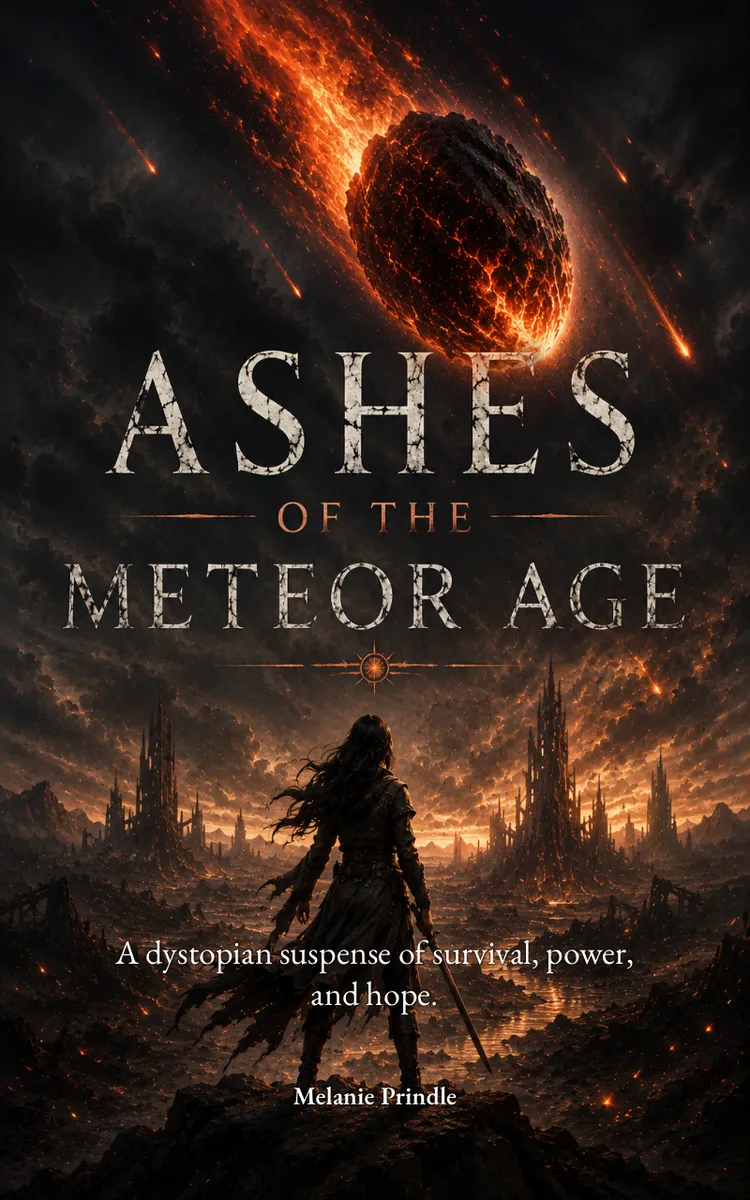
"Ashes Of The Meteor Age" is a fiction book by Melanie Prindle with 8 chapters and approximately 25,035 words. Dystopian suspense after a meteor reshapes Earth’s society and reproduction..
This book was created using Inkfluence AI, an AI-powered book generation platform that helps authors write, design, and publish complete books. It was made with the AI Novel Writer.
Frequently Asked Questions
What is "Ashes Of The Meteor Age" about?
Dystopian suspense after a meteor reshapes Earth’s society and reproduction.
How many chapters are in "Ashes Of The Meteor Age"?
The book contains 8 chapters and approximately 25,035 words. Topics covered include The Ash Market’s False Ledger, Choosing Between Oaths and Hunger, The Floodgate That Isn’t Sealed, Who Controls the Fertility Index?, and more.
Who wrote "Ashes Of The Meteor Age"?
This book was written by Melanie Prindle and created using Inkfluence AI, an AI book generation platform that helps authors write, design, and publish books.
How can I create a similar fiction book?
You can create your own fiction book using Inkfluence AI. Describe your idea, choose your style, and the AI writes the full book for you. It's free to start.
Write your own fiction book with AI
Describe your idea and Inkfluence writes the whole thing. Free to start.
Start writingCreated with Inkfluence AI


