
Read the first chapter
The whole of chapter one, free. About 9 min. Turn the pages with the arrows, your keyboard, or a swipe.
Chapter 1
The Expansion Ledger
The adding machine jammed on a strip of paper marked EXPANSION, its metal teeth chewing the same number until George Jefferson slapped the side of the desk.
“Don’t you quit on me now,” he said. “I got enough people in this city trying to make me quit.”
Across the counter, Louise “Weezy” Jefferson lifted one eyebrow. Behind her, pressing machines hissed and hangers clicked along the rail as Jefferson Cleaners carried on around them. The shop was full, the work was paid for, and still the second-floor space next door sat empty, waiting for George to turn it into another row of machines and another name on the ledger.
Louise reached over and pulled the paper free. “Maybe the machine knows something.”
“The machine knows I bought it new.”
“It knows you bought it cheap.”
George took the paper from her. The expansion costs covered the desk in neat columns: rent, plumbing, electrical work, delivery equipment, wages. He had checked the numbers three times. The lease would stretch them, but it would not break them. Not if the new accounts came through. Not if the landlord kept his word.
He tapped the final figure. “This is the number. We sign today, we move the pressing line upstairs, and we stop turning away hotel work.”
Louise folded her arms. “And if the hotel work doesn’t come?”
“Then we find work that does.”
“That is not a plan, George.”
“It is when I say it with confidence.”
Her mouth softened, but her eyes stayed sharp. Louise had stood beside him through every bad season and every good one. She knew when his confidence was a tool and when it was a coat hiding a shiver.
The bell above the front door rang. Tom Willis came in with a folder tucked under his arm, his overcoat still buttoned against the cold. He glanced at the columns and gave George a careful smile.
“I hope I’m not interrupting.”
“You are,” George said. “But I’ll forgive you if you brought money.”
Tom set the folder on the counter. “I brought something less pleasant.”
Louise opened it before George could. The top page showed a block map, several lots outlined in red. The lines crowded around the street where Jefferson Cleaners stood.
“Whittendale?” George asked.
Tom nodded. “Companies connected to him have been buying property through intermediaries. Quietly. One building at a time.”
“Quietly?” George snatched up the map. “I can hear this paper making noise.”
“They’re not buying everything,” Tom said. “They’re buying enough to control what happens next.”
George studied the marked lots. The empty space next door was outlined in red.
Louise looked from the map to him. “That the property office you’re meeting today?”
“The landlord’s office,” George said.
Tom’s expression tightened. “Where?”
“Midtown.”
“That office handles several of the purchases.”
George placed the map flat on the counter. A delivery boy waited near the racks with a bundle of shirts. The ordinary business of the place pressed in around them: steam, voices, the slap of a ticket against the counter. George wanted the lease. He wanted the upstairs space before somebody else decided what his business was worth.
He pushed the map back toward Tom. “I’m not selling my shop.”
“Nobody said you were.”
“People don’t have to say it when they send a map.”
Louise touched his sleeve. “Go to the meeting. Ask questions. Don’t sign anything until we both read it.”
George looked at her. “You think I don’t know that?”
“I think you want the expansion so badly you might read the promise before you read the fine print.”
The words landed because they were true.
He gathered the cost sheets and tucked them into his case. “I’ll get the lease. I’ll bring it back. We’ll read it together.”
“And if the office gives you trouble?”
George straightened his tie. “Then I’ll give them trouble back.”
• * *
The Midtown property office occupied the ninth floor of a building with brass doors and a lobby guard who looked at George’s garment bag as if it carried a contagious disease. The elevator rose without a sound. Even the buttons were quiet.
George missed the cleaners already.
At the reception desk, a woman in a gray suit asked his name without looking up.
“George Jefferson. I’m here about the lease for the adjoining space.”
She found his appointment in a ledger. “Mr. Hart will see you.”
“Mr. Hart the landlord?”
“Mr. Ralph Hart.”
“That clears up everything.”
She did not smile. George followed her past frosted glass doors and framed photographs of buildings that looked too clean to have people in them. Somewhere behind one wall, a copier clicked. The carpet swallowed his footsteps.
Ralph Hart stood in a narrow office with a window overlooking a canyon of rooftops. He was a thin man with silver hair and a tie the color of old pennies.
“Mr. Jefferson,” Hart said. “Please sit.”
George sat. Hart remained standing long enough to make the chair feel like a favor.
“We’re pleased by your interest in the expansion space,” Hart said. “Jefferson Cleaners has a strong reputation.”
“We do good work.”
“Indeed. The issue is timing.”
George placed his case on his knees. “Timing is what I came to settle.”
Hart opened a file. “The existing tenancy is secure through the end of the current term. The adjoining space, however, is under review.”
“Under review by who?”
“By the ownership group.”
“You’re the owner.”
“On paper.”
George leaned back. “That sounds like a sentence that costs money.”
Hart’s eyes flicked toward the window. “There are redevelopment discussions affecting this block. Nothing final. Nothing that should concern you if your business remains where it is.”
“Then why can’t I lease the space next door?”
“Because the ownership group may have a broader use for it.”
George felt the confidence he had carried upstairs begin to lose its shine. “I’m not asking for a skyscraper. I’m asking for four walls and a door.”
Hart slid a document across the desk. “We can offer a short extension on the adjoining space while the discussions continue.”
“How short?”
“Six months.”
George stared at the page. “That’s not an expansion. That’s a waiting room.”
“It gives you access to the space.”
“It gives you the right to take it back.”
Hart’s voice stayed mild. “It gives both parties flexibility.”
The office door opened. A man in a dark coat entered, carrying a second folder. Hart glanced at him, then at George.
“Mr. Jefferson, this is not the proper time to discuss the long-term arrangement.”
“Then when is?”
“When the ownership group has completed its review.”
The man set the folder beside Hart’s hand. A corner of the top page showed a familiar name in heavy black letters: H. L. Whittendale Holdings.
George reached for it.
Hart covered the page with his palm. “That is confidential.”
“So is the rent, until you raise it.”
“Mr. Jefferson.”
George stood. The room suddenly felt smaller than the cleaners’ front counter. “You called me in here to offer six months on a space I’m supposed to improve with my own money. Now you’re telling me the block may belong to somebody else.”
“No one is telling you to invest.”
“I’m telling myself. That’s what a man does when he owns his business.”
Hart’s expression hardened for the first time. “The notice will explain the situation.”
“What notice?”
Hart opened a drawer and removed an envelope. It was thick, cream-colored, and addressed to Jefferson Cleaners. George took it. The paper was cold and stiff beneath his fingers.
“Read it before you make accusations,” Hart said.
George tore it open.
The notice stated that the property was subject to a redevelopment review connected to an acquisition campaign by affiliated buyers. Existing tenants might be required to provide access for inspection. Future occupancy would depend on the acquisition schedule. At the bottom, under a list of affected properties, Jefferson Cleaners appeared by name.
Not as a tenant.
As a possible holdout.
George read the phrase twice.
“A holdout?” he said.
Hart rose. “A property owner who declines to cooperate with a coordinated sale.”
“I don’t own this building.”
“Your lease gives you operating rights.”
“And that makes me a holdout?”
“It makes your consent relevant.”
George folded the notice once, carefully. “You people have a funny way of asking.”
“We are trying to avoid conflict.”
“No. You’re trying to make conflict look like paperwork.”
Hart’s face went still. “The six-month extension remains available. Sign today, and your business has temporary protection while the review proceeds.”
“Protection from what?”
Hart did not answer.
George left the document unsigned and carried the notice downstairs. The elevator doors closed on Hart’s office, the red letters on Whittendale’s folder, and the clean quiet of a place where nobody had to touch the machines they controlled.
Outside, traffic shoved through the avenue. Horns snapped. A bus sighed at the curb. George stood with the envelope under his arm while people hurried around him, each carrying a destination that belonged to them.
He called Louise from a pay phone outside a luncheonette.
“Tell me you got the lease,” she said.
“I got six months.”
“That is not what I asked.”
“I got six months,” he repeated. “And a notice.”
Her silence came through the receiver.
“What kind of notice?”
“The kind that puts our name on a list.”
“George.”
“Whittendale’s people are buying the block. They call us a possible holdout.”
Louise breathed in slowly. “Are we?”
“We’re Jefferson Cleaners.”
“That wasn’t my question.”
He watched a taxi splash through a gutter and soak the shoes of a man in a business suit. “No. We’re not giving up the shop.”
“Then don’t sign anything until you come home.”
“I didn’t sign.”
“Good.”
The word steadied him, though only for a moment.
He returned to the office and found Hart waiting with the extension papers. This time George read every line. The term was short, the rent was higher, and a clause allowed inspection with limited notice. It was not safe. It was not fair. It was the only door left open.
George signed.
Hart countersigned and gave him a copy. “You’ve made a practical decision.”
“I made a temporary one.”
“Temporary decisions have a way of becoming permanent.”
George slipped the papers into his case. “So do bad ones.”
When he reached Jefferson Cleaners, Louise stood behind the counter with the notice spread before her. Tom was beside her, and Florence Johnston had arrived with a paper bag of rolls she had forgotten to put down.
Florence pointed at the page. “They call you a holdout? Baby, they don’t know who they’re dealing with.”
“I know exactly who I’m dealing with,” George said.
Louise looked up. “Do you?”
He placed the signed extension beside the notice.
“We keep the space for six months,” he said. “We expand enough to keep the business moving. But now they know our name.”
Tom bent over the notice. “And you know theirs.”
George looked at the red lines on the block map, then at the clean white shirts moving down the rail. His business had always been built on visible things: work, money, promises made face-to-face. Whittendale’s power lived behind folders, shell companies, and offices where a man could call a family livelihood a scheduling issue.
Louise reached for his hand beneath the counter.
George closed his fingers around hers.
The extension was in his case. The notice remained on the counter between them, naming Jefferson Cleaners as an obstacle to be removed.
End of chapter one. 19 more chapters and about 41,254 words in the full book.
Swipe or use the arrows to turn the page

What's inside: 20 chapters
- 1. The Expansion Ledger
- 2. A Candidate’s Promise
- 3. The Parcels on the Map
- 4. The Contract Trail
- 5. The Warning Archie Gives
- 6. The Broadcast at Breakfast
- 7. The Missing Copy
- 8. The Arrest Outside Court
- 9. The Visit Behind Glass
- 10. Ralph’s Visitor Log
- 11. Mother’s Old Favor
- 12. The Broker’s Denial
- 13. The Basement Records Room
- 14. The Cleaners Under Watch
- 15. The Shortcut George Refuses
- 16. The Sealed Contract
- 17. The Docket Room Door
- 18. The Hearing Record
- 19. A Family’s New Terms
- 20. The First Day Back
About this book
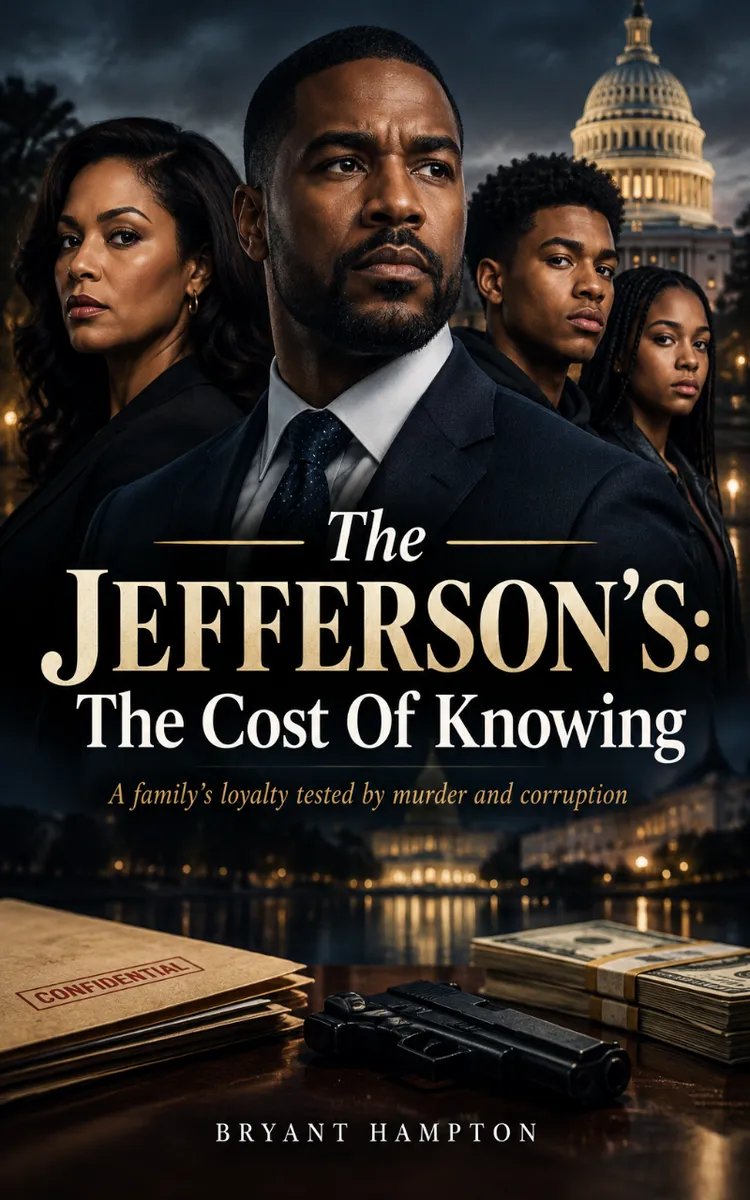
"The Cost Of Knowing" is a fiction book by Bryant Hampton with 20 chapters and approximately 41,254 words. A family confronts political corruption, murder, and the consequences of seeking justice.
This book was created using Inkfluence AI, an AI-powered book generation platform that helps authors write, design, and publish complete books. It was made with the AI Novel Writer.
Frequently Asked Questions
What is "The Cost Of Knowing" about?
A family confronts political corruption, murder, and the consequences of seeking justice
How many chapters are in "The Cost Of Knowing"?
The book contains 20 chapters and approximately 41,254 words. Topics covered include The Expansion Ledger, A Candidate’s Promise, The Parcels on the Map, The Contract Trail, and more.
Who wrote "The Cost Of Knowing"?
This book was written by Bryant Hampton and created using Inkfluence AI, an AI book generation platform that helps authors write, design, and publish books.
How can I create a similar fiction book?
You can create your own fiction book using Inkfluence AI. Describe your idea, choose your style, and the AI writes the full book for you. It's free to start.
Write your own fiction book with AI
Describe your idea and Inkfluence writes the whole thing. Free to start.
Start writingCreated with Inkfluence AI


