
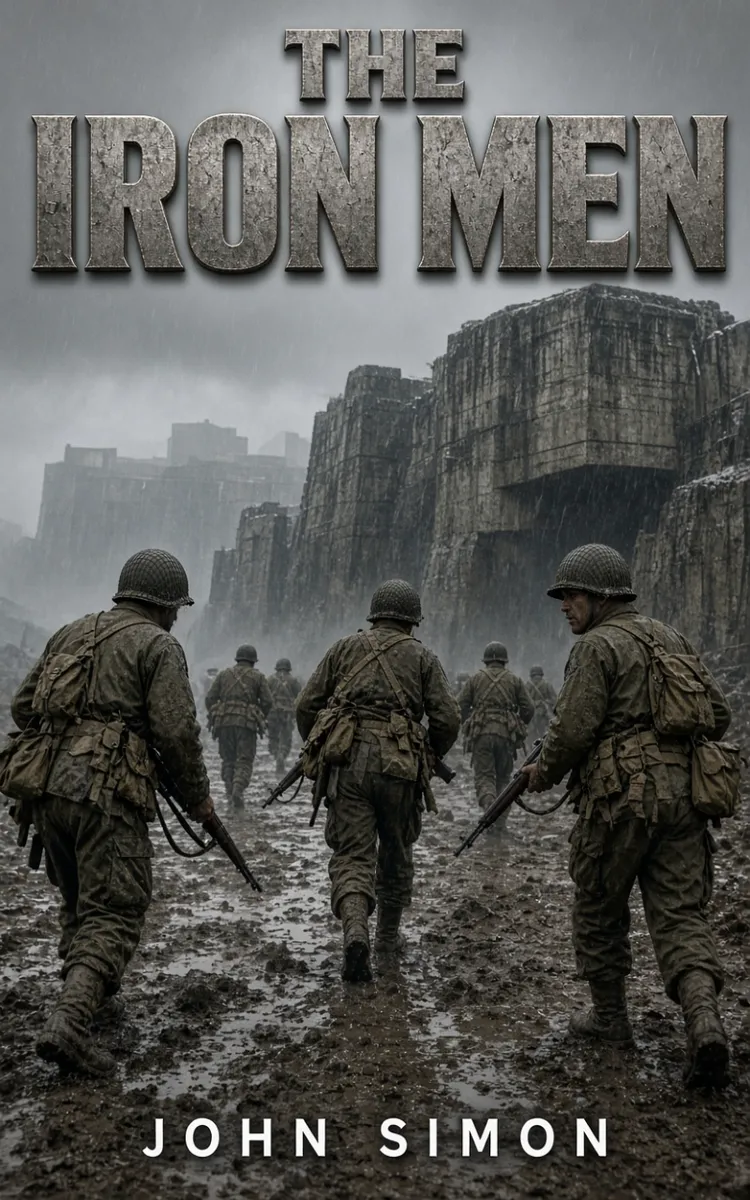

Read the first chapter
The whole of chapter one, free. About 8 min. Turn the pages with the arrows, your keyboard, or a swipe.
Chapter 1
The Road into Lorraine
The road had been laid over a ditch that no longer existed.
Elias Harlan saw the mistake only when the lead truck rolled past it. Rainwater covered the fields on both sides, turning the low ground into a gray sheet broken by fence posts and the black stubble of harvested corn. The road itself narrowed ahead, sinking between hedges toward a farmhouse whose roof tiles shone darkly under the October sky.
“Keep moving,” Eli called. “Stay on the road.”
His voice sounded calm. That was what two years of training had given him: a voice that did not show what his stomach was doing.
The men of his squad trudged behind him, packs slick with rain, rifles wrapped beneath their ponchos. They belonged to the 377th Infantry Regiment, 95th Infantry Division, and most of them had arrived in Lorraine with the same clean confidence that came from maps, field exercises, and instructors shouting across parade grounds. The road to Metz had been marked in grease pencil. The farmhouse had been an empty square on a map.
Now the square had a chimney, shuttered windows, and a ditch full of water deep enough to swallow a man’s knees.
Private Cal Rusk stopped beside Eli. “That the cover?”
“Farmhouse is.”
“Looks occupied.”
“So does every farmhouse.”
Rusk glanced toward the roof. “That supposed to make me feel better?”
“No.”
Behind them, the column pressed forward. Boots slipped in mud. Metal struck metal. Somewhere in the rear, a truck engine coughed and caught again. The division had been moving south and east of Metz for days, edging toward the Moselle through wet fields and villages that seemed built from stone and rain. German artillery had spoken now and then, distant and deliberate. The front had not yet shown its face.
Eli wanted the squad inside the farmhouse before it did.
He pointed. “We cross at the bend. Two at a time. Keep your heads down.”
“There’s no crossing,” said Private Otto Weiss.
Otto stood near the hedge, thin and pale beneath his helmet. His father had come from Germany before Otto was born. He spoke English without an accent and German with the flat confidence of a man who had heard it at his kitchen table all his life.
Eli looked at the ditch. “There’s a culvert.”
“Then it’s under the water.”
“You see another way?”
Otto studied the farmhouse. “No.”
The first shell landed beyond the fields.
The concussion rolled through the road and lifted a curtain of muddy water from the ditch. Men ducked by instinct. Eli felt the blast in his ribs. A second shell struck somewhere behind the column, followed by the sharp crack of splintering wood and a truck horn that stayed pressed down.
“Move!” Eli shouted. “Into the ditch!”
The squad dropped behind the hedge. Rain ticked against helmets. Eli crouched with his back against wet earth, trying to see through branches and smoke.
“Everybody accounted for?” he called.
“Rusk!”
“Here!”
“Dawson!”
A hand rose.
“Bennett!”
“Here.”
“Otto?”
“Here.”
The answer came too quickly. Eli counted again, touching each face as it appeared. Nine men. The same number he had led through every exercise, every inspection, every rehearsal in the States. Nine men who had never fired at anyone trying to kill them.
Another shell came in low and hard. It struck the road ahead, and the hedge jumped. Dirt slapped Eli’s cheek. A fragment hissed through the branches.
“Farmhouse,” he said. “We’re going now.”
Rusk stared at the flooded ditch. “That water’s over my belt.”
“Then keep your rifle high.”
“Sergeant - ”
“Now.”
Eli went first.
The water closed over his boots and climbed to his thighs. Cold punched through his trousers. The bottom was soft, sucking at his feet. He caught a submerged stone with one boot and lurched sideways, keeping his rifle above his head as the men followed.
Behind him, someone cursed. Another shell burst near the road. The noise became a solid wall, too large to separate into individual sounds. Eli reached the far bank and clawed at the grass. His fingers slipped once, then found roots. He hauled himself up and turned.
Rusk was halfway across. Bennett had fallen against him, and both men were trying to keep their weapons dry. Otto stood at the near edge, staring toward the farmhouse.
“What is it?” Eli shouted.
Otto pointed.
A muzzle flash winked from an upper window.
The shot cracked across the ditch. Bennett jerked, dropped his rifle, and folded into the water.
For one second Eli could not move. The farmhouse remained where it was, roof shining, windows black except for the thin smear of smoke drifting from one of them. Training had given him names for positions, fields of fire, and methods of advance. It had not told him what to do with the first man who fell.
“Bennett!” Rusk yelled.
Eli saw Bennett’s helmet floating beside him.
“Get him out!” Eli shouted. “Rusk, pull him over!”
Rusk turned back. “He’s hit!”
“I know that. Pull him!”
Rusk waded toward Bennett. Otto fired at the farmhouse window, his rifle bucking against his shoulder. The glass vanished. A second muzzle flash appeared lower, near the side door.
Eli dropped behind the bank and raised his rifle. He could not see a target, only the dark opening and the gray wall around it. He fired twice. The rounds struck stone.
“Keep firing!” he yelled.
The squad answered. Rifles cracked along the ditch. The farmhouse disappeared behind dust and smoke. Rusk dragged Bennett by the straps of his pack, inch by inch, while the water tugged at both of them.
Eli crawled forward and reached down. Bennett’s face was white beneath the mud. Blood ran from a hole high in his shoulder and mixed with the ditch water.
“Stay with me,” Eli said.
Bennett’s eyes opened. “I’m cold.”
“I know.”
“Can’t feel my hand.”
Eli grabbed the back of his jacket. “You’ll feel it when we get inside.”
That was a lie, and he knew it as he said it.
A burst of machine-gun fire tore through the hedge. Leaves shredded above them. Rusk flattened himself over Bennett. Otto fired again, then shouted something in German that Eli could not make out.
“Otto!”
“Window! Second floor!”
“Can you see them?”
“No!”
“Then keep them down!”
Eli looked toward the farmhouse. Between bursts, he saw the route: twenty yards of open ground, a low stone wall, then the side entrance. The ditch had stopped them, but the house was still within reach. If they stayed where they were, the German gun would work them over one at a time.
He pointed to the wall. “Rusk, you and Dawson take Bennett. Otto, cover the door. The rest of you follow me.”
Rusk’s expression tightened. “He needs a medic.”
“He needs cover first.”
Eli climbed the bank.
For a moment the road, the ditch, and the farmhouse seemed to tilt under him. He ran bent double, boots striking mud, rifle held across his chest. The German machine gun opened again. Dirt snapped around his legs. A round struck the stone wall and spat chips against his cheek.
He reached the wall and dropped behind it.
“Come on!” he shouted.
Dawson and Rusk hauled Bennett across the open ground. Otto fired from the ditch, each shot measured. The rest of the squad moved in short bursts, stopping whenever the machine gun spoke. One man fell to his knees, then rose again.
Eli reached the farmhouse door and pressed against the stone. The wood was swollen from rain. He tried the handle. Locked.
“Stand clear,” Rusk called.
Eli moved aside. Rusk drove his shoulder into the door. Once. Twice. On the third blow the latch tore free, and the door opened into darkness.
“Inside!” Eli shouted.
They crowded through the side entrance. The room smelled of damp plaster, coal smoke, and something sour beneath it. A table had been overturned against the far wall. A staircase rose into darkness. No one fired from above.
“Clear left,” Eli said.
Otto moved with him. “There are men here.”
“You sure?”
“The house is too quiet.”
Rusk carried Bennett through the doorway and lowered him onto the floor. Bennett groaned, his wounded arm hanging uselessly.
A shell struck the farmhouse.
The floor jumped. Plaster rained from the ceiling. Somewhere above them, glass shattered. Eli hit the ground with his hands over his helmet. When he looked up, the room had filled with dust.
“Cellar,” Otto said. “We need the cellar.”
He found the door beneath the stairs. It opened onto stone steps slick with mud. Eli went down first, feeling along the wall with one hand and holding his rifle in the other. The cellar was low and crowded with empty barrels, sacks of potatoes, and a broken cartwheel. The squad packed into it while shells continued to fall outside.
Rusk laid Bennett beside the wall. “He’s losing blood.”
Eli knelt over him. His fingers shook as he pulled the first-aid packet from his pouch. He tore it open with his teeth and pressed the dressing against the wound.
Bennett looked at him. “Sergeant?”
“I’m here.”
“Did we make it?”
Eli glanced up at the ceiling as another impact rolled through the farmhouse. Dust sifted down between the beams.
“Yeah,” he said. “We made it.”
Bennett closed his eyes.
Otto crouched near the stairs, listening. “The Germans pulled out.”
“Pulled out where?”
“Could be the fields. Could be another room.”
Eli tightened the bandage until Bennett cried out.
“Sorry,” he said.
“No, you’re not.”
Eli looked at him. Bennett’s face had lost its color, but his eyes were open now.
“No,” Eli said. “I’m not.”
For several minutes they stayed in the cellar while the artillery moved across the fields. Eli could hear men breathing, water dripping from their clothing, and the faint ticking of a wristwatch somewhere in the dark. His own watch had stopped in the ditch.
At last the shelling thinned.
Rusk leaned close. “What now?”
Eli looked toward the stairs. The farmhouse had given them cover, but not safety. Bennett was wounded. Their route forward was unknown. The Germans had fired from the house and might still be close enough to hear them breathing.
He checked each man in the dim light. Nine had entered the road. Eight were standing or crouching around him. Bennett lay against the wall, one hand pressed to his bandage.
Eli thought of the letters in his breast pocket, sealed inside oilcloth. One from Ruth, written in careful blue ink. One from his younger brother, still training somewhere in another division, asking what France was like.
He had no answer for either of them now.
Outside, a rifle fired once.
Every man in the cellar turned toward the sound.
Eli raised his hand, and the squad went still. The road into Lorraine had led them to cover, just as he had wanted. But Bennett’s blood was drying on his hands, and the farmhouse walls were thin enough to let the next shot through.
End of chapter one. 39 more chapters and about 88,216 words in the full book.
Swipe or use the arrows to turn the page


What's inside: 40 chapters
- 1. The Road into Lorraine
- 2. The Letter from Home
- 3. Tracks Beyond the Seille
- 4. The Farmhouse Gun
- 5. A Brother in Training
- 6. The Replacement Arrives
- 7. The Missing Signalman
- 8. The Orchard Withdrawal
- 9. The BAR in the Rain
- 10. The Company Line Breaks
- 11. The Map in the Cellar
- 12. The Flooded Approach
- 13. The Cost of the Order
- 14. The Shelling at Dusk
- 15. The German Reserve Road
- 16. The Moselle’s Black Water
- 17. A Letter Kept Dry
- 18. The Boats Go Missing
- 19. The Northern Detour
- 20. The False Front
- 21. Loudspeakers in the Fog
- 22. Across at Thionville
- 23. The Fort’s Blind Side
- 24. The D’Illange Slope
- 25. The Men Who Cannot Sleep
- 26. The Tunnel Entrance
- 27. The Prisoner’s Warning
- 28. The Gallery of Smoke
- 29. Charges at the Wall
- 30. The Empty Rifle Slot
- 31. The Fort’s Second Exit
- 32. The Casemate Crossfire
- 33. The Captain’s Map
- 34. The Door Behind the Guns
- 35. The Fort Opens
- 36. The Streets of Metz
- 37. November Twenty-Second
- 38. Iron Men on the Road
- 39. The Bridge at Saarlautern
- 40. The Line Eli Holds
About this book
"The Iron Men" is a fiction book by John Simon with 40 chapters and approximately 88,216 words. The road to Metz narrows between flooded fields, and Elias Harlan knows the map has already lied to him. His squad of the 377th Infantry Regiment reaches a farmhouse with shuttered windows, a water-filled ditch, and Germans somewhere beyond the rain.
This book was created using Inkfluence AI, an AI-powered book generation platform that helps authors write, design, and publish complete books. It was made with the AI Novel Writer.
Frequently Asked Questions
What is "The Iron Men" about?
The road to Metz narrows between flooded fields, and Elias Harlan knows the map has already lied to him. His squad of the 377th Infantry Regiment reaches a farmhouse with shuttered windows, a water-filled ditch, and Germans somewhere beyond the rain. In the cellar, a shot leaves them waiting in the dark beside Bennett, whose bandage is turning black. Eli must choose: stay behind stone walls that have become a target, or carry a wounded man back onto the road. The orders point toward the Seille and the Saar. The ground offers no clean route, and Eli’s stopped watch keeps marking the moment he went into the ditch. The Iron Men follows one rifle squad through the overlooked campaign at Metz, where every crossing and farmhouse can change what the men owe one another.
How many chapters are in "The Iron Men"?
The book contains 40 chapters and approximately 88,216 words. Topics covered include The Road into Lorraine, The Letter from Home, Tracks Beyond the Seille, The Farmhouse Gun, and more.
Who wrote "The Iron Men"?
This book was written by John Simon and created using Inkfluence AI, an AI book generation platform that helps authors write, design, and publish books.
How can I create a similar fiction book?
You can create your own fiction book using Inkfluence AI. Describe your idea, choose your style, and the AI writes the full book for you. It's free to start.
Write your own fiction book with AI
Describe your idea and Inkfluence writes the whole thing. Free to start.
Start writingCreated with Inkfluence AI


