

Read the first chapter
The whole of chapter one, free. About 8 min. Turn the pages with the arrows, your keyboard, or a swipe.
Chapter 1
The Replacement at the Treeline
The road had no road left in it.
Eddie Voss stepped where the wagon ruts should have been and sank to his ankles. Brown water climbed over his boot tops. He lurched forward, clutching his rifle in one hand and the strap of his pack in the other while rain ticked against his helmet.
“Keep moving!” a voice shouted behind him. “Don’t make the forest wait on you!”
Eddie looked back. The treeline stood ahead, black and close beneath the low sky. A runner in a soaked field jacket waved him onward from beside a leaning signpost. Beyond the trees waited the squad he had been assigned to, though Eddie had not yet seen a single one of them. He knew only that they belonged to the 28th Infantry Division and that he was expected to find them before the road disappeared entirely.
He tightened his grip on the pack. The weight dragged at his shoulders, filled with spare socks, ammunition, a shelter half, and the few pieces of home that the Army had not yet taken from him. His right boot came free with a wet sucking sound. The left stayed behind.
For one sharp second he thought the mud had swallowed it.
He dropped to one knee, shoved his rifle beneath his arm, and dug both hands around the heel. Cold water ran into his sleeve. The boot pulled loose with a slap, and he scrambled upright as a shell burst somewhere beyond the trees.
The ground jumped.
Branches cracked overhead. A shower of wet leaves fell across his helmet and shoulders. Eddie bent low without thinking, then heard the runner yelling again.
“Forest! Move!”
He ran.
The approach road narrowed between ditches choked with water and shattered brush. Men ahead of him vanished into the rain one at a time. Eddie followed the last pair, keeping his eyes on the backs of their jackets, but a second explosion lifted a curtain of mud between them. When it dropped, the men were gone.
He stopped.
The rain tapped on his helmet. Somewhere close, a machine gun fired three short bursts. Somewhere farther off, artillery answered. The sounds crossed and folded over one another until Eddie could not tell which direction meant forward.
He pulled the map from inside his jacket. The paper was already soft at the corners. A red pencil line led from the road to a marked position inside the forest. The line looked clean and certain. It crossed no shell holes, no flooded ditch, no trees blown across the track.
A burst landed to his left.
Eddie shoved the map back under his jacket and ran toward the trees.
At the edge of the forest, a man crouched beside a pine stump with a BAR across his knees. He was broad through the shoulders, his face dark with rain and mud, and he watched Eddie approach without rising.
“You Malloy’s replacement?” he asked.
“Voss.”
“That wasn’t my question.”
“Yes.”
The man pointed into the trees. “Then get in there before they send another one.”
Eddie stumbled past him. “Where’s the squad?”
“You’re looking at part of it.”
The man followed, carrying the BAR as if it weighed no more than a shovel. “Rivera.”
“Eddie Voss.”
“I heard.”
“How’d you hear?”
“Everybody hears about the new man.”
A shell burst behind them. The pine stump shuddered. Eddie ducked, and Rivera caught the back of his jacket before he fell into a ditch.
“Not there,” Rivera said. “That ditch is full.”
Eddie looked down. Water churned beneath the brush, carrying leaves and a torn strip of canvas toward the road.
Rivera pulled him across a narrow plank half buried in mud. “Keep your gear on you.”
“I am.”
“Then keep it from killing you.”
They moved beneath the trees. The forest closed around them at once. Trunks stood packed together, their lower branches stripped and blackened. Rainwater ran down Eddie’s neck. The ground was a skin of mud over roots and stones, and every step threatened to send him sprawling.
A figure rose from behind a fallen tree.
“Rivera,” he said. “You bring him?”
“Brought himself.”
The man was thin, pale, and young enough that Eddie might have mistaken him for another replacement if not for the way he held his rifle. He kept it angled toward the dark between the trunks, finger straight along the guard.
“Walt Kessler,” he said.
Eddie nodded.
Kessler glanced at the pack. “You lose anything?”
“No.”
“Give it time.”
Rivera looked deeper into the woods. “Where’s Malloy?”
“Forward.”
“Forward where?”
Kessler shrugged. “He said forward.”
Another shell struck somewhere ahead. The earth rolled beneath Eddie’s boots. A flock of black birds burst from the canopy, flapping low between the trees.
“Move,” Rivera said.
They followed a faint line of white cloth tied to a branch. The marker was no wider than Eddie’s hand, already gray with mud. He fixed his eyes on it and stepped where Rivera stepped. The cloth appeared, vanished, appeared again. Behind them, the road and the world beyond it had gone.
Eddie’s pack snagged on a branch. He jerked free, and the metal cup tied to its side clanged against a trunk.
Rivera spun around. “Quiet.”
“Sorry.”
“Don’t apologize. Fix it.”
Eddie caught the cup and bound it against the pack with a strap. His fingers shook from cold. Kessler watched him without expression.
“First time in the woods?” Kessler asked.
“First time in this one.”
“They’re all different.”
“That supposed to help?”
“No.”
A whistle sounded ahead, two notes swallowed by rain.
Rivera answered with one.
They moved faster. Eddie’s boot slipped on a root, and he fell against Kessler. The German-American shoved him upright, hard enough to hurt.
“Stay on your feet.”
“I’m trying.”
“Try quieter.”
They reached a shallow depression crowded with men and equipment. A telephone wire ran through the mud and disappeared into the trees. Two riflemen crouched beneath a ground sheet. At the center, a sergeant knelt over a map spread on an ammunition crate.
He looked up as Eddie approached.
Frank “Doc” Malloy had a narrow face, tired eyes, and a mustache that rain had flattened against his upper lip. He wore no greatcoat despite the cold. His sleeves were rolled beneath his field jacket, and one hand rested on the map while the other held a pencil.
“Voss?” he asked.
“Yes, Sergeant.”
“You still have your rifle?”
“Yes.”
“Your ammunition?”
“Yes.”
“Your feet?”
Eddie hesitated. “Yes.”
Malloy’s mouth moved almost toward a smile. “Then you’re ahead of some men I’ve known.”
Rivera lowered himself beside the crate. “Road’s being shelled.”
“I noticed.”
“Marker’s still up.”
“For now.” Malloy pointed at the map. “This is the ridge. That’s where we’re going.”
Eddie leaned closer. The map showed a long rise running through the forest, its contour lines crowded together like scratches. A penciled route led toward it from the road, bending around a stream and cutting through a patch marked with tight black strokes.
“How far?” Eddie asked.
Malloy looked at him.
“To the ridge.”
“On the map?”
Eddie nodded.
“Near enough to make headquarters happy.”
Kessler crouched at the edge of the depression. “The route briefing said the ground was open.”
Malloy’s pencil stopped.
“It isn’t,” Kessler said. “Not from what I saw coming in.”
“Then the briefing was wrong.”
“They know?”
“They know everything,” Malloy said. “That’s why we’re here.”
A shell landed close enough to throw mud over the map. Malloy covered it with his forearm. Eddie felt the blast press against his chest. The men under the ground sheet swore. One of them cried out, and Rivera was already turning toward the sound.
“Anybody hit?” Malloy called.
“No!”
“Check anyway.”
Rivera crawled toward the two riflemen. Eddie remained beside the crate, staring at the map. The line to the ridge passed through terrain that the rain had turned into black water and broken timber. It promised a path. The forest offered none.
Malloy folded the map. “You’re with us now.”
Eddie looked at him. “With the squad?”
“With whoever’s left standing when we get there.”
The words settled harder than the cold.
A runner appeared between the trees, bent nearly double. “Sergeant! Incoming!”
Malloy rose. “Everybody out of the low ground.”
The first shell struck behind them. The second landed beyond the depression, sending a trunk down through the branches with a splintering crash. Men grabbed rifles and packs. Eddie reached for his own gear, but the strap had caught beneath the ammunition crate.
He pulled once. Nothing.
“Voss!” Malloy shouted.
Eddie dropped to his knees and worked the buckle loose. Mud filled his gloves. The crate shifted as another shell came in, and the pack strap tore free with a sharp snap. He flung the pack over one shoulder and grabbed his rifle.
Rivera was already moving. “This way!”
They ran along the depression as shells struck the forest around them. The marked cloth flashed white through the trees. Eddie kept Rivera’s back in sight, then Kessler’s, then Malloy’s helmet. The ground pitched upward. Roots caught at his boots. He fell once, rose, and kept going.
A blast struck the tree beside the marker.
The trunk burst apart. Bark and white-hot splinters ripped through the rain. Eddie threw himself facedown. Something struck his pack and spun him onto his side.
When he looked up, the cloth marker was gone.
The tree lay across the route, burning in places despite the rain. The telephone wire had been severed. Smoke crawled through the branches, mixing with the wet earth and the bitter sting of explosives.
Rivera crouched beside him. “You hit?”
“No.”
“Then get up.”
Kessler stood beyond the fallen trunk, staring into the forest. “Which way?”
No one answered.
Malloy came through the smoke, his map pressed beneath his jacket. He looked back toward the ruined marker, then toward the dark slope ahead.
“Ridge is that way,” Eddie said.
Malloy studied him. “How do you know?”
Eddie pointed to the ground. Beneath the mud, the rise continued. The trees leaned with the slope. Somewhere beyond them, artillery thundered from the unseen far side.
Malloy nodded once. “Good. You can read a hill.”
“I can’t read the route.”
“Neither can the route.”
He turned to Rivera. “Take the left side. Kessler, right. Keep him between you.”
Eddie looked at the shattered tree. “What about the trail?”
Malloy pulled his rifle free. “Trail’s finished.”
They moved without it, leaving the map’s clean red line behind in the wreckage. Eddie followed the three men uphill, his pack torn, his boots heavy with mud, and the forest closing over every sign of where they had come from.
End of chapter one. 39 more chapters and about 82,702 words in the full book.
Swipe or use the arrows to turn the page


What's inside: 40 chapters
- 1. The Replacement at the Treeline
- 2. Names in the Foxhole
- 3. The Ridge on Paper
- 4. The Ravine Takes a Man
- 5. The Long Carry
- 6. The First Ridge Assault
- 7. The Missing Observer
- 8. The Hollow That Flooded
- 9. A Letter from Ohio
- 10. The Second Push Breaks
- 11. The Empty Position
- 12. The Aid Station Queue
- 13. Kessler’s Family Name
- 14. The Company’s New Order
- 15. The German in the Culvert
- 16. The Shell-Hole Prisoner
- 17. Rivera’s Rule
- 18. The Attack in the Branches
- 19. The Prisoner’s Transfer
- 20. The Ridge Is Still Vital
- 21. Malloy’s North African Silence
- 22. The Observer’s False Grid
- 23. The Unmarked German Track
- 24. The Broken Switchback
- 25. Walt’s Unsent Letter
- 26. The Rescue Under Fire
- 27. The Commander’s Quiet Map
- 28. The Frozen Water Point
- 29. The Ridge’s Near Crest
- 30. The Squad’s Empty Roll
- 31. The Unanswered Signal
- 32. The Logging Cut
- 33. Eddie Chooses the Detour
- 34. The Observer’s Last Correction
- 35. The Ridge-Side Rescue
- 36. Malloy Gives Up the Map
- 37. The Forest Road Out
- 38. Rivera’s Last Magazine
- 39. The Rear Guard’s Count
- 40. Beyond the Last Ridge
About this book
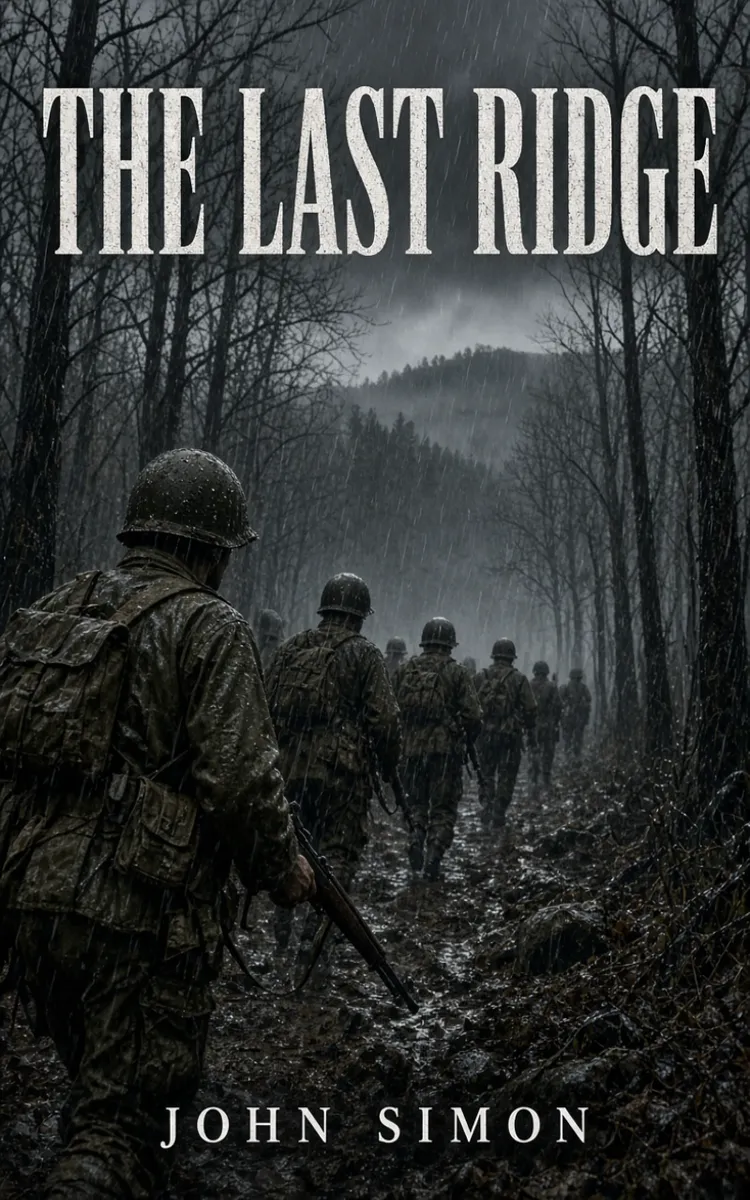
"The Last Ridge" is a fiction book by John Simon with 40 chapters and approximately 82,702 words. American infantrymen endure the brutal Hürtgen Forest campaign in World War II.
This book was created using Inkfluence AI, an AI-powered book generation platform that helps authors write, design, and publish complete books. It was made with the AI Novel Writer.
Frequently Asked Questions
What is "The Last Ridge" about?
American infantrymen endure the brutal Hürtgen Forest campaign in World War II
How many chapters are in "The Last Ridge"?
The book contains 40 chapters and approximately 82,702 words. Topics covered include The Replacement at the Treeline, Names in the Foxhole, The Ridge on Paper, The Ravine Takes a Man, and more.
Who wrote "The Last Ridge"?
This book was written by John Simon and created using Inkfluence AI, an AI book generation platform that helps authors write, design, and publish books.
How can I create a similar fiction book?
You can create your own fiction book using Inkfluence AI. Describe your idea, choose your style, and the AI writes the full book for you. It's free to start.
Write your own fiction book with AI
Describe your idea and Inkfluence writes the whole thing. Free to start.
Start writingCreated with Inkfluence AI


