

Read the first chapter
The whole of chapter one, free. About 8 min. Turn the pages with the arrows, your keyboard, or a swipe.
Chapter 1
Automating Your Client Intake Form
Turn Missed Enquiries Into Clear Next Steps
How many promising enquiries disappear because someone has to read a long message, ask the same questions again, and decide what happens next? For a coach, the delay often starts before the first call. A prospect sends a direct message, fills out a basic contact form, or emails a short sentence such as, “I need help getting my health back on track.” You still need to learn what they need, whether you can help, and which service fits them.
An AI-assisted intake workflow solves that gap. It collects the right details, identifies useful patterns in each response, and sends the person to the correct next step. It does not replace your judgment. It removes repetitive sorting so you can spend more time coaching and speaking with suitable clients.
This process suits the busy owner who handles sales, delivery, and administration alone. You may run a wellness, fitness, business, career, or mindset coaching practice. By the end, you will have a working intake form, clear qualification rules, automatic routing, and a simple test plan. You will also understand the reason behind each choice, so you can adjust the workflow when your offer changes.
I learned this lesson while helping service businesses review enquiries that looked active but rarely progressed. The problem usually did not come from a lack of leads. The form asked too little, the replies sat in an inbox, or every prospect received the same follow-up. The strongest improvement came from connecting three actions: capture the need, qualify the fit, and route the person without delay.
That approach forms the foundation of the Intake-to-Appointment Relay. The relay moves each enquiry through four points: Capture, Clarify, Classify, and Connect. You will build the first relay here. Later automation can support client management and marketing, but those systems work better when your intake process starts with clean, useful information.
Build the Intake-to-Appointment Relay
A good intake form does more than collect a name and email address. It gives you enough information to understand the person’s situation without forcing them to write an essay. Ask questions that help you make a decision.
Use these four parts:
1. Capture the basics. Ask for the person’s name, email address, preferred contact method, and time zone. These details let your system send the right confirmation and help you schedule calls without avoidable back-and-forth.
2. Clarify the need. Ask what they want to change, what has stopped them so far, and what result they want within a specific period. Use one short-answer question and one longer response field. A wellness coach might ask, “What would make the next 12 weeks feel successful?” This reveals more than a general question about goals.
3. Classify the fit. Add questions about urgency, available investment, decision-making, and the type of support the person wants. Keep the language respectful. “Which range best matches what you are prepared to invest in coaching?” works better than asking whether someone can afford you.
4. Connect the person to the next step. Set rules that send each response to a clear destination. A strong fit can receive a booking link. Someone who needs more information can receive a short email sequence. A person outside your service area or scope can receive a polite referral message or manual review.
The form tool can be Typeform, Jotform, Google Forms, or a form inside your client relationship management system. Connect it to an automation platform such as Zapier or Make. Use an artificial intelligence tool to summarize answers and apply your written rules. The automation should never invent a diagnosis, promise a result, or make a sensitive decision from incomplete information.
Create a simple scoring guide before you connect the tools. For example, give one point when a prospect has a clear goal, one point when the goal matches your coaching service, and one point when the person wants to start within 30 days. A score of three can trigger an appointment invitation. A score of two can trigger a helpful email and manual review. A score of zero or one can receive a resource that explains your approach.
Write the rules in ordinary language. “If the person selects ‘I need help with sleep,’ send the sleep-coaching page” gives the automation a clear instruction. “If the answer sounds serious, decide what to do” creates confusion. For health-related coaching, include a safety question and a manual-review rule. AI can organize information, but you remain responsible for professional boundaries and appropriate referrals.
The relay works because each answer serves a purpose. The intake form captures facts, the AI summary makes those facts easier to scan, your rules classify the enquiry, and the final action creates momentum. Without the final connection, qualification becomes another administrative task.
Put Talia’s Intake Relay to Work
Talia, 34, runs a wellness coaching practice for professionals who want a practical routine for movement, meals, and sleep. She offers a 12-week private coaching package and a lower-cost group programme. Before building her relay, she received about 12 enquiries each week through her website and social media. She spent roughly 10 minutes reviewing each message, then exchanged several emails before offering a call.
Talia builds her workflow with a form, Zapier, an artificial intelligence assistant, and Calendly. She uses the following sequence:
1. Create the form with nine questions. Talia asks for contact details, the main challenge, the desired result, previous attempts, preferred support, start date, investment range, and a safety confirmation. She keeps the form under five minutes because a long form can discourage people who have only just discovered her.
2. Add three fit signals. The form records whether the prospect wants private coaching, whether they want to start within 30 days, and whether their selected investment range matches the 12-week package. Talia does not treat the investment answer as a final judgment; she uses it to choose the right conversation.
3. Send the answers to the AI assistant. Zapier passes the responses into a fixed prompt: “Summarize the person’s goal in two sentences. List the main obstacle. Mark the enquiry as private coaching, group coaching, manual review, or outside scope. Use only the supplied answers. Do not provide medical advice.”
4. Apply the routing rules. A prospect who chooses private coaching, wants to start within 30 days, and confirms a suitable range receives Talia’s 30-minute booking link. A prospect who wants group support receives the group programme page. Any response mentioning a medical condition, crisis, or request outside Talia’s training goes to manual review.
5. Send confirmation immediately. The prospect receives an email that says, “Thanks for sharing your goals. We received your form and will review it. If your answers match private coaching, you will receive a booking option shortly.” This sets an honest expectation and prevents the silence that often causes people to move on.
6. Review the first 20 submissions. Talia checks every AI summary against the original answer. She records incorrect classifications, unclear questions, and any response that needs a human decision. She expects the first version to need adjustment because real answers rarely fit perfectly into neat categories.
After testing, Talia finds that the form routes clear private-coaching enquiries to her calendar, sends group enquiries the correct information, and flags safety-related answers for review. She no longer spends her first work block sorting messages. More importantly, each prospect receives a next step that matches the service they requested.
Quick checklist
• Write the four relay stages: Capture, Clarify, Classify, and Connect. - Choose one form tool and one automation platform. - Ask questions that support an actual routing decision. - Create written qualification rules before adding artificial intelligence. - Add a manual-review route for sensitive or unclear answers. - Tell prospects what happens after submission. - Test at least 20 submissions using different answers. - Compare every AI summary with the original response. - Track how many people complete the form, book, and need manual review.
A useful starting measure is simple: if 20 people submit the form and eight book or enter a suitable follow-up path, you know the relay moved 40 percent of enquiries forward. You do not need a complicated dashboard. A spreadsheet with submission date, route, booking status, and review note will show where the process breaks.
Protect the Relay From Common Failures
The form asks for everything
A form with 25 questions may feel thorough, but prospects often abandon it before they reach the useful questions. Talia originally considered asking for detailed meal records, sleep logs, and a full personal history. Those details belong in a later coaching process, not the first enquiry.
Do this: Keep the first form focused on the person’s goal, obstacle, desired timeline, service preference, and fit.
Not this: Ask for information that does not change the next step.
The AI makes a confident but wrong classification
A prospect may write, “I have tried three plans and feel exhausted.” AI could interpret that as a routine coaching issue even when the answer requires professional review. A summary can sound certain while missing context.
Do this: Limit the AI to summarizing and applying rules. Send unclear, sensitive, or out-of-scope answers to you.
Not this: Let AI diagnose, promise outcomes, or reject a person without a human check.
Every prospect receives the same booking link
A single calendar link creates a poor fit when group-programme enquiries book private calls or unsuitable prospects schedule time that neither side can use. Routing must reflect your actual offers.
Do this: Create one destination for each clear path: private appointment, group information, manual review, or referral.
Not this: Treat every submission as ready for the same sales call.
Start by writing your nine questions and four routing destinations today. Then submit the form yourself with three different sets of answers and inspect every email, summary, and calendar link. The Intake-to-Appointment Relay becomes valuable when a real prospect can move from uncertainty to an appropriate next step without waiting for you to sort an inbox. That clean starting point gives every later AI automation a stronger foundation.
End of chapter one. 9 more chapters in the full book.
Swipe or use the arrows to turn the page


What's inside: 10 chapters
- 1. Automating Your Client Intake Form
- 2. Using AI for Client Onboarding
- 3. Building a Client Data Hub
- 4. Automating Session Notes and Summaries
- 5. Creating AI-Driven Coaching Plans
- 6. Scheduling and Reminders with AI
- 7. Personalizing Email Follow-Ups at Scale
- 8. Generating Content Ideas from Client Data
- 9. Automating Social Posts and Repurposing
- 10. Launching Offers with AI Sales Funnels
About this book
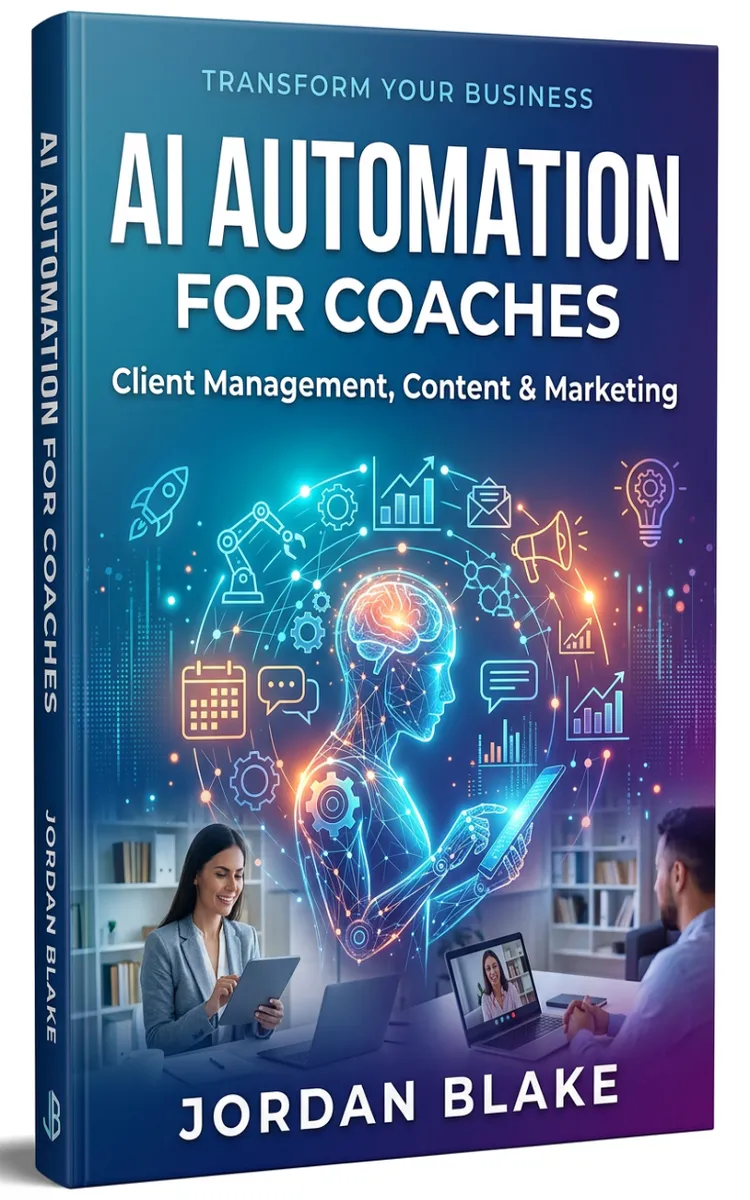
"AI Automation for Coaches: Client Management, Content & Marketing" is a business book by Jordan Blake with 10 chapters and approximately 18,883 words. Using AI automation to manage clients and market coaching services.
This book was created using Inkfluence AI, an AI-powered book generation platform that helps authors write, design, and publish complete books. It was made with the AI Business Book Writer.
Frequently Asked Questions
What is "AI Automation for Coaches: Client Management, Content & Marketing" about?
Using AI automation to manage clients and market coaching services
How many chapters are in "AI Automation for Coaches: Client Management, Content & Marketing"?
The book contains 10 chapters and approximately 18,883 words. Topics covered include Automating Your Client Intake Form, Using AI for Client Onboarding, Building a Client Data Hub, Automating Session Notes and Summaries, and more.
Who wrote "AI Automation for Coaches: Client Management, Content & Marketing"?
This book was written by Jordan Blake and created using Inkfluence AI, an AI book generation platform that helps authors write, design, and publish books.
How can I create a similar business book?
You can create your own business book using Inkfluence AI. Describe your idea, choose your style, and the AI writes the full book for you. It's free to start.
Write your own business book with AI
Describe your idea and Inkfluence writes the whole thing. Free to start.
Start writingCreated with Inkfluence AI


