

Read the first chapter
The whole of chapter one, free. About 7 min. Turn the pages with the arrows, your keyboard, or a swipe.
Chapter 1
AI Research Briefs From Prompts
Turn a Writing Goal Into Evidence You Can Use
What would happen if your next book idea produced a research plan instead of a blank document? Many authors start with a broad goal such as “write a practical book about home baking” or “research the history behind my novel.” That goal gives direction, but it does not tell an artificial intelligence tool what to find, how to organize it, or which claims require checking. The result often looks polished while leaving you with missing sources, mixed facts, and hours of cleanup.
A structured AI research brief solves that problem. It turns a writing goal into a defined assignment with a reader, scope, questions, source standards, and a format for findings. You still make the final judgment. AI helps you create the first organized pass, identify gaps, and expand the work without repeatedly starting from scratch.
This process suits the busy business owner or independent author who needs useful research without handing over editorial control. By the end, you will be able to create a brief, ask AI for a research draft, verify its claims, and request a stronger second pass. You will also have a repeatable method for moving from idea to usable material.
Build the Prompt-to-Brief Ladder
The Prompt-to-Brief Ladder moves from a loose writing goal to a research document you can inspect. Each rung adds information that reduces guesswork. The method has five parts:
1. Name the writing job. State what you plan to create and why. “Write a 2,000-word guide for first-time balcony gardeners” gives AI a real assignment. “Research gardening” does not. A clear job prevents broad, unusable results.
2. Define the reader and decision. Describe who will use the material and what they need to decide or do. For example, a reader may need to choose safe plants for a shaded balcony, not learn every fact about urban gardening. This keeps the research tied to a practical outcome.
3. Set the research boundaries. Add a location, time period, word count, exclusions, and source preferences. If your book covers food safety in the United States from 2020 onward, say so. Boundaries stop AI from mixing current guidance with outdated advice from another country.
4. Request a brief before requesting prose. Ask AI to return a research brief with questions, likely sources, key terms, disputed points, and open gaps. This creates a plan you can review before the tool spends effort drafting paragraphs.
5. Verify, then expand. Treat every factual claim as a lead until you check it against a reliable source. After verification, ask AI to expand only the confirmed material into an outline, comparison, example, or draft section. This separation protects your manuscript from confident errors.
Use a prompt that makes those parts visible. For example:
> I am writing a 2,000-word nonfiction guide for independent authors who want to research book topics efficiently. Create a research brief on how to evaluate online sources. Define the reader’s main problem, list five research questions, identify terms that need plain-English definitions, suggest primary and secondary sources, flag claims that require verification, and mark any areas where evidence may conflict. Do not write the article yet. Separate confirmed information from questions that remain open.
The instruction “do not write the article yet” matters. It keeps the first output focused on planning. You can then inspect whether the questions match your book before asking for more work.
A useful addition is the Claim-Check Grid. Ask AI to organize important statements under four labels: claim, source to check, verification status, and manuscript use. “Verification status” means whether you have checked the statement yourself, not whether AI presents it confidently. This grid turns research into an editorial control point rather than a pile of generated text.
Apply the Ladder to Talia’s Book
Talia, 34, writes indie novels and wants to publish a historical mystery set in a coastal town during the 1930s. Her initial goal reads, “Research how a small coastal town handled radio communication, weather warnings, and local policing in the 1930s.” That sentence contains three subjects, several possible locations, and no limit. If she asks AI to “research the 1930s,” she may receive details from the wrong country, decade, or type of town.
Talia applies the Prompt-to-Brief Ladder in order:
1. Writing job: She needs a four-page background brief for scenes involving a fishing harbor, a police station, and a storm warning.
2. Reader and decision: Her readers expect believable historical details. Talia needs to decide which communication methods characters could use during an approaching storm.
3. Boundaries: She sets the location as a fictional New England town, the period as 1932-1938, and the focus as everyday local practice. She excludes military communication and events after 1938.
4. Brief request: She asks AI for three research sections: radio and telephone access, weather warnings, and local policing. She requests five questions per section, source suggestions, uncertain claims, and terms that need checking.
5. Verification pass: The brief says that some fishing boats may have used radio equipment, but it does not establish how common that equipment was in small local fleets. Talia checks a museum archive, a contemporary newspaper collection, and a historical weather service document. She marks the claim “partly supported” until the sources agree on the local context.
6. Expansion request: After checking the sources, she asks AI to create a scene-reference sheet using only the verified details. She requests practical details such as who receives a warning, how the message travels, and what delay a character should expect.
Talia expects a usable result, not instant perfection. Her first brief contains 15 research questions, 8 source leads, and 4 claims marked for careful checking. After two hours of source review, she has 11 confirmed details, 3 details she removes, and 1 unresolved question she avoids placing in the manuscript. The outcome gives her a reliable four-page reference sheet and a clear boundary around what she should not claim.
Quick checklist
• Write the book task in one sentence. - Name the reader and the decision the research must support. - Set the place, time period, scope, and exclusions. - Ask for a brief before asking for prose. - Require source leads, open questions, and disputed claims. - Record each important claim in the Claim-Check Grid. - Check sources yourself before adding facts to the manuscript. - Ask AI to expand confirmed material only. - Save the prompt, brief, sources, and final notes together.
You can judge the brief by its usefulness. It should produce specific research questions, not broad topics. It should show what remains uncertain. It should help you decide what to include, exclude, or investigate next.
Avoid Trust Gaps and Scope Creep
Mistake: Asking for research with no defined reader
A prompt such as “Research radio communication in the 1930s” gives AI no reason to choose one level of detail over another. You may receive technical history when your scene only needs to show who hears a warning first.
Do this: “Research ordinary radio and telephone use in a small New England fishing town from 1932 to 1938 for a historical mystery. Focus on details that affect a storm-warning scene.”
Not this: “Tell me everything about communication in the 1930s.”
The fix works because the reader, scene, location, and date tell AI which facts matter.
Mistake: Treating generated citations as verified sources
AI may provide a convincing title, link, or quotation that does not support the claim. A citation becomes useful only after you open the source and confirm the relevant passage.
Do this: Copy the exact claim into your Claim-Check Grid, open the source, record the page or section, and mark the claim verified, partly supported, or rejected.
Not this: Paste a generated reference list into your manuscript because the titles look credible.
When you cannot confirm a claim, remove it, soften it, or continue researching. A smaller set of checked details gives you firmer ground than a large set of uncertain facts.
Mistake: Expanding the brief before resolving its open questions
Talia could ask AI to turn all 15 questions into polished background prose. That move would hide the difference between established facts and plausible guesses. It would also make later corrections harder because unsupported details would spread through several pages.
Do this: Resolve the highest-impact questions first, especially facts that control setting, character actions, safety, dates, or cause and effect.
Not this: Draft every section and plan to fact-check after publication.
The Prompt-to-Brief Ladder works because each rung creates a checkpoint. Start with the writing job, narrow the research, inspect the brief, verify the claims, and only then expand the material. Your next practical move is simple: take one current book idea and write its first rung in a single sentence. That small prompt becomes the starting point for a research workflow you can repeat across planning, marketing, and publishing.
End of chapter one. 9 more chapters in the full book.
Swipe or use the arrows to turn the page


What's inside: 10 chapters
- 1. AI Research Briefs From Prompts
- 2. Fact-Checking AI Research Sources
- 3. Competitor Analysis With AI Summaries
- 4. Designing Your Author Brand Statement
- 5. Automating Newsletter Lead Magnets
- 6. Writing Email Sequences With AI
- 7. AI Content Calendar For Social Proof
- 8. Generating Book Covers With AI Tools
- 9. AI-Assisted Manuscript Editing Workflow
- 10. Publishing Launch Kit Automation
About this book
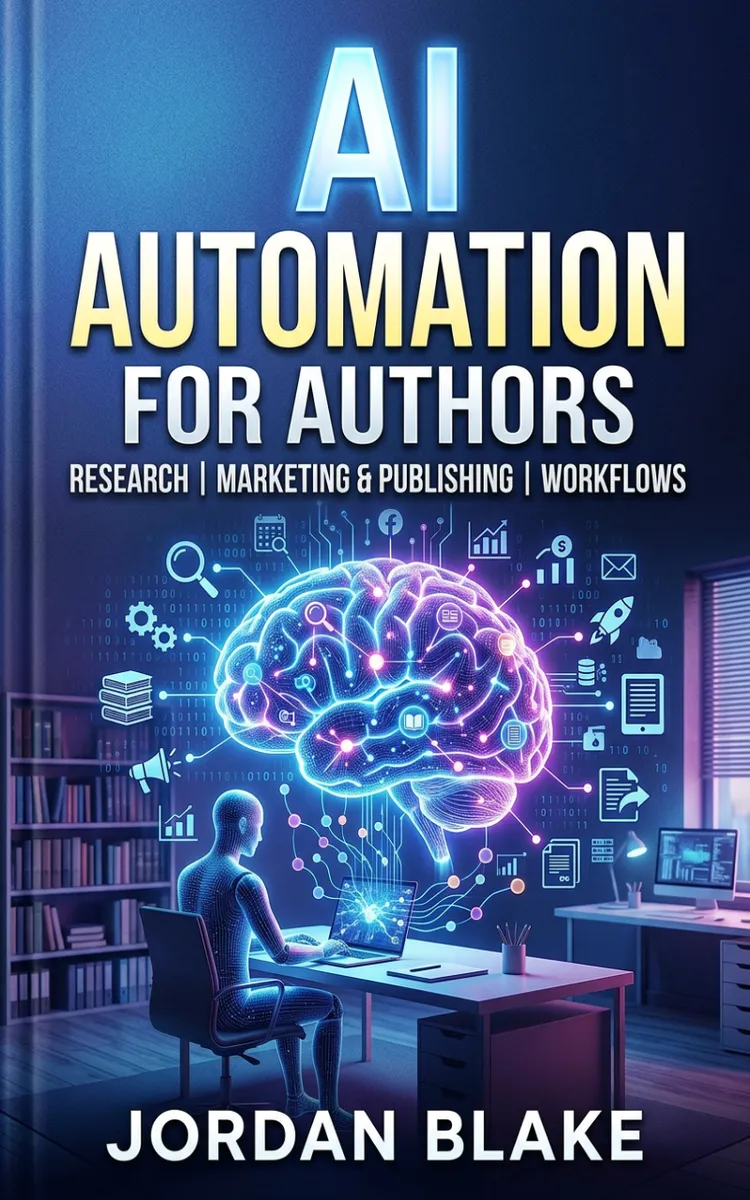
"AI Automation for Authors: Research, Marketing & Publishing Workflows" is a business book by Jordan Blake with 10 chapters and approximately 19,360 words. Using AI to automate author research, marketing, and publishing workflows.
This book was created using Inkfluence AI, an AI-powered book generation platform that helps authors write, design, and publish complete books. It was made with the AI Business Book Writer.
Frequently Asked Questions
What is "AI Automation for Authors: Research, Marketing & Publishing Workflows" about?
Using AI to automate author research, marketing, and publishing workflows
How many chapters are in "AI Automation for Authors: Research, Marketing & Publishing Workflows"?
The book contains 10 chapters and approximately 19,360 words. Topics covered include AI Research Briefs From Prompts, Fact-Checking AI Research Sources, Competitor Analysis With AI Summaries, Designing Your Author Brand Statement, and more.
Who wrote "AI Automation for Authors: Research, Marketing & Publishing Workflows"?
This book was written by Jordan Blake and created using Inkfluence AI, an AI book generation platform that helps authors write, design, and publish books.
How can I create a similar business book?
You can create your own business book using Inkfluence AI. Describe your idea, choose your style, and the AI writes the full book for you. It's free to start.
Write your own business book with AI
Describe your idea and Inkfluence writes the whole thing. Free to start.
Start writingCreated with Inkfluence AI


