
Read the first chapter
The whole of chapter one, free. About 5 min. Turn the pages with the arrows, your keyboard, or a swipe.
Chapter 1
Day 1-2: Women’s Faith Workbook-Awakening Trust (When Fear Feels Loud)
Women’s Faith Workbook: Awakening Trust
Day 1-2: When Fear Feels Loud
Fear can make every thought sound urgent. Before you try to solve everything, pause and name what’s happening. You don’t have to shame yourself for feeling afraid. You’re beginning with honesty, prayer, and one small choice to trust God in this moment.
These first two days are a gentle reset. You’ll practice noticing fear without letting it run the whole conversation in your mind. You’ll also learn a simple way to question spiraling thoughts and replace them with what is true, compassionate, and rooted in faith.
Scripture Focus
Philippians 4:6-7
> Do not be anxious about anything, but in every situation, by prayer and petition, with thanksgiving, present your requests to God. > And the peace of God, which transcends all understanding, will guard your hearts and your minds in Christ Jesus.
Today, trust begins by bringing your real fear to God instead of carrying it alone.
Fear often shows up before you’ve had time to think. You may notice a tight chest, racing thoughts, trouble sleeping, or the sudden urge to check, fix, explain, or prepare for every possible outcome. These reactions don’t mean your faith is weak. They mean your mind and body are responding to something that feels threatening.
Paul doesn’t tell us to pretend anxiety isn’t there. He gives us a direction: bring every concern to God. “Every situation” includes the conversation you’re dreading, the health worry you can’t stop replaying, the financial pressure, the family tension, and the question of whether you’re enough. Prayer is not denial; it is a safe place to tell the truth.
God’s peace may not arrive as an instant feeling of calm. Sometimes it looks like enough steadiness to take the next right step. Sometimes it’s choosing not to send the third worried text. Sometimes it’s going to bed without solving tomorrow. Peace can guard your mind while you’re still waiting for answers.
For these first two days, your goal isn’t to eliminate fear. That would put even more pressure on you. Your goal is to notice fear, name it without shame, and place it in God’s hands. Then you can ask, “What is true right now?” rather than allowing every frightening possibility to become a fact.
Practice for Today
Use the following practice over Days 1 and 2. Keep a notebook nearby, or write in the space below. You only need ten to fifteen quiet minutes. If your day is full, even three honest minutes count.
1. Name the fear without judging yourself.
Sit with both feet on the floor. Take four slow breaths. On each exhale, loosen your shoulders and unclench your jaw. Then complete this sentence:
Right now, I feel afraid of ____________________________________.
Be specific. “Everything” may be how it feels, but a more focused answer helps your mind settle. You might write, “I’m afraid I’ll disappoint my family,” or “I’m afraid this problem won’t get better.”
Now add:
My fear is trying to protect me from ____________________________.
Fear often tries to protect us from rejection, loss, embarrassment, uncertainty, or pain. You don’t have to agree with fear to understand what it’s attempting to do.
Your Turn: The fear I’m carrying today is: __________________________________________ The feeling in my body is: ____________________________________________ What I need from God in this moment is: _________________________________
2. Practice the Truth Check.
A spiral often moves quickly from a concern to a conclusion. For example:
• Concern: “My friend hasn’t replied.” - Fearful conclusion: “She’s angry with me, and I’m losing the friendship.” - More balanced truth: “I don’t know why she hasn’t replied. I can wait, pray, and respond wisely if I learn more.”
Use this three-part cognitive reframing tool:
The thought: What am I telling myself? The evidence: What do I know for sure, and what am I guessing? The truth: What is a more balanced thought that agrees with reality and God’s care?
Write your answers here:
The thought making me spiral is: _________________________________________ What I know for sure is: _____________________________________________ What I may be assuming is: __________________________________________ A steadier, truthful thought is: _________________________________________
Your truthful thought doesn’t need to sound overly cheerful. It should sound believable. Try phrases such as:
“This is difficult, but I don’t have to solve it all tonight.”
“I feel afraid, but I’m not abandoned.”
“I can ask for help and take one step.”
“I don’t know the outcome, but I know where I can bring my worry.”
This is not about forcing yourself to think positively. It’s about separating facts from fear’s predictions. Faith gives you a stronger foundation than the loudest thought in the room.
3. Turn the truth into a short prayer.
Set a timer for five minutes. You can sit quietly, walk slowly, or rest your hands in your lap. Begin with the fear you named. Then give God the balanced truth you wrote.
You might pray:
“God, I’m afraid of __________________. I notice my mind predicting ________________. What I know right now is __________________. Help me trust You with what I don’t know. Show me the next faithful step.”
When the timer ends, don’t measure the exercise by whether you feel completely calm. Notice one change instead. Is your breathing slower? Is the thought less absolute? Do you feel a little more able to wait? That small shift matters.
Reflect: After praying, I notice: ________________________________________________ One next faithful step I can take is: ____________________________________
If your fear returns later - and it may - repeat the sentence, “I can bring this to God again.” Repetition isn’t failure. It’s practice. Just as your mind learned to spiral, it can learn to pause, check the facts, and return to trust.
Before you finish today, write one request and one thanksgiving:
God, I ask You for: ____________________________________________________ Today, I thank You for: ________________________________________________
The thanksgiving doesn’t have to be grand. You might be grateful for a warm shower, a supportive text, a meal, a moment of laughter, or the strength to keep going. Gratitude doesn’t cancel pain. It helps you notice that fear is not the only thing present.
Closing Prayer
God, I bring You the fear I’ve been carrying and the thoughts I’ve been trying to manage alone. Help me name what is real without adding shame. Teach me to notice the difference between a fact and a fearful prediction. When my mind spirals, guide me back to Your presence and Your truth. Give me enough peace for this moment and wisdom for my next step. I am not alone, and I do not have to figure everything out today. Amen.
End of chapter one. 6 more chapters in the full book.
Swipe or use the arrows to turn the page
What's inside: 7 chapters
- 1. Day 1-2: Women’s Faith Workbook-Awakening Trust (When Fear Feels Loud)
- 2. Day 3-4: Women’s Faith Workbook-Prayer That Calms (Trading Worry for Communion)
- 3. Day 5-6: Women’s Faith Workbook-Hope Rewritten (When Identity Feels Shaken)
- 4. Day 7-8: Women’s Faith Workbook-Surrender the Control (Letting God Carry What You Can’t)
- 5. Day 9-10: Women’s Faith Workbook-Strength for the Middle (Courage When Feelings Lag)
- 6. Day 11-12: Women’s Faith Workbook-Healing the Mind (Renewal Through Scripture and Repetition)
- 7. Day 13-14: Women’s Faith Workbook-Hope That Holds (Living Identity and Peace Going Forward)
About this book
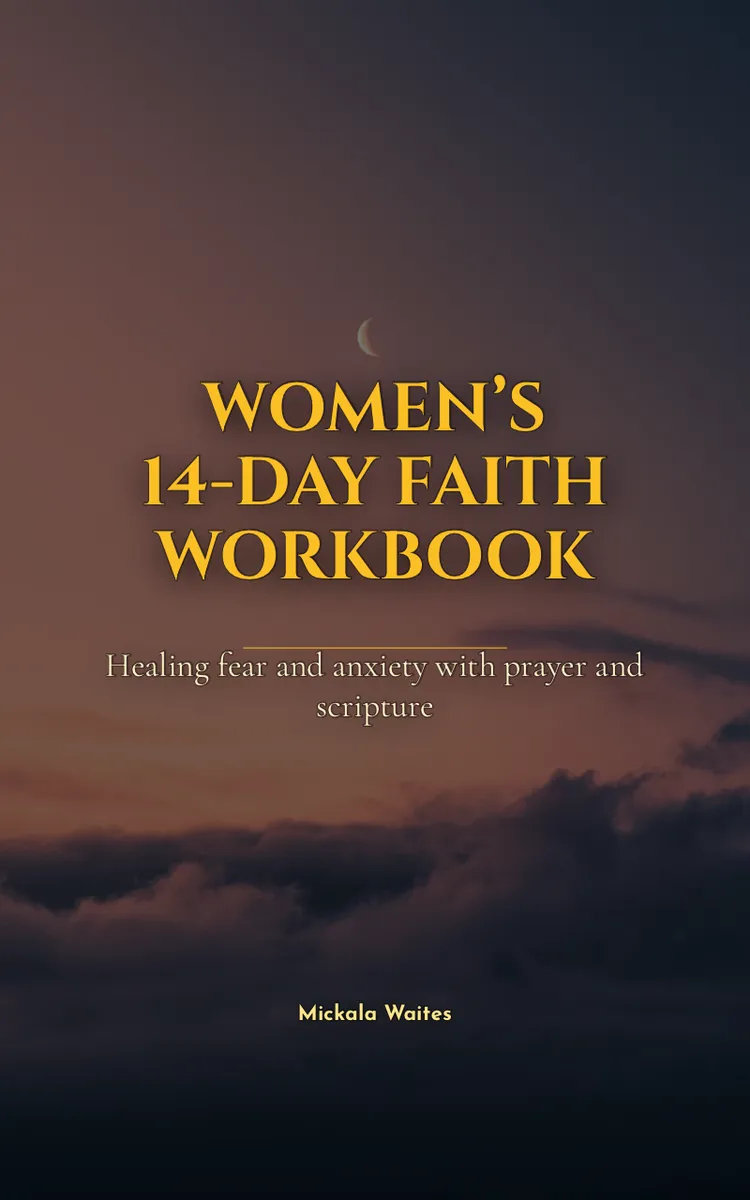
"Women’s 14-Day Faith Workbook" is a religious devotional book by Mickala Waites with 7 chapters and approximately 7,035 words. A 14-day Christian workbook for women healing anxiety and identity.
This book was created using Inkfluence AI, an AI-powered book generation platform that helps authors write, design, and publish complete books.
Frequently Asked Questions
What is "Women’s 14-Day Faith Workbook" about?
A 14-day Christian workbook for women healing anxiety and identity
How many chapters are in "Women’s 14-Day Faith Workbook"?
The book contains 7 chapters and approximately 7,035 words. Topics covered include Day 1-2: Women’s Faith Workbook-Awakening Trust (When Fear Feels Loud), Day 3-4: Women’s Faith Workbook-Prayer That Calms (Trading Worry for Communion), Day 5-6: Women’s Faith Workbook-Hope Rewritten (When Identity Feels Shaken), Day 7-8: Women’s Faith Workbook-Surrender the Control (Letting God Carry What You Can’t), and more.
Who wrote "Women’s 14-Day Faith Workbook"?
This book was written by Mickala Waites and created using Inkfluence AI, an AI book generation platform that helps authors write, design, and publish books.
Write your own religious devotional book with AI
Describe your idea and Inkfluence writes the whole thing. Free to start.
Start writingCreated with Inkfluence AI


