
Read the first chapter
The whole of chapter one, free. About 7 min. Turn the pages with the arrows, your keyboard, or a swipe.
Chapter 1
Design Your Soft-Life Identity
Picture This: When Luxury Feels Like a Costume (and Nia Can’t Stop Switching It Off)
Nia was halfway through her morning routine when it hit - the tiny moment where she’d normally slow down, sip something warm, and enjoy the calm. Instead, she snapped back into “prove yourself” mode. Her robe felt too soft for her deadlines. Her playlist felt too indulgent for her inbox. Even her tidy desk looked like it was mocking her: You’re trying to be a person who has it together.
She’s a junior architect, so she’s learned to measure everything. Materials. Angles. Time blocks. But her “luxury habit” brain kept asking the same question: If I slow down, will I fall behind? And the scarier part? She didn’t even realize she was arguing with herself. She just kept switching the softness off - like it was a light she wasn’t allowed to own.
That tension - wanting the luxury life, but feeling like you have to earn it every second - creates a weird loop. You buy the robe, then you rush. You plan the morning, then you punish yourself for needing it. And you start to wonder if soft-life success is actually for people who “naturally” have confidence.
Why does luxury feel harder than it should - like you have to trick your way into your own life?
The Mindset Shift: From “I’m Not That Person” to “My Habits Belong to Me”
Old Belief: Luxury habits only work if you’re already confident, already disciplined, already “the type of person.” New Reality: Luxury habits work because they train your identity - and when your habits match your values, softness stops feeling forced.
Here’s the shift that changes everything: you don’t need to become someone else first. You need to design an identity that makes your choices feel normal. Not perfect. Not effortless 24/7. Just natural enough that you stop negotiating with yourself every time you choose what you want.
Nia noticed it when she stopped treating her morning like a performance and started treating it like a cue. She chose one small luxury habit - just one - that matched how she wanted to show up at work: a 10-minute “design calm” ritual before she opened her first file. Same mug, same playlist, same chair. The routine wasn’t magic. It was a message. She wasn’t saying, “I deserve luxury.” She was saying, “This is how I operate.” And after a few days, her body believed it before her mind could argue.
Because identity cues are sneaky like that. Your brain loves consistency. When your actions repeatedly signal “this is who I am,” you stop feeling like you’re wearing a costume. You start feeling like you’re wearing your actual skin.
Going Deeper: The Velvet Mirror Identity Map (Identity Cues + Values Alignment)
Let me give you the exact mechanism behind this (without making it feel like homework). Think of your life like a mirror. Whatever you repeatedly reflect back - through what you wear, how you start your day, how you speak to yourself - eventually becomes your “default you.” The Velvet Mirror Identity Map is your way of choosing what that mirror reflects on purpose.
When your luxury habits don’t feel natural, it’s usually not because you’re “undisciplined.” It’s because there’s a mismatch between the identity your habits are asking you to live and the identity your current cues are reinforcing. Your mind reacts like, Wait - who are we pretending to be? Then it tries to regain control by making you rush, shrink, or overwork.
The fix isn’t “try harder.” The fix is to align the cue (what you do) with the value (what you stand for). Luxury isn’t just expensive. It’s intentional. It’s care. It’s timing. It’s taste. So when you practice luxury in a way that matches your real values, your nervous system stops treating it like a threat.
Signs this pattern is running your life 1. You only feel “allowed” to enjoy something after you’ve done a certain amount of productivity - like relaxation is a reward you have to earn with suffering. 2. Your luxury habits feel fragile. One busy day, and you abandon them completely because your identity feels unstable. 3. You make choices based on what would impress people (or what you think you “should” do) instead of what your values actually protect. 4. You keep replacing consistency with intensity - big bursts, then guilt, then restart.
Velvet Mirror Summary: Luxury becomes natural when your habits send the same identity signal your values already believe.
Reflection & Self-Assessment: Spot the Identity Mismatch Before You Fix It
Grab a pen and answer these like you’re writing to the version of you who’s tired of negotiating. Don’t overthink - just tell the truth.
1. What luxury habit do you want most right now, and what emotion shows up the moment you try it? If it’s anxiety, that’s data. If it’s guilt, that’s also data. Nia, for example, felt “behind” the moment her morning slowed down.
2. What identity are you trying to live when you choose that habit? (Pick one sentence.) Examples: “I’m someone who starts calm,” or “I’m someone who takes care of myself even when I’m busy.” Your answer reveals the identity your habit is asking you to embody.
3. What value is your habit actually supporting? Luxury can support values like care, excellence, presence, or craft. If you can’t name a value, your habit might be performing instead of reflecting.
4. What cue are you currently using that contradicts your desired identity? Maybe it’s scrolling first thing. Maybe it’s switching outfits mid-day to feel “more serious.” Maybe it’s checking messages before you even drink water. Cues are usually tiny, but they’re powerful.
5. If your identity was already the person who lives this way, what would be different in your next 24 hours? Look for specifics. Not “I’d be better.” Something like: “I’d keep my first hour sacred,” or “I’d stop punishing myself for needing rest.”
When you answer honestly, you’re not being dramatic - you’re getting clarity. And clarity is how you stop treating luxury like a fight.
Growth Challenge: The 7-Day Velvet Mirror Luxury Cue
This is the part where you stop debating your identity and start training it. For the next 7 days, you’ll choose one luxury habit and attach it to an identity cue that matches your values.
Challenge Title: Velvet Mirror Luxury Cue Week
• Pick one luxury habit you genuinely want (keep it small enough to repeat daily). Examples: a slower morning tea, a fragrance you only use when you’re “on purpose,” a tidy desk ritual before you start work, a 10-minute journal with a nice pen. - Choose one identity sentence that feels true-ish, not perfect. Fill in the blank: “I’m the kind of person who.” Keep it values-based (care, craft, presence, calm). - Create a fixed cue: same time window, same place, same object. If Nia is doing her “design calm,” it’s 10 minutes in the same chair with the same mug before opening her first file. - Before the habit, do a 10-second mirror cue: look at yourself (phone camera counts) and say your identity sentence once. Then start the luxury habit immediately. - After the habit, log one line: “My body felt and my identity felt ___.” Don’t write an essay. One line.
Expected difficulty rating: Medium (because your brain will resist at first - especially on day 2 or 3)
You’ll know it’s working when... - You complete the habit even when you’re slightly stressed. - The emotion shifts from “forced” to “familiar,” even if your mind still tries to bargain. - You catch yourself using the identity sentence naturally, without needing the mirror cue every time. - You notice fewer internal arguments like “I don’t deserve this” or “I’ll fall behind.”
The goal isn’t to become someone new overnight. The goal is to teach your system, day by day, that luxury is not a risk - it’s your operating style.
Key Takeaway: Your Luxury Isn’t a Reward - It’s a Relationship
The real reason luxury habits feel forced is because you keep treating them like a prize for “future you.” But soft-life success works differently. You’re not waiting for proof. You’re creating proof through identity cues that line up with your values.
Luxury feels natural when your habits act like receipts for who you are.
• You don’t need confidence first - you need alignment between what you do and what you believe you value. - The Velvet Mirror Identity Map helps you spot where your cues and identity messages are fighting. - Your next steps get easier when you repeat one luxury cue long enough for your nervous system to learn it. - Your self-image becomes sturdier when your habits reflect it consistently, not perfectly.
Next, we’ll make those luxury habits even more effortless by shaping the way you move through your day - so your softness doesn’t disappear as soon as life gets busy.
End of chapter one. 7 more chapters in the full book.
Swipe or use the arrows to turn the page

What's inside: 8 chapters
- 1. Design Your Soft-Life Identity
- 2. Rewrite Beliefs That Sabotage Ease
- 3. Build Boundaries Without Killing Vibes
- 4. Create Luxury Habits That Stick
- 5. Upgrade Your Environment for Instant Confidence
- 6. Master Soft Communication That Gets Results
- 7. Turn Setbacks Into Resilience Glow-Ups
- 8. Align Purpose With Your Soft-Life Plan
About this book
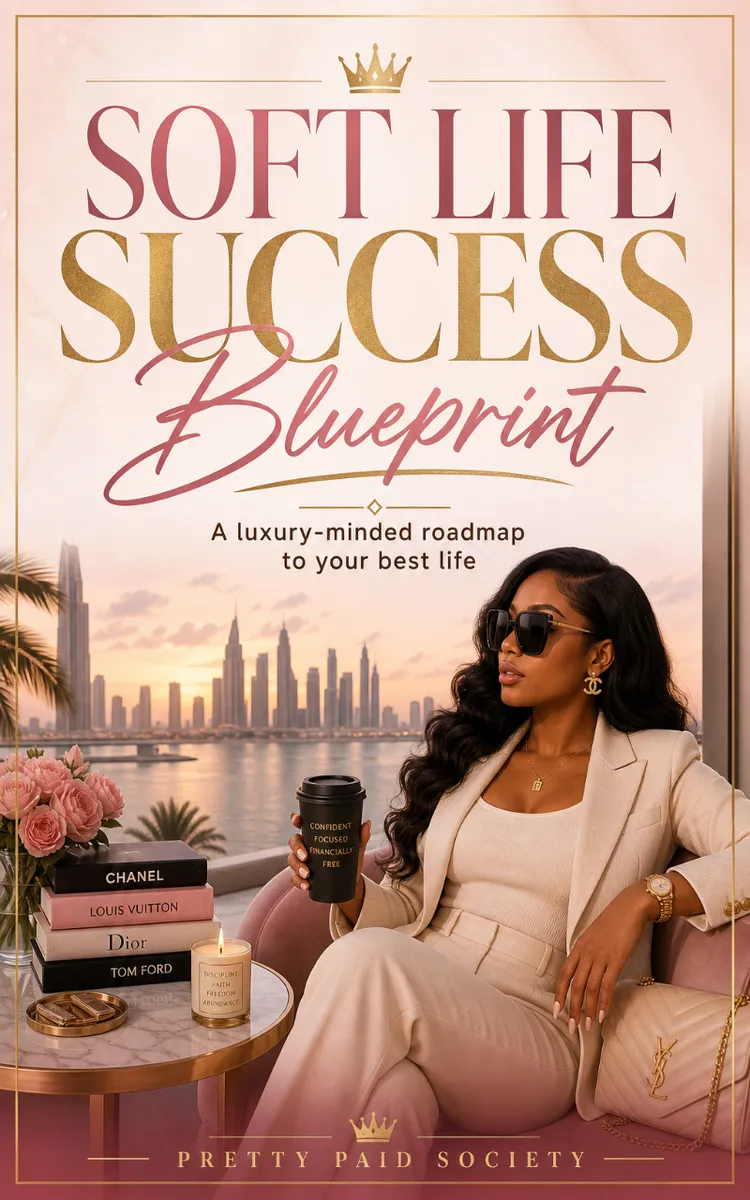
"Soft Life Success Blueprint" is a self-help book by Pretty Paid Society with 8 chapters and approximately 12,814 words. A soft-life lifestyle guide for success and personal growth.
This book was created using Inkfluence AI, an AI-powered book generation platform that helps authors write, design, and publish complete books. It was made with the AI Self-Help Book Writer.
Frequently Asked Questions
What is "Soft Life Success Blueprint" about?
A soft-life lifestyle guide for success and personal growth
How many chapters are in "Soft Life Success Blueprint"?
The book contains 8 chapters and approximately 12,814 words. Topics covered include Design Your Soft-Life Identity, Rewrite Beliefs That Sabotage Ease, Build Boundaries Without Killing Vibes, Create Luxury Habits That Stick, and more.
Who wrote "Soft Life Success Blueprint"?
This book was written by Pretty Paid Society and created using Inkfluence AI, an AI book generation platform that helps authors write, design, and publish books.
How can I create a similar self-help book?
You can create your own self-help book using Inkfluence AI. Describe your idea, choose your style, and the AI writes the full book for you. It's free to start.
Write your own self-help book with AI
Describe your idea and Inkfluence writes the whole thing. Free to start.
Start writingCreated with Inkfluence AI


