

Read the first chapter
The whole of chapter one, free. About 7 min. Turn the pages with the arrows, your keyboard, or a swipe.
Chapter 1
Choosing Intentional Responses Over Habits
When Your Reply Types Itself
Have you ever noticed how your body reacts before your mind even gets the memo? Like your finger is already moving, your thumbs are already typing, and then - boom - your “response” is out there in the world wearing your name like it was inevitable.
Nadia, 34, works in customer support. Her job is full of fast messages, sharp emotions, and the kind of frustration people bring to the screen when they feel stuck. One afternoon, a customer sent a long, angry message about a delay. Nadia felt heat rise in her chest. The old reflex showed up instantly: defend, explain, over-correct. She could practically feel the autopilot engaging - her words getting tighter, faster, and more certain that she was right to push back.
Then she paused mid-type. Not a big, cinematic pause. Just a small, stubborn moment - like her thumb hesitated on the edge of sending. In that tiny space, she suddenly realized something: her reaction wasn’t the only option. She could choose what kind of human she wanted to be in the next sentence, even if the customer was being intense.
What if the real power isn’t in having the “right” reaction - but in finding the pause where you can choose it?
---
The Pause-Choice Equation: Before vs After
Old Belief: If something triggers you, your reaction is basically automatic - your job is to manage the fallout after the fact. New Reality: A pause creates a small sacred space between stimulus and reaction, and in that space your response becomes a choice instead of a habit.
Here’s the shift that changes everything: you stop treating your first impulse like it’s destiny. You start treating it like a signal. The stimulus shows up (a harsh message, a slammed door, a sudden interruption), and then there’s a brief gap - sometimes barely noticeable - where you can intercept the default pattern.
Nadia felt that gap when she noticed herself typing “defensive” language. Instead of continuing the familiar route, she took a breath and wrote one sentence that changed the whole temperature of the conversation: “I hear how frustrating this has been. Let me look at your order details and get you a clear update.” Same situation, different response. She didn’t ignore the customer’s frustration. She just stopped letting her reflex drive the steering wheel.
Why does this matter so much? Because habits don’t just shape your actions - they shape your identity. If you keep reacting on autopilot, you start believing you’re that kind of person: quick to snap, quick to explain, quick to prove. But when you practice intentional pauses, you’re quietly training a different identity: “I respond from awareness.” That’s not softness. That’s strength.
And the best part? The pause doesn’t require you to become someone else overnight. It asks for one thing: a moment of honesty about what’s happening inside you before you act it out.
---
Why Pausing Changes Everything (Even When You Don’t Feel “Zen”)
Your default reactions are often protective. They’re trying to keep you safe - emotionally, socially, sometimes even spiritually. When you’re triggered, your nervous system interprets the moment as urgent. Your body moves first because it thinks speed equals safety.
But speed has a cost. Autopilot tends to tighten your language, shorten your patience, and push you toward “winning” instead of understanding. When you pause, you interrupt the reflex loop. You give your mind a split second to catch up to your body. That’s where choice lives.
Think of the pause like a door you didn’t know you had. The door is between the stimulus (“They’re attacking me”) and the reaction (“I must defend myself right now”). In that door-space, you can do something radically simple: check what’s true, check what’s needed, and then choose words or actions that align with the kind of person you’re becoming.
Here are signs this pattern is running your life - quietly, but constantly:
1. You feel “certain” right before you react, like your perspective is already locked. (Certainty can be a mask for adrenaline.) 2. You replay conversations after the fact, knowing you said or did something you wouldn’t choose again. 3. Your body signals first, and you follow without question - jaw tight, chest hot, shoulders up, fingers already moving. 4. You treat your first response as the only response, even when you’ve proven you could do better in hindsight.
The Pause-Choice Equation is this: you don’t remove triggers - you reclaim the space where your response is chosen.
---
Make the Pause Real: Reflection & Self-Assessment
If you want this to become more than a nice idea, you’ll need to get specific with your own moments. Not your “perfect future self.” Your actual life - your actual triggers, your actual conversations, your actual hands hovering over the send button.
Try these prompts. Answer them like you’re talking to a trusted friend, not like you’re writing an assignment:
1. What’s my most common “stimulus”? Is it being misunderstood, being interrupted, slow progress, criticism, feeling disrespected, or something else? Try to name it in one plain sentence - no drama, just truth.
2. What’s my default reaction style? Do you argue, over-explain, shut down, snap, people-please, or go silent? Nadia, for example, often defaulted toward explaining too much when she felt the customer was attacking her.
3. Where do I notice the pause - if I notice it at all? Is it a breath you take without thinking? A slight delay in typing? A shift in your chest? Be honest: you might notice nothing yet. That’s still information.
4. What does my reaction protect me from feeling? Under the anger or defensiveness, what are you trying not to feel - shame, fear, inadequacy, helplessness? A real answer might sound like: “I react because I don’t want to feel powerless.”
5. What response would align with my values in that exact moment? Not “what’s ideal.” What’s aligned? For Nadia, it wasn’t being nicer - it was being clear, steady, and accountable while staying human.
Write down one sentence you can live by in the middle of the moment. Keep it small. Something you could actually remember when your body tries to take over.
---
Growth Challenge: Three Breaths, One Chosen Response
You don’t need a perfect day to practice this. You need a repeatable moment. So here’s a challenge you can start today - short enough to actually do, real enough to matter.
Challenge Title: Selah in the Send Button (7 Days)
• For the next 7 days, choose one transition moment per day (before replying to a message, before stepping into a meeting, before starting a difficult conversation, or before switching tasks). - Take three deliberate deep breaths - slow in, slow out - like you’re creating a small pause on purpose. (Count them. Make it measurable.) - During the third breath, ask one question: “What response would I choose if I wasn’t reacting from autopilot?” - Then act - write the reply, speak the sentence, or start the task with that chosen response. - Afterward, jot one line: “Stimulus was; I noticed; my chosen response was ___.”
Difficulty Rating: Medium
You’ll know it’s working when… - You start to notice the pause before your words come out. - Your “after replay” moments shrink, even if your triggers still show up. - You catch yourself less often saying, “I had no choice,” and more often saying, “I chose.”
If you miss a day, don’t “make it up.” Just return to the next transition moment. This practice isn’t about proving discipline - it’s about rebuilding trust with yourself.
---
Key Takeaway: The Pause Is Your Spiritual Steering Wheel
Here’s what Nadia discovered after a few weeks of practicing this: the pause didn’t make her life calmer. It made her more present inside the storm. And presence changes the outcome more often than you’d expect.
When you can pause between stimulus and reaction, you stop living as a victim of your impulses. You start acting like someone who can meet life with intention - even when you’re tired, annoyed, or under pressure. That’s not abstract spirituality. That’s everyday freedom.
Your next level isn’t found in controlling people or circumstances - it’s found in choosing your response from the sacred space of a pause.
• You learned the Before vs After reframe: your reaction isn’t destiny; it’s a choice created by a gap. - You practiced noticing signs your autopilot is running the show. - You used reflection prompts to get honest about your triggers and your patterns. - You took a concrete 7-day challenge to turn pauses into real behavior.
And once you start trusting that space, breath becomes more than oxygen - it becomes a doorway. Next, we’ll let the breath guide you into those transitions with a steadier inner rhythm, so your pauses feel less like effort and more like home.
End of chapter one. 12 more chapters in the full book.
Swipe or use the arrows to turn the page


What's inside: 13 chapters
- 1. Choosing Intentional Responses Over Habits
- 2. Quieting Noise to Hear Your Inner Guidance
- 3. Anchoring Mindfulness in the Present Moment
- 4. The Breathwork Check Before Every Transition
- 5. Using the Selah Moment to Take Emotional Inventory
- 6. Building Confidence Through Small Sacred Checkpoints
- 7. Disconnecting From Your Phone to Reclaim Awareness
- 8. Integrating Pauses Into Purpose-Driven Resilience
- 9. Picture This: A Tiny Moment That Decides the Day
- 10. You don't need another productivity trick — you need a practiced pause that protects your ground.
- 11. The Pattern That Keeps Running Your Day
- 12. Paint a brief, vivid scene
- 13. Sacred Pauses, Everyday Changes
About this book
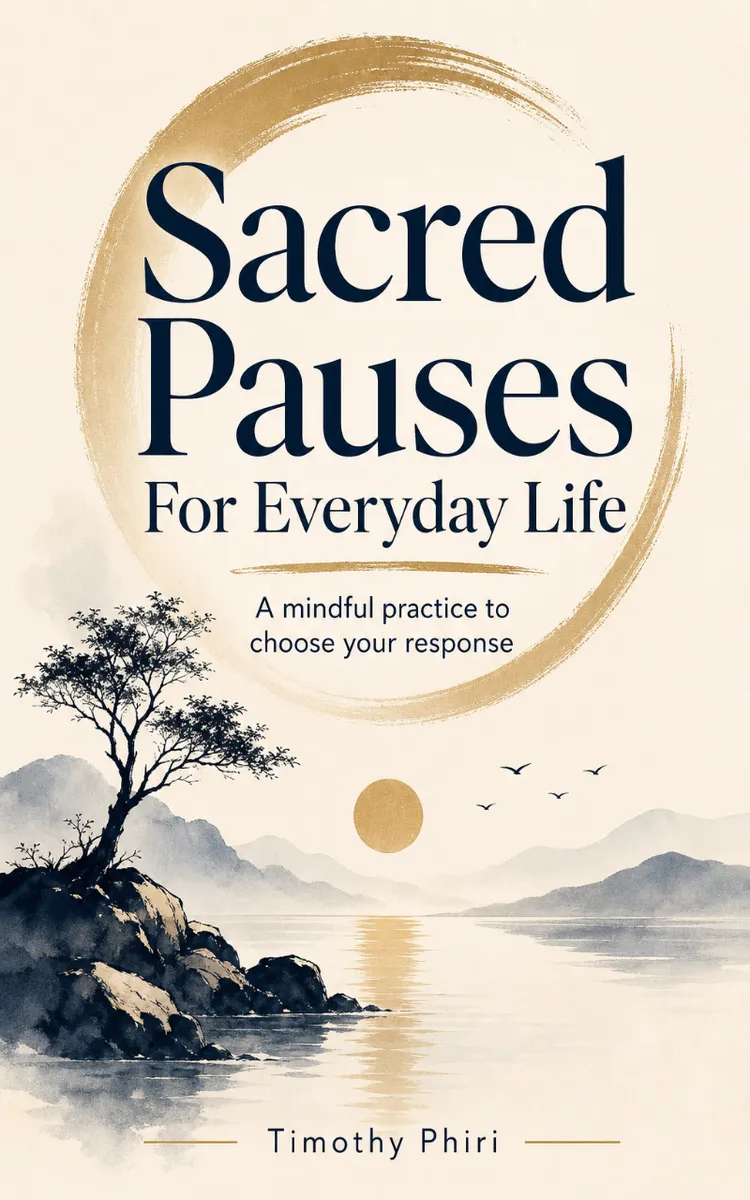
"Sacred Pauses For Everyday Life" is a self-help book by Timothy Phiri with 13 chapters and approximately 17,968 words. Mindful pauses, breathwork, and spiritual reflection in daily transitions.
This book was created using Inkfluence AI, an AI-powered book generation platform that helps authors write, design, and publish complete books. It was made with the AI Self-Help Book Writer.
Frequently Asked Questions
What is "Sacred Pauses For Everyday Life" about?
Mindful pauses, breathwork, and spiritual reflection in daily transitions
How many chapters are in "Sacred Pauses For Everyday Life"?
The book contains 13 chapters and approximately 17,968 words. Topics covered include Choosing Intentional Responses Over Habits, Quieting Noise to Hear Your Inner Guidance, Anchoring Mindfulness in the Present Moment, The Breathwork Check Before Every Transition, and more.
Who wrote "Sacred Pauses For Everyday Life"?
This book was written by Timothy Phiri and created using Inkfluence AI, an AI book generation platform that helps authors write, design, and publish books.
How can I create a similar self-help book?
You can create your own self-help book using Inkfluence AI. Describe your idea, choose your style, and the AI writes the full book for you. It's free to start.
Write your own self-help book with AI
Describe your idea and Inkfluence writes the whole thing. Free to start.
Start writingCreated with Inkfluence AI


